
For decades, the world of telecommunications was a black box. The Session Initiation Protocol (SIP) was a powerful standard, but it was the domain of hardware engineers and network specialists. It was a language spoken between monolithic PBXs and carrier switches, not by the applications that were reshaping every other aspect of our digital lives.
Then came a fundamental innovation that pried open that black box and handed the controls to the creators: the programmable SIP API.
This was not just an evolution; it was a revolution. The advent of the programmable SIP API marked the moment when the global telephone network was transformed from a rigid, monolithic utility into a dynamic, software-defined canvas. It democratized the power of API based telephony, allowing any developer to weave the complex, real-time magic of a phone call directly into their software.
This shift is not just changing how we build programmable communication systems; it is fundamentally redefining what is possible in the realm of real time SIP communication.
Table of contents
What Was the “Pre-Programmable” World Like?
To grasp the magnitude of this shift, we must first remember the old world. In the pre-programmable era, a SIP trunk was a static, pre-configured entity.
The Rigidity of Static Configuration
You would purchase a SIP trunk from a provider, and during the setup, you would point it to a single, static IP address, the address of your company’s on-premise or cloud-based PBX. From that point on, the SIP provider’s job was simple and dumb: it would take any call that came in to your numbers and blindly forward it to that IP address.
- A “Black Box” Hand-off: The provider had zero visibility or control over what happened to the call once it was handed off to the PBX.
- All Logic Lived in the PBX: All the intelligence, the call routing, the IVR menus, the voicemail was locked inside the proprietary, often-inflexible logic of the PBX hardware or software.
- Incredibly Slow to Change: If you wanted to change the call flow, you had to log in to the complex interface of your PBX. If you wanted to add a new number for a marketing campaign, you had to go back to your SIP provider’s web portal. Every change was a manual, time-consuming task.
This model created a major barrier to innovation. A developer trying to build a modern, data-driven voice application had to hack around the rigid PBX’s limitations, a process that was slow, brittle, and incredibly frustrating.
Also Read: Managing Utility Bills via AI Voicebots
The Programmable SIP Revolution: Turning Voice into an API
A programmable SIP API completely inverts this model. It takes the intelligence and the control out of the monolithic PBX and puts it directly into the hands of the developer, in the application layer where it belongs.
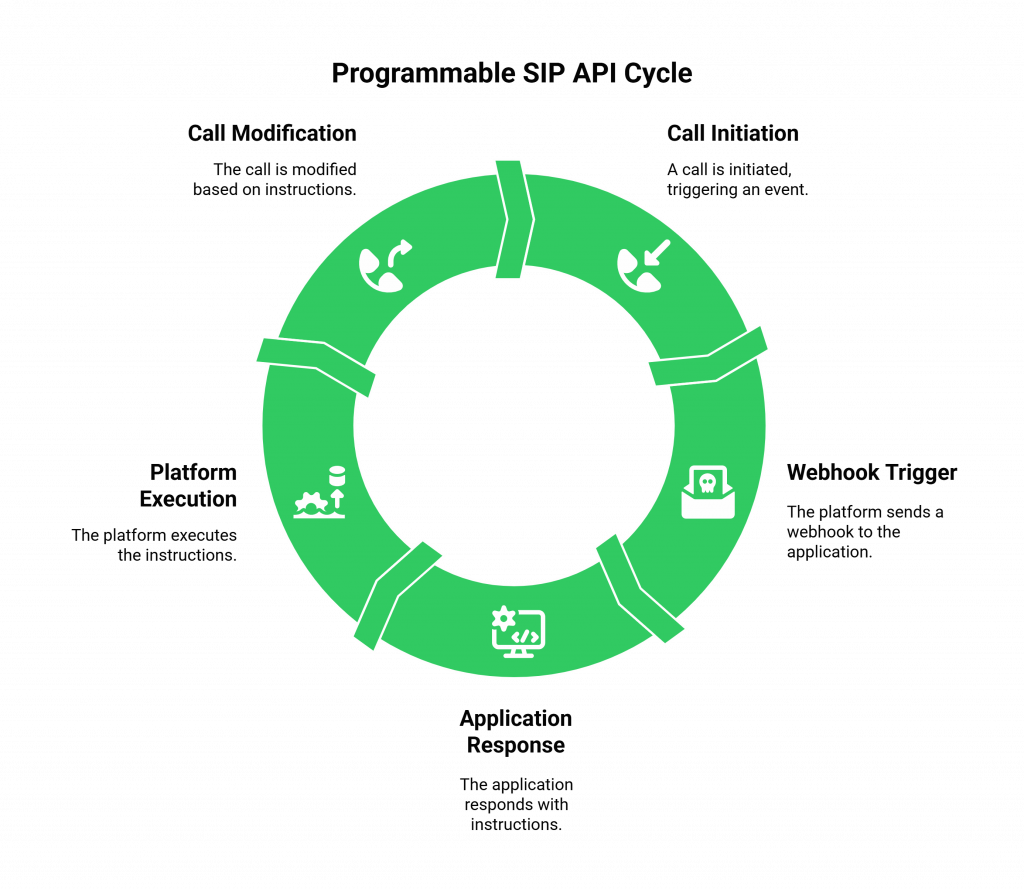
The Core Principles of a Programmable SIP API
A true programmable SIP API is not just a set of commands to make a call. It is a complete, event-driven framework for orchestrating every aspect of a real time SIP communication session.
- Event-Driven Architecture (Webhooks): This is the heart of the system. Instead of blindly forwarding a call, the platform asks your application what to do at every single step. When a call comes in, the platform sends a real-time HTTP request (a webhook) to your application with the details of the call.
- Dynamic, Real-Time Instruction: Your application’s code receives this webhook and responds with a set of instructions, often in a simple markup language like XML or JSON. This response tells the platform what to do next: play a message, gather user input, record the call, or transfer it.
- Complete Control Over the Call Leg: The API gives your application granular, real-time control over the “call leg”, the connection between the platform and the user. You can modify the call, bridge it to another call, or terminate it at any moment, all with a simple API command.
This is a monumental shift. The voice platform is no longer the master; it is a powerful, obedient servant that executes the real-time commands of your application’s logic. This architectural pattern has unlocked immense value across the software industry.
This table clearly illustrates the paradigm shift.
| Characteristic | Traditional SIP Trunking | Programmable SIP |
| Control Logic | Lives in a monolithic, proprietary PBX. | Lives in your application’s open, flexible code. |
| Call Flow | Static and pre-configured in a GUI. | Dynamic and orchestrated in real-time via an API. |
| Interaction Model | The provider “pushes” a call to a static IP. | The provider “asks” your app what to do via a webhook. |
| Flexibility | Rigid and slow to change. | Highly agile; change your call flow with a simple code deploy. |
| Target User | IT Administrator / Telecom Engineer. | Software Developer. |
Ready to take control of your voice infrastructure with the power of code? Sign up for FreJun AI and explore our powerful programmable SIP APIs.
Also Read: Voice Calling API: Simplifying Cloud Communication for Businesses
How Are Developers Using Programmable SIP APIs to Innovate?
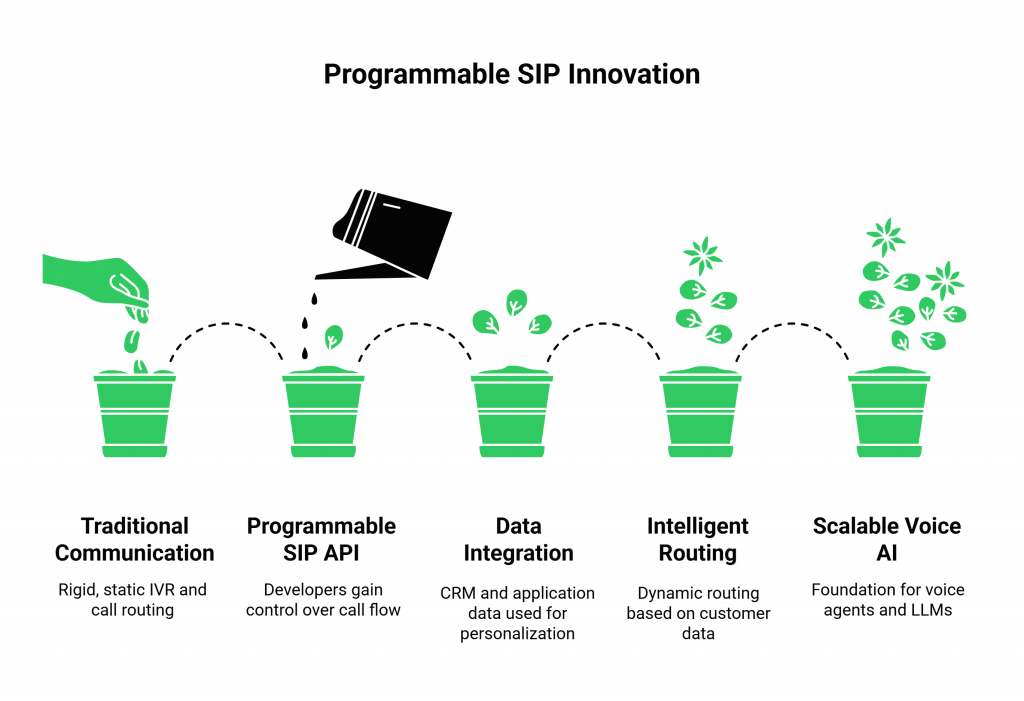
This new level of control has unleashed a wave of innovation, creating a new generation of programmable communication systems that were previously impossible to build.
Building Intelligent, Data-Driven IVRs and Voicebots
The old, rigid “press 1 for sales, press 2 for support” IVR is dead. With a programmable SIP API, a developer can build an IVR that is a fully integrated part of their application.
- A Real-World Example: A customer calls an e-commerce company. The programmable SIP platform sends a webhook to the company’s application. The application uses the caller’s phone number to look them up in the CRM, sees they have a recent order that is “out for delivery,” and instead of a generic menu, it proactively asks, “Hi Jane, are you calling about your order for the blue sweater that is scheduled to be delivered today?” This level of personalization is only possible when the application’s logic is in control of the call flow.
Creating Context-Aware Call Routing
Call routing for AI agents and human agents becomes a far more intelligent process.
- A Real-World Example: A high-value customer calls a financial services firm. The application receives the call, checks the CRM, sees the customer’s “platinum” status, and immediately routes the call to a dedicated, high-priority queue of senior support agents, bypassing the standard IVR entirely. This dynamic, data-driven routing is impossible in a static PBX environment.
The impact of this kind of intelligent routing is significant; a study on customer service found that 68% of customers are willing to pay more for products and services from a brand known to offer good customer service experiences.
The Foundation for Scalable Voice AI
For developers building voice agents using LLMs, the programmable SIP API is the essential foundation. It provides the real-time media streaming capabilities needed for the AI to “hear,” and the call control needed for it to “speak” and manage the conversation. The entire, complex, back-and-forth dialogue of an AI call is simply a series of webhook events and API responses, all orchestrated by the developer’s code.
Also Read: How Media Streaming Works Behind Every AI-Driven Voice Call
The FreJun AI Difference: Programmability at the Core
At FreJun AI, our Teler engine was not designed with a programmable SIP API as an add-on; it was architected with programmability at its very core. We believe that developers should have complete, granular, and real-time control over every aspect of their API based telephony.
- A Simple but Powerful Markup Language (FML): We provide a clean and intuitive set of XML-based verbs that allow developers to easily define complex call flows.
- A Rich, Event-Driven Webhook System: We provide a comprehensive stream of real-time events, giving your application the deep visibility it needs to make intelligent, context-aware decisions.
- A Low-Latency, Edge-Native Infrastructure: Our globally distributed platform ensures that the real-time communication between our engine and your application is as fast and responsive as possible, which is critical for a great user experience.
Conclusion
The advent of the programmable SIP API represents a fundamental democratization of the power of telecommunications. It is the technology that has finally moved the intelligence of voice out of the closed, proprietary black box of the PBX and into the open, flexible, and innovative world of the software developer.
This shift has unlocked a new universe of possibilities, from deeply personalized customer service to the scalable deployment of advanced AI voice agents.
Any business or developer that wants to build the future of real-time SIP communication must start by embracing a platform built on true, API-driven programmability.
Want to see a live demonstration of how our programmable SIP API can be used to build a dynamic, data-driven voice application in minutes? Schedule a demo with our team at FreJun Teler.
Also Read: Call Log: Everything You Need to Know About Call Records
Frequently Asked Questions (FAQs)
It means that you can control what happens on a live phone call using your own software code. Instead of being a static, pre-configured phone line, the call becomes a dynamic entity that your application can orchestrate in real-time via an API.
A regular SIP trunk is usually a “dumb pipe” that forwards a call to one fixed destination. A programmable SIP trunk is different. It is an intelligent service that talks to your application at every step. It asks what to do next and follows your logic in real time.
A webhook is a real-time HTTP notification from the voice platform. It tells your application about a call event. This could be a new call or a user pressing a key. The webhook triggers your app to react. It lets your app take control of the call. This makes it the core of API-based telephony.
Yes, it is the essential foundation for it. The API provides the necessary tools to access the real-time audio stream and to play back the AI’s generated response.
No, and that is one of its biggest advantages. The programmable SIP API allows you to build all of your call logic directly into your own application. It completely eliminating the need for a separate, traditional PBX system.
A markup language like FreJun AI’s FML is a simple way to send instructions to the voice platform. It provides easy verbs you can use in your call flows. You can combine these verbs to create complex behavior. You do not need to write complicated code.
The call routing for AI agents becomes intelligent because your application is in control. It can use data from your CRM or other systems to decide, in real-time.
If you know REST APIs and JSON or XML, you already have the needed skills. You do not need to be an expert in the low-level SIP or RTP protocols.
The Teler is built around a powerful, developer-first programmable SIP API. It is designed to be fully controlled by your application’s code through our APIs and our simple FML markup language.
Yes. A production-grade platform uses multiple layers of security. The communication between your application and the platform is secured with HTTPS and request signing. The calls themselves are protected with encryption (TLS/SRTP).