
In the fast-paced world of software development, the question “How long will it take?” is both the most common and the most difficult to answer. When it comes to building voice bots, this question is even more complex. A voice bot is not a standard web application; it is a unique fusion of conversational design, AI/ML integration, and real-time telecommunications infrastructure.
The journey from a simple “hello world” prototype to a robust, production-ready system that can handle thousands of real-world conversations is a multi-stage process, and the timeline can vary dramatically based on the project’s scope, complexity, and the tools you choose.
However, the timeline is not a complete mystery. By breaking down the voice bot development timeline into distinct phases and understanding the key prototyping milestones and deployment phases for voice AI, a business can create a realistic and achievable roadmap.
This guide will provide a practical framework for estimating how long it takes to go from a promising idea to a fully operational voice bot, and it will highlight how the choice of your underlying voice platform is the single biggest factor in accelerating this journey.
Table of contents
- The Three Core Phases of Voice Bot Development
- Phase 1: Prototyping & Proof of Concept (1 – 4 Weeks)
- Phase 2: Development & Integration (4 – 12 Weeks)
- Phase 3: Testing, Deployment, & Iteration (2 – 6 Weeks and Ongoing)
- How Can a Developer-First Voice Platform Accelerate Your Timeline?
- Conclusion
- Frequently Asked Questions (FAQs)
The Three Core Phases of Voice Bot Development
The journey from prototype to production can be broadly divided into three main phases, each with its own set of tasks, challenges, and timelines. A recent study on software project management found that agile projects are 28% more successful than traditional projects, and this iterative, phased approach is a core tenet of agile development.
Here is a high-level overview of the typical deployment phases for voice AI:
| Phase | Primary Goal | Key Activities | Estimated Timeline (Typical) |
| Phase 1: Prototyping & Proof of Concept (PoC) | To prove that the core concept is technically feasible and to validate the basic conversational flow. | Conversational design, basic API integrations, building a “happy path” prototype. | 1 – 4 Weeks |
| Phase 2: Development & Integration | To build out the full feature set, handle edge cases, and deeply integrate with business systems. | Robust error handling, CRM/database integration, security implementation. | 4 – 12 Weeks |
| Phase 3: Testing, Deployment, & Iteration | To ensure the bot is reliable, scalable, and provides a good user experience in the real world. | End-to-end testing, load testing, gradual rollout, and continuous monitoring. | 2 – 6 Weeks (and ongoing) |
Also Read: Best Practices for Testing and Debugging Voice Calling SDK Integrations
Let’s dive deeper into what is involved in each of these phases.
Phase 1: Prototyping & Proof of Concept (1 – 4 Weeks)
The goal of this initial phase is speed and validation. You are not trying to build a perfect, polished product. You are trying to answer a simple question: “Does this idea work?”
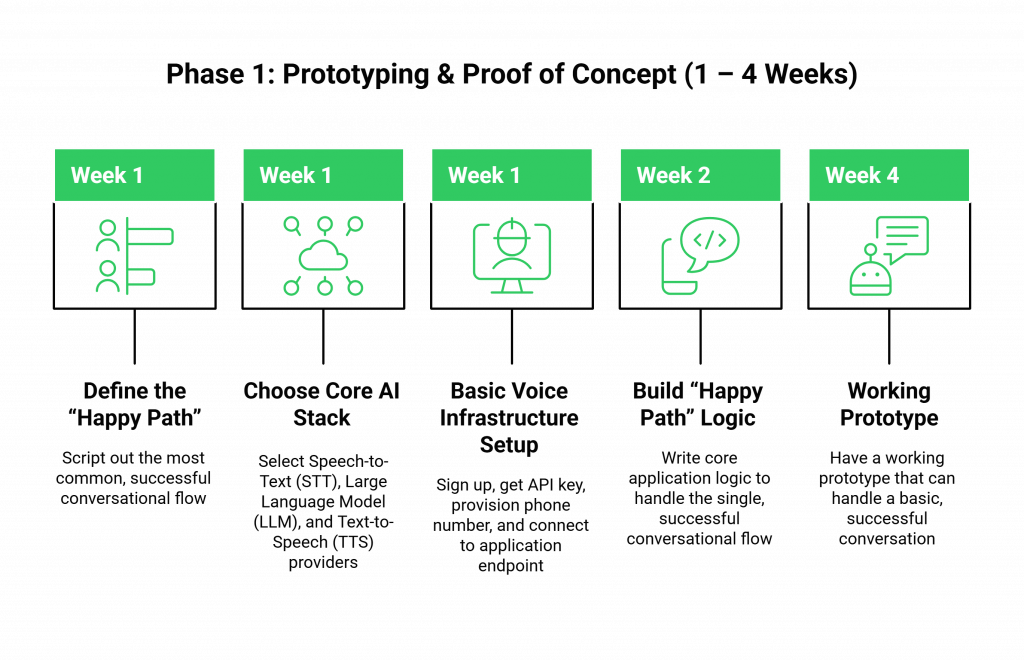
Key Prototyping Milestones
- Define the “Happy Path”: The first step is to script out the most common, successful conversational path. For a simple appointment scheduling bot, this would be the flow where the user calls, asks for a new appointment, is offered a time, accepts it, and the call ends.
- Choose Your Core AI Stack: You will make your initial selections for your Speech-to-Text (STT), Large Language Model (LLM), and Text-to-Speech (TTS) providers.
- Basic Voice Infrastructure Setup: This is where the choice of your voice platform is critical. With a modern, developer-first platform like FreJun AI, a developer can sign up, get an API key, provision a phone number, and connect it to their application’s endpoint in under an hour. This is a crucial part of the initial integration timelines.
- Build the “Happy Path” Logic: The developer writes the core application logic to handle this single, successful conversational flow.
At the end of this phase, you should have a working prototype that you can call and have a basic, successful conversation with. This is an essential milestone for demonstrating the value of the project to stakeholders and for getting early feedback on the conversational design.
Ready to build your first prototype in a matter of hours, not weeks? Sign up for FreJun AI and get your API keys to get started.
Phase 2: Development & Integration (4 – 12 Weeks)
This is where the real work of building voice bots happens. You are moving beyond the “happy path” and building a robust application that can handle the messy reality of real-world conversations and business processes. The timeline in this phase is the most variable and is highly dependent on the complexity of your use case.
Critical Integration Timelines and Tasks
- Deep Backend Integration: This is often the most time-consuming part. It involves building secure and reliable integrations between your voice bot’s “brain” and your core business systems, such as your CRM, your billing platform, or your appointment scheduling software.
- Handling “Unhappy Paths” and Edge Cases: What happens if the user says something the AI does not understand? What if they want to speak to a human? What if they are calling from a number that is not in your system? You need to design and build the logic for all of these “unhappy paths.” This includes building a seamless escalation path to a human agent.
- Implementing Security and Authentication: This is a non-negotiable step. You need to build a secure system for identifying and authenticating users and for handling any sensitive data according to industry best practices and regulations.
- Building Out the Full Conversational Logic: This involves expanding your bot’s capabilities to handle a wider range of intents and to have more complex, multi-turn conversations.
The choice of your voice platform can have a huge impact on the integration timelines. A platform with a clean, well-documented API, a rich set of features, and a model-agnostic approach (like FreJun AI) will make this phase significantly faster and smoother.
Also Read: How a Voice Calling SDK Can Improve Customer Experience in AI Voice Agents?
Phase 3: Testing, Deployment, & Iteration (2 – 6 Weeks and Ongoing)
You have built the bot. Now, you need to make sure it is ready for the real world. This phase is about ensuring quality, reliability, and a great user experience. It is a critical part of any production-readiness checklist.
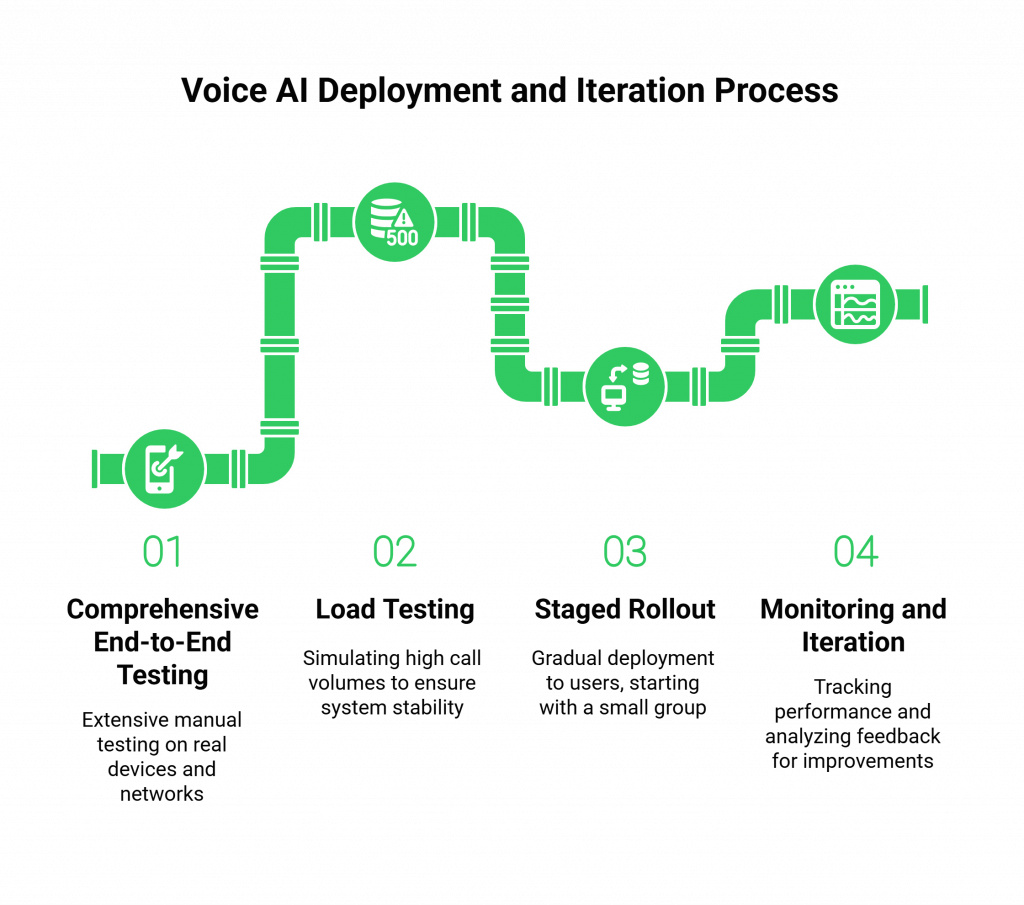
Key Deployment Phases for Voice AI
- Comprehensive End-to-End Testing: This goes far beyond the automated tests of Phase 1. It involves extensive manual testing on a wide variety of real devices and network conditions.
- Load Testing: This is essential for ensuring your system can handle the expected call volume. You need to use a testing tool to simulate a massive, sudden spike of hundreds or thousands of simultaneous calls to see how your application and your voice infrastructure hold up. A truly elastic voice platform is critical here.
- Staged Rollout (Canary Deployment): Do not launch your bot to 100% of your customers on day one. Start with a small, internal group of users. Then, gradually roll it out to 1%, then 5%, then 20% of your real customers, carefully monitoring the performance and user feedback at each stage.
- Monitoring and Iteration: The launch is not the end of the journey; it is the beginning. You need to have a robust monitoring system in place to track the bot’s performance, analyze call logs, and identify common failure points in the conversations.
A study by Accenture found that companies that are leaders in using data and AI for customer service are 3.5 times more likely to report significant revenue growth. The data you get from your live bot is the fuel for continuous improvement.
How Can a Developer-First Voice Platform Accelerate Your Timeline?
The single biggest variable in the voice bot development timeline is the choice of the underlying voice communication platform. A legacy, telco-first provider can add weeks or even months of complexity to your project. A modern, developer-first platform like FreJun AI is designed to do the exact opposite: to accelerate your journey from prototype to production.
We achieve this by:
- Abstracting Away the Telecom Complexity: We handle all the hard, low-level parts of connecting to the global telephone network, so your developers can focus on your application’s logic.
- Providing a Powerful, Easy-to-Use API: Our API and our FML markup language are designed to be intuitive and to make the process of controlling a live call as simple as possible.
- Ensuring Built-in Scalability: Our Teler engine is a globally distributed, elastic platform. You do not have to worry about building for scale; it is built in from day one.
- Offering Deep Observability: We provide the detailed logs and real-time analytics you need to effectively test, debug, and monitor your application in a production environment.
Also Read: Voice Calling SDKs for Enterprises: Scaling Conversations with AI and Telephony
Conclusion
The journey of building voice bots from a simple idea to a production-grade system is a complex but manageable process. While a basic “happy path” prototype can be built in a matter of weeks, a truly robust and fully integrated voice agent is a significant software engineering project that can take several months.
However, the timeline is not set in stone. By taking a phased, iterative approach, by focusing on a clear set of prototyping milestones, and, most importantly, by building on a modern, developer-first voice platform, businesses can dramatically accelerate this journey.
The right platform acts as a powerful catalyst, handling the immense complexity of real-time communication and allowing you to get to market faster with a more reliable, scalable, and intelligent voice bot.
Ready to see how our developer-first platform can accelerate your voice bot development timeline? Schedule a demo with our team at FreJun Teler.
Also Read: Call Center Reporting Automation: Real-Time Analytics for Better Decisions
Frequently Asked Questions (FAQs)
For a moderately complex voice bot (e.g., an appointment scheduler with CRM integration), a realistic total timeline is typically 2 to 4 months. This includes 1-4 weeks for a prototype, 4-12 weeks for full development and integration, and 2-6 weeks for testing and initial deployment.
A “happy path” is the ideal, error-free conversational flow. For an order status bot, it would be the conversation where the user provides a valid order number, and the system successfully finds and relays the status. The first of your prototyping milestones should be to build this path.
The most common delays during the deployment phases for voice AI are unexpected issues discovered during real-world testing (like poor performance on bad networks) and the need to retrain or fine-tune the AI models based on how real users are interacting with the bot.
Deep backend integration timelines are often the longest part of the development phase. Integrating with a modern, API-first CRM might take a week, while integrating with an old, legacy, on-premise billing system could take a month or more.
A good production-readiness checklist should include items like: comprehensive error handling for all API calls, a robust load testing plan, a secure authentication and authorization system, a detailed monitoring and alerting plan, and a clear escalation path to a human agent.
It is almost always better to follow an agile, iterative approach. Launch with a Minimum Viable Product (MVP) that handles the most common use case exceptionally well. Then, use the data and feedback from your real users to guide your future development.
The choice of the LLM itself does not have a huge impact on the initial build time if you are using a standard, pre-trained model. However, if your project requires extensive fine-tuning of a model on your own data, this can add several weeks or even months to the AI development part of the project.
Load testing simulates a large number of simultaneous calls to stress the system. It shows how your application performs under heavy load. This is critical for voice bots. It ensures your app and voice infrastructure can handle sudden spikes without failing.
It speeds up voice bot development by hiding the most complex infrastructure work. The platform abstracts low-level telecommunications entirely. A simple API handles scalability and reliability. Developers can focus on application logic instead of plumbing.
No. A voice bot is a living application. The launch is the beginning of a continuous cycle of monitoring, analyzing, and iterating. You will use the data from real conversations to constantly improve your bot’s intelligence, conversational design, and overall performance.