
We are living in the midst of a quiet revolution. The automated voice that answers when you call your bank, the intelligent agent that confirms your doctor’s appointment, the virtual assistant that books your dinner reservation, these are no longer the stuff of science fiction.
They are a rapidly growing part of our daily lives. At the heart of every one of these magical, AI-powered conversations is a technology that is completely invisible to the end-user, yet absolutely indispensable to its function: elastic SIP trunking.
While the Large Language Model (LLM) gets all the credit for the intelligence of the conversation, it is the underlying elastic SIP trunking infrastructure that acts as the real-time nervous system. It is the high-speed, low-latency bridge that connects the AI’s digital brain to the analog world of the global telephone network.
For developers, businesses, and IT leaders looking to deploy voice AI at scale, understanding how this foundational layer works is not just a technical curiosity; it is the key to building an application that is not just smart, but truly conversational.
Table of contents
What is the Fundamental Job of the SIP Trunk in an AI Call?
Before we get to the “elastic” part, we must first understand the core role of the SIP trunk. A SIP (Session Initiation Protocol) trunk is a virtual connection that allows you to make and receive phone calls over the internet. In the context of an AI conversation, its job is far more complex than just connecting a call. It has two primary, mission-critical responsibilities.
- To Establish and Control the Call: It is responsible for all the low-level signaling that makes a phone call possible. This includes everything from the initial “handshake” to set up the session to the final “goodbye” to tear it down. This is the essence of a basic SIP trunk setup.
- To Transport the Voice in Real-Time: This is its most critical function for AI. The SIP trunk is responsible for carrying the raw audio of the conversation, known as the media, which is streamed using the Real-time Transport Protocol (RTP). This real-time SIP media streaming is the lifeblood of the AI’s ability to “hear.”
The challenge is that this entire process must happen with incredible speed and reliability. The demands of a low latency voice AI are far more stringent than those of a simple human-to-human call.
Why Does “Elastic” Matter So Much for AI?
The “elastic” in elastic SIP trunking is what elevates this technology from a simple utility to a strategic enabler of AI. It refers to a cloud-native architectural model that is defined by two key characteristics: on-demand scalability and API-driven programmability.
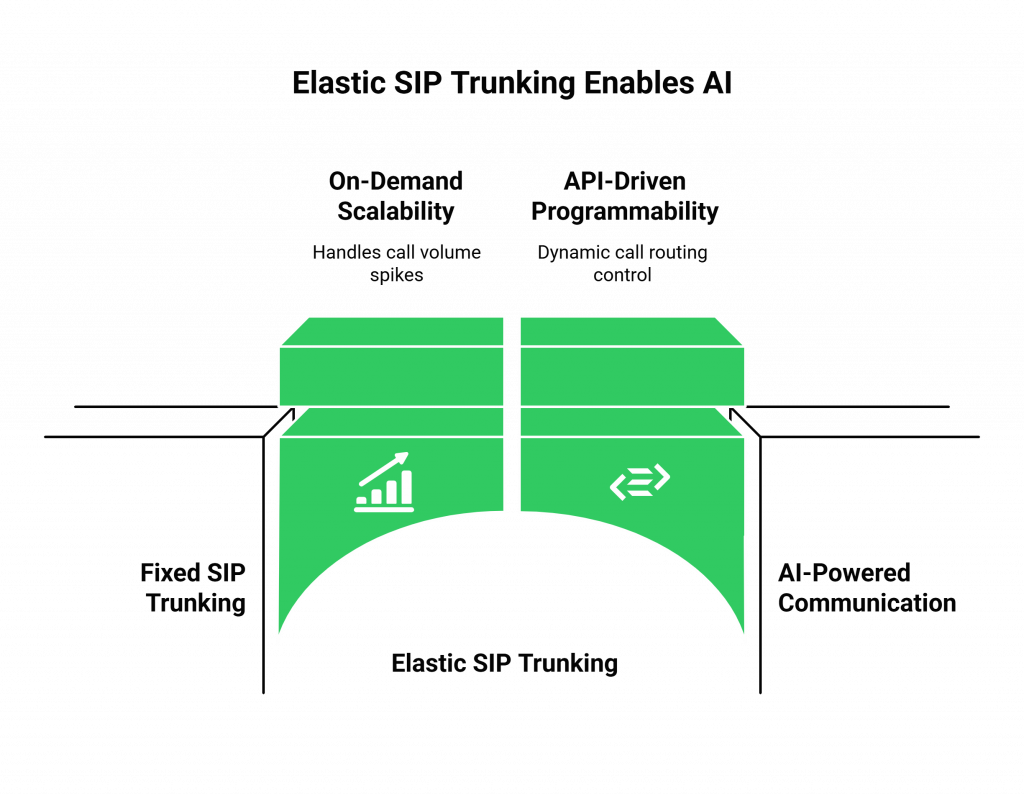
The Power of On-Demand Scalability
Traditional, channelized SIP trunking forced you to purchase a fixed number of call paths. This model is a complete non-starter for AI applications.
- Handling Unpredictable Spikes: Imagine a utility company’s outage reporting line during a major storm. The call volume can spike from 10 calls a minute to 10,000. An elastic SIP trunking platform is designed to handle this kind of massive, instantaneous surge automatically, without a single caller ever hearing a busy signal.
- Enabling Proactive, Large-Scale Campaigns: An AI-powered sales or marketing campaign might need to make 20,000 outbound calls in a single hour. Elastic SIP trunking provides the on-demand capacity to execute this, and then scales back down to zero when the campaign is over, ensuring you only pay for the capacity you actually use.
The Necessity of API-Driven Programmability
This is the feature that truly unlocks the potential for AI. A modern, developer-first elastic SIP trunking provider does not just connect a call; it exposes the entire lifecycle of the call to be controlled by your application’s code. This is a profound shift. The call routing for AI agents is no longer a static configuration set in a web portal; it is a dynamic, intelligent process managed by your AI’s logic in real-time.
A recent report on business process automation highlighted that companies leveraging API-driven automation see a 30-50% increase in operational efficiency. This efficiency is at the core of the synergy between elastic SIP trunking and AI.
Ready to build on a platform that was designed from the ground up for the demands of modern AI? Sign up for FreJun AI and explore our powerful, API-driven voice infrastructure.
Also Read: Automating Utility Payments Via AI Calls
How Does it All Work? A Look “Under the Hood” of an AI Conversation
To truly understand how elastic SIP trunking works behind the scenes, let’s follow the data flow of a single turn in a conversation between a human user and an AI voice agent. This is the high-speed dance that happens every time you speak to an automated assistant.
This process is a perfect illustration of a modern conversational infrastructure.
| Step | Action | The Role of the Elastic SIP Trunking Layer (e.g., FreJun AI’s Teler) | The Role of the AI Platform (Your “AgentKit”) |
| 1 | User Speaks | The call is active. The Teler engine is capturing the user’s voice and converting it into a stream of raw RTP packets at one of its global edge PoPs. | Is in a “listening” state, awaiting data. |
| 2 | Real-Time Media Streaming | Using a programmable media forking feature, Teler instantly creates a copy of the RTP stream and sends it to the designated endpoint of your AI platform. | Receives the raw audio stream in real-time. |
| 3 | Transcription (STT) | Continues to manage the live call connection, ensuring stability. | The audio stream is fed into its Speech-to-Text engine, which transcribes it into text. |
| 4 | Intelligence (LLM) | Is on standby, ready to receive a new audio stream to play back to the user. | The transcribed text is sent to the Large Language Model. The LLM processes the intent, consults its business logic, and generates a text-based response. |
| 5 | Synthesis (TTS) | Still on standby. | The LLM’s text response is sent to the Text-to-Speech engine, which synthesizes it into a new audio stream. |
| 6 | Response Delivery | Your application sends an API command to the Teler engine with the new audio stream and an instruction to “play audio.” | Prepares to send the command to the Teler engine. |
| 7 | User Hears Response | The Teler engine receives the command and the audio, and immediately streams it back to the user on the live phone call. | The loop is complete, and it is now ready for the user’s next utterance. |
This entire round-trip, from the user’s last word to the AI’s first word, must happen in a fraction of a second. The elastic SIP trunking layer is not a passive component in this process; it is an active, high-speed, and programmable participant.
Also Read: From MCP to AgentKit: How to Deploy Voice-Enabled LLM Agents with Teler
What is the Role of FreJun AI in This Ecosystem?
At FreJun AI, we have built our entire platform on the principle that the voice infrastructure should be a powerful, flexible, and completely abstracted tool for developers. Our Teler engine is the embodiment of a modern, AI-first elastic SIP trunking provider.
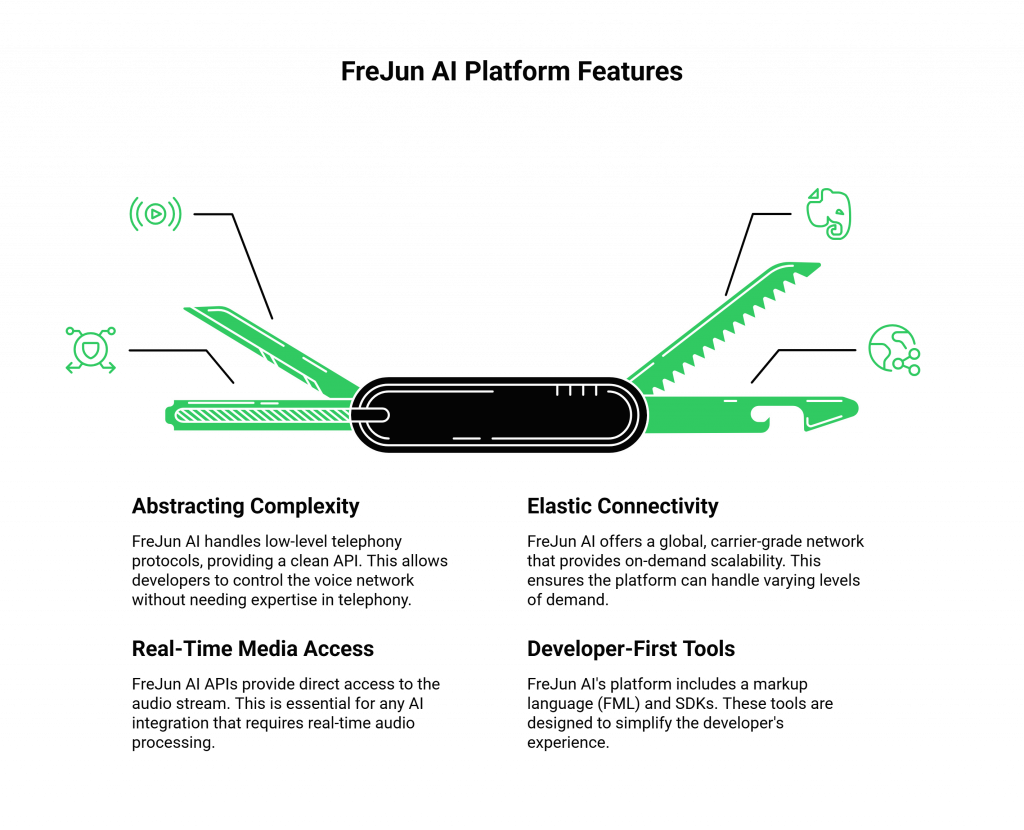
Abstracting Away the Complexity
The world of telephony is filled with a dizzying alphabet soup of protocols: SIP, RTP, TLS, SRTP, and more. A developer building an AI agent should not have to be an expert in any of these. Our platform handles all of this low-level complexity for you.
We provide a clean, high-level, and well-documented API that allows you to control the powerful voice network without ever needing to look “under the hood.”
Providing the Building Blocks for Innovation
We provide the essential, programmable building blocks that allow you to create any voice workflow imaginable.
- Elastic Connectivity: Our global, carrier-grade network provides the on-demand scalability you need.
- Real-Time Media Access: Our APIs give you the direct access to the audio stream that is essential for any AI integration.
- Developer-First Tools: From our markup language (FML) to our SDKs, every part of our platform is designed to make the developer’s life easier.
This is our core promise: “We handle the complex voice infrastructure so you can focus on building your AI.”
Also Read: Voice Recognition API: Enabling Smarter Voice-Based Applications
Conclusion
The magical experience of a seamless, intelligent AI voice conversation is the result of a deep and powerful partnership between two revolutionary technologies. The Large Language Model provides the intelligence, but it is the modern, developer-first elastic SIP trunking infrastructure that gives that intelligence a voice and connects it to the world.
It is the invisible, high-speed nervous system that handles the real-time streaming, the massive scalability, and the intricate call control that makes a natural conversation possible.
As voice AI becomes more integrated into every facet of business communication, the power and flexibility of the underlying elastic SIP trunking layer will be the key differentiator between the applications that feel like the future and those that are stuck in the past.
Want to dive deeper into the technical architecture and see how our elastic SIP trunking engine can power your AI voice application? Schedule a personalized demo for FreJun Teler.
Also Read: UK Mobile Code Guide for International Callers
Frequently Asked Questions (FAQs)
It is a modern, cloud-based way to connect your business’s voice applications to the global telephone network. The “elastic” part means it can automatically scale to handle any number of calls, and you only pay for the capacity you actually use.
A regular phone line is a physical connection with a fixed capacity (usually one call). Elastic SIP trunking is a virtual connection over the internet with a virtually unlimited capacity.
This refers to the process of transmitting the raw audio of a phone call (the “media”) over the internet in real-time using the RTP protocol. For an AI, getting access to this stream is how it “hears” the caller.
Latency is the delay in a conversation. If the delay between a user speaking and the AI responding is too long, the conversation feels unnatural and frustrating. A low latency voice AI is essential for a good user experience.
A modern elastic SIP trunking provider offers a Real-Time Media API. This allows a developer to write code that instructs the provider to create a live copy of the call’s audio and send it to their application’s server.
A basic setup involves provisioning a phone number with the provider and configuring that number to send a webhook to your application’s URL. When a call comes in, the provider notifies your application, which can then use an API to control the call.
Instead of a static routing table, the routing is dynamic and controlled by your code. Your application receives the call notification and can then decide, based on your business logic (like the time of day or the caller’s number), how to handle the call whether to send it to an AI agent, a human, or a voicemail.