
For years, the term “automated phone system” has been synonymous with a rigid, frustrating, and decidedly “dumb” experience. We have all been trapped in the endless loop of a poorly designed IVR, repeatedly pressing “0” in a desperate attempt to reach a human. This is the legacy of traditional voice automation: a hard-coded flowchart that is blind to context and incapable of adaptation.
But a new paradigm is here, one that is transforming these rigid scripts into dynamic, responsive, and truly intelligent conversations. The core technology powering this revolution is the modern, developer-first voice API for developers.
This is not just an incremental improvement; it is a fundamental re-imagining of what a voice workflow can be. An automation voice API is not just a tool for playing audio files and routing calls; it is a programmable bridge that allows a voice call to connect with the rich, data-filled world of your core business systems and the powerful intelligence of modern AI.
By leveraging this bridge, developers can create intelligent voice workflows and ai driven call flows that are not just more efficient, but profoundly smarter.
Table of contents
What Made Traditional Voice Workflows So “Dumb”?
To understand the “smart” revolution, we must first diagnose the “dumb” problem. Traditional Interactive Voice Response (IVR) systems, the workhorses of automated telephony for decades, were built on a foundation of severe limitations.
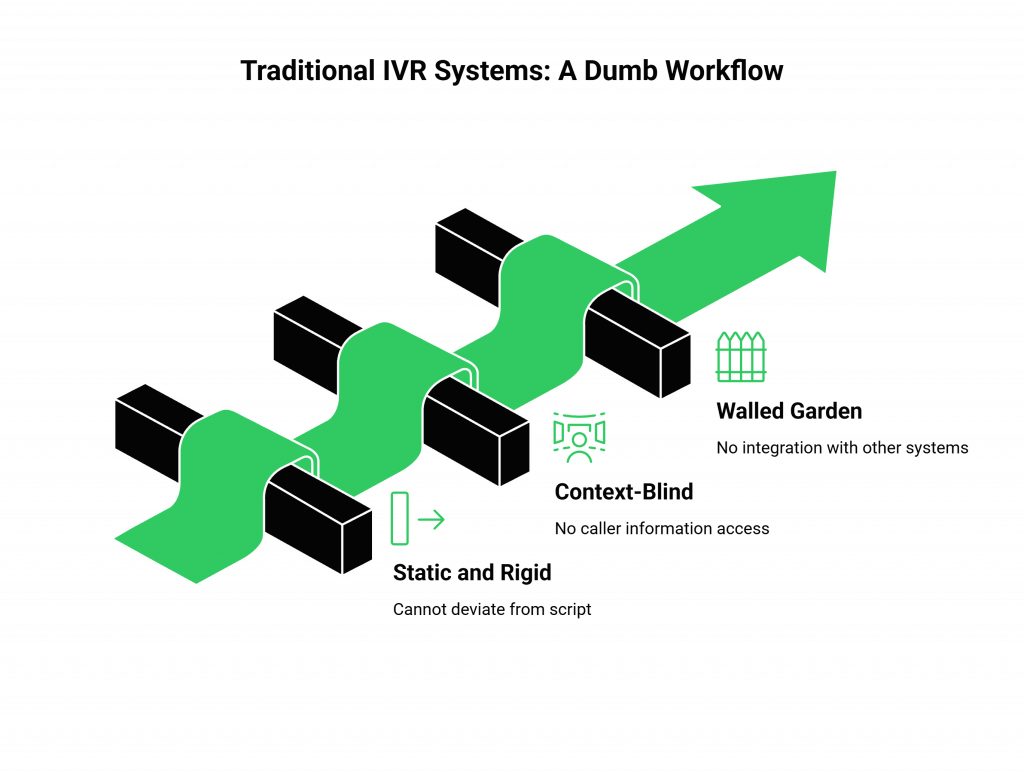
- They Were Static and Rigid: A traditional IVR was a pre-programmed, static flowchart. It could not deviate from its script. If a customer had a problem that did not fit neatly into one of the pre-defined options, they hit a dead end.
- They Were Context-Blind: The IVR had no idea who was calling. It could not access your CRM to see that the caller was a VIP customer or that they had just been on your website looking at a specific product. Every caller was treated as an anonymous stranger.
- They Were a “Walled Garden”: The IVR system was a closed, proprietary box. It had no easy way to communicate with other business systems. It could not look up an order status in your e-commerce platform or update a ticket in your helpdesk software.
This combination of rigidity and isolation is what made these systems feel so unintelligent. They were not a part of your business’s brain; they were a separate, disconnected limb.
Also Read: How Does a Voice Recognition SDK Improve AI Driven Interactions
How Does a Voice API Provide the “Intelligence” Layer?
A modern voice api for developers shatters these limitations by being designed from the ground up to be an open, programmable, and deeply integrated part of your software stack. It does not have its own “brain”; instead, it acts as the high-speed “nervous system” that connects the live phone call to your application’s brain.
The Power of Webhooks and an API-First Architecture
This is the core mechanism of intelligence.
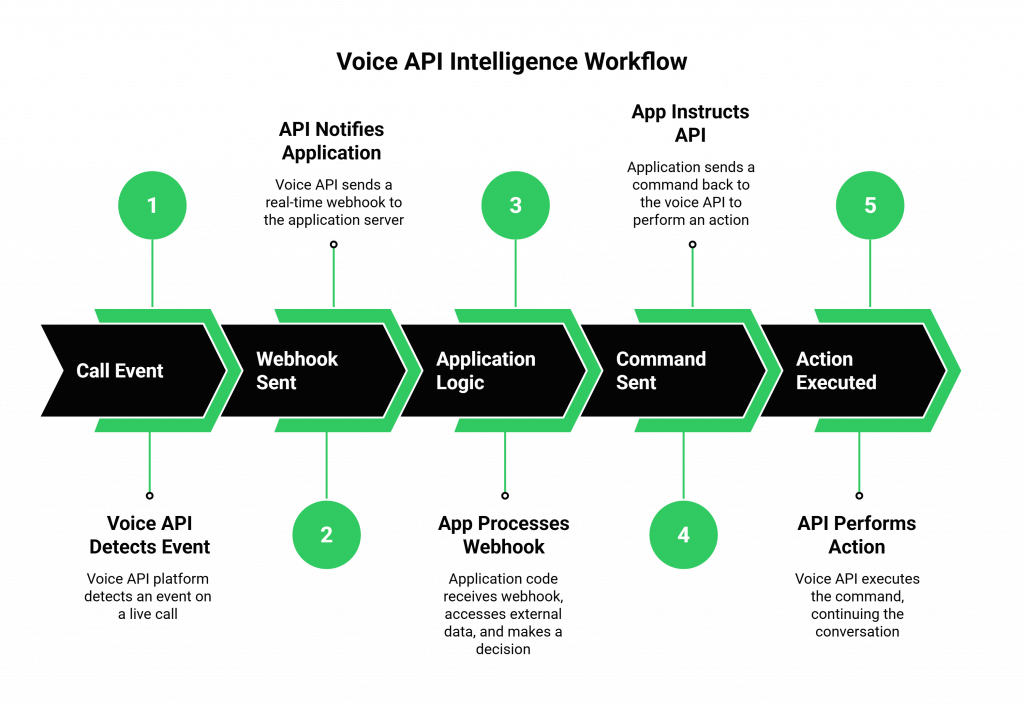
- The Workflow: When an event happens on a live call (e.g., a customer answers, they finish speaking), the voice API platform does not make a decision. Instead, it sends a real-time notification (a webhook) to your application server. This webhook asks a simple question: “This just happened. What should I do next?”
- The Intelligence: Your application’s code receives this webhook. This is where the intelligence lives. Your code can then make a decision and send a command back to the voice API, telling it what action to perform (e.g., “Play this audio,” “Transfer this call,” “Listen for the next response”). This continuous, request-response loop is what creates a dynamic conversation.
The Ability to Access External Data in Real-Time
This is what makes a workflow “context-aware.”
- The Workflow: In the moment between the voice platform sending a webhook and your application responding, your code can perform its own logic. This can include making its own API calls to other systems.
- The Intelligence: Your application can take the caller’s phone number, make an API call to your CRM, and retrieve their entire customer history. It can now make a much smarter decision. The importance of this is massive; a recent Salesforce report found that 73% of customers expect companies to understand their unique needs and expectations. Accessing CRM data is the key to meeting this expectation.
The Integration of AI and Large Language Models (LLMs)
This is the ultimate level of intelligence.
- The Workflow: The voice API streams the caller’s speech to your application (via a Speech-to-Text process).
- The Intelligence: Instead of your code using a simple if-else statement to understand the response, it can send the transcribed text to a Large Language Model (LLM). The LLM can understand the user’s natural, open-ended intent, even if it does not match a pre-defined option. This is the core of ai driven call flows.
Also Read: How Does A Voice API For Bulk Calling Improve Delivery Rates At Scale?
What Do Intelligent Voice Workflows Look Like in Practice?
When you combine these capabilities, you can move beyond simple IVRs and create truly intelligent voice workflows.
This table showcases some powerful, real-world examples.
| Intelligent Workflow | How It’s Smart (The Logic) | The Business Impact |
| Personalized Inbound Routing | When a call comes in, the application checks the caller’s ID against the CRM. If they are identified as a “VIP” customer, the API is used to bypass the main IVR and route them directly to a dedicated support agent. | Dramatically improves the experience for high-value customers, increasing retention and loyalty. |
| Proactive, Data-Driven Outreach | An e-commerce platform detects that a user has abandoned a high-value shopping cart. This triggers a workflow that uses the voice API to make an automated, outbound call from an AI agent an hour later. | Recovers potentially lost revenue by re-engaging the customer on a more personal and immediate channel. |
| Dynamic, Conversational IVR | A customer calls and is greeted by an AI that says, “How can I help you today?” The AI uses an LLM to understand their open-ended request (e.g., “I need to check on the status of my recent repair order”). | Slashes customer frustration by eliminating complex phone menus. Improves first-call resolution by quickly understanding the customer’s true intent. |
| Context-Aware Human Escalation | An AI agent is handling a call, but the customer’s sentiment turns negative. The AI detects this, and the application uses the API to seamlessly transfer the call to a human agent, passing the full call transcript and customer data to the agent’s screen. | Creates a seamless “warm transfer,” empowering the human agent to solve the problem faster and de-escalate the situation more effectively. |
Ready to build the intelligent brain for your next-generation support system? Sign up for FreJun AI to get your API keys and start building today.
What is FreJun AI’s Role in Building This Intelligence?
At FreJun AI, our architectural philosophy is to provide the most powerful, reliable, and flexible “nervous system” for your voice applications. We do not build the “brain”; we provide the automation voice api that allows your brain to connect to the world.
- A Radically Developer-First Platform: Our Teler and its associate APIs are design from the ground up to be controlled by your code. We provide the webhooks, the APIs for call and media control, and the documentation that you need to build these sophisticated, intelligent voice workflows.
- An Open, Model-Agnostic Ecosystem: We are a flexible bridge. We provide the high-quality, low-latency voice connection, and you have the complete freedom to connect that to the best-in-class data sources (your CRM) and intelligence sources (your chosen LLM) that you want. This is our core promise: “We handle the complex voice infrastructure so you can focus on building your AI.” A recent report on the API economy highlighted that 83% of organizations that have an API strategy see it as a key driver of innovation and business agility.
Also Read: Voice Recognition SDK That Handles Noise with High Precisio
Conclusion
The era of the “dumb” IVR is over. The modern voice API for developers has fundamentally changed what is possible, transforming the voice channel from a static, isolated system into a dynamic, intelligent, and deeply integrated part of the enterprise software stack.
By acting as a powerful, programmable bridge between the live phone call and a company’s own data and AI, it allows developers to build truly intelligent voice workflows.
This represents more than a technological upgrade; it redefines communication through context, personalization, and intelligent automation.
Want to do a deep architectural dive into the infrastructure required to power a high-performance, enterprise-grade voicebot? Schedule a demo with our team at FreJun Teler.
Also Read: How IVR Software Improves Customer Support Efficiency in 2025
Frequently Asked Questions (FAQs)
It acts as a programmable bridge, allowing your application’s logic and external data sources to control the call’s flow in real-time.
A webhook is a real-time notification from the voice platform to your application, which acts as the trigger for your intelligent decision-making logic.
A traditional IVR is a rigid, pre-programmed menu. A smart IVR, built with a voice API, can understand natural language and dynamically change its behavior.
Yes. Your application can use the caller’s ID to make a real-time API call to your CRM to retrieve the customer’s full context and history.
An ai-driven call flow is one where a Large Language Model (LLM) is used to understand a user’s open-ended intent and dynamically guides the conversation.
No. You can start by building simpler, data-driven workflows using your CRM, and then integrate an LLM as your application’s intelligence grows.
Voice workflow automation is a capability provided by a modern voice API that gives developers the tools to build these complex, automated, and intelligent call flows.