
In the hyper-competitive world of software, speed is the ultimate currency. The ability to go from a brilliant idea to a deployed, production-ready application faster than your competitors is a massive strategic advantage. For decades, the world of voice communication was a place where speed went to die. Building a voice application was a slow, complex, and frustrating process, mired in the arcane world of telecommunications.
But a new generation of technology has shattered this old paradigm. The modern, developer-first voice API for developers is a powerful catalyst for acceleration, transforming what was once a multi-month project into something that can be prototyped in an afternoon and deployed in a matter of days.
This is not just an incremental improvement; it is a fundamental re-imagining of how communication services are built and delivered. For a CTO, a product manager, or a developer, the promise of fast voice app deployment is not just about convenience; it is about agility.
It is about the ability to experiment, to iterate, and to respond to the needs of the market at the speed of software, not the speed of telecom. This guide will explore the specific, concrete ways that a developer friendly voice API and a plug and play voice SDK act as a powerful engine for rapid innovation.
Table of contents
The “Old Way”: Why Was Voice Development Traditionally So Slow?
To appreciate the speed of the new way, we must first diagnose the friction of the old. Building a voice application from the ground up, or even on top of legacy infrastructure, was a journey fraught with time-consuming roadblocks.
The Hardware Hurdle
- The Problem: In the not-so-distant past, a voice application required physical hardware. You had to procure, install, and configure an on-premise PBX or a dedicated media server. This process involved purchase orders, shipping delays, and physical installation, and it could take weeks or months before a single line of code was written.
- The Delay: Procurement, shipping, and installation (1-3 months).
Also Read: How Do You Measure Success After Building Voice Bots? Which KPIs Matter?
The Carrier Contract Cha-Cha
- The Problem: You needed a connection to the public telephone network. This meant negotiating complex, long-term contracts with one or more telecommunication carriers. You had to haggle over pricing, commit to a fixed number of channels, and then wait for their engineers to provision your physical or virtual circuits.
- The Delay: Contract negotiation and provisioning (1-2 months).
The Steep Learning Curve of Low-Level Protocols
- The Problem: Your developers had to become experts in a whole new, and incredibly complex, domain. They had to learn the intricacies of low-level protocols like SIP for signaling and RTP for media. This is a highly specialized skill set that most application developers do not have.
- The Delay: Developer training and ramp-up (months of learning).
This multi-month, high-friction process was a massive barrier to entry. It made voice development the exclusive domain of large, well-funded companies with specialized telecom engineering teams.
The “New Way”: How a Voice API Creates a “Zero to Sixty” Experience
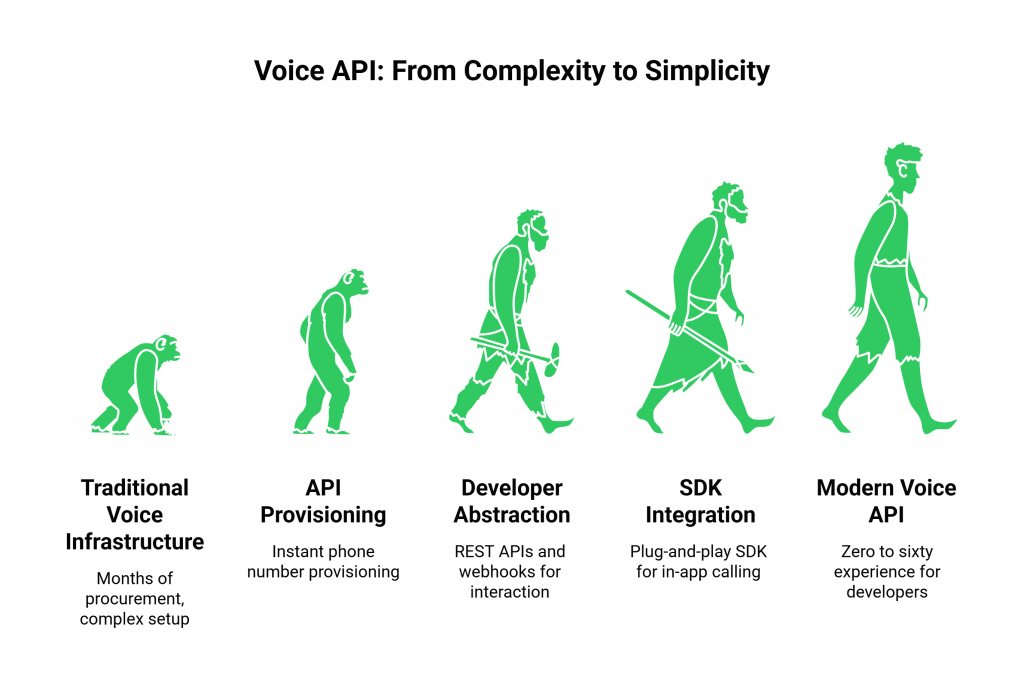
A modern voice api for developers is a powerful layer of abstraction that makes all of this complexity simply disappear. It is a fully managed, cloud-native platform that provides all the power of a global telecommunications network as a simple, on-demand, and instantly accessible service.
From Months of Procurement to Minutes of Provisioning
This is the most immediate and dramatic acceleration.
- The New Model: A developer can go to a provider’s website, sign up for an account, and get their API keys in under five minutes. They can then use a simple API call to search for and instantly provision a new phone number, anywhere in the world.
- The Impact: The entire process of “getting a phone line” is reduced from a multi-month ordeal to a single, sub-second API call. This is the power of a simplified voice infrastructure.
Abstracting Away the Complexity with a Developer-Friendly Voice API
The core mission of a modern voice API is to hide the immense, underlying complexity of telecommunications.
- The New Model: A developer friendly voice api allows a developer to interact with the phone network using the same, familiar tools they use every day: REST APIs and webhooks. They do not need to know what a SIP header is; they just need to know how to make an HTTP request.
- The Impact: This drastically reduces the learning curve. A proficient web developer can learn the basics of the voice API and build their first functional prototype in a single afternoon.
Also Read: How Do You Integrate LLMs When Building Voice Bots For Real-Time Calls?
Accelerating the Front-End with a Plug and Play Voice SDK
For applications that require in-browser or in-app calling, a plug and play voice sdk is a massive accelerator.
- The New Model: The provider offers a pre-built, high-level software library for web (JavaScript), iOS, and Android. This SDK handles all the complex, client-side mechanics of a voice call, such as accessing the microphone, managing the audio session, and handling the real-time WebRTC connection.
- The Impact: Instead of spending weeks building and debugging their own WebRTC client, a developer can simply drop the SDK into their application, call a few high-level functions like device.connect(), and have a fully functional in-app phone in a matter of hours.
This table provides a clear, side-by-side comparison of the development timelines.
| Development Stage | The “Old Way” (DIY / Legacy) | The Modern Voice API for Developers Way |
| Infrastructure Setup | Procure hardware, negotiate carrier contracts (2-5 months). | Sign up online, get API keys, provision a number via API (5 minutes). |
| Backend Development | Learn low-level protocols (SIP/RTP), build a stateful media server (months). | Build a stateless web application that responds to webhooks (days to weeks). |
| Client-Side Development | Build a custom WebRTC or native client from scratch (weeks to months). | Integrate a pre-built, plug and play voice sdk (hours to days). |
| Total Time to “Hello World” | 3 – 8 months. | < 1 hour. |
Ready to experience this new, accelerated pace of voice development for yourself? Sign up for FreJun AI
What is FreJun AI’s Role in Enabling Fast Voice App Deployment?
At FreJun AI, our entire platform was architected with the explicit goal of enabling fast voice app deployment. We are a radically developer-first company, and this philosophy is embedded in every part of our product.
- A Powerful, Yet Simple, API: We have obsessed over the design of our API to make it as intuitive, consistent, and powerful as possible.
- Comprehensive, Actionable Documentation: Our documentation is not just a reference; it is a learning tool, filled with tutorials, code samples, and best practices to help you get started quickly.
- A Global, Elastic, and Instantly Available Infrastructure: Our Teler engine is a massive, globally distributed voice network that you can tap into on demand. There is no waiting for provisioning; the scale and the reach are there for you from the moment you sign up. This is our core promise: “We handle the complex voice infrastructure so you can focus on building your AI.”
Also Read: Why Should Businesses Invest In Building Voice Bots, Not Just Chatbots?
Conclusion
In the modern digital economy, the ability to build, test, and deploy new ideas at a rapid pace is a defining characteristic of a successful company. The world of voice communication, for too long a bastion of slow-moving, legacy technology, is now fully a part of this agile revolution, thanks to the power of the modern voice API for developers.
By abstracting away the immense underlying complexity of the global telephone network and providing a set of simple, powerful, and instantly accessible tools, it has transformed voice development.
Fast voice app deployment is no longer an oxymoron; it is the new standard. And for the developers and businesses that embrace this new paradigm, the opportunity to innovate and to lead is greater than ever.
Want a personalized, hands-on walkthrough of our developer platform to see just how quickly you can build your next voice application? Schedule a demo for FreJun Teler.
Also Read: IVR Software for Enterprises: Advanced Features & High-Volume Handling
Frequently Asked Questions (FAQs)
It is a programmable interface that allows a developer’s application to control and manage phone calls, abstracting away the complexity of the underlying telecom infrastructure.
A developer friendly voice api is one that is well-documented, easy to use, and based on modern web standards like REST and webhooks.
A plug and play voice SDK is a pre-built software library for web or mobile. It handles all the complex client-side audio and connection management, allowing for very fast integration.
It enables fast voice app deployment by eliminating the need for hardware procurement, carrier negotiations, and low-level protocol development. It allows developers to start building immediately.
No. This is the key benefit. The API abstracts all of this away. If you are a developer who understands how to work with web APIs, you can build a voice app.
With a modern voice API, you can programmatically search for and provision new phone number in a matter of seconds.
A webhook is a real-time notification that voice platform sends to application to inform it of a call event.