
You have just launched your first major AI voice bot. It is handling thousands of customer inquiries, processing payments, and scheduling appointments flawlessly. It is a masterpiece of AI workflow automation. But then, at 2:00 PM on a Tuesday, during your peak call volume, the third-party STT service you rely on has a regional outage.
Suddenly, your brilliant AI brain is deaf. Calls are being answered with dead air, customer frustration is skyrocketing, and your support channels are catching fire. This is the moment where the difference between a clever prototype and a true, production-grade system becomes painfully clear.
When building voice bots for mission-critical applications, the “happy path” is only half the story. The other, more important half is planning for failure. A voice call is a real-time, synchronous interaction; there is no “refresh” button for a dropped call. This makes a robust strategy for failover and redundancy not just a technical best practice, but a non-negotiable requirement for business continuity and customer trust.
This guide will explore the key points of failure in a voice AI system and the architectural strategies required to build resilient, automatic recovery systems.
Table of contents
Why is Redundancy a Non-Negotiable for Voice Bots?
In the world of web applications, a few seconds of downtime or a slow page load is an annoyance. In the world of real-time voice, it is a catastrophic failure. A voice call is an ephemeral, all-or-nothing event. If the connection drops or the AI stops responding mid-sentence, the entire interaction is lost, and the customer is left with a jarring and deeply negative experience.
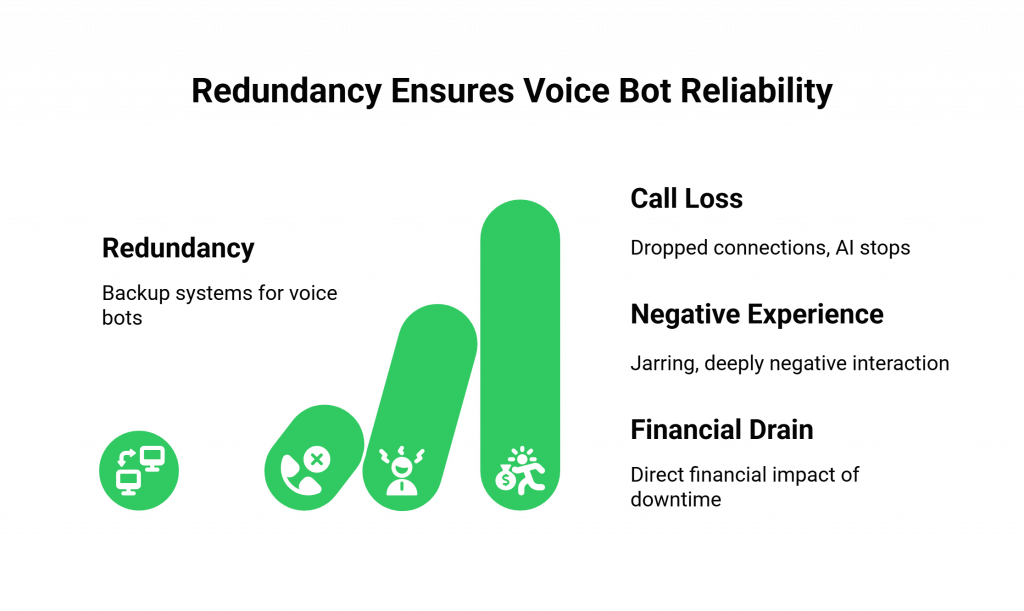
The business impact of this is enormous. The cost of downtime is not just theoretical; it is a direct financial drain. For a large-scale voice bot handling thousands of concurrent calls, that number could be significantly higher. For a voice bot, “high availability” is not a feature; it is the entire product.
Also Read: 5 Common Mistakes Developers Make When Using Voice Calling SDKs
What Are the Key Points of Failure in a Voice AI System?
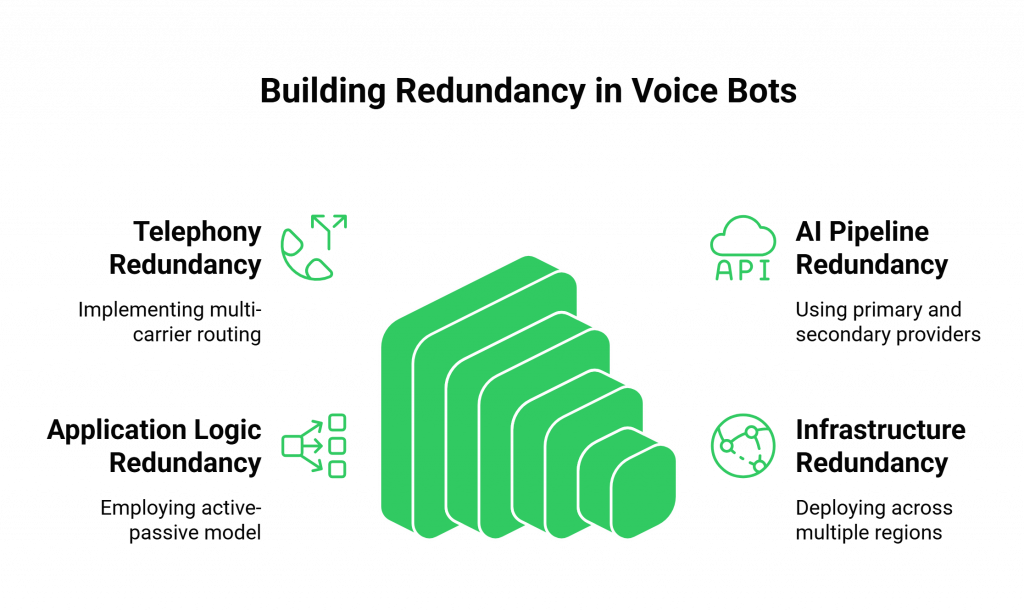
To build a resilient system, you must first understand where it can break. A complete voice AI application is not a single monolith; it is a complex, distributed system with several distinct layers, each presenting its own potential point of failure. A comprehensive redundancy plan must address all four of these layers:
- The Telephony Layer: This is the connection to the outside world, the voice provider’s network and its connection to the global Public Switched Telephone Network (PSTN).
- The AI Pipeline: This is the chain of AI models that enable the conversation, the Speech-to-Text (STT), the Large Language Model (LLM), and the Text-to-Speech (TTS) services. These are often third-party APIs.
- Your Application Logic: This is the code you write, the “brain” that orchestrates the conversation, manages the business logic, and connects to your internal databases and systems.
- The Underlying Cloud Infrastructure: These are the servers, containers, and databases that all of the above components run on.
A failure in any one of these layers can bring the entire system to a halt.
How Do You Architect for Redundancy at Each Layer?
A production-grade approach to building voice bots involves creating specific telephony failover workflows and redundancy strategies for each layer of the stack.
For the Telephony Layer: The Power of Multi-Carrier PSTN Routing
You cannot have a single point of failure in your connection to the world.
- The Problem: Your voice provider might rely on a single upstream carrier to route calls to a specific region. If that carrier has an outage, you can no longer make or receive calls in that region, even if your own systems are perfectly healthy.
- The Solution: This is where the quality of your voice infrastructure provider is paramount. A carrier-grade provider like FreJun AI does not rely on a single carrier. We maintain a complex, global web of interconnections with multiple Tier-1 carriers in every region. Our Teler engine uses multi-carrier PSTN routing, meaning that if one path is congested or down, our system can automatically and instantly reroute calls over an alternative carrier’s network. This provides a level of foundational resilience that is impossible to achieve on your own.
For the AI Pipeline: Building Redundant Voice AI Pipelines
Your AI is only as reliable as the third-party services it depends on.
- The Problem: The STT, LLM, or TTS provider you are using has a partial outage or a spike in latency, causing your voice bot to become slow or unresponsive.
- The Solution: You must design redundant voice ai pipelines. In your application’s logic, you should integrate with a primary and a secondary provider for each AI service. You can then implement a “circuit breaker” pattern.
If your application detects that the primary service has failed (e.g., it has returned an error or has not responded within a set timeout for several consecutive requests), the circuit breaker “trips,” and your application automatically begins sending requests to the secondary provider.
Also Read: Best Practices for Testing and Debugging Voice Calling SDK Integrations
For Your Application Logic: The Active-Passive Redundancy Model
Your own code and databases are a critical point of failure.
- The Problem: The server or container running your main application crashes, or the database it connects to becomes unavailable.
- The Solution: This is a classic software engineering challenge that is solved with active-passive redundancy. You should run at least two identical instances of your application, ideally in different availability zones within your cloud provider.
A load balancer directs all traffic to the “active” instance. If the active instance fails a health check, the load balancer automatically reroutes all new traffic to the “passive” (standby) instance, which is then promoted to become the new active one.
For the Underlying Infrastructure: The Gold Standard of Multi-Region Deployment
For the absolute highest level of availability, you can extend the active-passive model across entire geographic regions.
- The Problem: Your primary cloud provider (e.g., AWS us-east-1) has a major, region-wide outage.
- The Solution: A true disaster recovery plan involves having a complete, synchronized copy of your entire infrastructure running in a different geographic region (e.g., AWS us-west-2). In the event of a regional failure, you can execute a DNS failover to redirect all traffic to your recovery site.
This table provides a summary of the redundancy strategies for each layer.
| Layer | Potential Failure | Redundancy Strategy |
| Telephony | Provider’s upstream carrier has an outage. | Choose a provider with multi-carrier PSTN routing. |
| AI Pipeline | A third-party AI model (STT/LLM/TTS) fails. | Implement a circuit breaker and failover to a secondary provider. |
| Application Logic | Your application server or database crashes. | Use load balancers and database replication in an active-passive redundancy model. |
| Infrastructure | A major cloud region outage. | Implement a multi-region disaster recovery plan. |
Ready to build your voice bot on a platform that has multi-carrier redundancy built into its core? Sign up for FreJun AI and explore our resilient global infrastructure.
Also Read: How a Voice Calling SDK Can Improve Customer Experience in AI Voice Agents?
Conclusion
When you are building voice bots, the brilliance of your AI’s conversation is only part of the equation. For a business, the true measure of a voice bot’s success is its unwavering reliability. A system that works “most of the time” is a system that will fail when you need it most.
By embracing a disciplined, multi-layered approach to redundancy, from the foundational telephony to your own application logic, you can move beyond the prototype phase and create true, production-grade automatic recovery systems.
This commitment to planning for failure is what transforms a clever piece of technology into a trusted and indispensable business tool.
Want to do a deep dive into our multi-carrier routing and discuss the best practices for architecting your own redundant voice AI pipelines? Schedule a demo with our team at FreJun Teler.
Also Read: The Future of Cloud Telephony: Trends, AI, and Unified Messaging (2026 Edition)
Frequently Asked Questions (FAQs)
Redundancy is the practice of duplicating critical components of a system (like having two servers instead of one). Failover is the actual process of automatically switching from a primary component to a redundant, standby component when a failure is detected. Redundancy is the “what”; failover is the “how.”
Active-passive redundancy is a common high-availability strategy where you have one “active” server handling live traffic and one identical “passive” (standby) server. If the active server fails, the system automatically promotes the passive server to become the new active one.
It is a design pattern used to detect failures in remote service calls (like an API call to an LLM). If the remote service starts to fail repeatedly, the “circuit breaker” trips and your application immediately stops trying to call it for a short period, instead failing over to a secondary service or a default response. This prevents your application from being bogged down by a failing dependency.
For most applications, a well-architected single-region deployment with multiple availability zones provides sufficient high availability. A full multi-region deployment is typically reserved for the most mission-critical applications where even a region-wide cloud outage is an unacceptable risk (e.g., emergency services or major financial systems).
Testing telephony failover workflows can be challenging. A good voice provider will offer tools to help. This might include a “chaos testing” feature where they can simulate a failure of one of their upstream carriers on demand, allowing you to verify that your calls correctly fail over to another path.
High Availability (HA) refers to the automated systems (like active-passive redundancy) that are in place to handle small, common failures (like a server crash) with minimal or zero downtime. Disaster Recovery (DR) refers to the, often more manual, process of recovering from a major, catastrophic failure, such as the complete loss of a data center or a geographic region.
Effective monitoring requires observing all three AI components. You need to log the response times and error rates for your primary and secondary STT, LLM, and TTS providers. A sudden spike in latency or errors from your primary provider is the trigger that should cause your circuit breaker to trip and fail over to your redundant voice ai pipelines.
FreJun AI provides the foundational resilience at the telephony layer. We are responsible for managing the multi-carrier PSTN routing and ensuring that our globally distributed voice network is always on. We provide the reliable “dial tone” so you can focus on the redundancy of your own application and AI pipelines.