
For decades, the sound of an automated voice was an instant giveaway. It was a flat, monotone delivery, devoid of emotion or natural rhythm, the unmistakable voice of a machine. Customers learned to dread these interactions, often resorting to desperate button-mashing in a futile attempt to bypass the robotic barrier and reach a human. However, the field of natural speech synthesis has undergone a revolution. Advanced voice bot solutions are now capable of delivering AI voices that are not just understandable, but remarkably human-like, complete with prosody, emotion, and natural conversational flow.
This dramatic leap forward is powered by breakthroughs in Artificial Intelligence, specifically in the areas of Speech-to-Text (STT) and Text-to-Speech (TTS). When combined with a sophisticated conversational AI engine (like an LLM) and a low-latency voice infrastructure, these technologies create a human-like AI voice that can engage customers in truly natural and empathetic conversations.
The ability to achieve this conversational ai voice is no longer a futuristic dream; it is a present-day reality, and it is fundamentally reshaping customer expectations and business capabilities.
Table of contents
What Makes Human Speech So Complex (and So Hard to Replicate)?
Human speech is incredibly nuanced and complex. It is far more than just a sequence of words. The subtle variations in tone, rhythm, and emphasis convey a wealth of meaning and emotion. Replicating this sophistication is a monumental task for artificial intelligence.
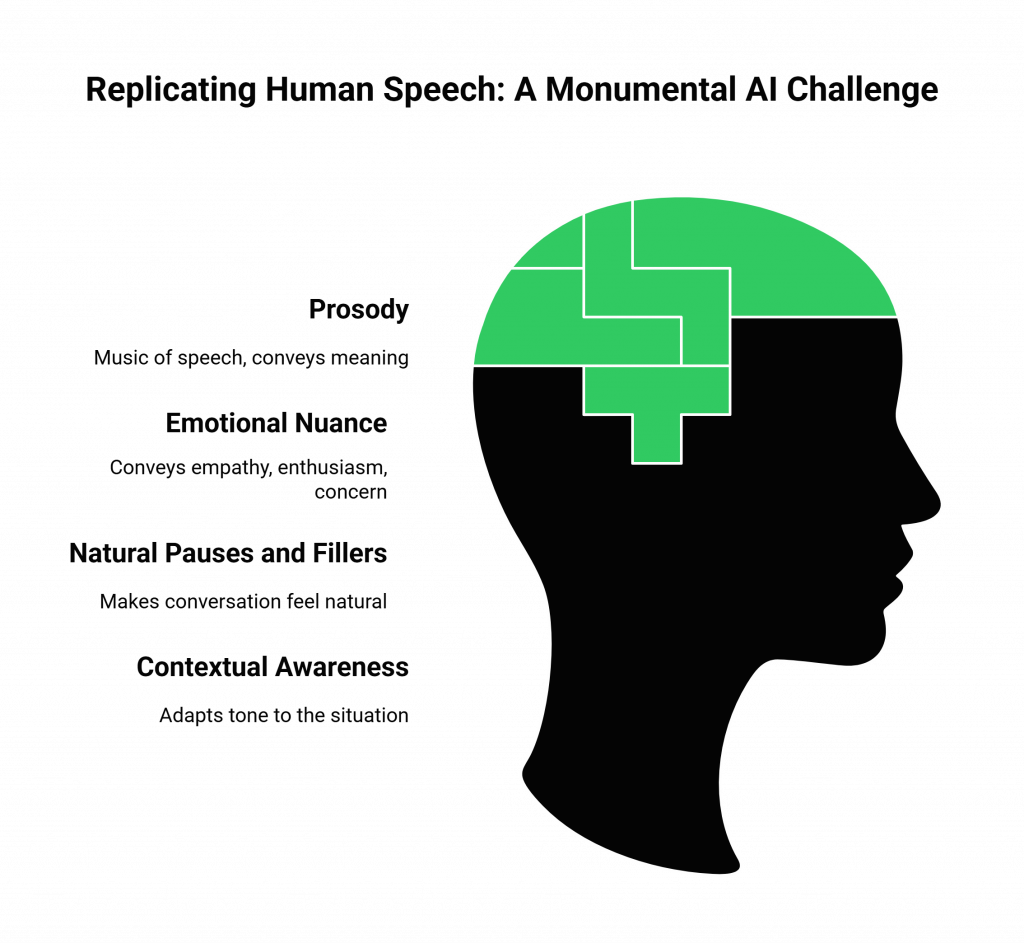
The key elements that contribute to human-like speech include:
- Prosody: This is the “music” of speech, the variations in pitch, rhythm, stress, and intonation that convey meaning and emotion. For example, a rising intonation at the end of a sentence can turn a statement into a question. A change in pace can signal urgency or thoughtfulness.
- Emotional Nuance: Humans naturally convey emotions like empathy, enthusiasm, concern, or politeness through their voice. Mimicking these subtle emotional cues is vital for building rapport and trust.
- Natural Pauses and Fillers: In natural conversation, we use pauses strategically to gather our thoughts or signal that we are listening. We also use filler words like “um” and “uh.” While these might seem like imperfections, they are often crucial for making a conversation feel natural and human.
- Contextual Awareness: Our tone of voice often adapts to the situation. We speak more softly when sharing sensitive information and more energetically when conveying exciting news.
The traditional, robotic IVR failed because it ignored all of these elements, delivering a flat, unexpressive, and often jarring experience.
Also Read: Key Benefits of Programmable SIP for Building Context-Aware Voice Applications
How Advanced TTS and LLM Integration Create Human-Like Voices
The transformation from robotic to human-like speech is powered by the sophisticated integration of two AI technologies: Large Language Models (LLMs) for understanding and generating text, and advanced Text-to-Speech (TTS) models for synthesizing the voice.
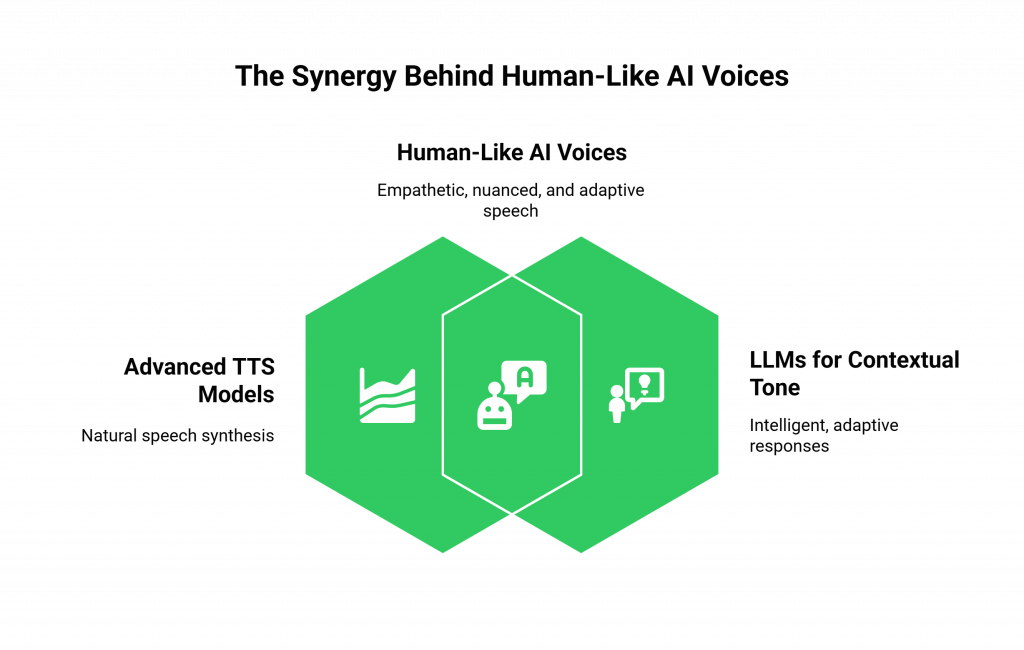
The Power of Expressive TTS Models
Modern TTS engines have moved far beyond simple text-to-speech. They are now capable of incredibly natural speech synthesis through advanced techniques:
- Neural Networks: Instead of stitching together pre-recorded sounds, neural TTS models learn the patterns of human speech from massive datasets. They generate speech from scratch, allowing for much greater control over nuances.
- SSML (Speech Synthesis Markup Language): This is a special markup language that developers can use to annotate their text responses. SSML allows for granular control over speech characteristics. Developers can specify:
- Emphasis: Using tags like <emphasis level=”strong”> to stress specific words.
- Rate and Pitch: Adjusting the speaking speed or the pitch of the voice to convey different emotions or tones.
- Pauses: Inserting natural pauses using <break time=”500ms”/> to mimic human speech patterns.
- Pronunciation: Controlling how specific words or phrases are pronounced.
- Emotional TTS: Some of the latest TTS models are specifically trained to convey different emotions. Developers can sometimes specify an emotional tone (e.g., “happy,” “concerned,” “empathetic”) in the SSML, and the TTS engine will attempt to render the speech accordingly. This is a key aspect of emotional prosody control.
The Intelligence of LLMs for Contextual Tone
The LLM is the “brain” that decides what the AI should say and how it should say it.
- Understanding Context: The LLM can analyze the entire conversation history and the customer’s current intent.
- Adaptive Responses: Based on this context, the LLM can help to inform the conversational tone tuning of the TTS output. For example, if the LLM detects that the customer is frustrated (perhaps through STT analysis of their tone), it can instruct the TTS engine to use a more empathetic and calm tone. If the customer expresses excitement, the AI can respond with a more upbeat and faster pace. This ability to adapt the tone based on context is what makes the interaction feel truly human-like.
Also Read: Why Programmable SIP Is the Backbone of Voice Infrastructure for AI Agents
This table summarizes the essential components and their contributions.
| AI Component | Role in Human-Like Interaction | How it Achieves Naturalness |
| Speech-to-Text (STT) | To accurately understand the user’s speech. | High accuracy models trained on diverse accents and noisy environments. |
| Large Language Model (LLM) | To understand intent, manage context, and formulate a relevant response. | Advanced NLP capabilities and the ability to incorporate emotional context into responses. |
| Text-to-Speech (TTS) | To generate the AI’s spoken response. | Advanced neural networks and SSML support for natural speech synthesis and emotional prosody control. |
| Voice API Platform | To provide the low-latency, real-time connection and control. | Enables seamless, instant delivery of audio and capture of user speech for an uninterrupted conversational ai voice. |
Ready to bring natural, human-like conversations to your voice applications? Sign up for FreJun AI and explore our platform’s capabilities for integrating advanced TTS and LLM models.
What is the Role of the Voice API in Achieving This?
The most sophisticated LLM and TTS models are useless if the underlying voice infrastructure cannot deliver them in real time and with the required quality. The voice api for developers is the essential bridge.
- Low Latency is Paramount: For a conversation to feel natural, the entire round-trip from the user speaking, to the AI processing it, to the AI responding, must happen in milliseconds. A low latency voice api is the key to achieving this, as it minimizes the network delay.
- Real-Time Media Streaming: The API must provide a way to stream the audio of the conversation in real-time. This allows the STT engine to process the input as it arrives and the TTS engine to start sending the response back as soon as it is generated, rather than waiting for the entire utterance to be complete.
- Control Over the Conversation Flow: The API provides the commands to manage the turn-taking, such as detecting when the user has finished speaking and seamlessly injecting the AI’s response into the conversation.
FreJun AI’s platform is designed to be the most reliable, lowest-latency, and developer-friendly voice infrastructure available. We handle the complex telecom plumbing, allowing you to focus on the intelligence and the personality of your AI.
Also Read: The Developer’s Guide to Integrating LLMs with Programmable SIP Infrastructure
Conclusion
The days of the robotic, monotone IVR are over. The future of customer interaction is conversational, intelligent, and deeply human, even when the “human” on the other end is an AI.
The transformation from a crude imitation of speech to a natural, human-like AI voice is powered by the remarkable advancements in LLMs and TTS, but it is enabled by the robust, low-latency, and programmable infrastructure provided by a modern voice API for developers.
By mastering the tools of natural speech synthesis, emotional prosody control, and real-time conversational flow management, and by building on a flexible, model-agnostic voice platform, businesses can create voice experiences that are not just automated, but truly engaging and remarkably human.
Want to see how our platform can help you integrate advanced TTS and LLM capabilities to create lifelike voice interactions? Schedule a demo for FreJun Teler.
Also Read: Top Mistakes to Avoid While Choosing IVR Software
Frequently Asked Questions (FAQs)
Natural speech synthesis refers to the ability of AI to generate spoken audio that sounds human-like, with natural intonation, rhythm, and emotional expression.
They achieve this by combining advanced, expressive TTS models with sophisticated AI that can control prosody and tune the conversational tone.
SSML (Speech Synthesis Markup Language) is a markup language that allows developers to control aspects of the synthesized speech, such as emphasis, rate, pitch, and pauses, to make it sound more natural.
Emotional prosody control is the ability of a TTS engine to adjust the tone, pitch, and rhythm of the speech to convey specific emotions, making the AI sound more empathetic or engaging.
The voice API provides the low-latency, real-time audio streaming and the control commands needed to deliver the AI’s response seamlessly, ensuring the conversation feels natural.
Yes, advanced AI models can perform sentiment analysis on the caller’s voice in real-time to gauge their emotional state.
LLMs help by processing the transcribed speech, understanding the user’s intent, and generating contextually relevant responses that can inform the emotional tone of the AI’s delivery.