
Your business is a global success. You have customers in London, an operations team in Lisbon, and a supply chain that stretches to Manila. Your digital presence is seamless, available to anyone, anywhere in the world. But your voice operations are a different story. They are a complex, fragmented patchwork of different regional providers, legacy phone systems, and inconsistent customer experiences.
How do you take the brilliant, automated voice bot solution that works so well in your home market and deploy it on a global scale, providing a consistent, high-quality, and localized experience for every customer, in every language?
This is the ultimate challenge of global voicebot deployment. It is a challenge that is not just about translating a script; it is a deep, architectural problem that requires a platform designed from the ground up for the complexities of global telecommunications.
A modern, cloud-native voice bot solution, built on top of a globally distributed voice infrastructure, is the key to solving this. It allows an enterprise to move from a fragmented, country-by-country approach to a unified, centrally managed, and infinitely scalable global voice strategy.
Table of contents
The “Tower of Babel” Problem: The Challenges of Global Voice
Deploying a voice application on a global scale is exponentially more difficult than deploying a website. The global telephone network is not a single, unified entity like the internet. It is a complex and often-archaic web of thousands of different carriers, each with its own rules, regulations, and technical standards.
The Tyranny of Latency and Physics
This is the most fundamental and unavoidable challenge.
- The Problem: The speed of light is the ultimate speed limit. If your voicebot’s “brain” and its voice infrastructure are all located in a single data center in North America, a caller from Japan is facing a massive, unavoidable latency penalty. The round-trip time for their voice to travel across the Pacific Ocean, be processed by your AI, and for the response to travel back can easily be over a full second.
- The Impact: This delay makes a real-time, natural conversation completely impossible. The AI will feel slow and unresponsive, and the customer experience will be a frustrating mess of people talking over each other.
Also Read: How Do You Measure Success After Building Voice Bots? Which KPIs Matter?
The Labyrinth of Language and Culture
A successful international calling AI must do more than just speak the language; it must understand the culture.
- The Accuracy Problem: A Speech-to-Text (STT) model that is a world-champion at understanding American English may have a very high word error rate when trying to transcribe a user with a thick Scottish accent or a user speaking a regional dialect of Spanish.
- The Nuance Problem: Multilingual voicebots need to sound authentic. A generic, anglicized accent when speaking Japanese is a jarring and unprofessional experience for a native speaker. You need high-quality, native-sounding Text-to-Speech (TTS) voices for every market.
- The Regulatory Problem: Every country has its own unique and strict set of telecommunications regulations. This includes rules about who can own a phone number, what data can be stored, and how emergency services are handled. Navigating this on a country-by-country basis is a massive legal and administrative burden.
The Architectural Solution: A Globally Distributed, API-First Voice Platform
A modern voice bot solution that is built for global scale solves these problems by leveraging a powerful, globally distributed, and API-first voice infrastructure. This is the architectural foundation that allows you to deploy a single, unified voice application that can serve the entire world.
Slaying Latency with an Edge-Native Architecture
This is the key to providing a high-quality, real-time experience for every user.
- The Architecture: A platform like FreJun AI is built on a globally distributed network of Points of Presence (PoPs). We have our own, powerful voice infrastructure (our Teler engine) in data centers all over the world, in North America, Europe, and Asia.
- The Solution: When your user in London calls, they are automatically connected to our London PoP. The most time-sensitive, heavy lifting of the audio processing happens right there, as close to the user as possible. This dramatically reduces the physical distance the data has to travel, which is the single most effective way to slash latency.
Conquering the Language Barrier with a Model-Agnostic Approach
A truly global platform must be flexible.
- The Architecture: The FreJun AI platform is model-agnostic. This means we are not tied to a single, proprietary set of AI models. Our job is to be the best-in-class “voice,” and we give you the freedom to choose the best-in-class “brain.”
- The Solution: This allows you to build a truly best-of-breed multilingual voicebot. You can use your application’s logic to dynamically route the audio stream from a German caller to a specialized German STT provider, and the audio from a Mandarin caller to a different, specialized Mandarin provider. This ensures you are always using the most accurate and highest-quality AI for every single language and region.
Also Read: How Do You Integrate LLMs When Building Voice Bots For Real-Time Calls?
This table provides a clear summary of how this modern architecture addresses the challenges of global scale.
| Global Challenge | The Old, Fragmented Approach | The Modern, Unified Voicebot Solution |
| High Latency for Global Users | A centralized server creates a slow experience for international callers. | A globally distributed, edge-native architecture processes the call close to the user. |
| Poor Language & Accent Accuracy | Relies on a single, “one-size-fits-all” AI model that is not optimized for every language. | A model-agnostic platform allows you to use the best, specialized AI models for each language. |
| Complex Global Management | Requires managing multiple, separate regional providers and platforms. | A single, unified API and platform to manage your entire global voice operation. |
| Inconsistent User Experience | The quality and capabilities of the voicebot vary from country to country. | Provides a consistent, high-quality, and branded experience for every user, everywhere. |
Ready to take your voice automation global? Sign up for FreJun AI and explore our globally distributed voice infrastructure.
What Is the Role of a Modern Voice API in Global Deployment?
The API is the “command and control” layer for your entire global operation. A modern, developer-first voice API provides a single, unified interface that makes managing a complex global network incredibly simple.
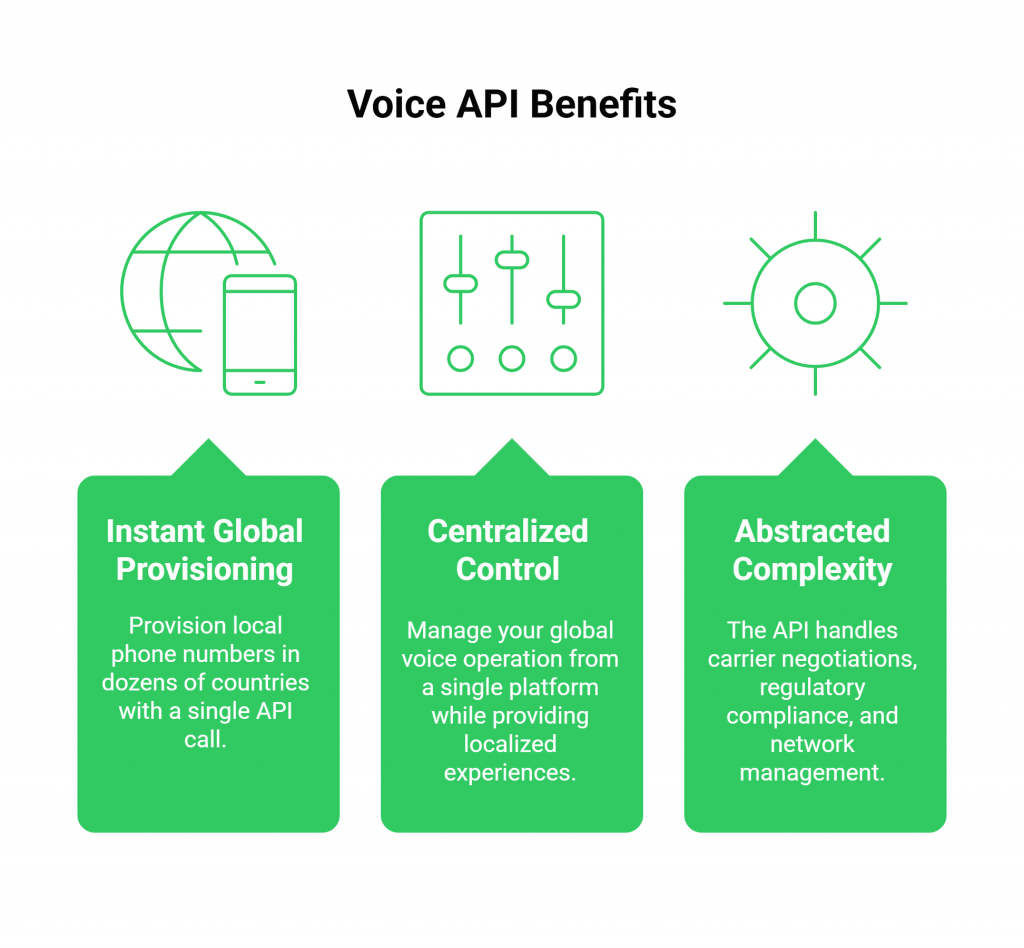
- Instant Global Provisioning: You can use a single API call to search for and instantly provision a local phone number in dozens of different countries.
- Centralized Control, Localized Experience: You can manage your entire global voice operation from a single platform, while still providing a localized experience for your customers (e.g., a local number and a native-sounding AI voice).
- Abstracted Complexity: The API completely abstracts away the immense, underlying complexity of global carrier negotiations, regulatory compliance, and network management.
This is the core promise of the FreJun AI platform: “We handle the complex voice infrastructure so you can focus on building your AI.”
Also Read: Why Should Businesses Invest In Building Voice Bots, Not Just Chatbots?
Conclusion
The ambition of a modern business is global. Your customer communication strategy must be too. The old, fragmented, country-by-country approach to voice operations is a relic of the past. It is a model that is too slow, too complex, and too inconsistent to meet the demands of a global, AI-first world.
A modern voice bot solution, built on the foundation of a globally distributed, API-first voice platform, is the key to unlocking true global scale.
By providing a unified, low-latency, and flexible infrastructure, it allows an enterprise to finally speak the language of all its customers, delivering a consistent, high-quality, and intelligent conversational experience to every user, on every continent.
Is your business facing the challenges of global expansion? Schedule a demo with our team at FreJun Teler.
Also Read: IVR Software with CRM Integration: Benefits, Setup & Use Cases
Frequently Asked Questions (FAQs)
The biggest challenge is network latency. The physical distance that audio data has to travel can cause significant delays, making a real-time conversation feel unnatural and frustrating.
Scalable voicebot solutions solve this with a globally distributed, edge-native architecture that processes the call at a data center physically close to the end-user.
A model-agnostic platform is not tied to a single AI provider. It gives you the freedom to integrate the best, most specialized AI models (STT, TTS) for each specific language.
Effective multilingual voicebots are created by using high-quality, native-sounding TTS voices and highly accurate, language-specific STT models for each language you want to support.
An international calling AI is a voicebot that is design to handle conversations with users from different countries, taking into account different languages, accents, and cultural nuances.
No. With a modern, unified platform, you can have a single, central AI “brain” that can be configured to handle conversations from all over the world.
The provider is responsible for ensuring that its own infrastructure and services are compliant with the complex web of telecommunications regulations in every country it operates in.