
Imagine this all-too-common scenario: you are on a company’s website trying to resolve an issue with a recent order. You spend ten minutes interacting with a text chatbot, patiently providing your name, order number, and the details of your problem. The chatbot, unable to resolve the issue, ends the conversation with the dreaded phrase: “For more complex issues, please call our customer support line.” So, you call.
After waiting on hold, a friendly human agent answers, and their first question is, “Hello, how can I help you today?” All the context, all the effort you just expended, has vanished into the digital ether. You have to start all over again.
This is the “start-over” problem, and it is the single biggest failure of modern customer service. It is a direct result of a siloed, multichannel approach where every communication channel is a separate island. For businesses, building voice bots is no longer about just automating the phone line; it is about using voice as a powerful, integrated component of a truly unified customer experience.
By creating a seamless bridge between your digital and voice channels, you can finally eliminate the “start-over” problem, creating the kind of effortless, context-aware unified customer journeys with voice AI that build lasting customer loyalty.
Table of contents
Why is the Siloed Customer Journey a Major Business Problem?
Many businesses today are “multichannel,” meaning they offer customers multiple ways to get in touch, a website, a mobile app, a phone number. However, very few are truly “omnichannel.”
An omnichannel strategy means that those channels are deeply interconnected, allowing a customer to move seamlessly between them without losing context. The failure to achieve this is not just a minor inconvenience; it is a major business liability.
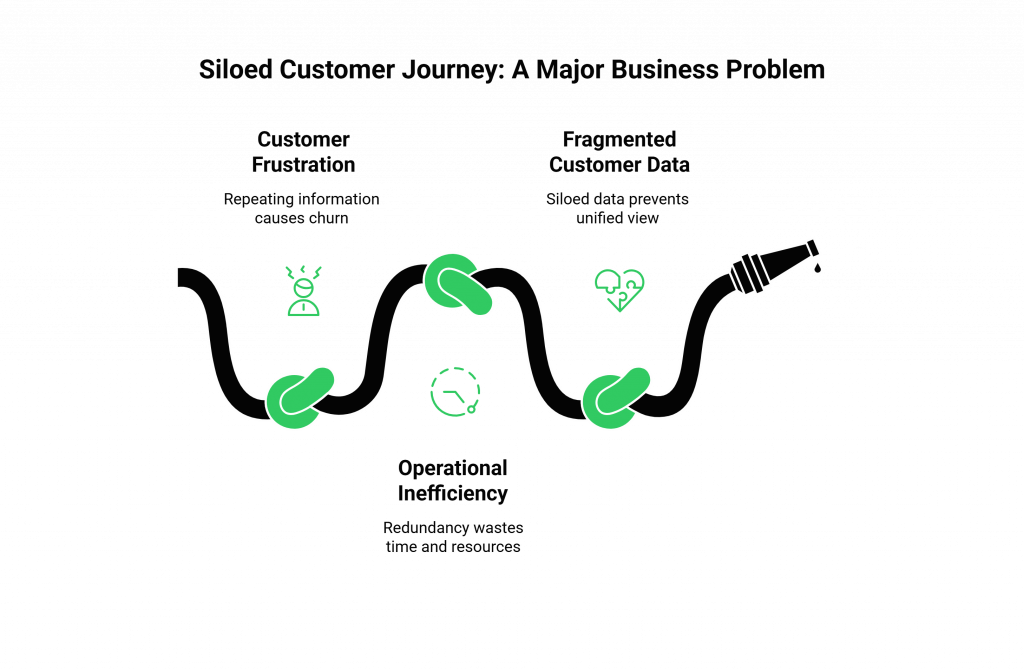
This broken journey is the consequence of several key failures:
- Customer Frustration and Churn: The single most frustrating part of a customer service experience is having to repeat information. Even 33% of customers are most frustrated by having to repeat themselves to multiple support reps. This frustration is a direct driver of customer churn. When an interaction with your brand feels like hard work, customers will simply find a competitor that makes it easier.
- Operational Inefficiency: The “start-over” problem is a massive waste of time for everyone. The customer wastes time re-explaining their issue, and the human agent wastes time re-collecting information that the company’s own chatbot had already gathered moments before. This redundancy drives up average handling times and reduces the overall efficiency of your contact center.
- Fragmented Customer Data: When your channels are siloed, your data is siloed. Your web chat platform has one set of interaction data, and your contact center platform has another. This makes it impossible to get a single, unified view of the customer’s end-to-end journey. This fragmented data is a huge missed opportunity for business intelligence and for truly understanding your customers’ pain points.
Also Read: Best Practices for Testing and Debugging Voice Calling SDK Integrations
How Does a Unified Conversational AI Strategy Work?
The key to solving the silo problem is to stop thinking about building a “chatbot” or a “voice bot” and to start thinking about building a single, unified “conversational AI brain” that can communicate across multiple channels. This is the core principle of multichannel conversational design.
The “Brain and Senses” Architectural Model
The most effective way to conceptualize this is with a “brain and senses” model.
- The Brain: This is your central application logic. It is a single, unified backend that contains all of your business rules, your connections to your CRM and other databases, and, most importantly, the conversational state and history for every customer. This is the core intelligence and memory of your entire AI operation.
- The Senses: The different channels, your website chat widget, your mobile app’s messaging feature, and your phone line are simply the different “senses” that this central brain can use to interact with the world. The web chat is the sense of sight (text and UI elements), and the phone call is the sense of hearing and speech.
When you are building voice bots within this architectural model, you are not creating a new, separate AI. You are simply adding the powerful “sense of hearing” to your existing AI brain, allowing it to engage in the rich, real-time medium of a voice conversation.
What is the Technical Bridge for Voice + Chat Integration?
This architectural vision of a unified AI brain is only possible with a modern, API-first communication platform. A platform like FreJun AI provides the essential, programmable “plumbing” that allows your central AI brain to connect to the global telephone network in an intelligent, context-aware way.
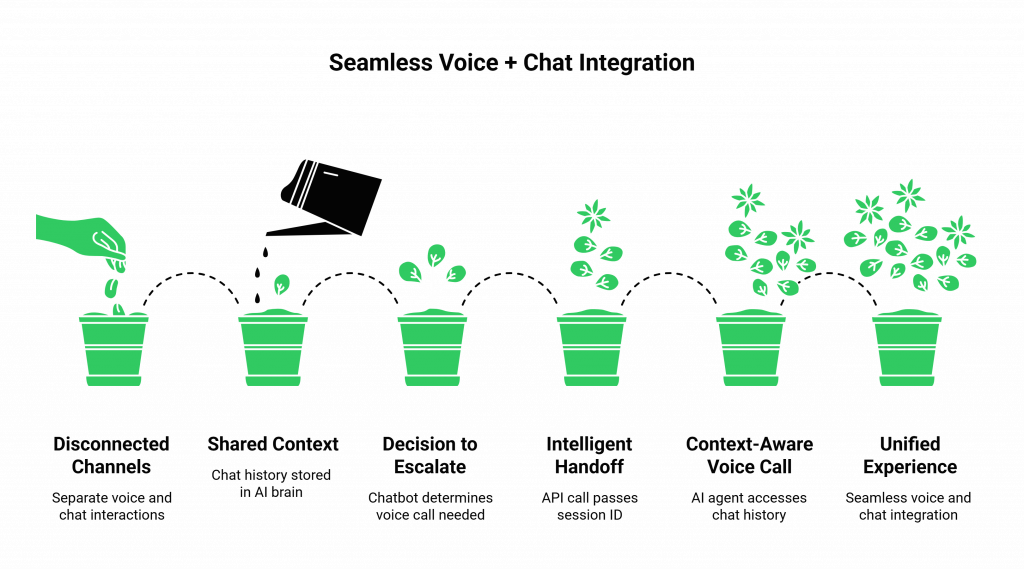
The key is the platform’s ability to be controlled by your application’s code in real-time. This is what enables a true voice + chat integration. Here is how the seamless handoff works:
- Shared Context: A customer is interacting with your text chatbot. The entire conversational history is being stored in your central AI “brain” (your application’s backend).
- The Decision to Escalate: The chatbot’s logic determines that the issue needs to be escalated to a voice call. It might display a message like, “This seems a bit complex for chat. Would you like to speak with our automated voice assistant to resolve this faster?”
- The Intelligent Handoff: When the customer agrees, your backend makes an API call to a platform like FreJun AI. This API call can pass a critical piece of information: a unique session ID that is tied to the customer’s chat history.
- The Context-Aware Voice Call: The customer calls your support number. The FreJun AI Teler engine receives the call, and your application can use the caller’s phone number to look up their active session ID. Teler then sends a webhook to your AI “brain,” which now knows exactly who this customer is and has the entire history of their chat conversation readily available.
The AI voice agent can then greet the customer with a level of context that is a revolution in customer experience: “Hi, Sarah. Thanks for calling. I see you were just chatting with us about the delivery of order number 12345. I’m ready to help you with that right now.” This single sentence eliminates the “start-over” problem entirely.
Ready to start building a unified conversational AI that can delight your customers across every channel? Sign up for FreJun AI and explore our powerful API.
Also Read: How a Voice Calling SDK Can Improve Customer Experience in AI Voice Agents?
What Are the Tangible Benefits of an Omnichannel Voice Approach?
When you move from a siloed approach to a unified one, the benefits are felt across the entire organization. Improving CX with AI calls is not just about the quality of a single call; it is about the quality of the seamless, end-to-end journey.
This table highlights the dramatic differences between the two strategies.
| Benefit | Siloed (Separate Bots) | Unified (Omnichannel Voice Automation) |
| Customer Experience | Frustrating and disjointed. Customers are forced to repeat themselves. | Seamless and context-aware. The AI remembers the conversation across channels. |
| Average Resolution Time | Longer. The customer has to start their journey over on each new channel. | Significantly faster. The context is carried over, leading to a quicker diagnosis and resolution. |
| Operational Efficiency | Inefficient. Requires managing, updating, and maintaining multiple, separate systems and AI models. | Highly efficient. A single, centralized “brain” is easier to update and maintain. |
| Data & Analytics | Fragmented data silos. Provides an incomplete and disconnected picture of the customer journey. | Unified data. Provides a complete, end-to-end transcript and analytics of all customer interactions. |
| Brand Perception | Can feel outdated, disorganized, and unprofessional. | Feels modern, intelligent, customer-centric, and respectful of the customer’s time. |
The business impact of this is enormous. A recent study on omnichannel customer engagement found that companies with strong omnichannel strategies retain an average of 89% of their customers, compared to just 33% for companies with weak strategies. This is a clear indicator of the massive ROI of creating these unified journeys.
Also Read: Voice Calling SDKs for Enterprises: Scaling Conversations with AI and Telephony
Conclusion
The era of the standalone, siloed chatbot is coming to a close. The future of automated customer interaction is a unified one, where a single, intelligent AI brain can seamlessly engage with customers across every channel they choose to use.
The process of building voice bots is no longer about creating an isolated IVR system; it is about adding the powerful and universal sense of hearing and speech to your existing AI. The key to unlocking this future is a modern, API-first communication platform that provides the essential, programmable bridge between your AI’s intelligence and the global voice network.
By embracing omnichannel voice automation, businesses can finally deliver on the promise of a truly seamless, context-aware, and exceptional customer experience.
Want to do a technical deep dive into how our APIs can enable a true voice + chat integration for your existing AI? Schedule a demo with our team at FreJun Teler.
Also Read: Call Center Reporting Automation: Real-Time Analytics for Better Decisions
Frequently Asked Questions (FAQs)
A multichannel experience means you offer multiple, separate channels for customers to contact you (like chat and phone). An omnichannel experience means those channels are deeply interconnected, allowing a customer to move between them without losing the context of their conversation.
The integration works by passing a unique session identifier from the chat session to the voice session. When you call, the voice platform uses your phone number (Caller ID) to look up this active session, which allows the central AI “brain” to retrieve the full chat history and continue the conversation seamlessly.
No, and this is a key benefit. The principle of multichannel conversational design is to reuse your existing AI’s core logic (the “brain”). The main work is in adapting the conversational interface (the “script”) for the voice medium and building the technical integration via a voice API.
The most important principle is to “share the brain, but design for the channel.” This means having a single, centralized source of logic and customer history, but tailoring the specific conversational interaction (e.g., using shorter sentences for voice, or using buttons for chat) to the unique strengths of each channel.
FreJun AI provides the powerful, API-driven voice infrastructure that acts as the programmable bridge. Our APIs and webhooks allow your central AI application to control a live phone call in real-time, enabling the seamless, context-aware handoff from a voice + chat integration.
Absolutely. A well-designed omnichannel system will ensure that if an escalation from a bot (voice or chat) to a human is needed, the human agent receives a “warm transfer.” This means they get the customer’s full conversational history and data on their screen before they even say “hello.”
The biggest benefit of creating unified customer journeys with voice AI is a dramatic increase in customer satisfaction and loyalty. By eliminating the “start-over” problem and showing that you value your customers’ time, you create a superior experience that builds strong emotional connections to your brand.