
Imagine leaving your house key under the doormat. It is convenient for you. But it is also very convenient for a burglar. Now imagine that your house is not filled with furniture but with money. Every time someone enters using that key it costs you dollars from your bank account.
This is exactly what happens when developers mishandle an AI Voice API Key.
In the world of software development we want to move fast. We want to write code and test it and push it to the world instantly. This process is called CI/CD which stands for Continuous Integration and Continuous Deployment. It is the automated assembly line of code.
However there is a danger. When you automate the assembly line you have to give the robots access to your secrets. If you hardcode your AI Voice API Key into the script you are essentially leaving the key under the doormat of the internet. If that key leaks hackers can use your account to make thousands of fraudulent calls costing you a fortune in minutes.
In this guide we will explore how to secure these keys within your CI/CD voice APIs pipelines. We will look at automated deployments voice AI strategies and secure key injection and how robust infrastructure platforms like FreJun AI help you manage this security without slowing down your innovation.
Table of contents
- Why Is API Key Security Critical for Voice Applications?
- What Is the Role of CI/CD in Voice AI Development?
- How Do You Handle Secrets in Automated Deployments?
- How Does FreJun AI Secure Your Infrastructure?
- What Are the Best Practices for Secure Key Injection?
- How Do You Rotate Keys Without Downtime?
- What Tools Should You Use for CI/CD Voice APIs?
- How Does Testing in CI/CD Differ for Voice?
- How Does FreJun Infrastructure Support Secure Deployments?
- Step by Step Implementation Guide
- Conclusion
- Frequently Asked Questions (FAQs)
Why Is API Key Security Critical for Voice Applications?
Security is important for all software. But for voice applications the stakes are higher.
If someone steals an API key for a weather app the worst thing that happens is they check the weather too many times and you hit a rate limit.
If someone steals an AI Voice API Key they can commit toll fraud. This is where bad actors use your account to pump traffic to expensive premium rate phone numbers that they own. They make money and you get the bill.
When you are building a voice application you are connecting to the Public Switched Telephone Network (PSTN). This is a paid utility. Therefore your API key is essentially a credit card. You must treat it with the same level of security as your banking password.
What Is the Role of CI/CD in Voice AI Development?
Before we fix the problem we need to understand the workflow. CI/CD is the modern way to build software.
- Continuous Integration (CI): This is where developers merge their code changes into a central repository. Automated tests run to make sure the new code does not break anything.
- Continuous Deployment (CD): This is where the code is automatically pushed to production servers so users can see the new features immediately.
For CI/CD voice APIs this pipeline is complex. You are not just testing a website. You are testing if the AI answers the phone correctly. You are testing if the voice latency is low. You are testing if the call transfers work.
To run these tests the automated system needs access to your voice provider. It needs the AI Voice API Key to initiate calls and check status. The challenge is giving the system the key without exposing the key to everyone who can read the code.
Also Read: What Should Developers Expect from a Voice API for Developers in 2026?
How Do You Handle Secrets in Automated Deployments?
The golden rule of automated deployments voice AI is simple. Never commit secrets to your version control system.
You should never see a line of code that looks like this: const apiKey = “sk_live_12345abcdef”;
If you do this anyone who has access to your code (or anyone who hacks your repository) has your key.
Instead we use a technique called secure key injection.
This means the code uses a variable. It looks like this: const apiKey = process.env.FREJUN_API_KEY;
The code says “I need a key but I do not know what it is. I will look for it in the environment where I am running.”
When the CI/CD pipeline runs it injects the actual key into that variable at the very last second. The key lives in a secure vault not in the code.
How Does FreJun AI Secure Your Infrastructure?
While you secure your keys FreJun secures the pipe.
FreJun handles the complex voice infrastructure so you can focus on building your AI. We act as the transport layer. When you make a call using your AI Voice API Key you are opening a secure tunnel to our global network.
We utilize FreJun Teler for our telephony services including elastic SIP trunking. SIP (Session Initiation Protocol) is the language of internet calls. Securing SIP is vital.
FreJun ensures that even if you handle your keys correctly the transmission of the call itself is encrypted. We support TLS (Transport Layer Security) for signaling and SRTP (Secure Real time Transport Protocol) for media. This means that while your CI/CD pipeline protects the key FreJun protects the conversation.
What Are the Best Practices for Secure Key Injection?
To implement secure key injection properly you should follow a strict hierarchy of secrets.
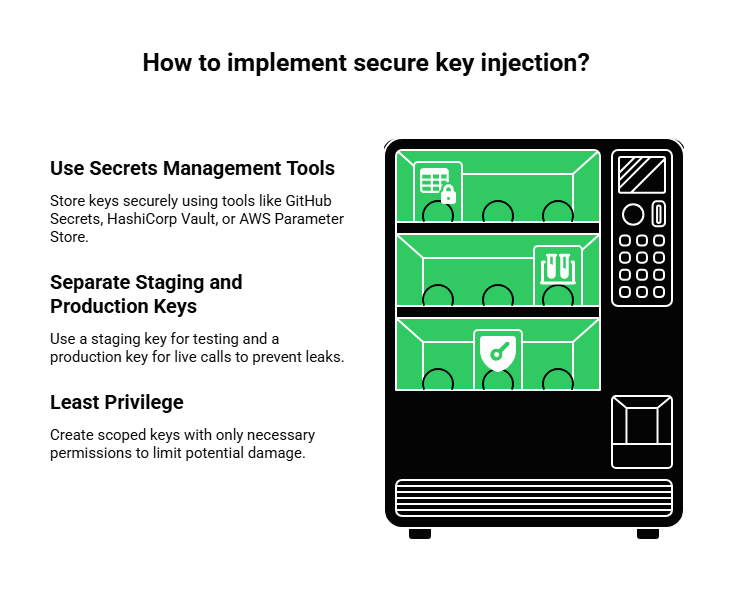
1. Use Secrets Management Tools
Do not store keys in a text file on your server. Use tools designed for this.
- GitHub Secrets: If you use GitHub Actions store your keys here. They are encrypted and can only be read by the runner.
- HashiCorp Vault: For enterprise teams this is a dedicated server for managing secrets.
- AWS Parameter Store: If you host on AWS this keeps your keys secure and accessible to your EC2 instances.
2. Separate Staging and Production Keys
You should never use your live production AI Voice API Key for testing.
- Staging Key: This key is for your test environment. It might have a spending limit. If it breaks or leaks it is annoying but not fatal.
- Production Key: This is the master key for real customer calls. It lives only in the production deployment pipeline.
3. Least Privilege
Does your CI/CD runner need to delete phone numbers? Probably not. It only needs to make calls. If your voice provider supports it create “scoped keys” that only have permission to do the specific tasks needed for deployment.
Here is a comparison of bad vs good key practices.
| Practice | Bad Approach (Risk of Leak) | Good Approach (Secure) |
| Storage | Hardcoded in config.js | Environment Variables (.env) |
| Sharing | Emailed to developers | Stored in Secret Manager |
| Access | One key for everything | Separate keys for Dev/Prod |
| Rotation | Never changed | Rotated every 90 days |
| Visibility | Visible in git history | Never committed to git |
Also Read: How Can a Voice API for Developers Reduce Telephony Complexity?
How Do You Rotate Keys Without Downtime?
Even with the best security keys can leak. Or maybe an employee leaves the company and they had access to the key. You need to change the key. This is called “key rotation.”
In a manual world you would generate a new key and then hastily update your code and hope nothing breaks. In automated deployments voice AI this causes downtime.
The correct way to rotate an AI Voice API Key in a pipeline is:
- Generate: Create a new key in your FreJun dashboard. Now you have two active keys (Old and New).
- Update: Update your Secrets Manager (e.g. GitHub Secrets) with the New Key.
- Redeploy: Trigger a new deployment. The pipeline injects the New Key into your application servers.
- Verify: Check that calls are working with the New Key.
- Revoke: Delete the Old Key in the dashboard.
This process ensures that at no point is the application without a valid key.
What Tools Should You Use for CI/CD Voice APIs?
There are many tools available but some work better for CI/CD voice APIs because they handle environment variables well.
- GitHub Actions: Very popular. You can define “Secrets” in the repository settings and access them in your YAML workflow files easily.
- GitLab CI: Similar to GitHub but offers “Protected Variables” which are only available on protected branches (like main).
- Jenkins: The classic tool. It requires a “Credentials Plugin” to handle secure key injection safely.
When configuring these tools ensure that you mask the logs. Sometimes a script might print an error message that contains the key. Most modern CI tools automatically mask known secrets in the logs displaying them as *** instead of the actual characters.
How Does Testing in CI/CD Differ for Voice?
Testing voice is hard. You cannot just check if a div exists on a page. You have to verify audio. However running a live test call every time you commit code is expensive and slow.
Use Mocking for Unit Tests
For basic logic tests do not use the real AI Voice API Key. Mock the API response. Tell your code “Pretend FreJun sent back a 200 OK.” This tests your logic without touching the network.
Use Live Keys for Integration Tests
For the final check before production use the real key. But limit the scope. Maybe the test places one call to a predefined number and verifies that it rings.
According to the State of DevOps Report, high performing teams are 46 times more frequent in their code deployments. They achieve this speed by trusting their automated tests. By mocking the majority of tests and using live keys only for critical integration checks you maintain speed without racking up a huge phone bill.
How Does FreJun Infrastructure Support Secure Deployments?
FreJun is designed with the developer in mind. We know you are building automated pipelines.
- Instant Key Generation: You can generate and revoke keys instantly via our dashboard giving you full control over your security lifecycle.
- Webhook Verification: When FreJun sends data back to your server (like a call recording) we sign the request. Your CI/CD pipeline can verify this signature to ensure the data is really from us and not an imposter.
- Elastic Infrastructure: When you deploy a new version of your AI agent you might restart your servers. FreJun Teler ensures that incoming calls are queued or rerouted during that brief restart window so you do not drop customer calls during a deployment.
Step by Step Implementation Guide
If you are setting this up today here is a simple checklist.
Step 1: Sign up for FreJun AI and generate two API keys. Label one “Staging” and one “Production.”
Step 2: Go to your CI/CD provider (e.g. GitHub). Navigate to Settings > Secrets.
Step 3: Create a secret named FREJUN_API_KEY_STAGING and paste the staging key. Create another for production.
Step 4: In your code replace the hardcoded string with process.env.FREJUN_API_KEY.
Step 5: In your deployment script (YAML file) map the secret to the environment variable.
env: FREJUN_API_KEY: ${{ secrets.FREJUN_API_KEY_PRODUCTION }}
Step 6: Commit your code. The pipeline will run. It will grab the key from the vault inject it into the server and your voice agent will be live and secure.
Also Read: How Does a Voice API for Developers Support Web and Mobile Voice Apps?
Conclusion
Building voice applications is exciting. You are creating software that can speak and listen. But this power comes with responsibility. The AI Voice API Key is the gateway to your billing account and your customer interactions.
You cannot afford to manage these keys manually. Human error is inevitable. Someone will paste a key in Slack. Someone will commit a key to GitHub.
By integrating secure key injection into your CI/CD voice APIs pipelines you eliminate human error. You ensure that secrets live in vaults not in code. You allow your team to deploy automated deployments voice AI fearlessly knowing that the security protocols are handled automatically.
FreJun AI supports this modern workflow. We provide the robust infrastructure and the developer tools you need to build secure scalable voice agents. With FreJun Teler handling the secure transport and our platform enabling easy key management you can focus on building the best AI experience possible while we handle the safety and the scale.
Ready to build secure and scalable voice pipelines? Schedule a demo with our team at FreJun Teler and let us help you optimize your DevOps strategy for voice.
Also Read: UK Phone Number Formats for UAE Businesses
Frequently Asked Questions (FAQs)
An AI Voice API Key is a unique string of characters that authenticates your application with a voice provider like FreJun. It acts like a password allowing your code to make and receive phone calls.
Committing a key to GitHub makes it public. Hackers scan GitHub constantly for keys. If they find yours they can use it to make fraudulent calls which will be charged to your account.
CI/CD stands for Continuous Integration and Continuous Deployment. It is a method of frequently delivering apps to customers by introducing automation into the stages of app development.
Secure key injection is the process of providing sensitive data (like API keys) to an application at runtime through environment variables rather than writing the key directly into the source code.
It is best practice to rotate keys every 90 days. You should also rotate them immediately if you suspect a leak or if a team member with access leaves the company.
Yes. You can generate multiple keys for the same account. This allows you to have separate keys for development staging and production environments which improves security.
You should mock the API responses for your unit tests. This means simulating the behavior of the FreJun API without actually making a network request or placing a real phone call.