
For years, the promise of automation in the enterprise has been a tantalizing but often-frustrating journey. We have automated factories, we have automated software deployment, and we have automated digital marketing. But the most universal and fundamental of all business interactions, the phone call, has remained a stubbornly manual process, a final frontier of human-powered inefficiency.
That frontier is now being conquered. Enterprises are moving beyond simple IVRs and are now building voice bots that are not just conversational front-ends, but deeply integrated engines for enterprise workflow automation.
This is the dawn of “hyper-automation” in the voice channel. It is a strategic shift from using voice bots to simply deflect calls to using them to actively execute complex, multi-step business processes from start to finish. These are not just “talking FAQs”; they are intelligent agents that can authenticate a user, query a database, update a CRM, process a payment, and trigger a downstream action in another system, all within a single, seamless conversation.
This guide will explore the architectural principles and technical components that enterprises are using to build these sophisticated, end-to-end intelligent call automation systems.
Table of contents
The Evolution: From Simple IVR to Intelligent Workflow Engine
To appreciate the scale of this evolution, we must first understand the journey. The history of call automation can be seen in three distinct phases.
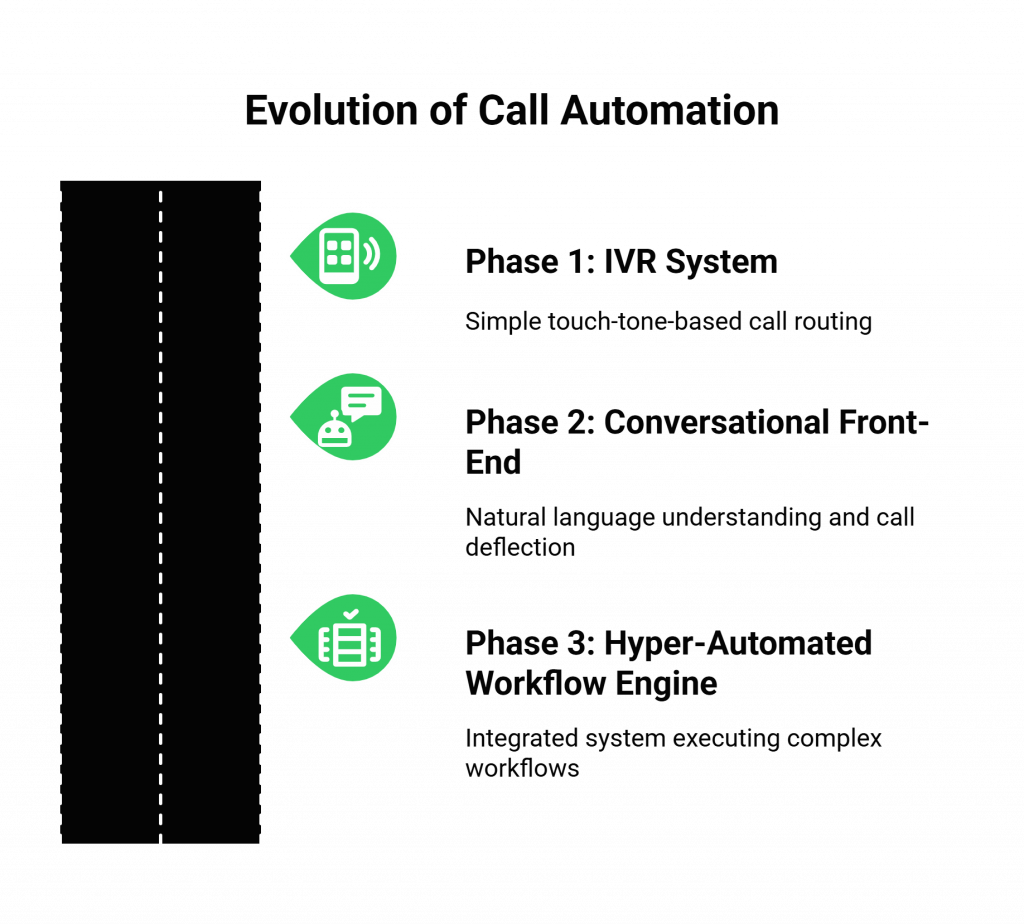
- Phase 1: The IVR (Interactive Voice Response): The “press one for sales, press two for support” model. This was a rigid, touch-tone-based system designed for simple call routing. It was a blunt instrument for sorting calls, not for solving problems.
- Phase 2: The Conversational Front-End: The first generation of true voice bots. These bots could understand natural language and could answer frequently asked questions by pulling information from a knowledge base. Their primary purpose was “call deflection”—to answer simple questions and reduce the load on human agents.
- Phase 3: The Hyper-Automated Workflow Engine: This is the current, cutting-edge phase. The voice bot is no longer just a front door; it is the entire factory. It is a powerful, event-driven application that is deeply integrated with the enterprise’s core backend systems, capable of executing complex workflows in real time.
Also Read: How to Build Scalable Voice Calling Apps Using a Voice Calling SDK?
What is the Core Architecture of a Hyper-Automated Voice Bot?
Building voice bots for hyper-automation requires a sophisticated, decoupled, and API-first architecture. It is a system of three core, interconnected layers.
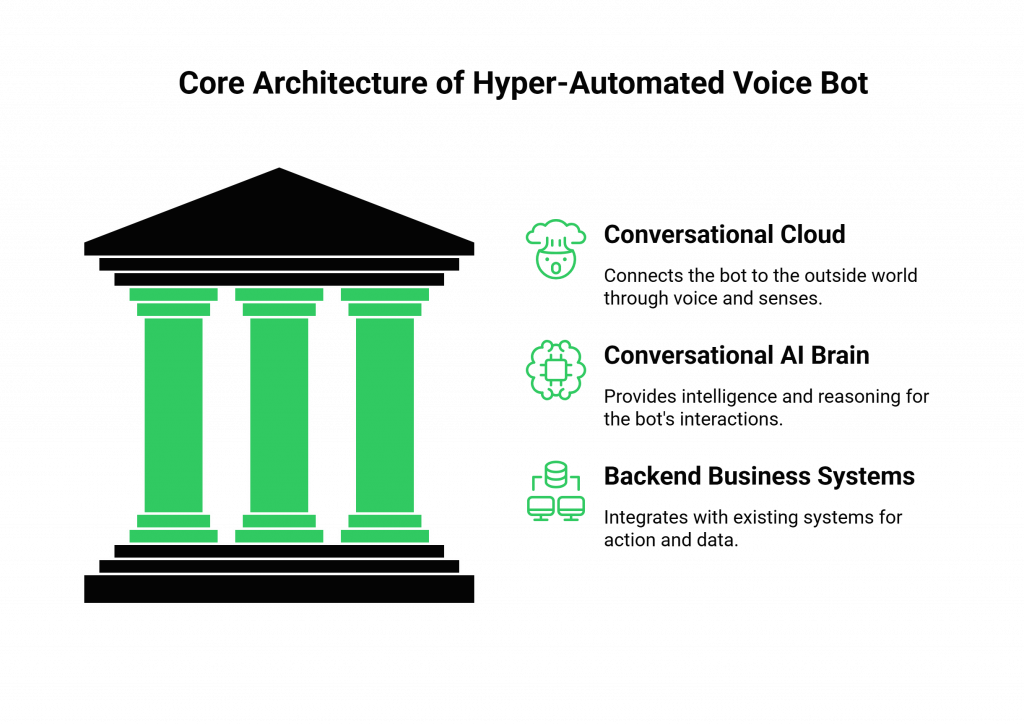
Layer 1: The Conversational Cloud (The Voice and Senses)
This is the foundational layer that connects your bot to the outside world. It is a programmable, real-time communication platform, like FreJun AI.
- The Voice Infrastructure: This layer handles all the immense complexity of the global telephone network. It provides the elastic SIP trunking, manages the phone numbers, and, most importantly, handles the real-time, low-latency streaming of the audio.
- The “Senses”: This layer includes the Speech-to-Text (STT) and Text-to-Speech (TTS) engines. It is responsible for turning the spoken word into text and turning the AI’s text response back into a natural-sounding voice.
Layer 2: The Conversational AI “Brain” (The Logic and Reasoning)
This is the core intelligence of your operation. It is the application that you, the enterprise developer, build and control.
- The Large Language Model (LLM): This is the engine of understanding. It takes the transcribed text from the user, comprehends their intent, and determines the next step in the conversation.
- The State Manager: This is the AI’s short-term memory. It keeps track of the context of the current conversation (e.g., “the user has already been authenticated,” “they are asking about their most recent order”).
Layer 3: The Backend Business Systems (The Action Layer)
This is the “source of truth” and the “engine of action” for your enterprise. It is the collection of your existing, mission-critical software systems.
- Systems of Record: This includes your CRM (like Salesforce), your ERP (like SAP), your billing systems, and your order management databases.
- Action APIs: These are the APIs that allow other systems to perform actions, such as a payment gateway API (like Stripe) or a shipping provider’s API (like FedEx).
A hyper-automated voice bot is the intelligent orchestrator that sits in the middle, seamlessly weaving these three layers together in real time.
Also Read: VoIP API: Building Voice Communication into Your Applications
How Does the Workflow Orchestration Actually Work? A Real-World Example
To see how this all comes together, let’s walk through a common but powerful example: an ai-driven support workflow for a customer wanting to return a product.
This process is a perfect illustration of CRM + voice bot orchestration.
| Step | User Action / AI Response | Behind the Scenes: The Technical Workflow |
| 1 | User: “Hi, I need to return an item from my last order.” | The Conversational Cloud (FreJun AI) answers the call and streams the audio to the STT engine. The AI Brain (LLM) receives the text. |
| 2 | AI: “I can help with that. I see you’re calling from a number associated with Sarah Jones. Is that correct?” | The AI Brain, using the caller’s phone number, makes a real-time API call to the CRM to look up the customer’s record. |
| 3 | User: “Yes, that’s me.” | The AI Brain updates its state manager to confirm the user is authenticated. |
| 4 | AI: “Great. I see your most recent order was for a blue shirt. Is that the item you’d like to return?” | The AI Brain now makes a second API call, this time to the Order Management System, to retrieve the customer’s latest order details. |
| 5 | User: “Yes.” | The AI Brain receives the confirmation. |
| 6 | AI: “Okay, I’ve initiated the return for the blue shirt. A return label has just been sent to your email address on file. Can I help with anything else?” | The AI Brain makes a third API call to the Returns Management System to trigger the return process, which in turn triggers the email notification. |
Ready to start building your own hyper-automated workflows? Sign up for FreJun AI and explore our powerful, API-driven voice platform.
Also Read: Voice Call API: Automating and Scaling Customer Communication
Conclusion
The era of the standalone, informational voice bot is over. The true value and the future of this technology lie in deep integration and end-to-end automation. Enterprises that are building voice bots today are not just building conversational front-ends; they are architecting sophisticated, event-driven applications that can orchestrate complex business processes in real time.
The key to this hyper-automated future is a powerful, flexible, and developer-first voice infrastructure that can act as the seamless bridge between your AI’s intelligence and your core backend systems.
By embracing this new model of intelligent call automation, enterprises can unlock unprecedented levels of efficiency, create a superior customer experience, and build a communication stack that is as smart and as automated as the rest of their digital enterprise.
Want to do a deep dive into our APIs and see how our platform can orchestrate with your specific backend systems? Schedule a demo with our team at FreJun Teler.
Also Read: Solving Cloud Telephony Challenges: Downtime, Scale, and Number Porting
Frequently Asked Questions (FAQs)
Simple call automation focuses on “call deflection” by answering basic questions. Enterprise workflow automation is far more advanced; it involves the voice bot executing multi-step business processes (like processing a return or updating a CRM) by integrating with backend systems.
Backend workflow integrations are the API connections between the voice bot’s core logic (its “brain”) and the company’s other software systems, such as its CRM, ERP, billing platform, or order management system. These are essential for the bot to perform real actions.
A classic ai-driven support workflow is an automated returns process. The AI can authenticate the user, look up their order history, identify the item to be returned, initiate the return in the backend system, and trigger a shipping label to be emailed, all within a single conversation.
CRM + voice bot orchestration is when the voice bot and the Customer Relationship Management (CRM) system work together in real time. For example, the voice bot can use the caller’s phone number to look up their record in the CRM to personalize the conversation, and it can also log a summary of the call and its outcome back into the CRM, creating a unified customer record.
Hyper-automation is a business-driven, disciplined approach that organizations use to rapidly identify, vet, and automate as many business and IT processes as possible. In this context, it refers to using a voice bot to automate not just a simple query, but an entire, end-to-end business workflow.
No. A key benefit of a modern voice platform is that it is model-agnostic. You can choose from a variety of best-in-class, third-party Speech-to-Text (STT) and Text-to-Speech (TTS) providers and integrate them into your workflow.
FreJun AI provides the foundational “Conversational Cloud” layer. We handle the immense complexity of the global telephone network, provide the real-time, low-latency audio streaming, and offer the powerful APIs and webhooks that allow your AI “brain” to connect to and control a live phone call.