
The promise of the AI voice agent is a dream that businesses have been chasing for years: a customer service channel that is infinitely scalable, always available, and incredibly cost-effective. We have finally reached the point where the “AI” part of that equation, powered by sophisticated Large Language Models (LLMs), is a stunning reality. These AI brains can understand, reason, and converse with remarkable fluency.
But the intelligence of the AI is only half the battle. The other, equally important half is the experience of the call itself. A brilliant AI that is delivered over a choppy, high-latency, and frustrating connection is a failed investment. This is where the voice calling SDK emerges as the unsung hero of the customer experience.
The quality of the conversational AI user journey is not determined in a data center where the LLM lives; it is determined in the milliseconds of real-time interaction between the user and the agent.
A modern, developer-first voice calling SDK is far more than just a “pipe” to the phone network. It is a sophisticated toolkit that gives developers the power to control, shape, and optimize every aspect of the call’s audio and flow. It is the key to transforming a robotic interaction into a natural, pleasant, and genuinely helpful cx with voice AI.
Table of contents
- What is a Voice Calling SDK and Why Does It Matter for AI?
- How Does a Voice Calling SDK Directly Improve the Conversational Experience?
- How Can a Voice Calling SDK Enable a More Personalized and Empathetic AI?
- The FreJun AI Difference: An SDK Built for the AI Era
- Conclusion
- Frequently Asked Questions (FAQs)
What is a Voice Calling SDK and Why Does It Matter for AI?
A voice calling SDK (Software Development Kit) is a powerful layer of abstraction. It is a set of software libraries and tools that takes the immense, underlying complexity of the global telephone network and presents it to a developer as a simple, programmable, and powerful set of features. It is the bridge that connects the digital world of your AI application to the analog world of a phone call.
For an AI voice agent, this bridge is absolutely mission-critical. The SDK is responsible for two fundamental tasks that directly impact the customer experience:
- Transporting the Audio: It must be able to carry the real-time audio stream from the caller to the AI’s “ears” (the Speech-to-Text engine) and from the AI’s “mouth” (the Text-to-Speech engine) back to the caller.
- Controlling the Call Flow: It must give the developer the power to manage the state of the conversation, such as detecting when a user starts or stops speaking.
The quality, speed, and intelligence with which the SDK performs these two tasks are the primary determinants of the overall improving AI call experience.
How Does a Voice Calling SDK Directly Improve the Conversational Experience?
The difference between a frustrating AI call and a delightful one is often found in the subtle, real-time mechanics of the conversation. These are the mechanics that a high-quality voice calling SDK allows you to master.
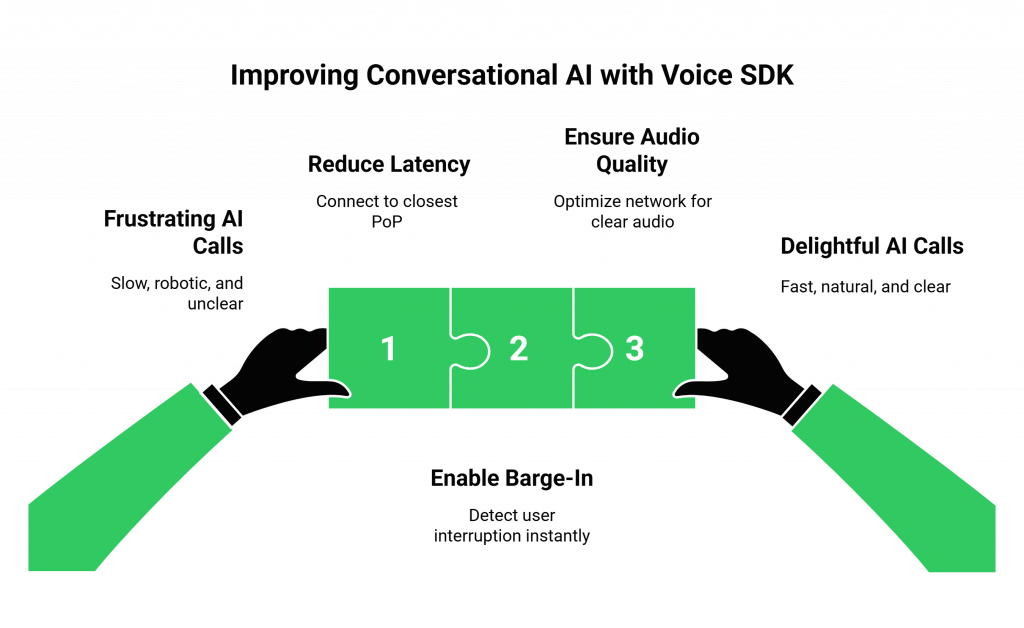
By Defeating the Arch-Nemesis: Latency
This is the single most important factor. Latency is the awkward pause of dead air between the moment you stop speaking and the moment the AI begins to respond.
- The Problem: High latency makes the AI feel slow, stupid, and robotic. It is the #1 cause of users getting frustrated and talking over the AI, which completely derails the conversation.
- The SDK Solution: A modern voice calling SDK is built on a globally distributed, edge-native infrastructure. A provider like FreJun AI has Points of Presence (PoPs) all over the world. The SDK automatically connects the call to the PoP that is physically closest to the end-user. This drastically reduces the network travel time for the audio data, which is the most effective way to minimize latency and create a fast, snappy conversation.
The impact of speed on customer satisfaction is well-documented, with one study showing that 51% of customers will stop doing business with a company due to slow response times.
Also Read: From Chatbots to Callbots: How the Best Voice APIs Are Redefining Business Communication
By Enabling Natural Turn-Taking with Interruption (Barge-In)
In a natural human conversation, we interrupt each other all the time. It is a key part of how we signal that we understand or want to take a turn.
- The Problem: A basic AI agent will blindly play out its entire, pre-programmed sentence, even if the user has already figured out the answer and is trying to say “stop.” This is incredibly frustrating.
- The SDK Solution: A sophisticated voice calling SDK has a feature often called “barge-in.” It can detect the instant that the user starts speaking, even while the AI’s audio is playing. It can then immediately notify your application. Your application’s code can then use the SDK to command the playback to stop and to start listening to what the user is saying. This single feature is a quantum leap in improving AI call experience, transforming a monologue into a true dialogue.
By Ensuring Crystal-Clear Audio Quality
The intelligence of your LLM is useless if its “ears” are clogged.
- The Problem: If the audio stream from the caller is full of static, jitter, or packet loss due to a poor network, the Speech-to-Text (STT) engine will produce an inaccurate transcription. This “garbage in, garbage out” problem means the LLM gets a nonsensical input and provides an irrelevant or incorrect response.
- The SDK Solution: The best voice API for business communications is built on a carrier-grade network that is obsessively optimized for audio quality. It will use high-quality audio codecs (like Opus) and can even employ AI-powered features like Packet Loss Concealment (PLC) to intelligently fill in small gaps in the audio stream, ensuring that the STT engine gets the cleanest possible signal.
Ready to build an AI experience that your customers will actually love? Sign up for FreJun AI and explore our powerful, low-latency voice calling SDK.
How Can a Voice Calling SDK Enable a More Personalized and Empathetic AI?
The future of voice AI is not just about transactional efficiency; it is about creating an experience that feels personal and empathetic. A modern voice calling SDK provides the tools to add these crucial layers of polish to your conversational AI user journey.
This table illustrates how specific SDK features can enable a more human-like interaction.
| SDK Feature | What It Does | Impact on Voice Calling Personalization & Empathy |
| Real-Time Sentiment Analysis | The underlying platform can analyze the caller’s tone of voice for emotional cues in real-time. | The SDK can pass this “sentiment score” to your LLM. The LLM can then tailor its response, perhaps using a more empathetic tone if it detects that the user is frustrated. |
| Dynamic, Branded Caller ID | The SDK allows you to programmatically set the outbound caller ID for proactive calls. | When your AI calls a customer, it can show a local, trusted number, or even display your brand name (via CNAM), which increases trust and answer rates. |
| Seamless Human Escalation | The SDK provides a simple API command to seamlessly transfer the live call to a human agent. | If the AI detects a highly emotional or complex situation, it can gracefully hand off the call, along with the full conversational context, to a human expert, ensuring the customer always gets the right level of support. |
This ability to create a more nuanced and context-aware experience is at the heart of improving cx with voice AI. A recent study on brand loyalty found that 65% of customers feel an emotional connection to the brands they are loyal to, and these personalization features are key to building that connection, even through an automated channel.
Also Read: Best Voice API for Global Business Communication: What to Look for Before You Build
The FreJun AI Difference: An SDK Built for the AI Era
At FreJun AI, we architected our platform from the ground up with the demands of voice AI as our guiding principle. Our voice calling SDK is the powerful front-end to our globally distributed, low-latency Teler engine. We are relentlessly focus on providing developers with the tools they need to perfect the conversational AI user journey.
- An Obsession with Low Latency: Our edge-native architecture is designed to minimize the speed-of-light delay, ensuring your AI’s responses are as close to instantaneous as possible.
- Powerful Real-Time Control: Our SDK and Real-Time Media APIs give you the granular control you need to implement sophisticated features like barge-in and dynamic audio injection.
- A Commitment to Quality: We manage a carrier-grade global network, constantly optimizing for the highest possible audio quality to ensure your AI is always working with the cleanest possible signal.
Also Read: LLMs + Voice APIs: The Perfect Duo for Next-Gen Business Communication
Conclusion
The intelligence of an AI voice agent may reside in its Large Language Model, but its soul, its ability to have a natural, pleasant, and effective conversation, resides in the quality of the connection that brings it to life. A modern voice calling SDK is the indispensable technology that provides this connection.
By conquering latency, enabling natural turn-taking, ensuring crystal-clear audio, and providing the tools for personalization, the SDK is the key to improving AI call experience.
For any business looking to deploy a voice AI that customers will not just tolerate, but will actually love to use, the choice of their underlying voice calling SDK is the most important customer experience decision they will make.
Want to see a live demonstration of how our low-latency SDK can create a more natural AI conversation? Schedule a demo with our team at FreJun Teler.
Also Read: UK Phone Number Formats for UAE Businesses
Frequently Asked Questions (FAQs)
It improves cx with voice AI by providing the technical foundation for a high-quality call. This includes minimizing latency (the awkward pauses), enabling interruption (barge-in) for natural turn-taking, and ensuring the audio is crystal clear.
By far, the most important factor is low latency. A fast, responsive AI feels intelligent and is easy to talk to. A slow, laggy AI is frustrating and feels robotic.
Barge-in is the ability for a user to interrupt the AI while it is speaking. It is critical for a good conversational AI user journey because it allows for natural turn-taking and prevents the user from having to listen to a long, unnecessary monologue.
It enables voice calling personalization by giving the developer the tools to create a more context-aware experience. For example, it can provide real-time data on the caller’s sentiment, which the AI can use to adjust its tone, or it can allow for a seamless, context-aware transfer to a human agent.
An edge-native platform has a globally distributed network of servers (Points of Presence). It handles a call at the server that is physically closest to the end-user, which is the most effective way to reduce network latency.
Poor audio quality (like static or choppiness) will lead to a poor transcription from the Speech-to-Text (STT) engine. If the AI gets a “garbage” transcription, it will provide a “garbage” response, making it seem unintelligent.
The FreJun AI voice calling SDK is the foundational layer. It provides the low-latency connection to the global telephone network, the real-time media streaming capabilities, and the rich set of call control APIs that developers need to connect their AI “brain” (their LLM and other models) to a live phone call.
The underlying voice platform can. It can analyze the raw audio stream in real-time for acoustic indicators of emotion (like pitch, volume, and speech rate). The SDK can then deliver this “sentiment analysis” data to your application alongside the transcribed text.
No. A key benefit of a modern voice calling SDK is that it abstracts away the low-level complexity. A developer can implement a sophisticated feature like barge-in with a simple API command, without needing to be an expert in real-time media processing.