
In the landscape of modern business communication, there is a constant tension between the need for personalized outreach and the demand for operational scale. How do you personally inform ten thousand customers about a critical service update? How do you remind a thousand clients about their upcoming appointments without hiring a hundred new employees?
For years, the answer was a frustrating trade-off: you could have scale (with impersonal email blasts) or you could have a personal touch (with slow, expensive manual calls), but you could not have both. Today, this trade-off is being shattered by a powerful new tool: the voice API for bulk calling.
This technology is at the heart of the customer update automation 2026 trend. It is about moving beyond passive, easily ignored text-based messages and embracing a proactive, engaging, and incredibly efficient voice channel.
By leveraging a voice API for bulk calling, businesses can automate the process of making thousands of simultaneous, personalized, and interactive phone calls, creating a communication workflow that is both deeply personal and massively scalable. This is more than just a new feature; it is a fundamental workflow simplification that is reshaping how businesses communicate with their customers.
Table of contents
The Failure of Traditional, At-Scale Communication
Before we can appreciate the power of automated voice, we must first recognize the limitations of the traditional methods for mass communication.
The Impersonal Nature of Email and SMS
Email and SMS have been the workhorses of customer updates for years, but their effectiveness is waning in an increasingly crowded digital world.
- Low Engagement: Email open rates can be notoriously low, often hovering around 20-30% depending on the industry. A significant portion of your customers may never even see your critical update.
- Passive and One-Way: These are “fire and forget” channels. You send the message and hope the customer reads it. There is no easy way for them to ask a clarifying question or take immediate action.
- The “Spam” Factor: Customers are inundated with hundreds of digital messages a day. It is easy for an important service alert to get lost in a sea of promotional offers and spam.
Also Read: Key Benefits of Programmable SIP for Building Context-Aware Voice Applications
The Impossibility of Manual Calling at Scale
A manual phone call is still the most personal and effective way to communicate, but it is a tool that is fundamentally unscalable.
- Prohibitive Labor Costs: The cost of having human agents manually dial thousands of customers is astronomical. It is a non-starter for all but the most high-stakes use cases.
- Slow and Inefficient: A single agent can only make a limited number of calls per hour. A campaign to reach ten thousand customers could take a team of agents several days to complete.
- Inconsistency: The message, tone, and quality of a manual call can vary dramatically from one agent to another, leading to an inconsistent brand experience.
What is a Voice API for Bulk Calling and How Does it Work?
A voice API for bulk calling is a powerful, developer-focused tool that allows your application to programmatically initiate a large number of outbound phone calls simultaneously. It is the engine that powers modern customer update automation 2026.
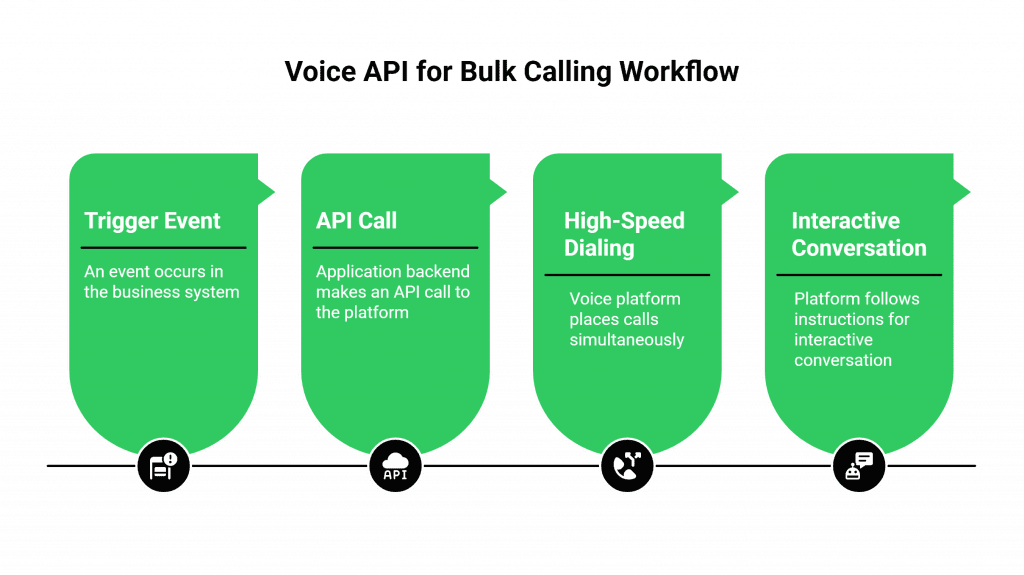
Think of it as a cloud-based, infinitely scalable auto-dialer that is controlled by your code. Here is how a typical workflow operates:
- The Trigger: An event happens in your business system. This could be a scheduled trigger (e.g., “it is 24 hours before a customer’s appointment”) or a real-time trigger (e.g., “a service outage has just been detected in this geographic area”).
- The API Call: Your application’s backend code makes a simple API call to a platform like FreJun AI for each customer you need to contact. This API call contains the customer’s phone number and a URL that points to a set of instructions for the call.
- The High-Speed Dialing: The voice platform’s infrastructure (our Teler engine) then places all of these calls simultaneously, handling all the complex, low-level telephony in the background.
- The Interactive Conversation: When a customer answers, the platform follows the instructions at the URL you provided. This can be as simple as playing a pre-recorded message or as complex as initiating an interactive conversation with an AI voice agent.
This entire process is automated, incredibly fast, and can scale to handle tens of thousands of calls without any human intervention.
Also Read: Why Programmable SIP Is the Backbone of Voice Infrastructure for AI Agents
Real-World Use Cases: From Simple Reminders to Critical Alerts
The applications of a call reminders API and a bulk calling system are vast and span across every industry. It is a powerful tool for any business that needs to communicate timely, important information to a large group of people.
This table highlights some of the most common and high-impact use cases.
| Use Case | Industry | Why It’s a Perfect Fit for a Voice API |
| Appointment Reminders | Healthcare, Services | Drastically reduces costly no-shows by ensuring the customer is aware of their upcoming appointment and giving them an easy way to confirm or reschedule. |
| Service Outage Notifications | Utilities, Telecom | Provides a proactive, high-urgency channel to inform thousands of affected customers about a service disruption and provide an estimated restoration time. |
| Payment Reminders | Finance, Subscriptions | Reduces late payments and improves cash flow by providing a friendly, automated reminder a few days before a bill is due. |
| Delivery and Shipment Alerts | E-commerce, Logistics | Improves first-attempt delivery success by calling the customer when their package is a few stops away to confirm they are home. |
| Emergency Broadcasts | Education, Public Sector | Instantly and reliably disseminates critical, time-sensitive information (like a school closure or a public safety alert) to an entire community. |
Ready to start automating your customer updates and simplifying your workflows? Sign up for FreJun AI
The Power of an Interactive, AI-Driven Call
The true workflow simplification comes when you move beyond a simple, one-way notification and create an interactive, AI-powered conversation. A modern voice API for bulk calling allows you to do exactly that.
Moving Beyond the “Robocall”
The term “robocall” has a negative connotation because it is associated with a dumb, one-way message. An AI-powered call is completely different. When the customer answers, they are not just a passive listener; they are an active participant.
For an appointment reminder, the AI can say: “This is a reminder of your appointment tomorrow at 2 PM. Please say ‘Confirm’ to keep your appointment, or say ‘Reschedule’ to speak with our scheduling team.” This is not just a reminder; it is an interactive tool that solves a problem in real time.
The impact of this is huge. A recent study on healthcare scheduling found that automated, interactive reminders can reduce patient no-show rates by up to 38%.
Also Read: The Developer’s Guide to Integrating LLMs with Programmable SIP Infrastructure
How FreJun AI Enables This at Scale
The FreJun AI platform is built for this new era of interactive, automated communication.
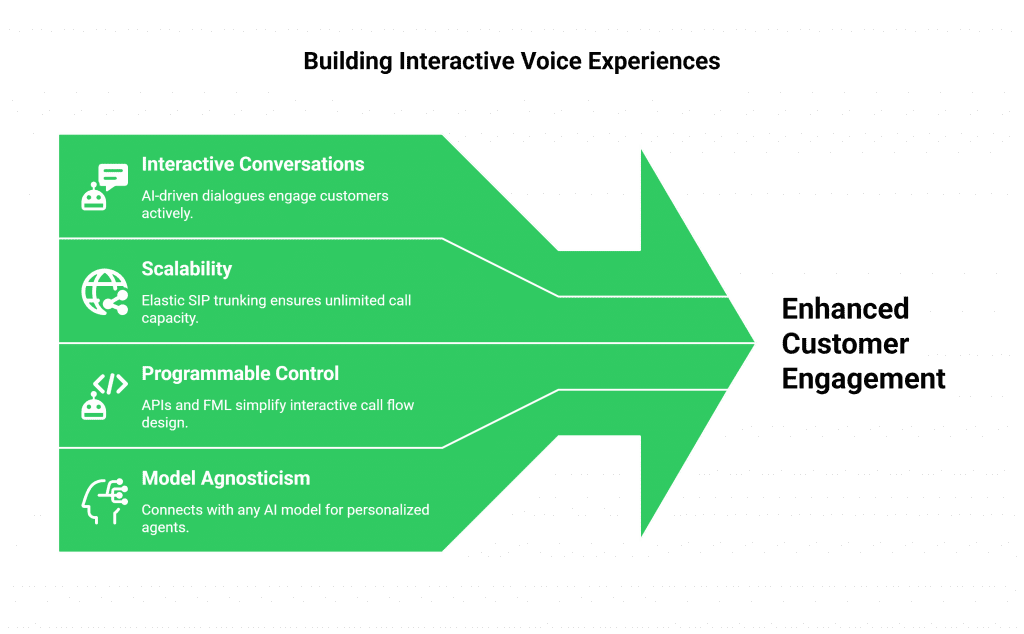
- Elastic Scalability: Our Teler engine is an elastic SIP trunking platform at its core. It provides the on-demand, virtually unlimited capacity you need to launch a large-scale bulk calling campaign in an instant.
- Simple, Programmable Control: Our powerful APIs and our FML markup language make it incredibly easy for a developer to design these interactive call flows. You can build a sophisticated, AI-driven reminder system with just a few lines of code.
- A Model-Agnostic Foundation: We provide the “voice.” You provide the “brain.” Our platform allows you to connect your own AI models, giving you the freedom to build the most intelligent and natural-sounding agent for your specific use case. This is our core promise: “We handle the complex voice infrastructure so you can focus on building your AI.”
Conclusion
The old methods of mass communication are no longer sufficient for the demands of the modern customer. In a world of digital noise, the proactive, personal, and engaging nature of a voice call is more powerful than ever.
But until now, the cost and complexity of making calls at scale have been a major barrier. The voice API for bulk calling completely demolishes this barrier. It is a powerful tool for workflow simplification that allows businesses to automate their customer updates in a way that is both massively scalable and deeply personal.
From simple reminders to critical alerts, this technology is the key to building a more proactive, responsive, and customer-centric communication strategy.
Want to see just how easy it is to launch your first automated, AI-powered calling campaign with our API? Schedule ademo for FreJun Teler.
Also Read: 10 Best Business Phone Systems: Features, Pricing & Comparison
Frequently Asked Questions (FAQs)
It is a programming interface that allows a software application to automatically initiate a large number of outbound phone calls simultaneously. It is the core technology behind automated appointment reminders, service notifications, and other mass communication workflows.
A traditional robocall is a simple, one-way, pre-recorded message. A call made with a modern voice API for bulk calling can be interactive and intelligent. It can be powered by an AI that can understand the customer’s spoken responses and have a real conversation.
The main benefit of customer update automation 2026 is the ability to communicate proactive, important information to your customers at a massive scale, in a way that is far more engaging and effective than email or SMS. This improves customer satisfaction and operational efficiency.
A call reminders API is a specific use case of a voice API for bulk calling. It is the programming interface that a developer would use to build an automated system for making appointment reminder calls.
It simplifies workflows by fully automating a previously manual process. The system replaces labor-intensive dialing tasks. Software identifies who to call automatically. It also places calls and logs outcomes without human effort.
No. With a modern, cloud-based voice platform, the per-call cost is typically just a few cents per minute. It is dramatically more cost-effective than having human agents make the calls.
Yes. By integrating with a high-quality, modern Text-to-Speech (TTS) engine, the voice of the AI can be made to sound incredibly natural, warm, and professional.