
For decades, the sound of the office was the ringing of a desk phone, a sound orchestrated by a mysterious, refrigerator-sized box humming away in a server closet. This was the world of the Private Branch Exchange, or PBX, a world of physical hardware, rigid capacity, and complex maintenance. It was a reliable workhorse, but a workhorse built for a bygone era.
Today, as businesses move every other part of their operation to the cloud, the old PBX stands out as a final, stubborn remnant of the analog past. The technology that is finally liberating businesses from this hardware is elastic SIP trunking.
The journey from a legacy PBX to a modern, cloud-based voice system is more than just a simple technology upgrade; it is a fundamental cloud telephony transformation. It is about moving from a system that is a capital expense to one that is an operational expense, from a system that is a barrier to growth to one that is an enabler of it.
This PBX to SIP migration is a critical step for any business looking to build a more agile, scalable, and cost-effective communication stack.
Table of contents
What Was the World of the Legacy PBX?
To truly appreciate the evolution, we must first remember what the old world looked like. The on-premise PBX was the undisputed king of business telephony for half a century. It was a piece of physical hardware installed at your office that managed all of your internal and external phone calls.
The Strengths and Weaknesses of the Old Guard
The PBX was not without its merits. It was reliable and offered a high degree of control over your internal calling features. However, its weaknesses became increasingly apparent in the internet age:
- The Tyranny of Physical Hardware: The PBX was a significant capital expenditure. You had to buy the box, pay for its installation, and often sign a costly long-term maintenance contract.
- The Inflexibility of the PSTN: The PBX connected to the outside world via physical Primary Rate Interface (PRI) lines from the phone company. These lines were sold in rigid blocks of 23 channels, making it incredibly difficult and expensive to scale your call capacity.
- The Chains of Geography: Your phone numbers and your employees were physically tied to the location of the PBX. This made supporting remote workers or opening a new office a complex and expensive undertaking.
This old model was a major roadblock to innovation. A recent industry report on digital transformation highlighted that companies still burdened by legacy systems are 50% less likely to achieve their strategic goals. The legacy PBX is a prime example of such a system.
How Did Elastic SIP Trunking Shatter the Old Model?
Elastic SIP trunking emerged as the disruptive force that broke the chains of the legacy PBX. Instead of using physical copper wires to connect to the phone company, it used the internet. This simple shift from physical to virtual was a revolution.
What is SIP Trunking and Why is it “Elastic”?
SIP, or Session Initiation Protocol, is the open standard for managing real-time communication sessions, like voice and video calls, over the internet. A “SIP trunk” is the virtual equivalent of the old PRI line.
The “elastic” nature is its most powerful attribute. Instead of buying a fixed number of channels, elastic SIP trunking allows you to tap into a massive, shared pool of capacity from your provider.
- You are only billed for the actual number of concurrent calls you are using at any given moment.
- This means your capacity can automatically scale from one call to one thousand calls and back down again in an instant.
This single innovation solved the biggest problem with the old PRI model: its rigidity.
Also Read: AI Voicebot for Flight Change Requests
What Does the PBX to SIP Migration Journey Look Like?
For a business modernizing voice systems, the move away from a legacy PBX is a clear and logical progression. The migration is not just about replacing one technology with another; it is about embracing a new, more flexible philosophy for VoIP infrastructure upgrades.
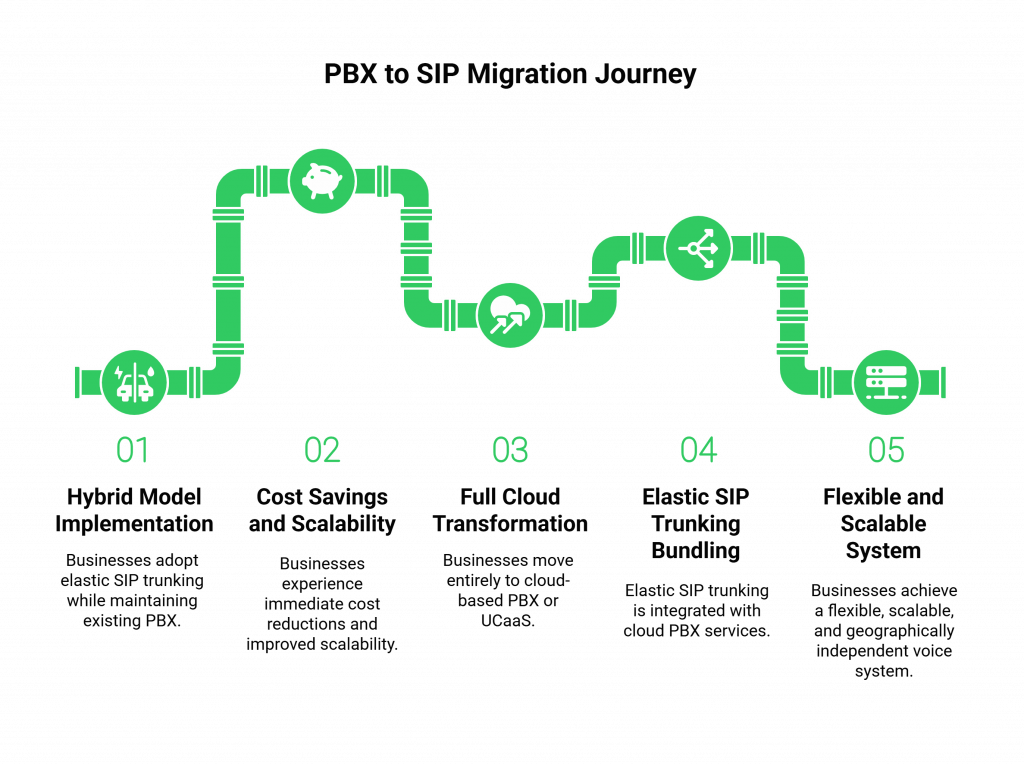
Phase 1: The Hybrid Model
The first step for many businesses is a hybrid approach. They keep their existing on-premise IP-PBX but replace the expensive PRI lines with a more cost-effective elastic SIP trunking service. This provides immediate cost savings and scalability for their external calls, while keeping their internal call management the same. It is a low-risk first step into the world of cloud telephony.
Phase 2: The Full Cloud Transformation
The ultimate goal for most businesses is to eliminate the on-premise hardware entirely. This involves moving to a cloud-based PBX or a more modern Unified Communications as a Service (UCaaS) platform.
In this model, the elastic SIP trunking is often bundled directly with the cloud PBX service. This completes the cloud telephony transformation, turning your entire voice system into a flexible, scalable, and geographically independent cloud service.
This table shows the key differences in this evolutionary path:
| Feature | Legacy PBX with PRI | Hybrid Model (PBX + SIP Trunk) | Full Cloud Model (Cloud PBX + SIP) |
| Core Hardware | On-premise PBX. | On-premise PBX. | None. Fully cloud-hosted. |
| External Connection | Physical PRI lines. | Elastic SIP Trunking. | Elastic SIP Trunking. |
| Scalability | Rigid and expensive. | Flexible and on-demand. | Highly flexible and on-demand. |
| Geographic Flexibility | Limited to the physical office. | Limited by the PBX location. | Completely location-independent. |
| Cost Model | High CapEx and fixed monthly fees. | Low CapEx, pay-as-you-go usage. | Purely operational, pay-as-you-go. |
Ready to start your own migration journey and leave your old PBX behind? Sign up for FreJun AI and explore our flexible voice infrastructure.
Also Read: How to Maintain Call Quality in Voice AI?
How Does FreJun AI Support This Entire Evolution?
At FreJun AI, we understand that every business is at a different stage of its cloud journey. Our platform is design to be the flexible foundation that can support you, no matter where you are in the process. Our underlying elastic SIP trunking engine, Teler, is a carrier-grade, globally scalable service that can be configured to meet your exact needs.
- For the Hybrid Model: You can easily connect our elastic SIP trunking service to your existing on-premise IP-PBX to get immediate cost savings and scalability.
- For the Full Cloud Model: Our platform can be the voice engine for your chosen cloud PBX or UCaaS provider.
- For the Future: Our true power lies in our developer-first, API-driven approach. As you move beyond a simple phone system and start to build custom voice applications, like AI-powered IVRs or voicebots, our platform provides the tools and the infrastructure you need to innovate.
The power of a Communication Platform as a Service (CPaaS) model, which is built on this API-first principle, is undeniable. The market for CPaaS is projected to grow to over $29 billion by 2025, a testament to the demand for this kind of programmable communication. We handle the complex voice infrastructure so you can focus on building your business.
Conclusion
The journey from the on-premise PBX to the cloud is a critical part of any modern business’s digital transformation. The era of being locked into expensive hardware and rigid, long-term contracts is over.
Elastic SIP trunking was the catalyst for this revolution, providing the initial bridge to a more flexible and cost-effective world. Today, it has evolved into the foundational layer for the entire cloud telephony transformation.
For businesses looking to build a communication system that is as agile, scalable, and innovative as they are, the PBX to SIP migration is not just a technical upgrade; it is a strategic imperative.
Ready to take the first step in modernizing your voice systems? Schedule a demo with our team at FreJun Teler to see how we can help.
Also Read: UK Mobile Code Guide for International Callers
Frequently Asked Questions (FAQs)
1. What is elastic SIP trunking in simple terms?
It is a way to use your internet connection to make and receive business phone calls, replacing the need for traditional, physical phone lines. The “elastic” part means you can instantly scale the number of calls you can handle up or down and only pay for what you use.
2. What is a PBX?
PBX stands for Private Branch Exchange. It is a private telephone network used within a company. A legacy PBX is a physical piece of hardware, while a modern IP-PBX or cloud PBX is a software-based system.
3. What is the main benefit of a PBX to SIP migration?
The solution delivers significant cost savings by eliminating expensive PRI lines and reducing hardware maintenance, and it increases flexibility by allowing you to easily scale call capacity and support remote workers.
4. Can I keep my existing phone numbers when I switch to elastic SIP trunking?
Yes. In most cases, you can port your existing business phone numbers from your old provider to your new elastic SIP trunking service through a process called Local Number Portability (LNP).
5. Do I need to replace my entire phone system at once?
No. A key advantage of modernizing your voice systems is that you can do it in phases. Many companies start with a hybrid model, using elastic SIP trunking with their existing IP-PBX, before moving to a fully cloud-based solution later.
6. What is a “cloud telephony transformation”?
It is the process of moving your entire business communication infrastructure—including your phone system, call management, and connectivity—from on-premise hardware to cloud-based services.
7. Is the call quality of elastic SIP trunking reliable?
Yes. When you use a high-quality, carrier-grade provider like FreJun AI and have a stable business internet connection, the call quality is crystal clear and highly reliable.
8. What kind of VoIP infrastructure upgrades are needed for this migration?
The primary requirement is a reliable, business-grade internet connection with sufficient bandwidth. For the best quality, a dedicated internet connection for your voice traffic is often recommended. On the software side, you will need an IP-PBX or a connection to a cloud PBX service.
9. How does a provider like FreJun AI fit into this process?
FreJun AI provides the foundational elastic SIP trunking infrastructure (our Teler engine). We give you the secure, reliable, and globally scalable connectivity you need to power your on-premise or cloud-based PBX, as well as the powerful APIs to build custom voice applications for the future.
10. Is elastic SIP trunking only for large enterprises?
Not at all. It is actually an ideal solution for businesses of all sizes, from startups to large enterprises. The pay-as-you-go, scalable model is particularly beneficial for small and medium-sized businesses that need enterprise-grade features without the enterprise-grade cost.