
Enterprises today operate in an environment where customers expect immediate, reliable support at any hour. However, scaling human-led call operations to meet this demand is expensive, complex, and often inefficient. As a result, many organizations are rethinking how voice support should work in a digital-first world. This shift has accelerated the adoption of voicebot solutions that combine real-time voice infrastructure with modern AI capabilities.
In this blog, we explore why enterprises are increasingly choosing always-on AI calls, how voicebots work at scale, and what technical foundations are required to build reliable, production-ready voice automation.
What Are Voicebot Solutions And Why Are They Gaining Popularity?
Modern enterprises face growing pressure to provide instant, uninterrupted support. Customers today expect assistance at any hour, across multiple time zones, without waiting in long queues. To meet these expectations, businesses are increasingly turning to voice bot solutions, intelligent systems capable of handling phone conversations in real time.
Unlike traditional interactive voice response (IVR) systems, voicebots can interpret natural language, maintain context over multiple exchanges, and perform complex actions such as scheduling, retrieving account information, or routing calls intelligently. They leverage a combination of technologies including:
- Speech-to-Text (STT): Converts spoken language into machine-readable text.
- AI Agents / LLMs: Understand intent and generate appropriate responses.
- Text-to-Speech (TTS): Converts AI-generated text into natural, human-like audio.
- Retrieval-Augmented Generation (RAG): Accesses enterprise knowledge bases, CRM data, or external tools to provide accurate answers.
- Tool Calling: Executes actions like updating records, scheduling, or payments directly within the conversation.
The combination of these components allows businesses to offer 24/7 voicebot support, reduce response times, and improve customer satisfaction without heavily increasing operational costs. Moreover, voicebots create a seamless customer journey that feels personalized, consistent, and efficient.
Why Do Enterprises Need Always-On AI Calls?
Enterprises often struggle with maintaining human support around the clock. Hiring and training large teams to handle peak hours is expensive, and even well-staffed call centers cannot ensure immediate response to every customer query. Additionally, manual operations are prone to errors, inconsistencies, and longer resolution times.
Key reasons enterprises adopt always-on AI calls include:
- High Call Volume Management: AI-driven voicebots can handle hundreds or thousands of calls simultaneously without degradation in performance.
- Global Customer Base: Enterprises operating internationally can provide uninterrupted support regardless of time zone differences.
- Cost Efficiency: Reduces reliance on large, full-time support teams while maintaining high-quality service.
- Consistency: Ensures standard responses, avoiding human error or variance in information delivery.
From a technical standpoint, low-latency voice streaming and real-time dialogue management are essential for supporting always-on interactions. Enterprises must ensure that audio from inbound or outbound calls is captured accurately and transmitted with minimal delay to the AI agent. Any lag can disrupt the conversation and negatively impact the customer experience.
How Do Voicebots Work In Enterprise Environments?
To understand the power of enterprise voice automation, it’s crucial to examine how a voicebot functions. At its core, a voicebot integrates multiple layers of technology that together allow it to converse intelligently and execute tasks:
- Speech-to-Text (STT): Converts spoken input into text in real time. Modern STT engines support multiple languages and dialects, and can differentiate between speakers in multi-party calls. This allows enterprises to deploy voicebots globally without compromising comprehension accuracy.
- AI Agent / Large Language Model (LLM): The text generated from STT is processed by an AI agent or LLM. This layer determines the intent of the user, decides the appropriate response, and identifies any required actions. The AI agent can connect to enterprise knowledge sources, CRM systems, or other business tools to provide accurate and context-aware responses.
- Text-to-Speech (TTS): Once the AI determines a response, TTS converts it into human-like speech. Natural intonation, pacing, and pronunciation are essential to make interactions feel authentic, which is especially important in customer-facing environments.
- Retrieval-Augmented Generation (RAG): In enterprise applications, AI must often access live data. RAG ensures that the voicebot can pull the latest information from databases, knowledge bases, or external APIs to answer customer queries with precision.
- Tool-Calling Integration: A fully capable voicebot does more than converse. It can trigger enterprise actions such as booking appointments, updating customer accounts, or sending notifications. This ensures that AI calls are productive and actionable.
Technical Flow:
| Step | Component | Function |
| 1 | STT | Converts caller speech to text in real time |
| 2 | AI/LLM | Interprets intent, manages dialogue context |
| 3 | RAG | Retrieves data from internal or external sources |
| 4 | Tool Calling | Executes business-specific actions |
| 5 | TTS | Converts AI response back into natural speech |
| 6 | Audio Streaming | Sends voice response back to caller |
This architecture enables enterprises to run always-on AI calls, manage large-scale support operations, and ensure consistent, context-aware customer experiences.
What Benefits Do Enterprises Get From Voicebot Solutions?
Adopting enterprise voice automation offers measurable advantages across operational, technical, and customer-facing dimensions:
Faster Response Times And Reduced Wait Queues
- Voicebots can handle hundreds of calls simultaneously.
- Real-time processing ensures that customers receive immediate attention.
- Enterprises avoid delays caused by agent unavailability during peak hours.
Cost Efficiency And Scalability
- Reduces need for large, continuously staffed call centers.
- Scales dynamically to handle seasonal spikes or unexpected call volume.
- Eliminates operational bottlenecks common in human-only systems.
24/7 Support Across Multiple Time Zones
- AI agents never sleep and are available around the clock.
- Supports international customer bases without requiring night-shift staff.
- Ensures enterprise operations remain responsive at all times.
Personalized Customer Experience With AI Context
- AI retains conversational context, enabling natural, coherent interactions.
- Integration with CRMs and RAG ensures responses are personalized and accurate.
- Customers feel understood, increasing satisfaction and loyalty.
Offloading Repetitive Tasks From Human Agents
- Voicebots handle routine inquiries like order tracking, account balances, or FAQs.
- Human agents focus on complex issues, increasing productivity and engagement.
- Reduces agent burnout and improves employee experience.
Data Insights And Analytics From AI Calls
- Enterprises gain actionable insights from conversation logs.
- Metrics include call volume, average handling time, sentiment, and intent analysis.
- Analytics help refine AI models, improve customer experience, and drive strategic decisions.
While these benefits are compelling, enterprises must consider technical challenges to ensure their voicebot strategy succeeds.
What Are The Technical Challenges In Implementing Voicebots?
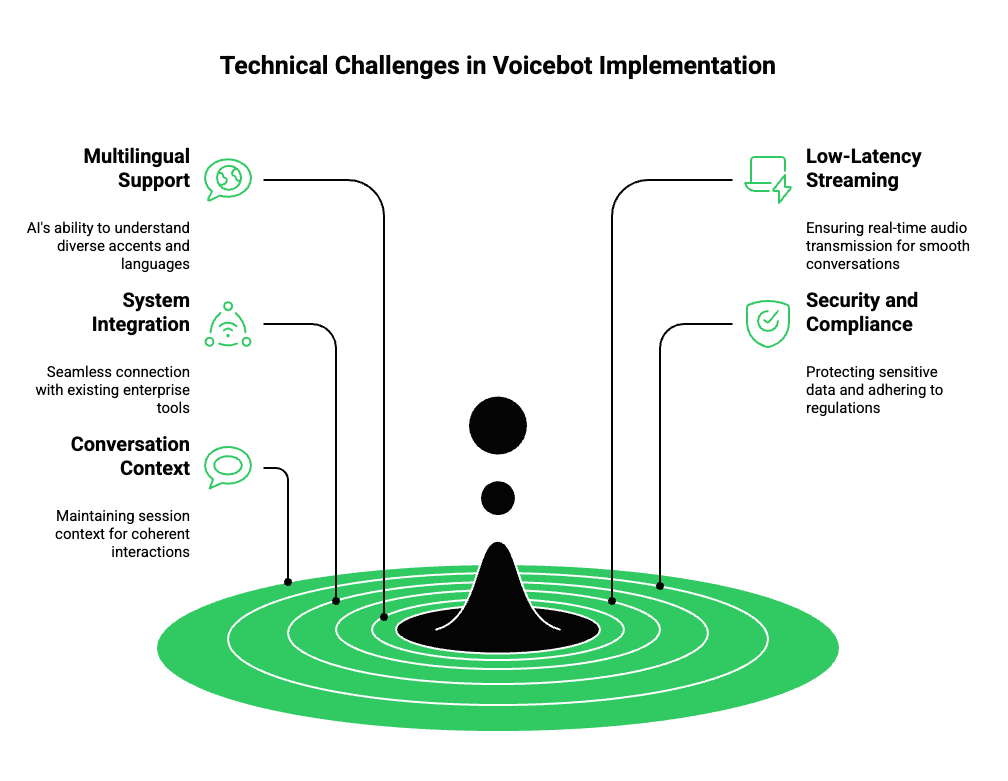
Implementing always-on AI calls is not without hurdles. Enterprises face several technical considerations:
- Multilingual And Accent Variations:
AI must understand diverse accents and languages without losing accuracy. - Low-Latency Voice Streaming:
Audio must travel from the caller to the AI agent and back in milliseconds to maintain conversational flow. - Integration With Existing Systems:
Voicebots must connect with CRMs, ticketing platforms, and enterprise tools seamlessly. - Security And Compliance:
Enterprise calls often involve sensitive data. Encryption, access control, and compliance with regulations like GDPR and PCI-DSS are mandatory. - Managing Conversation Context:
Maintaining session context across long or multi-turn conversations is crucial to avoid miscommunication.
Technical teams must carefully design pipelines for STT, LLM inference, RAG retrieval, TTS conversion, and audio streaming to ensure reliable, always-on performance.
How Does FreJun Teler Make Voicebot Implementation Easier?
For enterprises, managing all the layers of real-time voice processing can be complex. This is where FreJun Teler acts as a dedicated voice infrastructure layer for AI-powered voicebots. Teler allows companies to connect any AI model, STT engine, or TTS system while ensuring low-latency, reliable, and scalable voice operations.
Key Features of Teler:
- Low-Latency Streaming: Audio input and output are processed in real time, reducing pauses in conversation.
- Model-Agnostic Integration: Works with any LLM, STT, or TTS provider. Enterprises maintain full control of AI logic.
- Full Conversational Context Transport: Keeps track of multi-turn conversations to maintain coherence.
- Developer-First SDKs: Quick implementation for web, mobile, and backend systems.
- High Concurrency And Reliability: Handles thousands of simultaneous calls with a globally distributed architecture.
- Security By Design: End-to-end encryption, role-based access, and compliance with enterprise standards.
Use Case Example:
An enterprise can deploy a voicebot capable of handling 500 concurrent calls for lead qualification, customer support, or appointment scheduling. Using Teler as the infrastructure layer, AI models generate real-time responses while the platform manages audio streaming, call routing, and context maintenance.
How Can Enterprises Implement Voicebots Using Teler?
Deploying always-on AI calls requires careful orchestration of multiple components: voice capture, AI processing, knowledge retrieval, TTS conversion, and call management. Using FreJun Teler simplifies this process by providing a robust infrastructure layer.
Step-By-Step Implementation Workflow
- Voice Capture (STT):
- Inbound or outbound calls are routed through Teler, which captures real-time audio with minimal latency.
- Supports multiple channels: cloud telephony, VoIP, and PSTN.
- Inbound or outbound calls are routed through Teler, which captures real-time audio with minimal latency.
- AI Processing (LLM / Agent):
- Teler streams audio to your chosen AI model.
- The model interprets intent, manages dialogue context, and triggers business logic.
- Teler streams audio to your chosen AI model.
- Knowledge Retrieval (RAG):
- AI can query enterprise databases, CRM systems, or external APIs.
- Ensures responses are accurate, up-to-date, and relevant.
- AI can query enterprise databases, CRM systems, or external APIs.
- Action Execution (Tool Calling):
- Voicebot can perform tasks like scheduling, payment processing, or ticket creation.
- Enables enterprise voice automation that is not limited to conversation.
- Voicebot can perform tasks like scheduling, payment processing, or ticket creation.
- Response Playback (TTS):
- AI-generated responses are converted to speech in real time.
- Teler ensures low-latency streaming back to the caller for natural interaction.
- AI-generated responses are converted to speech in real time.
- Monitoring and Analytics:
- Track call metrics, conversation flows, and user behavior.
- Adjust AI behavior, update knowledge retrieval, and optimize system performance.
- Track call metrics, conversation flows, and user behavior.
By offloading voice transport and streaming to Teler, enterprises can focus on improving AI logic, retrieval quality, and tool integration without worrying about infrastructure bottlenecks.
What Are The Best Practices For Deploying Enterprise Voicebots?
Successfully implementing always-on AI calls goes beyond technology. Enterprises must plan for operational efficiency, system resilience, and customer satisfaction.
1. Define Scope and User Journeys
- Map out customer intents and call types.
- Prioritize high-volume, repetitive tasks for automation first.
- Identify scenarios requiring human handoff to ensure seamless escalation.
2. Optimize Latency and Performance
- Use low-latency STT and TTS engines to reduce conversational pauses.
- Monitor audio streaming, model inference time, and retrieval speed.
- Employ caching strategies for frequently accessed data to speed up RAG operations.
3. Maintain Conversational Context
- Multi-turn conversations must retain state across the session.
- Teler ensures context persistence while passing data to AI models for accurate, coherent responses.
4. Integrate With Enterprise Systems
- Connect voicebots to CRMs, ticketing systems, calendars, and payment gateways.
- Tool-calling APIs should follow secure, transactional protocols.
- Ensure logging and monitoring for both troubleshooting and compliance.
5. Security And Compliance
- Encrypt audio and data in transit and at rest.
- Implement role-based access controls.
- Follow industry regulations like GDPR, HIPAA, and PCI-DSS, depending on use case.
6. Continuous Learning And Improvement
- Use conversation logs to refine AI intent detection and response quality.
- Update knowledge bases frequently to maintain accuracy.
- Monitor KPIs such as first-call resolution rate, average handling time, and user satisfaction.
Following these best practices ensures that enterprises get the full value from 24/7 voicebot support, minimizing errors and improving ROI.
How Does Enterprise Voice Automation Transform Customer Support?
Implementing enterprise voice automation with AI-powered voicebots significantly changes how companies interact with customers:
- Reduced Operational Costs
- Voicebots handle routine queries at scale, reducing the need for large human teams.
- Enterprises save on staffing, training, and infrastructure costs.
- Voicebots handle routine queries at scale, reducing the need for large human teams.
- Enhanced Customer Experience
- Immediate responses eliminate waiting times.
- Natural, human-like speech enhances engagement.
- Personalization using AI and RAG increases customer satisfaction.
- Immediate responses eliminate waiting times.
- Scalable Support Operations
- Voicebots can process thousands of simultaneous calls without performance degradation.
- Dynamic scaling handles seasonal spikes or sudden increases in support demand.
- Voicebots can process thousands of simultaneous calls without performance degradation.
- Actionable Insights
- Data collected from calls provides insight into customer behavior, intent, and sentiment.
- Enterprises can use these insights to improve products, services, and internal workflows.
- Data collected from calls provides insight into customer behavior, intent, and sentiment.
- Global 24/7 Availability
- AI calls ensure uninterrupted support across time zones.
- Reduces dependency on shift-based staffing models and increases customer trust.
- AI calls ensure uninterrupted support across time zones.
Example: A multinational e-commerce company can deploy AI agents to handle order inquiries, payment confirmations, and shipping updates around the clock, while human agents focus only on complex disputes or escalations.
What Are The Future Trends In AI-Powered Voicebots?
The landscape of always-on AI calls continues to evolve, driven by advances in voice AI, natural language understanding, and enterprise automation.
1. Multimodal AI Agents
- Voicebots increasingly integrate with chat, email, and messaging platforms.
- Enterprises can provide seamless customer journeys across multiple channels, all coordinated by a central AI layer.
2. Predictive and Proactive AI Calls
- AI can anticipate customer needs based on past interactions and behavior patterns.
- Proactive notifications, reminders, or updates improve engagement and reduce inbound query load.
3. Advanced Personalization
- AI can leverage RAG and CRM data to offer highly tailored responses.
- Voice, tone, and phrasing can be dynamically adjusted for specific customer segments.
4. Continuous Learning From Conversations
- Every AI call contributes to a growing knowledge base.
- Fine-tuning models based on call outcomes improves response accuracy and contextual understanding over time.
5. Integration With Business Automation
- Beyond conversations, voicebots will execute enterprise workflows in real time.
- Tasks like invoice processing, order placement, and appointment scheduling become fully automated.
Why Should Enterprises Choose Voicebot Solutions For Always-On Support Today?
Adopting voice bot solutions and always-on AI calls is no longer a futuristic idea—it’s a necessity for competitive enterprises. The benefits are clear:
- 24/7 Support: Customers can access services anytime, anywhere.
- Enterprise Voice Automation: Routine queries are handled efficiently, freeing human agents for strategic tasks.
- Scalability: Thousands of concurrent calls can be managed without performance loss.
- Data-Driven Insights: Enterprises gain real-time analytics for decision-making.
- Cost Efficiency: Reduced operational and staffing costs while maintaining service quality.
FreJun Teler provides the infrastructure to achieve all these benefits. By managing real-time voice streaming, maintaining conversational context, and supporting any AI model or TTS/STT engine, Teler allows enterprises to focus on AI logic and business workflows instead of infrastructure challenges.
Final Takeaway
Always-on voice support is no longer a differentiator; it is an operational requirement for modern enterprises. Voicebot solutions allow organizations to handle high call volumes, maintain consistent service quality, and operate across time zones without scaling human teams linearly. When combined with LLMs, STT, TTS, RAG, and secure tool integrations, enterprise voice automation becomes both scalable and reliable. However, success depends on having the right voice infrastructure in place.
FreJun Teler provides the real-time voice layer that connects AI agents to phone networks with low latency, full conversational context, and enterprise-grade reliability.
If you’re building or scaling always-on AI calls, schedule a demo with Teler to see how quickly you can move from concept to production.
FAQs –
- What is an enterprise voicebot?
An enterprise voicebot is an AI-powered system that handles real-time voice calls using speech recognition and language models. - How is a voicebot different from IVR?
Voicebots understand natural language, maintain context, and perform actions, unlike rigid menu-based IVR systems. - Can voicebots work 24/7?
Yes, voicebots are designed for continuous availability and can handle calls anytime without human intervention. - What technologies power modern voicebots?
They use STT, LLMs, TTS, RAG, and tool-calling to understand speech, generate responses, and perform actions. - Are voicebots secure for enterprise use?
Yes, when built with encryption, access controls, and compliance-ready infrastructure, they meet enterprise security standards. - Can voicebots integrate with existing systems?
Voicebots can connect to CRMs, ticketing tools, databases, and internal APIs for real-time data access. - How scalable are AI-powered voicebots?
They scale horizontally, handling thousands of concurrent calls without performance degradation. - Do voicebots replace human agents completely?
No, they handle routine tasks while escalating complex cases to human agents when needed. - How long does it take to deploy a voicebot?
With proper infrastructure, enterprises can move from prototype to production in weeks, not months.
Why is voice infrastructure critical for AI calls?
Reliable, low-latency voice infrastructure ensures natural conversations and stable AI performance during live calls.