
The town hall meeting is a cornerstone of local democracy, yet it is often a room of empty chairs. The suggestion box in the lobby gathers more dust than ideas. The “Contact Us” form on the city website can feel like sending a message into the void.
For decades, a wide and frustrating gap has existed between citizens and the public services they rely on. This communication breakdown is not due to a lack of desire to listen, but a lack of effective tools. This is the challenge that a modern AI voicebot is perfectly designed to address.
Building trust between a government and its citizens is foundational to a healthy society. However, a recent Pew Research Center survey found that public trust in government remains near historic lows.
A key driver of this distrust is the feeling that one’s voice is not heard. By creating a feedback system that is accessible, responsive, and easy to use, public sector organizations can bridge this gap, transforming civic engagement from a rare event into a continuous conversation.
Table of contents
Why is Gathering Citizen Feedback So Difficult?
The traditional methods for collecting public opinion are often inefficient, exclusionary, and fail to capture a true representation of the community’s needs and concerns. These outdated systems create barriers that prevent the vast majority of citizens from participating in the civic process.
The Challenge of Accessibility
True civic engagement requires that every citizen has an equal opportunity to be heard, but traditional methods often fall short.
- The Digital Divide: While online forms are common, not everyone has reliable internet access or the digital literacy to use them effectively.
- Physical and Time Barriers: Attending a town hall meeting in person can be nearly impossible for the elderly, individuals with disabilities, or parents who cannot find childcare. Furthermore, most public offices are only open from 9 to 5, the exact time when most citizens are at work.
- Language Barriers: In diverse communities, providing feedback channels in multiple languages is a significant logistical challenge, often leaving non-native English speakers without a voice.
The Black Hole of Feedback
Perhaps the biggest deterrent to providing feedback is the feeling that it goes nowhere. A citizen takes the time to report a problem or offer a suggestion, only to receive no acknowledgment or update. This lack of a closed feedback loop creates cynicism and discourages them from making the effort in the future.
Also Read: How Brokers Use Inbound Call Handling?
How Does an AI Voicebot Create a Better Feedback Loop?
An AI voicebot reimagines the citizen feedback process by creating a channel that is as simple and universally accessible as a telephone call. It acts as a 24/7, multilingual virtual assistant for the city, ensuring that every citizen has a direct and easy way to make their voice heard.
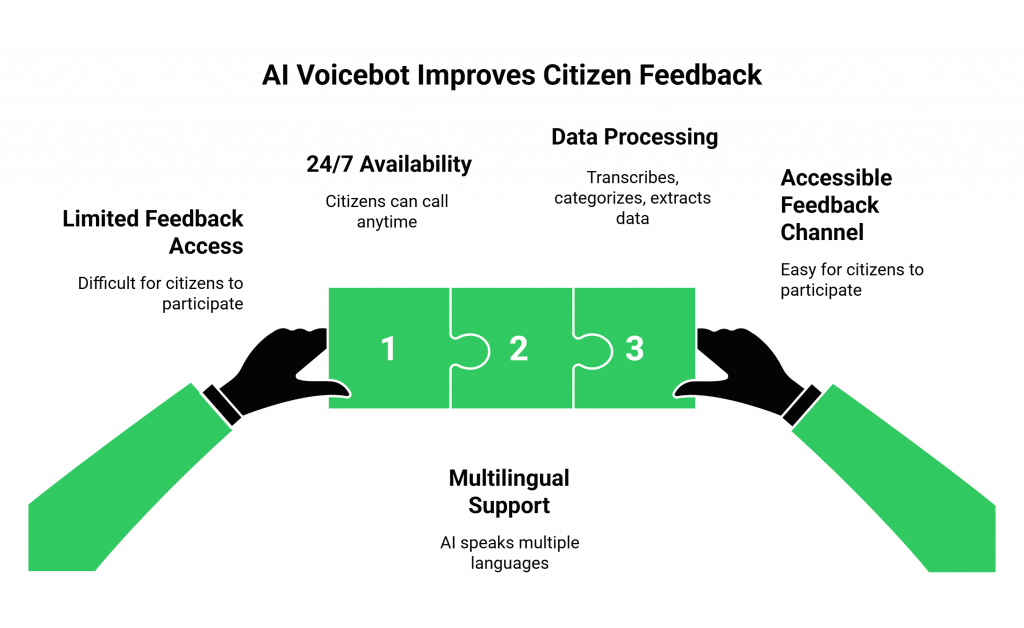
A resident can call a dedicated number at any time and simply speak their feedback. For example, “I’d like to report a broken streetlight on the corner of Oak Avenue and 3rd Street.”
The AI voicebot, using conversational AI, understands this request, captures the key details, and can even provide a confirmation. For this interaction to be effective, the conversation must be seamless.
The underlying voice infrastructure from a provider like FreJun AI is the engine that makes this possible. FreJun AI handles the real-time, low-latency audio streaming, ensuring the conversation is as clear and natural as speaking with a human.
How Does It Make Feedback Accessible to Everyone?
An AI voicebot breaks down the traditional barriers to participation.
- It Bridges the Digital Divide: Nearly everyone has access to a phone, making it the most inclusive communication technology available.
- It Offers 24/7 Convenience: Citizens can call whenever it is convenient for them, whether it is during their morning commute or late at night.
- It Speaks Everyone’s Language: The AI can be easily configured to understand and speak multiple languages, ensuring that every member of a diverse community can participate in their preferred language.
How Does It Capture and Structure Data at Scale?
An AI voicebot does far more than just record a message. It acts as an intelligent data processing tool.
- Transcription: It uses Speech-to-Text (STT) technology to instantly transcribe the citizen’s spoken words into written text.
- Categorization: It uses a Large Language Model (LLM) to understand the intent and automatically categorize the feedback (e.g., “Public Works Request,” “Parks Department Suggestion,” “Code Violation Report”).
- Data Extraction: It can be trained to pull out key entities from the conversation, such as addresses, names, or specific keywords.
This turns a flood of unstructured voice calls into a clean, organized, and analyzable dataset that public officials can use to make data-driven decisions.
Also Read: Voice Assistants in Luxury Travel Experiences
What Are the Key Benefits for Public Sector Organizations?
Adopting an AI voicebot for citizen feedback is a strategic move that delivers powerful benefits for government agencies, municipalities, and public services. It creates a more efficient, responsive, and transparent government.
Here is a clear comparison of the two approaches:
| Feature | Traditional Feedback System | AI Voicebot Feedback System |
| Data Collection | Manual, unstructured, and slow to process. | Automated, structured, and available in real-time. |
| Citizen Reach | Limited to the most motivated or those with free time. | Broad, inclusive, and accessible to the entire community. |
| Operational Cost | High labor costs for staff to manually field calls and emails. | Extremely low operational cost and infinitely scalable. |
| Feedback Loop | Often one-way, with no confirmation for the citizen. | Can provide an automated confirmation or a case number. |
How Does It Lead to More Inclusive Governance?
By making it easy for everyone to participate, an AI voicebot helps to capture a more accurate and representative snapshot of public opinion. It ensures that decisions are not just influenced by the “loudest voices in the room” but by the needs and concerns of the entire community.
How Does It Improve Operational Efficiency?
The automation provided by an AI voicebot can save thousands of administrative hours. By automatically collecting, transcribing, and categorizing feedback, it frees up public employees from repetitive data entry. The structured data can also be automatically routed to the correct department’s workflow, ensuring that a report about a pothole instantly creates a ticket for the Public Works department.
Ready to build a government that truly listens? Sign up for FreJun AI and get your API keys to start building a more connected community.
Also Read: How to Handle Last-Minute Bookings via AI Calls?
How Can a Public Agency Implement a Voice AI Feedback System?
Deploying a voice AI feedback system is a manageable project that involves a clear, logical process built on modern and secure technology.
- Identify Key Feedback Channels: The first step is to determine the most common types of feedback you currently receive. Is it service requests (like 311 calls)? General complaints? Suggestions for new programs? This will help you define the initial scope and design the most effective conversation flow.
- Design the Citizen Conversation: This is where you craft the user experience. You will create the scripts for the AI voicebot, including a welcoming greeting and simple, guiding questions to help the citizen provide clear and useful information. The goal is to make the process effortless for the caller.
- Build on a Secure and Reliable Voice Platform: This is the most critical technical decision. You need an enterprise-grade voice infrastructure that can guarantee reliability and security. This is the essential role of FreJun AI. We provide the robust “plumbing” that handles the complex telephony and real-time audio streaming. Our model-agnostic platform gives you the freedom to choose the best AI models for your needs, while our developer-first toolkit simplifies the integration process. We handle the complex voice infrastructure so you can focus on building your AI.
Conclusion
A healthy democracy thrives on a continuous dialogue between its citizens and its government. For too long, the tools for this dialogue have been broken, creating a system that is inefficient for public agencies and frustrating for the people they serve. An AI voicebot offers a powerful and elegant solution to this long-standing problem.
By providing a universally accessible, 24/7 channel for feedback, this technology empowers every citizen to make their voice heard. For public officials, it transforms a chaotic flood of unstructured input into a valuable stream of clean, actionable data. An AI voicebot is more than just a piece of technology; it is a tool for building a more responsive, inclusive, and trusted government.
Want to discuss how a custom AI voicebot can be tailored to your municipality’s specific needs? Schedule a personalized demo with our team at FreJun Teler.
Also Read: UK Phone Number Formats for UAE Businesses
Frequently Asked Questions (FAQs)
It is a system that allows citizens to call a dedicated phone number and leave feedback, report issues, or make suggestions by speaking naturally to a conversational AI. The AI then automatically transcribes, categorizes, and logs this feedback.
A voicemail is a passive recording. An AI voicebot is interactive. It can ask clarifying questions, structure the data it receives, provide a confirmation number, and even route the information directly into a departmental workflow.
No, it is a tool to make public employees more effective. It automates the repetitive, data-gathering part of the job, which frees up human staff to focus on complex problem-solving, community outreach, and policy analysis.
The AI recognizes keywords that indicate an emergency (e.g., “fire,” “crime in progress”). When it detects an urgent situation, it immediately stops the automated flow and instructs the caller to hang up and dial 911 or transfers them to an emergency dispatcher.
Yes. A platform like FreJun AI uses enterprise-grade security, encrypts all data, and can anonymize personally identifiable information to protect citizen privacy.
Absolutely. Advanced AI models enable the AI voicebot to communicate fluently in multiple languages and understand a wide variety of regional accents, ensuring inclusivity.
The system can send the structured data to a central dashboard for analysis, email it directly to the relevant department heads, or integrate it into a city’s CRM or work order management system.
Yes. This is a key feature for closing the feedback loop. After a citizen has submitted their feedback, the AI voicebot can provide them with a unique reference number that they can use to track the status of their issue.
FreJun AI provides the foundational voice infrastructure. We are the experts in telephony and real-time, low-latency audio streaming. Our reliable and secure platform provides the “plumbing” to ensure that the conversations between your AI voicebot and your citizens are always crystal clear.
With a modern, developer-first platform like FreJun AI, the implementation is significantly faster and more straightforward than traditional government IT projects. A functional pilot program can often be launched in a matter of weeks.