
For years, the voice of AI has been one of convenience and utility. We have assistants that can book appointments, answer trivia, and route our calls with ever-increasing efficiency. They are helpful tools, but they lack a crucial element of human interaction: personality. Most voice bots sound generic, interchangeable, and ultimately forgettable. They have a voice, but they don’t have a character.
But a new frontier is emerging in conversational AI, moving beyond mere function and into the realm of engaging, persona-driven experiences. This is the world of the Character AI Voice Chat. It’s about building AI that doesn’t just transact, but interacts; an AI that can embody a specific personality, whether it’s a witty and sarcastic sidekick, a wise and empathetic mentor, or a cheerful and enthusiastic brand mascot.
For developers, this is an exciting new creative and technical challenge. It’s about fusing the art of storytelling with the science of real-time AI.
This guide will explore the architectural components, the design principles, and the platforms you need to build a Character AI Voice Chat that can captivate and engage your audience.
Table of contents
- Why Should You Build an AI with Character?
- What Are the Top Use Cases for a Character AI Voice Chat?
- What is the Anatomy of a Character AI Voice Chat?
- What are the Platforms and Tools for Building a Character AI?
- Why FreJun AI is the Perfect Foundation?
- What are the Advanced Design Principles for a Believable Character?
- Conclusion
Why Should You Build an AI with Character?
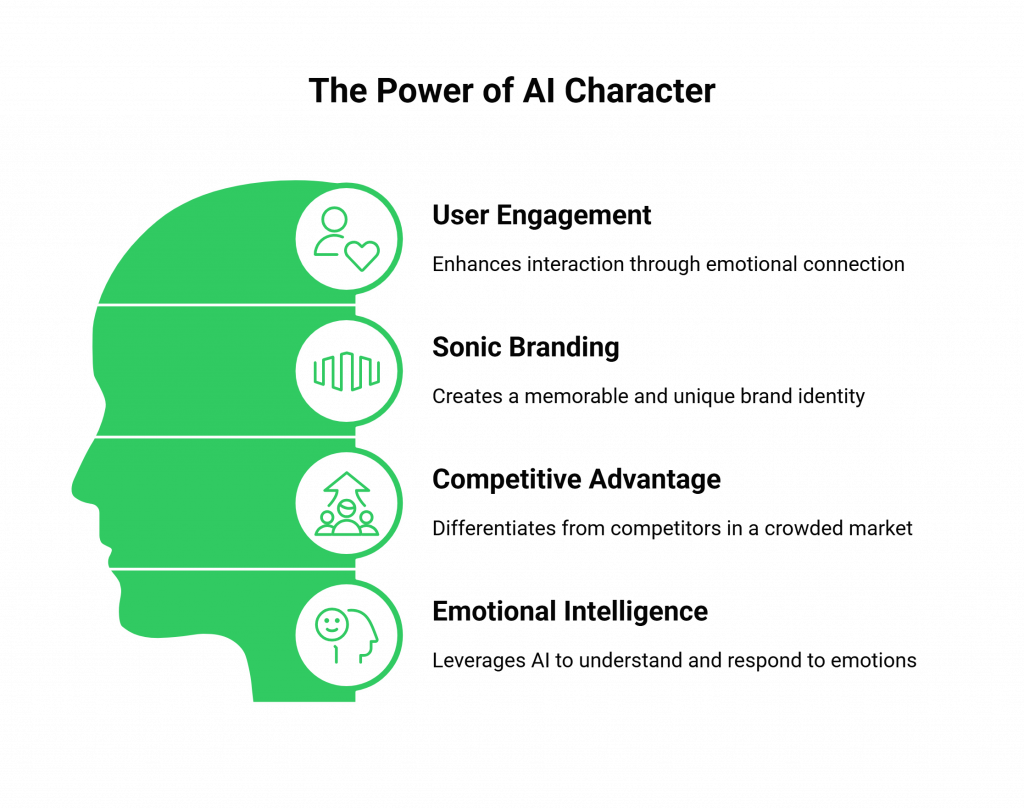
Moving beyond a generic, utilitarian voice is a strategic decision that can create a powerful and lasting connection with your users. In a crowded digital world, a memorable personality is a massive competitive advantage.
How Does Personality Drive Deeper User Engagement?
Humans are wired for connection. We don’t just remember information; we remember how someone made us feel. A voice AI with a well-defined character can be dramatically more engaging than a standard, robotic assistant. Users are more likely to spend more time interacting with a bot that is entertaining, empathetic, or interesting.
This increased “time on task” is a key metric for engagement. The market for emotionally intelligent AI is a clear indicator of this trend, with a report from MarketsandMarkets projecting the Emotion Detection and Recognition market to grow to $52 billion by 2028.
How Can You Create a Powerful “Sonic Brand”?
Your brand is more than just a logo and a color scheme; it’s a personality. A Character AI is the ultimate expression of that personality. It’s your “sonic brand”, the audible voice of your company.
Do you want your brand to sound innovative and witty? Calm and reassuring? Fun and playful? A custom character AI allows you to craft an experience that is a perfect, living embodiment of your brand’s values, creating a much stronger and more memorable identity.
What Are the Top Use Cases for a Character AI Voice Chat?
- Immersive Gaming: Imagine an in-game Non-Player Character (NPC) that you can have a full, dynamic, and unscripted conversation with. A character AI can bring a game world to life in a way that pre-recorded dialogue never could.
- Interactive Storytelling & Education: A historical figure can guide a student through a virtual museum, or a beloved cartoon character can help a child learn to read.
- Brand Mascots & Marketing: Your brand’s mascot can become a real, interactive personality that customers can talk to, creating a fun and memorable marketing experience.
- Next-Generation Companionship: For applications in mental wellness or elder care, a voice AI with a consistently patient, empathetic, and supportive personality can provide valuable companionship.
Also Read: How To Integrate Tool Calling Into Voice Conversations?
What is the Anatomy of a Character AI Voice Chat?
Building an AI with a believable personality requires a “best-of-breed” technology stack where each component is chosen for its specific ability to contribute to the character. Think of it as casting the perfect actors and crew for a movie.
- The “Actor” (The Expressive TTS Voice): This is the most crucial choice. The Text-to-Speech (TTS) voice is the literal voice of your character. You need a modern, expressive TTS engine that can deliver a wide range of emotions and intonations. The ability to control the pitch, pace, and style of the voice is what brings the character to life.
- The “Screenwriter” (The Persona-Driven LLM): This is the AI’s “brain.” The Large Language Model is responsible for generating the words that the actor will speak. Through careful and detailed prompt engineering, you will define the character’s entire personality: their backstory, their quirks, their sense of humor, and their unique way of speaking.
- The “Ears” (The Accurate STT): The best actor in the world can’t perform if they can’t hear their cues. A high-quality, low-latency Speech-to-Text (STT) engine is essential for accurately transcribing what the user is saying, especially in a rapid, back-and-forth conversation.
- The “Soundstage” (The Real-Time Voice Infrastructure): This is the invisible but essential foundation. The soundstage is the voice infrastructure that connects the user to your AI actor in real-time. A platform like FreJun AI provides this high-performance soundstage. It handles the ultra-low-latency, crystal-clear audio streaming that is the absolute prerequisite for a believable, interactive performance.
What are the Platforms and Tools for Building a Character AI?
To build a truly custom Character AI, an API-first, model-agnostic approach is the only way to go. You need the freedom to choose the perfect “actor” and “screenwriter” for your specific character.
For the “Actor” (Expressive TTS)
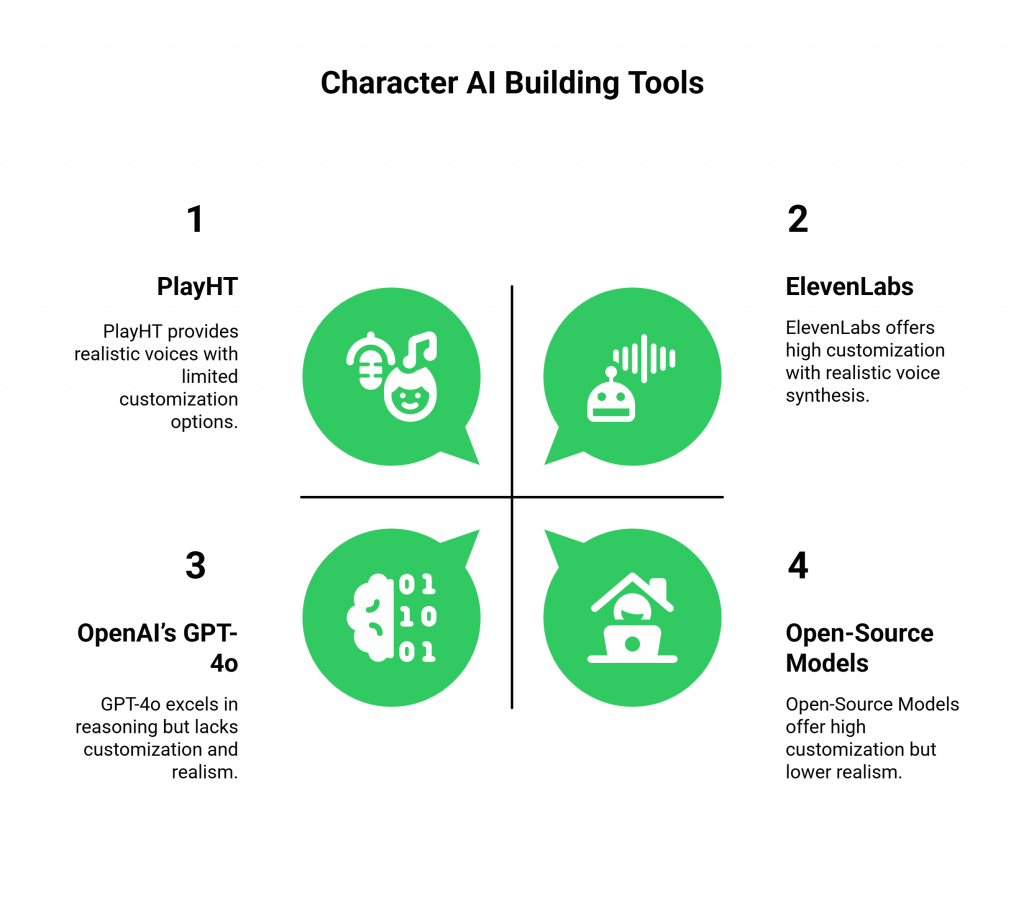
- ElevenLabs: A market leader in expressive and realistic voice synthesis. They offer a huge library of high-quality stock voices and, most importantly, powerful tools for voice cloning and creating completely custom, unique voices.
- PlayHT: Another top-tier provider known for its ultra-realistic and conversational TTS voices. They also offer a wide range of styles and emotions, making them a great choice for character work.
For the “Screenwriter” (The LLM)
- OpenAI’s GPT-4o: Known for its state-of-the-art reasoning and its ability to follow complex persona instructions.
- Anthropic’s Claude 3: Praised for its more nuanced and “thoughtful” conversational style, which can be ideal for creating more empathetic or philosophical characters.
- Open-Source Models (Llama 3, Gemma 2): For developers who need to self-host for data privacy or want to deeply fine-tune a model on a character’s specific “writings,” open-source models offer the ultimate control.
Also Read: How To Scale Voice Agents For Millions Of Calls?
Why FreJun AI is the Perfect Foundation?
To bring your custom-cast “actor” and “screenwriter” together, you need a voice infrastructure that is built for this kind of creative freedom. This is where FreJun AI provides the essential, foundational platform.
We are a model-agnostic platform. This is our superpower for developers building Character AI. It means you are not locked into a single, generic TTS voice or a single LLM “personality.” You have the complete freedom to choose the most expressive, most powerful, and most suitable AI components from any provider on the market.
We provide the high-performance, ultra-low-latency “nervous system” that allows you to plug in your “best-of-breed” brain and voice, giving you the power to create a character that is truly unique.
Ready to create a voice AI with a personality? Sign up for a FreJun AI and start integrating your custom character today.
What are the Advanced Design Principles for a Believable Character?
Building a great character goes beyond just the technology. It’s about the art of conversation.
- Create a Detailed Backstory and Persona: Before you write a single line of code, write a “character sheet” for your AI. Where is it from? What are its goals? What are its pet peeves? The more detailed the persona, the more consistently the LLM will be able to embody it.
- Use Idiosyncratic Language: Real people have unique verbal tics and favorite phrases. Program your LLM to use a specific set of words or a unique style of speaking that reinforces its character.
- Maintain Conversational Memory: A believable character remembers what you’ve talked about before. Implementing both short-term (current conversation) and long-term (past conversations) memory is the key to making the interaction feel like a real, developing relationship.
- Handle Interruptions Naturally: A key part of a natural conversation is the ability to handle interruptions. The user should be able to speak over the AI, and the AI should gracefully stop, listen, and respond.
This focus on a high-quality experience is critical. A recent study on brand loyalty showed that customers who have a positive emotional connection with a brand have a 306% higher lifetime value. A well-designed Character AI is a powerful tool for building that connection.
Also Read: Voice Interface UX Mistakes Businesses Should Avoid
Conclusion
We are moving beyond the era of the generic, utilitarian AI Voice Chat. The future of conversational AI is in creating memorable, engaging, and persona-driven experiences. For developers, this is an incredible opportunity to blend creative storytelling with cutting-edge technology.
By carefully selecting the right AI “actors” and “screenwriters,” and by building on a foundation of a flexible, high-performance voice infrastructure, you have the complete toolkit to build a Character AI Voice Chat that can entertain, educate, and create a lasting connection with your audience.
Want to learn how a model-agnostic infrastructure can help you build a unique Character AI? Schedule a demo with FreJun Teler!
Also Read: What Is Click to Call and How Does It Simplify Business Communication?
Frequently Asked Questions (FAQs)
A Character AI Voice Chat is a conversational AI that is designed to embody a specific personality or persona. It goes beyond simple question-answering to have conversations in a unique, consistent, and engaging style, much like a character in a story or game.
A standard voicebot is typically designed for efficiency and a neutral, professional tone. A character AI is designed for engagement and personality. Its responses are shaped by its defined character traits, which might include humor, empathy, or a specific knowledge domain.
A “sonic brand” is the audible identity of your company. It’s the unique sound and voice that customers associate with your brand, just like a visual logo. A Character AI’s voice is a key component of a sonic brand.
The most important technology is the Text-to-Speech (TTS) engine. You need a modern, “expressive” TTS that can deliver a wide range of emotions and intonations and, ideally, one that allows for the creation of completely custom voices.
This is done through a technique called prompt engineering. You provide the LLM with a very detailed “system prompt” that acts as a character sheet, describing its name, backstory, personality traits, and specific rules for how it should speak.
Voice cloning is a feature offered by some advanced TTS providers (like ElevenLabs) that allows you to create a unique AI voice based on a short recording of a real person’s voice. This is a powerful tool for creating a truly custom character.
Yes. For example, a “calm and reassuring” character could be designed for a mental wellness app, or a “hyper-professional and precise” character could be designed to interact with financial analysts. The character should always be appropriate for the use case.
Start by thinking about your brand’s core values. Is your brand playful, serious, luxurious, or budget-friendly? Your character’s personality should be a direct extension of these values. Write a one-page “persona document” before you write any code.