
Picture a complex, cross-country shipment. It starts on a container ship, gets transferred to a freight train, is picked up by a long-haul trucking company, and is finally handed off to a local courier for the last mile. This intricate dance involves at least four different carriers, each with its own tracking system, its own dispatchers, and its own way of doing things.
Now, imagine the long-haul truck gets a flat tire and will be three hours late for the handoff. How is that information relayed down the chain? The answer, all too often, is a frantic, manual chain of phone calls, emails, and text messages, a logistical “game of telephone” where information is delayed, distorted, or lost entirely.
This is the communication black hole at the heart of modern logistics. The solution is not more phone calls; it’s smarter ones, powered by a voice API for developers.
The supply chain is no longer a linear chain; it’s a complex, interconnected web. A single disruption can have a cascading effect, causing costly delays and frustrated clients.
By using a voice API to build automated, real-time communication workflows directly into their operational software, logistics companies can bridge the communication gaps between carriers, creating a more resilient, efficient, and transparent supply chain.
Table of contents
Why is Traditional Carrier Communication So Inefficient?
The traditional methods of coordinating between different shipping, trucking, and rail companies are a relic of a pre-digital era. They rely on human-to-human interaction for tasks that should be automated, creating a system that is slow, prone to error, and simply cannot scale to meet the demands of modern commerce. The core of the problem lies in the fragmented nature of the industry. The primary inefficiencies include:
- Deeply Entrenched Data Silos: Every carrier operates on its own Transportation Management System (TMS), Warehouse Management System (WMS), or proprietary software. These systems are not designed to talk to each other, creating digital islands with no bridges between them.
- Reliance on Manual Processes: When systems can’t communicate, the burden falls on human dispatchers and coordinators. They spend their days making and receiving phone calls to confirm pickups, report delays, and get status updates. This is an incredibly inefficient use of skilled human capital.
- The Lag of “Stale” Information: By the time a dispatcher from Carrier A gets off the phone with a supervisor from Carrier B and manually updates their system, the information is already minutes, or even hours, old. In logistics, real-time data is everything, and manual communication can never be truly real-time.
- High Potential for Human Error: A misheard dock number, a mistyped container ID, or a forgotten follow-up call can all lead to significant delays and costs. When humans are the primary data transfer mechanism, errors are inevitable. A McKinsey report highlights the fragility of this system, noting that significant supply chain disruptions can cost a company the equivalent of 45% of one year’s profits over the course of a decade.
Also Read: How to Add Voice to Your AI Agent?
What Exactly is a Voice API for Developers?
To understand the solution, it’s important to first understand the tool. An API, or Application Programming Interface, is a set of rules and tools that allows different software applications to communicate with each other. A voice API for developers takes this concept and applies it to voice communication.
Think of it as a box of building blocks for voice. It is not a finished application like Skype or Zoom. Instead, it is a toolkit that gives software developers the power to embed voice functionalities like making calls, receiving calls, and streaming audio, directly into their own custom applications.
This is the key difference: a voice API for developers is about creation. It lets a company build its own unique communication workflows tailored to its specific operational needs, turning any piece of logistics software into an intelligent communication hub.
How Can a Voice API Streamline Carrier Coordination?
By integrating a voice API for developers into their core operational software, logistics companies can automate the critical communication touchpoints between different carriers. This creates a unified, machine-to-machine communication layer that is faster, more accurate, and more reliable than any manual process.
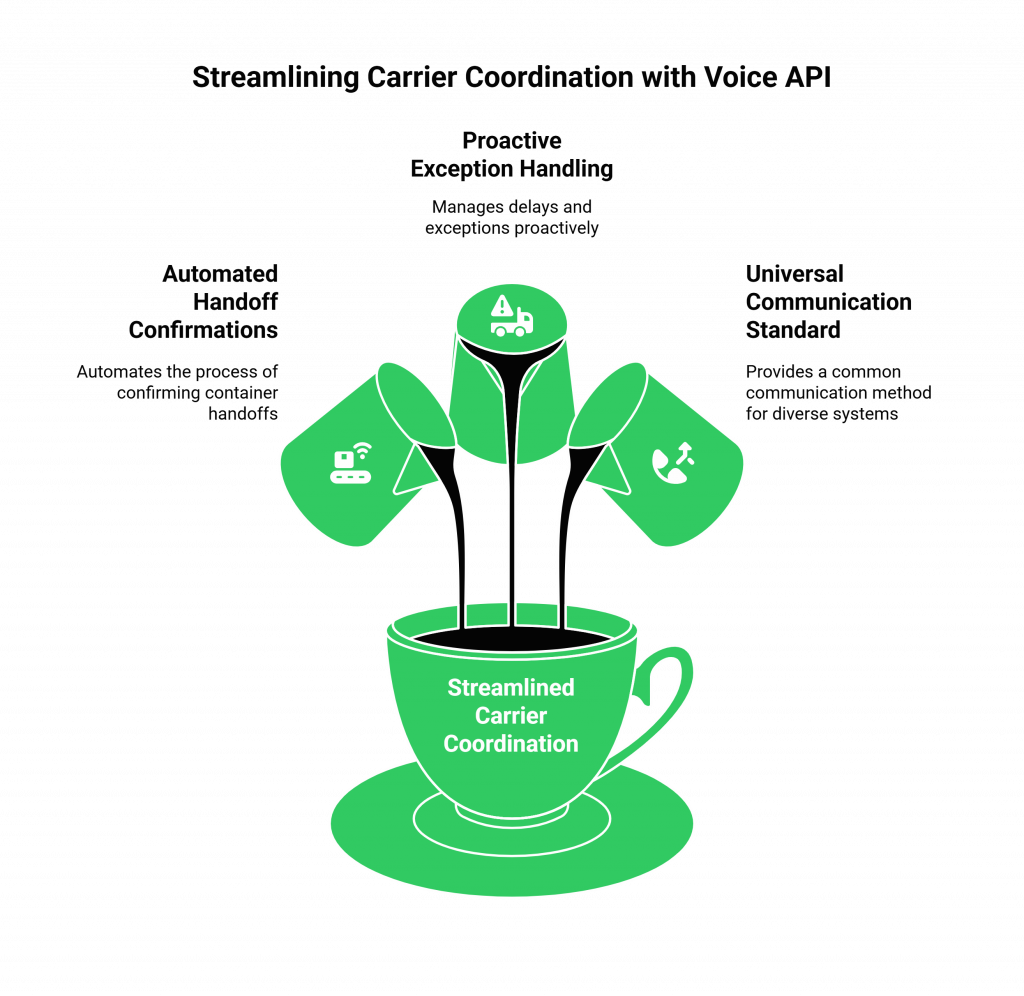
How Does It Automate Handoff Confirmations?
This is one of the most powerful applications. Imagine a container being unloaded from a train at a railyard.
- The railyard’s system scans the container, marking it as “ready for pickup.”
- This event automatically triggers an API call through a platform like FreJun AI.
- The system makes an automated voice call to the designated trucking company’s automated receiving line.
- The AI voice says, “This is an automated notification from Union Rail Yard. Container ID US-456 is now staged and ready for pickup at Bay 12. Please confirm receipt of this message.”
- The trucking company’s system can send a simple audio tone or a verbal “Confirmed,” and both systems instantly and automatically log the transaction.
How Does It Enable Proactive Exception Handling?
The real value of a supply chain is in how it handles problems. A voice API for developers allows for the creation of intelligent alert systems that can proactively manage exceptions. For example, a long-haul truck is equipped with GPS that is integrated with its TMS.
- The TMS detects that the truck is stuck in a major traffic jam and will miss its scheduled delivery window at a distribution center.
- Instead of waiting for the driver to call, the TMS automatically triggers a voice API call to the distribution center’s scheduling line.
- The AI voice can state, “Alert: This is an automated message from Express Hauling. Truck 78, carrying Bill of Lading 91011, is projecting a 2-hour delay due to an incident on I-80. The new estimated time of arrival is 16:30. Please advise on a new receiving dock assignment.”
This proactive communication allows the distribution center to adjust its labor and dock schedule, minimizing the ripple effect of the delay.
Also Read: How to Stream Audio to Your AI Model in Real Time?
How Does It Create a Universal Communication Standard?
A voice API acts as a universal translator. It doesn’t matter if Carrier A uses an old legacy system and Carrier B uses the latest cloud-based TMS. The voice call becomes the common standard.
As long as a system can receive a phone call (even an automated one), it can be integrated into this communication web. This allows for rapid integration between partners without the need for complex and costly direct software integrations.
Here is a clear comparison of the two methods:
| Task | Manual Coordination Method | API-Driven Coordination Method |
| Handoff Confirmation | Dispatcher waits for an email or makes a phone call to confirm readiness. | Automated voice call is triggered by a system event (e.g., a scan). |
| Delay Notification | Driver calls dispatcher, who then calls the receiving party. | GPS/TMS automatically detects the delay and triggers an alert call. |
| Status Check | A coordinator calls their counterpart at another carrier to ask for an update. | System can “call” the other system’s automated line to get a real-time status. |
| Audit Trail | Relies on manual call logs and notes. | Every automated call is digitally logged with a timestamp and outcome. |
What Are the Key Considerations When Choosing a Voice API for Developers?
When you decide to build these kinds of mission-critical workflows, the quality of your underlying infrastructure is paramount. A logistics operation is a 24/7/365 environment, and your communication system must be just as robust. Key factors to consider include:
- Enterprise-Grade Reliability: The API cannot fail. You need a platform with a geographically distributed infrastructure and a guarantee of high uptime. FreJun AI is built for this level of enterprise reliability.
- Ultra-Low Latency: For real-time, interactive conversations whether between two AIs or an AI and a human, there can be no perceptible delay. A low-latency architecture is essential for natural-sounding interactions, which is a core focus of the FreJun AI platform.
- A Superior Developer Experience: A voice API for developers is only as good as the tools provided to use it. Look for comprehensive SDKs, clear and detailed documentation, and responsive developer support to accelerate your build time.
- Flexibility and Model Agnosticism: The world of AI is changing fast. You do not want to be locked into a single AI provider’s STT or LLM. A model-agnostic platform like FreJun AI gives you the freedom to bring your own AI models, allowing you to use the best technology for the job and future-proof your solution. We handle the complex voice infrastructure so you can focus on building your AI.
Ready to build a more connected and resilient supply chain? Sign up for FreJun AI and get your API keys to start building today.
Also Read: Support and SLAs for Voice API Users
Conclusion
The era of coordinating a multi-billion dollar supply chain with a series of manual phone calls is coming to an end. The communication black holes between carriers represent one of the biggest remaining frontiers for optimization in the logistics industry.
A voice API for developers provides the essential toolkit to build a modern, automated, and intelligent communication network.
By automating handoffs, proactively managing exceptions, and creating a universal standard for interaction, this technology makes the entire supply chain faster, more transparent, and more resilient.
For logistics companies looking to gain a competitive edge, embracing a powerful and flexible voice API for developers is the key to unlocking the next level of operational excellence.
Want to discuss how a voice API can solve your specific inter-carrier coordination challenges? Schedule a demo for FreJun Teler.
Also Read: America Code Number: How to Dial the USA from UAE
Frequently Asked Questions (FAQs)
It is a set of programming tools that lets developers embed voice features, such as automated calls and intelligent routing, directly into TMS or logistics software.
A VoIP system is a tool for humans to talk to each other. A voice API for developers is a tool for software systems to talk to each other (or to humans) in an automated way, based on triggers and logic within the software.
Yes. The beauty of a voice API lies in its universality. The automated call can reach a traditional phone number where a human dispatcher receives the automated message, still improving the speed and reliability of the notification.
By integrating with multilingual AI models for Text-to-Speech (TTS) and Speech-to-Text (STT), the system can make and understand calls in virtually any language, which is essential for global supply chains.
Yes. A platform like FreJun AI uses enterprise-grade security. It applies protocols like Secure Real-time Transport Protocol (SRTP) and Transport Layer Security (TLS) to encrypt all voice communication, ensuring that it protects sensitive shipment data.
Yes. The system follows clear escalation paths and automatically transfers complex calls from AI to a human coordinator.
A voice API enables hands-free driver reporting, using simple voice commands to update the TMS automatically.
It reduces delays, lowers coordination labor costs, and improves asset utilization by enabling faster, more efficient operational handoffs.
With a modern, developer-first platform like FreJun AI, developers can use SDKs and documentation to build and test a functional prototype in days, not months.