
You have likely been there before and you call your bank to check on a strange transaction. You are worried and in a hurry. But before you can get an answer you have to pass a test. “What is your mother’s maiden name?” “What was the name of your first pet?” “Please state the last four digits of your social security number.”
This interrogation takes two or three minutes. It is annoying for you. It is expensive for the bank because time is money. And the worst part is that it is not even very secure. Hackers can find your mother’s maiden name on social media in five seconds.
Now imagine a different world. You call the bank. You say “Hi I am calling about a charge on my card.” The agent says “Hello Mr. Smith I have verified your voice. Let us look at that charge.”
No questions, No PINs, and No stress. You just speak and the system knows it is you.
This is the promise of voice biometrics. It turns your voice into your password. But how do businesses actually build this into their phone systems? They cannot just install a microphone and hope for the best. They need a robust connection between the telephone network and the security software.
This connection is called voice API integration. By integrating voice APIs with biometric engines developers are building a fortress that is both stronger and friendlier than the old walls of passwords. In this guide we will explore how this technology works and why infrastructure is the secret ingredient to accuracy and how platforms like FreJun AI make it possible.
Table of contents
- The Failure of Traditional Authentication
- How Voice Biometrics Works
- The Role of Voice API Integration
- Why Infrastructure Determine Accuracy
- Security vs Convenience
- Preventing Fraud and Spoofing
- Comparison of Authentication Methods
- Integrating Voice Biometrics Step by Step
- The Importance of Low Latency
- Use Cases Beyond Banking
- Is It Future Proof?
- Conclusion
- Frequently Asked Questions (FAQs)
The Failure of Traditional Authentication
We need to be honest about the current state of security. It is broken.
Knowledge Based Authentication (KBA) relies on things you know. Passwords and PINs and secret answers. The problem is that fraudsters know them too. Data breaches happen every day. Millions of passwords are floating around on the dark web.
According to a report by Verizon, over 80% of hacking related breaches involve the use of lost or stolen credentials. If a hacker has your password the system thinks they are you. It cannot tell the difference.
This is where biometrics comes in. Biometrics relies on who you are. Your fingerprint or your face or your voice. You cannot lose your voice. A hacker cannot steal it from a database in the same way they steal a text file.
How Voice Biometrics Works
Your voice is unique. It is not just about pitch. It is about the shape of your mouth and the length of your vocal tract and the way you form words.
When you speak a biometric engine analyzes hundreds of unique characteristics. It creates a digital map called a “voiceprint.”
When you call again the system compares your live voice to the stored voiceprint. If they match you are authenticated.
There are two main types used in voice API integration.
- Active Verification: You are asked to say a specific phrase like “My voice is my password.” This is often used for high security actions like resetting a password.
- Passive Verification: The system listens in the background while you talk to the agent. After a few seconds of natural conversation it lights up green to say “Verified.” This is the gold standard for customer experience.
Also Read: Why Are Voice Bot Solutions Ideal for AI-Assisted Sales Calls?
The Role of Voice API Integration
So where does the API fit in?
A bank or a healthcare company does not build the biometric engine themselves. They buy it from experts like Nuance or Pindrop. But those engines live on servers. They are not phones.
You need a way to get the audio from the phone call to the engine.
This is the job of voice API integration. It acts as the courier.
- Capture: The API accepts the incoming call via the telephone network.
- Stream: It forks the audio stream. One stream goes to the human agent. The other stream goes to the biometric engine.
- Process: The engine analyzes the audio in real time.
- Signal: The engine sends a signal back through the API to the agent’s screen saying “Identity Verified.”
Without a robust API this real time data transfer is impossible.
Why Infrastructure Determine Accuracy
Here is the catch. Voice biometrics is sensitive. It needs high quality audio to work.
If you have ever been on a bad cell phone call where the audio cuts out or sounds robotic you know what “jitter” and “packet loss” sound like.
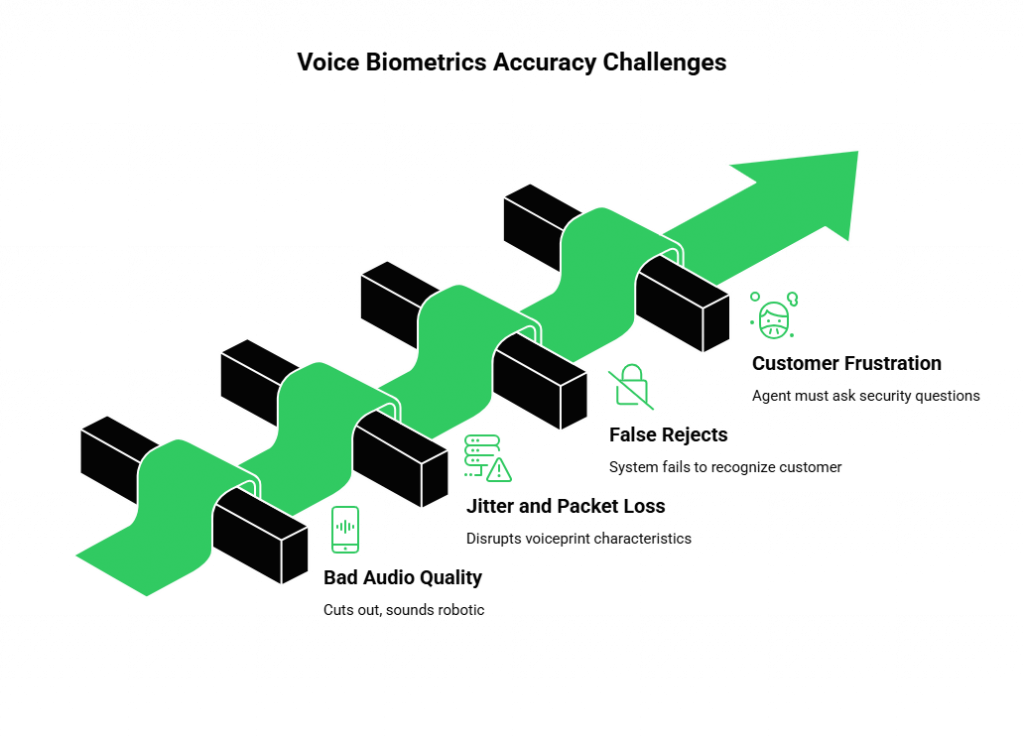
To a human this is annoying. To a biometric engine it is a disaster. If the audio is choppy the engine cannot hear the unique characteristics of the voiceprint. It will return a “False Reject.” This means the system fails to recognize the real customer. The customer gets frustrated and the agent has to go back to asking security questions.
This is why FreJun AI is critical. We handle the complex voice infrastructure so you can focus on building your AI.
FreJun prioritizes audio fidelity. We use FreJun Teler which provides elastic SIP trunking to ensure a stable connection to the carrier network. We optimize the media path to reduce latency and jitter. By delivering a clean and high definition audio stream to the biometric engine we ensure that your authentication rates remain high and your customers remain happy.
Ready to build secure voice applications? Sign up for FreJun AI to access our high fidelity voice infrastructure.
Security vs Convenience
Security usually comes at the cost of convenience.
- High Security: Long passwords and hardware tokens and multiple security questions. (Low Convenience)
- High Convenience: No passwords. (Low Security)
Voice API integration with biometrics is one of the rare technologies that offers both.
It is more secure because voiceprints are incredibly hard to fake (we will discuss deepfakes later). And it is more convenient because the user does not have to do anything except speak.
Preventing Fraud and Spoofing
You might be wondering “Can’t someone just record my voice and play it back?”
This is called a “replay attack.” Early systems were vulnerable to this. Modern systems are not.
Advanced biometric engines use “Liveness Detection.” They look for subtle artifacts in the audio that indicate a recording and they can detect the electronic noise of a speaker playing into a microphone. They can detect if the voice is generated by a computer (a deepfake).
However these detection algorithms require data. They need to analyze the full frequency range of the audio.
If your voice provider compresses the audio too much (to save money on bandwidth) they strip away the data needed to detect fraud.
FreJun AI understands this. We support high quality codecs. We ensure that the full richness of the audio signal is preserved and passed to your security engine. This gives the anti-spoofing algorithms the data they need to catch the bad guys.
Also Read: What Future Trends Are Shaping Voice Bot Solutions in 2026?
Comparison of Authentication Methods
Let us look at how voice stacks up against other methods.
| Feature | Password / PIN | SMS 2FA | Voice Biometrics |
| User Effort | High (Must remember) | Medium (Must check phone) | Low (Just speak) |
| Security | Low (Easily stolen) | Medium (SIM swapping risk) | High (Biological trait) |
| Speed | Slow (Typing) | Slow (Waiting for code) | Fast (Instant) |
| Cost | Low | Medium (SMS fees) | Medium (Engine fees) |
| Spoofability | High | Medium | Very Low (With liveness) |
| Customer Experience | Frustrating | Interruptive | Seamless |
Integrating Voice Biometrics Step by Step
If you are a developer looking to implement this here is the workflow.
Step 1 choose Your Engine
Select a biometric vendor. This could be Nuance or Pindrop or a cloud API like Azure Speaker Recognition.
Step 2 Secure Your Transport
You need a voice provider to handle the calls. Use FreJun Teler for your SIP connectivity. This ensures you have global reach and reliable uptime.
Step 3 Fork the Audio
Using FreJun’s API you will create a WebSocket connection. When a call comes in you stream the audio to two places.
- The Agent (so they can talk).
- The Biometric API (so it can listen).
Step 4 Handle the Webhook
The biometric engine will process the audio. When it reaches a decision (Match or No Match) it sends a webhook to your server.
Step 5 Update the UI
Your server receives the webhook and pushes a notification to the agent’s CRM. A green checkmark appears next to the customer’s name.
The Importance of Low Latency
In a passive authentication scenario speed matters.
Imagine the customer calls. They talk for ten seconds. The agent is about to ask a security question.
If the system is fast the green checkmark appears before the agent asks the question.
If the system is slow (high latency) the agent asks the question and then the checkmark appears five seconds later. The opportunity is lost. The customer is already annoyed.
FreJun AI is optimized for low latency. We route media packets through the fastest available paths. This ensures that the audio reaches the biometric engine instantly allowing for a verification decision in near real time.
Use Cases Beyond Banking
While banks were the early adopters voice API integration is spreading to other industries.
Healthcare
Doctors calling into a hospital system to dictate notes or prescribe medication need to be verified. Voice biometrics ensures that the person speaking is actually the doctor ensuring HIPAA compliance without slowing them down with passwords.
Remote Work
Employees calling into an internal IT helpdesk to reset a password are a prime target for social engineering hackers. Voice verification ensures IT is helping the real employee not an imposter.
Call Centers
Any high volume support center can use this to shave 30 to 60 seconds off every call. When you multiply that by a million calls a year the cost savings are massive.
Is It Future Proof?
Voice technology is moving fast. We are seeing the rise of “synthetic voice” or deepfakes.
This is an arms race. As the fakes get better the detection gets better.
The one constant is the need for data. To distinguish a fake from a real voice you need more resolution and more frequencies and cleaner audio.
By building your application on a robust infrastructure like FreJun you are future proofing your stack. We provide the high bandwidth pipe that future security algorithms will demand. We are model agnostic meaning you can switch biometric vendors whenever a better one comes out without changing your telephony infrastructure.
Also Read: How Does a Voice API for Developers Help Build Smarter Voice Workflows?
Conclusion
The password is dying. It had a good run but it is no longer fit for the modern world. It is too insecure for businesses and too annoying for humans.
Voice biometrics offers a better way. It allows us to prove our identity simply by being ourselves. It strengthens security by relying on biological traits rather than shared secrets.
But a biometric engine is only as good as the audio it hears. If you feed it garbage audio you will get garbage results.
This is why voice API integration is the foundation of modern security. It provides the clean and reliable and fast connection between the caller and the verification system. Platforms like FreJun AI are the unsung heroes of this revolution. By providing the elastic infrastructure and the low latency streaming required for high fidelity analysis we enable developers to build authentication flows that are unbreakable and invisible.
Want to discuss how to secure your voice channels? Schedule a demo with our team at FreJun Teler and let us help you build a safer and faster authentication flow.
Also Read: Call Routing for E-Commerce Businesses: Faster Support, Better Conversions
Frequently Asked Questions (FAQs)
Voice recognition (Speech to Text) figures out what is being said. Voice biometrics figures out who is saying it. One is for transcription and the other is for identity.
Generally no. Modern systems use “Liveness Detection” to identify recordings. They look for the lack of specific frequencies that a live human voice produces. However using a high quality voice provider like FreJun is essential to preserve these subtle signals.
Most advanced systems can still recognize you. Your vocal tract shape does not change much with a cold. If your voice is extremely distorted the system might fail to match (False Reject) in which case the agent will revert to asking security questions.
No. A voiceprint is a mathematical hash or a string of numbers. It is not a recording. Even if a hacker stole the voiceprint database they could not play it back to listen to your voice.
FreJun provides the transport layer. We capture the call via FreJun Teler and stream the high quality audio to your chosen biometric engine. We do not perform the biometrics ourselves but we ensure the engine gets the clean data it needs to work.
Yes but you must obtain consent. You typically hear a message saying “Voice is used for authentication” at the start of the call. The storage and processing of biometric data must adhere to strict privacy regulations.
Yes. If you are calling a customer to confirm a high value transaction you can use voice biometrics to verify they are the account holder before discussing sensitive details.