
Imagine running a logistics company with a fleet of five hundred trucks. To manage this fleet you decide to build your own gas stations in every city where your trucks stop. You hire mechanics to staff those gas stations 24 hours a day. You buy the fuel tankers to fill them up.
This sounds incredibly expensive and inefficient. It would be much smarter to just use existing gas stations and pay for the fuel you need when you need it.
Yet for decades this is exactly how enterprises handled their phone systems. They bought massive hardware servers called PBX (Private Branch Exchange) systems and rented expensive dedicated copper lines from phone companies. They hired specialized technicians to fix the wires when they broke.
This approach costs businesses millions of dollars in wasted capital and maintenance.
Today there is a better way. It is called voice API integration. By moving communications from hardware to software enterprises can slash their operational costs significantly.
In this guide we will explore the financial impact of modernizing your voice infrastructure. We will look at how eliminating hardware and automating workflows and using elastic scaling can save your budget. We will also discuss how infrastructure providers like FreJun AI act as the efficient foundation that makes these savings possible.
Table of contents
- How Does It Eliminate Hardware Costs (CapEx)?
- Why Is Maintenance Cheaper with APIs?
- How Does Scalability Prevent Waste?
- How Does Automation Reduce Labor Costs?
- How Does FreJun AI Optimize Infrastructure Spend?
- How Can Integration Improve Productivity?
- Comparing Traditional Costs vs API Costs
- How Do Global Operations Save on Long Distance?
- What Are the Hidden Costs of Poor Quality?
- How Does AI Automation Further Reduce Costs?
- Conclusion
- Frequently Asked Questions (FAQs)
How Does It Eliminate Hardware Costs (CapEx)?
The most immediate saving is in Capital Expenditure (CapEx). In the legacy model setting up a call center required a massive upfront investment. You had to buy:
- Physical servers.
- Desk phones for every agent.
- Routers and switches.
- Cooling systems for the server room.
This equipment depreciates quickly. It breaks. It needs to be replaced every five to seven years.
With voice API integration this hardware cost disappears. The infrastructure lives in the cloud. You do not buy servers. You do not need a dedicated room with air conditioning. Your agents can make calls using a laptop and a headset.
You shift from CapEx (buying heavy things) to OpEx (Operating Expense). You only pay for the minutes you use. This frees up massive amounts of cash that can be invested in product development or marketing.
Why Is Maintenance Cheaper with APIs?
Hardware breaks. When a physical PBX goes down you have to call a specialist. They charge a high hourly rate. You have to wait for them to drive to your office. This is called a “truck roll.”
Every truck roll costs money. Plus while you wait your business is offline which costs even more.
With a cloud based API solution there is no hardware to fix. The provider (like FreJun) manages the servers. If a server fails traffic is automatically rerouted to a backup.
Also Read: How Do Voice Bot Solutions Deliver Human-Like Voice Interactions?
How Does Scalability Prevent Waste?
Legacy systems force you to guess the future.
Imagine you are a retailer. You expect a huge spike in calls during Black Friday. To handle this you buy enough phone lines for your busiest day. Let us say you buy 500 lines.
But for the rest of the year you only need 100 lines. You are paying for 400 lines that sit empty for ten months. This is “over provisioning” and it is a massive waste of money.
Voice API integration solves this with “elasticity.”
Platforms like FreJun offer elastic SIP trunking via FreJun Teler. This works like electricity. When you turn on more lights you pay for more power. When you turn them off the bill goes down.
If you need 500 lines for one day you get them instantly. The next day you scale back down to 100. You never pay for capacity you are not using. This efficient scaling is one of the biggest drivers of cost reduction for seasonal businesses.
How Does Automation Reduce Labor Costs?
Labor is usually the biggest expense for any enterprise. If you have highly paid staff answering simple questions you are burning money.
“What are your opening hours?”
“What is my account balance?”
“Is my order shipped?”
A human agent costs dollars per minute to answer these. An automated system costs fractions of a penny.
Voice API integration enables you to build smart Interactive Voice Response (IVR) systems. Unlike the dumb menus of the past these systems can connect to your database. They can look up the answer and speak it to the customer.
By deflecting these routine calls you reduce the number of human agents you need. Or better yet you free up your existing agents to focus on high value sales calls that actually generate revenue.
How Does FreJun AI Optimize Infrastructure Spend?
Not all APIs are priced the same. And not all run efficiently.
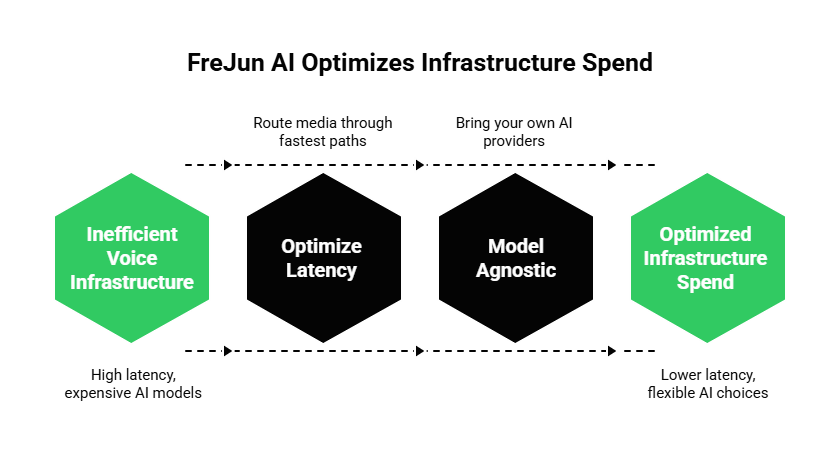
FreJun AI is designed to be the “plumbing” of the voice world. We handle the complex voice infrastructure so you can focus on building your AI and business logic.
Lower Latency Means Shorter Calls
Time is money. In a contact center Average Handle Time (AHT) is a key metric. If your audio is choppy or has a delay (latency) the conversation takes longer.
- Agent: “Hello?”
- (2 second delay)
- Customer: “Can you hear me?”
- Agent: “Yes go ahead.”
This back and forth adds seconds to every call. Over a million calls that adds up to thousands of hours of paid labor wasted on silence.
FreJun optimizes for low latency. We route media through the fastest paths. Clearer audio means faster resolution which means lower labor costs.
Model Agnostic Flexibility
Some platforms lock you into their ecosystem. They force you to use their AI models which might be expensive.
FreJun is model agnostic. You can bring your own Speech to Text or Large Language Model providers. This allows you to shop around for the cheapest or most efficient AI brain while using FreJun for the reliable transport. This flexibility prevents vendor lock in and keeps your costs under control.
Ready to stop paying for unused capacity? Sign up for FreJun AI and start optimizing your voice spend.
How Can Integration Improve Productivity?
Operational costs are not just about the phone bill. They are about how much work your team gets done.
In a non integrated system an agent has to:
- Answer the phone.
- Ask the customer for their ID.
- Type the ID into the CRM.
- Wait for it to load.
This manual process takes time.
With voice API integration you can connect the phone system to your CRM (like Salesforce or HubSpot). When the call comes in the API looks up the phone number and pops the customer record on the screen instantly.
This saves 15 to 30 seconds per call. If you have 100 agents taking 50 calls a day that is a massive amount of time saved. It essentially gives you “free” employees by making your existing team more efficient.
Also Read: What Role Do Voice bot Solutions Play in AI-First Business Workflows?
Comparing Traditional Costs vs API Costs
Here is a breakdown of where the money goes in both models.
| Cost Category | Legacy Hardware System | Voice API Integration |
| Setup Cost | High (Servers and Phones) | Low (Software integration) |
| Maintenance | High (Technicians and Contracts) | Zero (Managed by provider) |
| Scalability | Expensive (Buy more hardware) | Elastic (Pay per use) |
| Upgrades | Expensive (Replace hardware) | Free (Software updates) |
| International Calls | High (Long distance rates) | Low (Local SIP routing) |
| Space | Requires server room | Zero footprint |
| Redundancy | Requires duplicate hardware | Built into the cloud |
How Do Global Operations Save on Long Distance?
If you are a global enterprise international calling fees can be a budget killer.
Traditional carriers charge a premium to route a call from New York to London.
With voice API integration using FreJun Teler you can leverage SIP trunking and local presence.
The call travels over the internet (VoIP) for most of the journey. It only drops onto the local phone network in the destination country. This bypasses the expensive international tolls.
Additionally you can purchase local phone numbers in over 100 countries programmatically. This allows your team in India to call customers in the US using a US phone number. It increases the answer rate (people answer local numbers) and significantly reduces the cost per minute.
What Are the Hidden Costs of Poor Quality?
There is a cost that does not show up on the phone bill but hits your bottom line hard. It is the cost of lost customers.
If you use a cheap low quality VoIP solution calls will drop. Audio will sound robotic due to jitter.
According to a study by PwC, 32% of all customers would stop doing business with a brand they loved after just one bad experience.
Poor voice quality is a bad experience. It makes your company look unprofessional.
FreJun AI focuses heavily on quality. Our infrastructure is built to minimize packet loss and jitter. By ensuring crystal clear conversations you protect your brand reputation and prevent customer churn. Retaining a customer is always cheaper than acquiring a new one.
How Does AI Automation Further Reduce Costs?
The next frontier of cost reduction is the AI Voice Agent.
Instead of just routing calls you can now have an AI handle the entire conversation.
- Lead Qualification: An AI calls prospects to see if they are interested.
- Appointment Booking: An AI handles scheduling.
- Support Triage: An AI solves common technical issues.
This technology allows you to scale your operations without increasing headcount. You can handle 10x the volume with the same size team.
However running AI requires a robust transport layer. FreJun provides the real time media streaming capabilities needed to connect the phone network to modern AI brains. This enables you to deploy cost saving automation that actually sounds human.
Also Read: Why Are Voice bot Solutions Critical for AI-Driven Customer Support?
Conclusion
The question was “Can voice API integration reduce operational costs?” The answer is a resounding yes.
It reduces costs by eliminating the need for expensive hardware and maintenance, reducing waste by allowing you to pay only for what you use. It reduces labor costs by automating tasks and improving agent efficiency. And it reduces communication costs by leveraging internet routing for global calls.
But to realize these savings you need the right partner. You need an infrastructure that is reliable and scalable and easy to integrate.
FreJun AI provides that foundation. With FreJun Teler for elastic connectivity and our developer friendly tools for custom integration we help enterprises modernize their communications stack. We allow you to stop spending money on “gas stations” and start spending it on growing your business.
Want to analyze your current communication spend and see where you can save? Schedule a demo with our team at FreJun Teler and let us help you build a more efficient future.
Also Read: Predictive Call Routing: Using AI Insights to Boost Agent Efficiency
Frequently Asked Questions (FAQs)
CapEx (Capital Expenditure) is money spent on physical assets like servers and phones. OpEx (Operating Expense) is money spent on ongoing services. Voice APIs shift costs from CapEx to OpEx which is generally better for cash flow and flexibility.
It allows you to pay only for the simultaneous calls you actually use rather than paying for a fixed number of lines that sit idle during quiet times.
Not necessarily. You can often use “softphones” (software on a computer) which eliminates the need for desk phones. However Voice APIs can also integrate with existing IP enabled hardware if needed.
Yes. Since the provider manages the servers you do not need to pay for hardware repairs or software patches or electricity for a server room.
Yes. FreJun Teler provides global connectivity. We route calls efficiently to lower the cost of international communication compared to traditional long distance carriers.
By connecting the phone system to the CRM customer data pops up on the screen automatically. This saves the agent from having to ask for spelling of names or account numbers saving 30-60 seconds per call.
Downtime costs thousands of dollars per minute in lost sales and productivity. Cloud based API platforms offer redundancy to minimize this risk compared to a single physical office system.
Yes. Poor quality leads to longer call times (repeating information) and frustrated customers who might leave your business. High quality infrastructure saves money in the long run.