
You are trying to log into your bank account. You type in your password. The bank says it sent a code to your phone. You wait. You wait some more. Finally, the text arrives. You type it in. You are in.
This process is called Two-Factor Authentication (2FA). It feels secure. But what if I told you that hackers have found a way to intercept that text message without ever touching your phone?
It is called SIM swapping. Criminals trick the phone company into switching your phone number to their SIM card. Once they do that, they get your texts, they get your codes, and they empty your bank account.
The world needs a better way to prove you are who you say you are. We need something that cannot be stolen like a password or intercepted like a text message. We need something that is biologically unique to you. We need your voice.
This is where voice API integration is changing the security landscape. By connecting applications directly to the telephone network, businesses can use advanced voice analysis to stop fraudsters in their tracks.
In this article, we will explore how voice technology is becoming the new firewall. We will look at voice biometrics, anti-spoofing techniques, and how robust infrastructure platforms like FreJun AI provide the crystal-clear audio required to tell a real customer from a criminal.
Table of contents
- Why Is Traditional Verification Failing?
- What Is Voice API Integration in Security?
- How Does Voice Biometrics Actually Work?
- Can Voice Integration Stop SIM Swap Attacks?
- Why Is Audio Quality Critical for Fraud Detection?
- How Does Real-Time Analysis Prevent Social Engineering?
- Is Voice Verification Faster Than SMS?
- How Do You Implement Voice Security?
- Why Is Infrastructure the Weak Link in Security?
- Comparing Voice vs. SMS vs. App Push
- What Industries Benefit Most?
- Conclusion
- Frequently Asked Questions (FAQs)
Why Is Traditional Verification Failing?
For years, the gold standard for security was the SMS One-Time Password (OTP). It was cheap and easy. But in the modern age of cybercrime, it is becoming a liability.
The problem with SMS is that it relies on possession. It assumes that if you have the phone, you are the owner. But phones can be stolen. SIM cards can be cloned. Signals can be intercepted.
According to the Federal Trade Commission (FTC), reports of SIM swapping fraud are rising sharply, resulting in millions of dollars in losses for consumers every year.
Businesses need a method that relies on inherence who you are rather than possession what you have.
This is why companies are moving toward voice API integration. When you verify a user via voice, you are not just checking a code. You can check the unique physical characteristics of their vocal tract. A hacker can steal your code, but they cannot steal your throat.
What Is Voice API Integration in Security?
To understand the solution, we must define the tool. Voice API integration is the software bridge that connects your secure application to the public telephone network.
It allows your app to make calls, receive calls, and most importantly, capture high-quality audio streams programmatically.
In a security context, the API acts as the gatekeeper.
- The user initiates a login.
- The API triggers a phone call to the user.
- The user speaks a phrase.
- The API streams that audio to an analysis engine.
- The engine approves or denies the login.
This happens in seconds. But for it to work, the audio must be flawless. If the connection is crackly, the security check fails. This is why infrastructure providers like FreJun AI are critical. We ensure that the voice data is transported with the highest possible fidelity, giving the security algorithms the clear data they need to work.
Also Read: Why Is Low Latency Essential for Modern Voice Bot Solutions?
How Does Voice Biometrics Actually Work?
You might think, “My voice sounds different when I have a cold. Will I get locked out?”
Voice biometrics is smarter than just listening to the sound. It analyzes the “voiceprint.” This is a mathematical representation of your voice. It looks at over 100 different characteristics, including:
- The shape of your larynx.
- The size of your nasal passage.
- The speed of your speech.
- The pitch and cadence.
When you integrate voice APIs, you can capture this data during a simple conversation.
Active vs. Passive Verification
- Active: The user is asked to say a specific passphrase, like “My voice is my password.” The system compares this to a stored recording.
- Passive: The user just talks naturally to a support agent. The system analyzes the voice in the background to verify identity without the user even knowing.
Can Voice Integration Stop SIM Swap Attacks?
Yes, and it does so using a few clever techniques that are only possible with voice API integration.
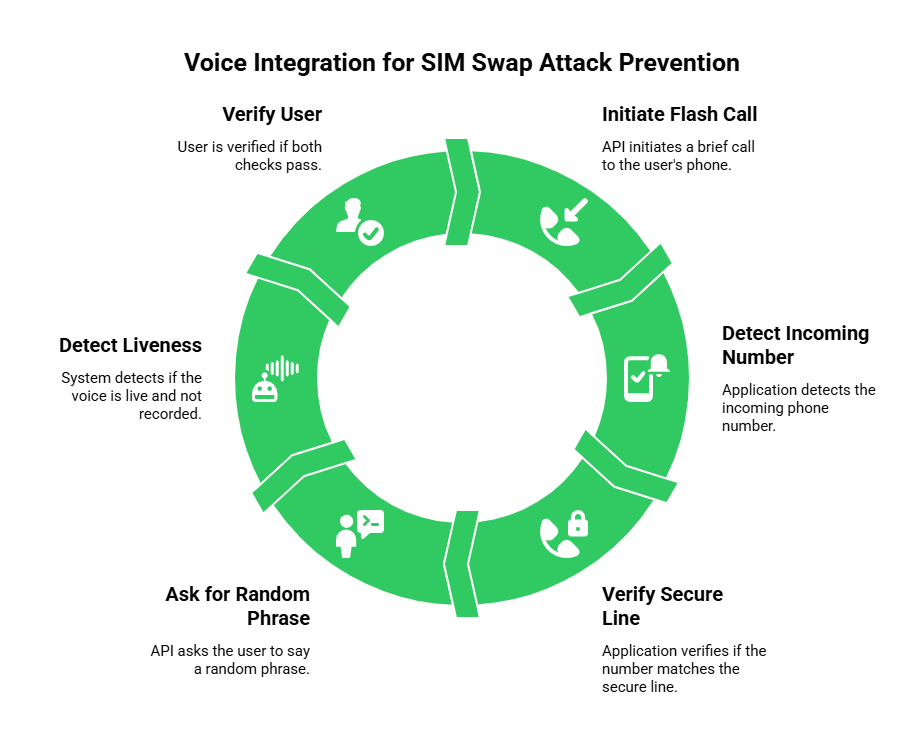
Flash Calls
This is a brilliant alternative to SMS OTPs. instead of sending a text code, the API initiates a call to the user’s phone. The call rings for a split second and then hangs up automatically. The user does not even answer.
The application detects the incoming phone number. If the number matches the secure verification line, the user is verified. This is virtually impossible to intercept because it happens on the device level, not the network message level.
Liveness Detection
A common fear is, “What if the hacker has a recording of my voice?”
Advanced systems use liveness detection. The API asks the user to say a random phrase that changes every time. “Please say: Purple Monkey Dishwasher.” A pre-recorded message of the user saying “Hello” will fail this test.
Why Is Audio Quality Critical for Fraud Detection?
This is the most overlooked aspect of voice security.
Imagine trying to scan a fingerprint, but the glass is covered in mud. The scanner will fail.
The same applies to voice. If your voice provider uses low-quality routes or compresses the audio too much, the unique biometric data is lost. The “voiceprint” becomes blurry. This leads to false rejections (locking out real users) or false acceptances (letting in fraudsters).
FreJun AI specializes in high-definition audio transport. We utilize FreJun Teler to provide premium carrier connections. We do not compress the life out of the audio. We stream the raw, rich media directly to your security engine. This clarity ensures that the biometric analysis is accurate, keeping your system secure and your users happy.
How Does Real-Time Analysis Prevent Social Engineering?
Fraud is not always high-tech hacking. Sometimes, it is just a criminal bullying an elderly person over the phone into transferring money. This is called social engineering.
Voice API integration enables real-time sentiment and stress analysis.
As the call is happening, the AI analyzes the user’s voice for signs of distress, coercion, or confusion.
- Is the user pausing frequently?
- Is there a second voice in the background whispering instructions?
- Is the user’s stress level abnormally high?
If the system detects these red flags, it can automatically flag the transaction for manual review or freeze the account temporarily. This protects vulnerable customers even when they are technically “verifying” the transaction themselves.
Also Read: What Makes Voicebot Solutions Suitable for Multilingual Customers?
Is Voice Verification Faster Than SMS?
Security usually comes at the cost of convenience. But voice is different. Speaking is the most natural human interface.
Typing a 6-digit code takes effort. You have to switch apps, memorize the number, switch back, and type it. It creates friction.
Answering a call and saying “Yes, it is me” takes two seconds.
By removing the friction, you improve the User Experience (UX). When security is easy, users are less likely to try to bypass it.
How Do You Implement Voice Security?
If you are a developer looking to add this layer of protection, here is the workflow.
Step 1: Choose a High-Fidelity Transport
You need a voice provider that prioritizes quality. Sign up for FreJun AI to get access to our HD voice infrastructure.
Step 2: Enroll Your Users
You need a baseline. Create a flow where the user records their voiceprint. Store this mathematical model securely (not the audio file itself).
Step 3: Trigger the Challenge
When a risky action occurs (like a large transfer), trigger the voice API.
- Call the user using FreJun Teler.
- Stream the audio to your biometric engine.
- Compare the stream to the stored voiceprint.
Step 4: Automate the Decision
If the match score is above 95%, allow the transfer. If it is below, block it and alert the fraud team.
Why Is Infrastructure the Weak Link in Security?
You can buy the most expensive biometric software in the world, but if your phone lines are unstable, it is useless.
Network jitter and packet loss introduce artifacts into the audio. These glitches can sound like “masking” attempts to a security AI. The AI thinks the user is using a voice modulator, so it blocks them.
This creates “False Positives.” Valid customers get blocked. They get angry. They leave your bank.
FreJun AI is built to solve this. We focus heavily on network stability and low latency.
- Low Latency: We route calls through the fastest path to ensure the user does not experience awkward delays during verification.
- Jitter Handling: Our infrastructure smooths out network bumps to ensure the audio stream remains consistent.
- Global Reach: We allow you to verify users anywhere in the world with the same high quality.
Comparing Voice vs. SMS vs. App Push
Here is how the different verification methods stack up.
| Feature | SMS OTP | App Push | Voice Verification |
| Security Level | Low (SIM Swap risk) | Medium (Device theft risk) | High (Biometric) |
| User Effort | High (Switch apps, type) | Low (One tap) | Low (Just speak) |
| Cost | Medium (Per SMS) | Low (Data only) | Medium (Per minute) |
| Accessibility | Requires literacy | Requires Smartphone | Works on any phone |
| Spoofing Risk | High | Medium | Very Low |
| Verification Speed | Slow (Delivery delays) | Instant | Instant |
What Industries Benefit Most?
While any secure app can use this, some sectors are adopting it rapidly.
Banking and Finance
Banks use voice to verify high-value wire transfers. It adds a layer of certainty that a password cannot provide.
Healthcare
Patient data is sensitive. Voice verification ensures that the person calling for test results is actually the patient, maintaining HIPAA compliance.
Government Services
Verifying identity for benefits or tax returns helps prevent the massive fraud that often plagues public sector programs.
Also Read: How Can Voice bot Solution Scale Across Global Voice Operations?
Conclusion
The battle against fraud is an arms race. As criminals get smarter, our defenses must get stronger. The old methods of text codes and passwords are cracking under the pressure.
Voice API integration offers a powerful shield. It leverages the unique biology of the human voice to prove identity. It stops SIM swappers, detects social engineering, and provides a faster, smoother experience for the user.
However, this technology relies entirely on the quality of the data it receives. A secure system built on a shaky voice network is not secure at all.
That is why partnering with the right infrastructure provider is essential. FreJun AI delivers the uncompressed, low-latency, and reliable voice streams that security algorithms demand. With FreJun Teler handling the global connectivity and our developer-first tools managing the media, you can build a fraud prevention system that is as solid as a vault.
Want to secure your customer interactions? Schedule a demo with our team at FreJun Teler and let us show you how high-quality voice infrastructure strengthens security.
Also Read: Why Call Routing Is Essential for High-Volume Call Centers
Frequently Asked Questions (FAQs)
It is the use of software APIs to connect telephone calls to security systems. It allows businesses to use voice data (biometrics) to verify a user’s identity instead of relying on passwords or SMS codes.
Generally, no. Modern systems use “liveness detection.” They might ask the user to say a random phrase or ask a question that requires a specific answer, making pre-recorded audio useless.
Yes. SMS relies on you having your phone, which can be stolen or SIM-swapped. Voice verification relies on your vocal characteristics, which are biologically unique to you and much harder to steal.
Most advanced biometric engines can handle slight variations caused by illness. However, if your voice is completely lost, the system usually offers a backup verification method, like answering security questions.
FreJun AI provides the high-quality infrastructure needed to capture clear audio. Without clear audio, biometric software makes mistakes. FreJun ensures the “voiceprint” data is accurate.
No. FreJun is the transport layer. We stream the audio to your security application or third-party biometric provider. We do not store biometric data, ensuring your privacy.
It is comparable to SMS costs. While there is a per-minute cost for calls, the reduction in fraud losses often makes it a highly profitable investment for businesses.
Yes, because it is fast. Speaking is easier than typing. It removes the friction of remembering complex passwords or waiting for text messages to arrive.