
For decades, the outbound calling campaign has been shrouded in a fog of uncertainty. A marketing or sales team would spend a huge amount of time and money on a calling initiative, and at the end of it, the only real metrics they had were frustratingly vague: the number of calls dialed and the number of final conversions. What happened in between in the thousands of individual conversations, the voicemails, the busy signals, was a massive, un-analyzable black box.
This lack of data has made it nearly impossible to truly understand what is working, what is not, and how to improve. But a new generation of technology is finally lifting this fog. A modern voice API for bulk calling does more than just make calls; it transforms every single call into a rich, structured, and instantly analyzable data point.
This is a fundamental shift in what is possible. The future of campaign analytics voice 2026 and beyond is not about gut feelings or anecdotal evidence from sales reps. It is about a world of hard data, A/B testing, and continuous, data-driven optimization.
By leveraging the deep, real-time metrics and call performance insights that a modern voice API provides, businesses can move beyond simply executing campaigns and can start truly understanding and improving them.
Table of contents
The Problem: The “Black Box” of Traditional Outbound Calling
To appreciate the revolution in data, we must first understand the “data desert” that preceded it. The traditional methods of bulk calling, whether through manual dialing or a legacy auto-dialer, were notoriously difficult to measure and analyze. The core problems included:
- A Lack of Structured Data: The most valuable information, the content of the conversation itself was ephemeral and unstructured. A sales rep might make a few manual notes in the CRM, but this data was inconsistent, subjective, and nearly impossible to analyze at scale.
- Vague and Lagging Metrics: The only available metrics were often high-level and delivered long after the campaign was over. You might get a report that said “5,000 calls were made,” but it could not tell you how many were answered, how many went to voicemail, or what the average duration of a successful conversation was.
- The Impossibility of A/B Testing: How do you scientifically test which opening script is more effective? Or which time of day is best to call? In a manual environment, there are too many variables to conduct a controlled, statistically significant test.
- No Real-Time Visibility: A campaign manager was effectively flying blind while the campaign was in progress. They had no way of knowing in real-time if a particular list was underperforming or if a certain script was failing, preventing them from making agile, in-flight adjustments.
Also Read: What Should You Look For In A Scalable Voice Recognition SDK?
How Does a Voice API for Bulk Calling Turn Every Call into a Data Point?
A modern, developer-first voice API for bulk calling is not just a dialer; it is a sophisticated data-gathering platform. Because every single aspect of the call is initiated and managed by a piece of software, every action, every outcome, and every millisecond of the call can be logged, measured, and analyzed. This transforms the “black box” into a transparent, observable system.
The Power of Structured, Real-Time Metrics
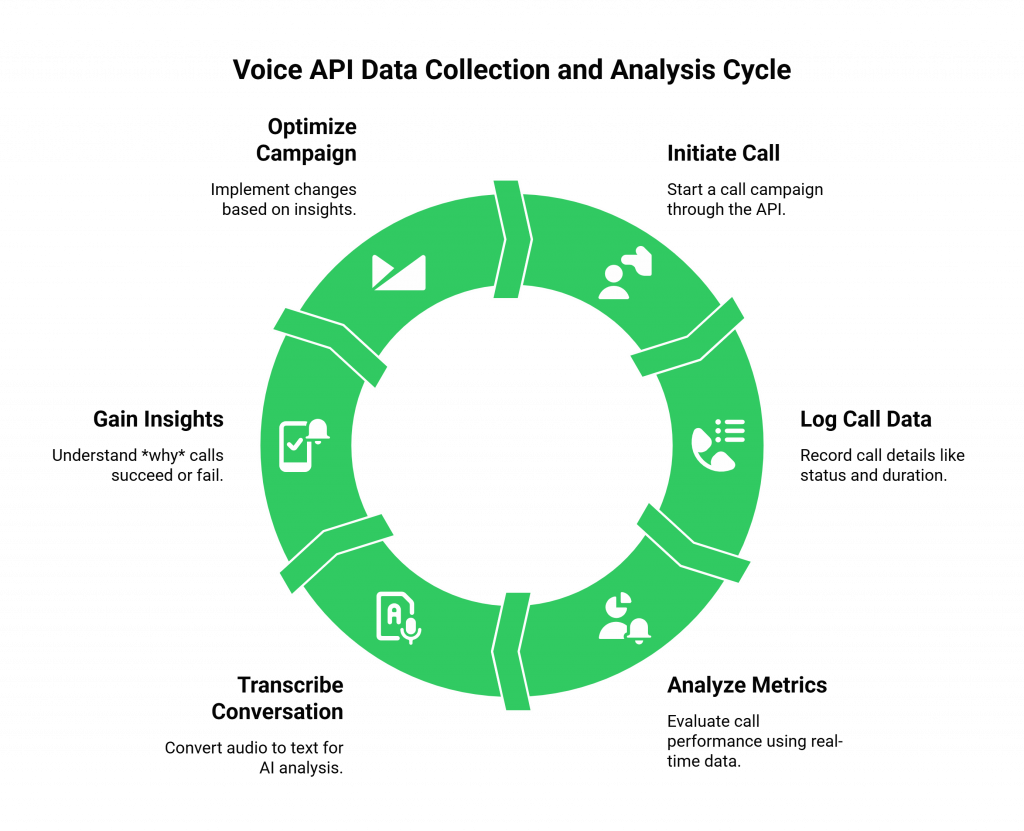
The moment you initiate a campaign via an API, the data starts flowing. A platform like FreJun AI provides a rich stream of real-time metrics for every single call. This is delivered via a combination of webhooks and a detailed analytics API. The data you can get for every call includes:
- Detailed Call Status: A precise, timestamped log of the call’s entire lifecycle: initiated, ringing, answered, completed, busy, failed, no-answer.
- Precise Call Duration: The exact length of the call, down to the second.
- Post-Call Analytics: A full call recording and, if you are using an AI, a complete, machine-generated transcription of the conversation.
- Cost and Billing Data: A transparent, real-time record of the cost of every single call.
This granular data becomes extremely valuable. Teams can answer campaign performance questions with confidence. They can measure call answer rates accurately. They can also track average conversation length by lead source.
Unlocking the “Why” with AI-Powered Conversation Intelligence
The structured metrics tell you what happened. The integration of AI tells you why. By using a Speech-to-Text (STT) engine to transcribe every answered call, you can unlock a new world of call performance insights.
- Keyword and Topic Analysis: You can programmatically scan thousands of call transcriptions. You can measure how often specific keywords appear. These keywords may include competitor names or feature requests.
- Sentiment Analysis: You can analyze the text to gauge the customer’s sentiment throughout the call. Was the conversation positive, negative, or neutral?
- Script Adherence and Effectiveness: You can analyze how your human or AI agents are performing. Are they sticking to the script? At what point in the conversation do most customers lose interest?
This is the holy grail of campaign analytics. You are no longer just measuring outcomes; you are measuring the conversation itself. The importance of this is massive. A recent study from Salesforce revealed that 88% of high-performing sales teams say that data-driven insights are critical to their success. A modern voice API finally brings this capability to the voice channel.
Ready to stop guessing and start measuring your outbound campaigns? Sign up for FreJun AI
Also Read: Voice Recognition SDK Built For Low Latency Voice Streaming
How Can This Data Be Used to Optimize Your Campaigns?
This rich stream of data is not just for historical reporting; it is a powerful tool for real-time and future campaign optimization.
This table showcases how specific metrics from a voice API for bulk calling can be used to answer critical business questions.
| Business Question | Key Metric from the Voice API | How It Drives Optimization |
| “When is the best time of day to call our leads?” | Answer Rate by Hour: A real-time analysis of the percentage of calls that are answered at 9 AM vs. 2 PM vs. 6 PM. | You can dynamically shift your calling campaigns to the hours with the highest answer rates, dramatically improving your efficiency. |
| “Which of our lead sources is the most valuable?” | Conversation Duration by Campaign: A comparison of the average talk time for leads from “Source A” vs. “Source B.” | A longer conversation is often a strong indicator of a higher-quality lead. You can reallocate your budget to the sources that generate more engaged prospects. |
| “Is our new opening script working?” | A/B Test of Call Duration and Sentiment: Run two campaigns with two different scripts and compare the average conversation length and the average sentiment score for each. | You can use hard data, not gut feelings, to scientifically determine which script is more effective at engaging customers. |
| “Why are customers objecting to our new pricing?” | Keyword Spotting on Transcriptions: Programmatically search all call transcriptions for keywords like “too expensive,” “price,” or “discount.” | You can get instant, unfiltered feedback from the market about your pricing and messaging, allowing you to make rapid adjustments. |
Also Read: How Can a Voice Recognition SDK Enhance Real Time Call Accuracy
What is the Role of FreJun AI in This Data-Rich World?
At FreJun AI, we believe that a modern voice platform should be a world-class data platform. Our entire architecture is built around the principle of providing our developers with deep, real-time, and easily accessible insights into their voice traffic.
- A Foundation of Structured Data: Our Teler engine, the core of our voice API for bulk calling, is designed to capture a rich set of data for every single call.
- Real-Time by Default: We provide a comprehensive system of real-time webhooks that can push this data to your application the instant an event happens.
- A Flexible, API-First Approach: Our analytics and reporting are not confined to a pre-built dashboard. We provide a powerful set of APIs that allow you to pull this granular data into your own business intelligence tools, your data warehouse, or your custom analytics platforms.
Conclusion
The era of the “spray and pray” outbound calling campaign is over. The modern voice API for bulk calling has transformed the phone call from an un-analyzable black box into a transparent, data-rich, and infinitely optimizable part of the customer journey.
By providing deep, real-time metrics and unlocking powerful call performance insights through AI, this technology gives businesses an unprecedented level of understanding and control over their voice outreach.
The companies that will win in the campaign analytics voice 2026 landscape will not be the ones that call the most, but the ones that call the smartest. And that intelligence begins with data.
Want to see a live demonstration of our analytics platform and explore the rich data you can get from our voice API? Schedule a demo for FreJun Teler.
Also Read: Building an IVR Flow: Best Practices & Tools
Frequently Asked Questions (FAQs)
It is a programmable interface that allows a developer’s application to initiate and manage a large number of outbound phone calls simultaneously and automatically.
It transforms every call into a structured data point, providing detailed real-time metrics on call outcomes, durations, and even the content of the conversation itself.
The most important insights are often answer rate, average call duration, and, with AI, the sentiment and key topics of the conversation itself.
The campaign analytics voice 2026 trend points to fully automated, self-optimizing campaigns where AI can A/B test scripts and reallocate resources in real-time.
Yes. With a voice API for bulk calling, you can easily run two parallel campaigns with two different scripts and then compare the analytics to see which one performs better.
Sentiment analysis is the use of AI to analyze the text of a call transcription to determine the emotional tone of the speaker (e.g., positive, negative, neutral).
A modern voice platform can be configured to automatically record a call and then use a Speech-to-Text (STT) engine to transcribe the audio into a text file.