
Businesses today face increasing pressure to engage customers in real time while optimizing operational efficiency. Voice, as the most immediate and trusted channel, offers unique opportunities to drive conversions and reduce friction across interactions. With the rise of AI and programmable voice infrastructure, organizations can now combine real-time calls, intelligent agents, and automation to accelerate growth.
This blog explores the technical and strategic benefits of implementing Voice APIs, the architecture behind AI voice agents, and how platforms like FreJun Teler empower product teams to build scalable, reliable, and globally deployable voice-first systems that align with modern business objectives.
Why Is Voice Still Critical For Business Growth In A Digital-First World?
Voice has remained one of the most immediate and reliable channels for business communication. Unlike text-based interactions, voice enables real-time engagement, higher trust, and personalized experiences. In a world where customers expect fast and accurate responses, relying solely on traditional call centers or static IVRs can limit growth.
With an estimated 8.4 billion voice assistants active worldwide, voice interaction has already become a fundamental part of modern digital communication and customer engagement.
Businesses are increasingly adopting digital transformation voice strategies to maintain a competitive edge. By embedding voice capabilities into applications, organizations not only enhance the customer experience but also streamline operations. This shift is the foundation of a voice-first business strategy, where every interaction is optimized for speed, clarity, and efficiency.
Key Advantages Of Voice In Business Growth
- Immediate engagement: Customers connect in real time without typing delays.
- High trust and reliability: Voice conveys context and emotion better than text.
- Automation opportunities: Programmable voice enables repeatable, consistent workflows.
- Scalability: Cloud-based voice systems support simultaneous interactions globally.
What Are Voice APIs And How Do They Differ From Traditional Calling Systems?
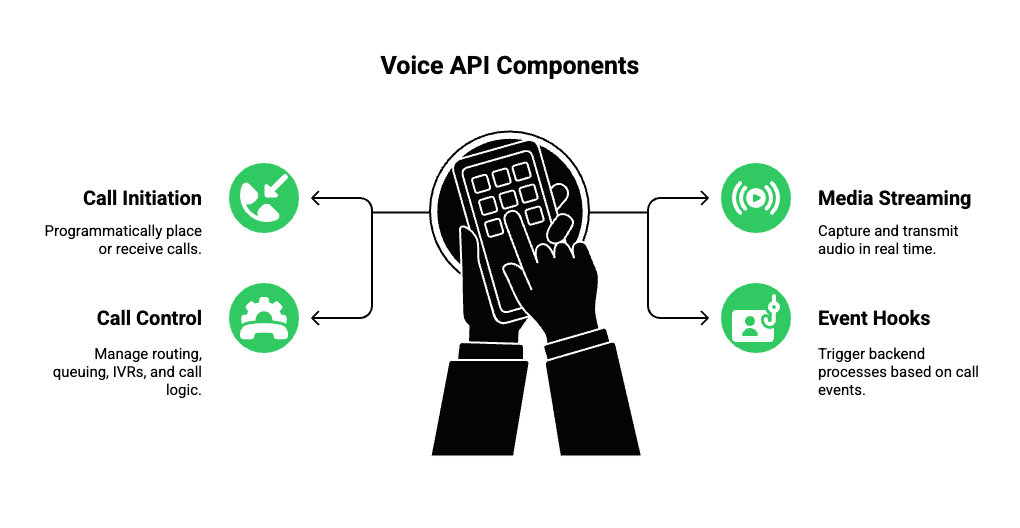
A Voice API is a set of programmable interfaces that allows developers to manage and control voice calls programmatically. Unlike conventional telephony or call center software, a Voice API provides full flexibility over call handling, media streaming, and automation logic.
Components Of A Voice API
- Call Initiation: Programmatically place or receive calls.
- Media Streaming: Capture and transmit audio in real time.
- Call Control: Manage routing, queuing, IVRs, and call logic.
- Event Hooks: Trigger backend processes based on call events.
Traditional systems often limit businesses to fixed features. With a Voice API, organizations gain control, allowing integration with any AI service, CRM, or workflow automation tool.
How Do Voice APIs Directly Enable Business Scaling With Voice?
Voice APIs allow businesses to scale communication without being constrained by physical infrastructure or human agents. By enabling programmatic control over every interaction, businesses can expand operations quickly and efficiently.
How Voice APIs Support Scaling
- Elastic Capacity: Handle thousands of concurrent calls without performance degradation.
- Automated Workflows: Route, respond, and follow up without manual intervention.
- Global Reach: Manage international calls over PSTN, SIP, or VoIP without separate systems.
- Operational Efficiency: Reduce cost per interaction and optimize resource allocation.
By leveraging business scaling with voice, organizations can maintain high-quality customer engagement while minimizing overheads, which directly accelerates revenue growth.
Which Business Functions See The Highest ROI From Voice API Adoption?
Implementing Voice APIs impacts several critical business functions. Each function benefits from automation, reliability, and integration with existing systems.
Inbound Call Management
- Smart IVRs: Automatically route calls based on customer intent.
- Context Retention: Preserve conversation history for accurate responses.
- 24/7 Availability: Reduce missed calls with automated handling.
Outbound Engagement
- Appointment Reminders: Automated calls improve attendance and reduce cancellations.
- Notifications and Alerts: Timely information delivery enhances customer satisfaction.
- Lead Qualification: Use automated calls to validate and enrich leads efficiently.
Industry-Specific Applications
| Industry | Voice API Use Case |
| E-commerce | Order updates, delivery tracking, COD confirmation |
| Healthcare | Appointment scheduling, reminders |
| BFSI | Payment reminders, verification calls |
| Logistics | Delivery coordination, route updates |
These applications showcase the direct connection between voice automation and tangible business outcomes, such as cost reduction, higher engagement, and faster operations.
Why Are Voice APIs Becoming The Foundation For AI Calling Growth?
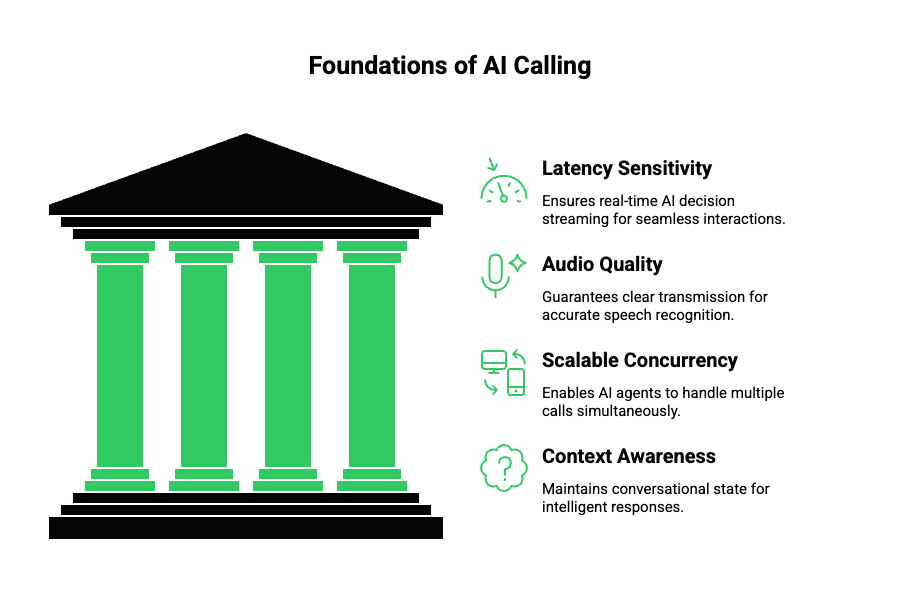
Voice APIs are no longer just tools for automation—they form the foundation for AI-driven voice agents. AI calling relies on real-time, low-latency voice infrastructure to process conversations effectively. Without a robust voice layer, the intelligence of AI cannot reach the customer in real time.
Key Considerations For AI Voice Growth
- Latency Sensitivity: AI decisions must be streamed quickly to prevent delays.
- Audio Quality: Clear transmission ensures accurate speech recognition.
- Scalable Concurrency: AI agents must handle multiple calls simultaneously.
- Context Awareness: Maintaining conversational state is essential for intelligent responses.
By providing these capabilities, Voice APIs enable businesses to integrate AI calling growth strategies, enhancing personalization and operational efficiency.
What Is A Modern AI Voice Agent Made Of At A Technical Level?
An AI voice agent is not a single system but a combination of components working in harmony to provide natural, intelligent conversations. Understanding the technical layers helps decision-makers plan integration and deployment.
Core Components
- Speech-to-Text (STT): Converts live audio into textual input for AI processing.
- Large Language Models (LLMs): Analyze text, interpret context, and determine responses.
- Retrieval-Augmented Generation (RAG): Accesses business knowledge, databases, and CRMs for accurate answers.
- Tool Calling: Triggers workflows or updates systems automatically based on conversation intent.
- Text-to-Speech (TTS): Converts AI-generated text back into natural audio for the caller.
Why Each Component Matters
- STT Accuracy: Directly impacts AI comprehension.
- LLM Flexibility: Ensures the agent can handle dynamic customer queries.
- RAG Integration: Provides factual responses instead of generic answers.
- TTS Quality: Maintains conversational flow and professional tone.
Without a strong voice infrastructure, even the best AI cannot deliver consistent, real-time interactions.
Why Is Voice Infrastructure The Hardest Layer To Get Right?
Even with advanced AI, the voice infrastructure layer determines success in real-time interactions. Challenges include:
- Latency Between Speech And Response: Delays disrupt conversation naturalness.
- Audio Jitter And Buffering: Poor streaming affects AI comprehension.
- Global Telecom Complexity: Managing PSTN, SIP, and VoIP across countries is non-trivial.
- Maintaining Conversational Context: Dropped or lost connections can frustrate users.
- High Concurrency: Handling thousands of simultaneous calls requires optimized architecture.
Most businesses underestimate these challenges, which is why voice-first strategies often fail if the underlying infrastructure is not designed for scale.
How Does FreJun Teler Enable Real-Time AI Voice Applications At Scale?
FreJun Teler is a global voice infrastructure platform built to connect AI agents, including any Large Language Model (LLM), with real-time voice interactions. Unlike traditional telephony platforms that focus only on call management, Teler is designed specifically to handle low-latency, high-fidelity audio streams while providing full control over conversational context.
Technical Advantages Of Teler
- Real-Time Media Streaming: Audio is transmitted instantly, ensuring AI agents respond without perceptible delay.
- Persistent Connections: Maintains conversational state across long calls for natural interactions.
- Global Call Handling: Supports inbound and outbound calls over PSTN, SIP, or VoIP networks worldwide.
- Scalable Architecture: Optimized for thousands of simultaneous AI-driven conversations.
- Developer-First APIs & SDKs: Easy integration with any AI, STT, TTS, or RAG system.
By abstracting the complexity of voice infrastructure, Teler allows product teams to focus on building intelligent agents instead of managing telecom issues.
How Can Teams Implement Teler With Any LLM, STT, Or TTS Stack?
The flexibility of Teler ensures that businesses are not tied to any single AI or speech provider. Teams can combine their preferred AI, STT, and TTS solutions to build custom voice agents.
Step-By-Step Implementation Flow
- Stream Caller Audio to Teler
- Incoming speech is captured in real time and streamed reliably.
- Latency is minimized to preserve conversational naturalness.
- Incoming speech is captured in real time and streamed reliably.
- Convert Speech To Text (STT)
- Text is generated from audio using the chosen STT provider.
- Real-time streaming ensures immediate AI processing.
- Text is generated from audio using the chosen STT provider.
- Process Text With LLM
- The text input is passed to any LLM for understanding, decision-making, and response generation.
- LLM maintains logic, intent recognition, and contextual reasoning.
- The text input is passed to any LLM for understanding, decision-making, and response generation.
- Retrieve Relevant Data (RAG)
- Agents can access CRMs, knowledge bases, or external APIs for accurate responses.
- Enables fact-based replies instead of generic or scripted answers.
- Agents can access CRMs, knowledge bases, or external APIs for accurate responses.
- Execute Tool Calls
- Agent actions such as booking appointments, sending notifications, or updating systems occur seamlessly.
- Agent actions such as booking appointments, sending notifications, or updating systems occur seamlessly.
- Convert Response Text To Speech (TTS)
- TTS generates natural, human-like audio.
- Audio is streamed back to the caller without delay.
- TTS generates natural, human-like audio.
- Return Audio Via Teler
- Persistent, low-latency connection ensures smooth, continuous conversation.
- Persistent, low-latency connection ensures smooth, continuous conversation.
Key Benefits Of This Architecture
- Fully model-agnostic: Any AI provider can be used.
- Modular: STT, TTS, and RAG can be replaced independently.
- Scalable: Infrastructure supports enterprise-level concurrency.
- Context-aware: Maintains memory and conversation state across calls.
This modular approach ensures businesses can experiment, optimize, and iterate without being locked into a single vendor.
How Does This Architecture Support Long-Term Business Growth?
A properly implemented voice infrastructure paired with AI capabilities creates measurable business impact. Organizations that adopt this approach gain advantages in multiple areas:
Faster Time-To-Market
- Pre-built APIs and SDKs reduce integration time.
- Teams can launch AI voice agents in days rather than months.
Cost Optimization
- Automation reduces dependency on human agents.
- Scalable architecture eliminates over-provisioning and redundant infrastructure.
Improved Customer Experience
- Natural, responsive conversations increase engagement.
- Context-aware agents provide relevant information without repetition.
Flexibility And Control
- Teams can switch or upgrade AI models, STT, or TTS providers.
- Voice logic is decoupled from AI logic, enabling easier updates.
Global Scalability
- Businesses can handle international calls without worrying about telecom complexity.
- Supports high-volume campaigns, enterprise outreach, and 24/7 availability.
How Do Voice Infrastructure Platforms Differ From AI-First Calling Tools?
It is important to distinguish infrastructure-first platforms like Teler from AI-first calling tools. Many platforms focus only on AI decision-making or pre-built call logic. While these tools appear quick to implement, they often lack the robust voice layer required for enterprise operations.
| Feature | Infrastructure-First (Teler) | AI-First Calling Tools |
| Voice Scalability | Supports thousands of concurrent calls | Limited concurrency |
| Latency Management | Ultra-low latency media streaming | Often batch or delayed responses |
| Global Telephony | PSTN, SIP, VoIP abstraction | Regional, limited network support |
| AI Integration Flexibility | Any LLM, STT, TTS, RAG, tool layer | Usually pre-configured AI only |
| Conversational Context | Maintained across sessions | Often lost in long conversations |
| Enterprise Reliability & Support | High uptime, geo-redundancy, support teams | Limited SLAs, support |
This distinction ensures that teams implementing AI-driven voice strategies are not constrained by limitations in the underlying telephony system.
How Do Security, Reliability, And Uptime Affect Voice-First Systems?
When scaling AI-powered voice systems, reliability and security become critical. Businesses cannot compromise on uptime, especially for customer-facing interactions.
Security Considerations
- End-to-end encryption for calls.
- Secure API authentication.
- Data privacy compliance across geographies.
Reliability Measures
- Geo-redundant architecture to prevent outages.
- Low-latency streaming even during high concurrency.
- Built-in failover and buffering to handle network inconsistencies.
Enterprise Support
- Dedicated integration support ensures smooth deployment.
- Continuous monitoring and maintenance optimize performance.
These measures make Teler suitable for mission-critical business applications where AI agents act as frontline customer representatives.
What Role Does a Voice-First Business Strategy Play In Driving Growth?
Adopting a voice-first business strategy positions companies to take advantage of AI, automation, and global scalability. It is no longer just about replacing manual calls with automation—it’s about redefining customer interaction.
Strategic Advantages
- Personalized Customer Engagement: Voice allows dynamic, tailored conversations.
- Operational Efficiency: Reduces manual workload while maintaining high-quality interactions.
- Competitive Differentiation: Early adoption of AI-enabled voice positions businesses ahead of competitors.
- Insightful Analytics: Real-time call data provides actionable insights for continuous improvement.
Companies that combine voice infrastructure with AI can scale faster, respond in real time, and maintain higher levels of customer satisfaction.
How Can Businesses Start Building With Voice APIs Today?
Implementing a voice-first AI strategy requires clear planning and execution. Here’s a practical approach:
Recommended Steps
- Identify Core Use Cases: Focus on calls where automation adds measurable value.
- Select AI Stack: Choose your LLM, STT, TTS, and RAG solutions.
- Integrate Voice Infrastructure: Use Teler or similar platforms for reliable call management.
- Implement Modular Architecture: Keep AI logic, voice transport, and backend processes decoupled.
- Test And Optimize: Monitor latency, conversation quality, and business outcomes.
- Scale Globally: Gradually increase volume while maintaining reliability.
By following this framework, businesses can implement voice-first systems that accelerate growth and improve operational efficiency.
Conclusion
Integrating Voice APIs with AI-driven agents is no longer optional; it is critical for accelerating business growth. By combining real-time voice infrastructure, flexible AI models, and automation tools, organizations can scale efficiently, reduce operational costs, and enhance customer engagement across channels.
FreJun Teler provides the robust infrastructure necessary to implement AI-powered voice agents reliably, ensuring low latency, global reach, and seamless integration with any LLM, STT, or TTS stack. For product leaders, engineers, and founders, this approach enables faster time-to-market while maintaining control over AI logic and call management.
Explore how Teler can power your AI voice agents. Schedule a demo.
FAQs –
- What is a Voice API?
A programmable interface that enables automated call handling, media streaming, and integration with AI or backend systems in real time. - How does Teler differ from traditional voice platforms?
Teler provides low-latency, scalable infrastructure for AI-driven conversations, while traditional platforms focus only on basic call management. - Can I integrate any AI model with Teler?
Yes, Teler supports any LLM, STT, TTS, and RAG tool, giving full flexibility for custom voice agent deployment. - How quickly can I deploy AI voice agents?
With Teler’s SDKs and APIs, teams can deploy intelligent voice agents in days, not months, even at enterprise scale. - Does Teler support global calling?
Yes, Teler handles PSTN, SIP, and VoIP worldwide, ensuring reliable, low-latency voice connections for international operations. - What are the key business benefits of Voice APIs?
Faster engagement, cost optimization, scalable operations, improved customer satisfaction, and streamlined automation across inbound and outbound calls. - Can Teler maintain conversation context over long calls?
Yes, persistent connections allow AI agents to track context, enabling natural and continuous conversations without losing information. - Is Teler secure for enterprise applications?
Absolutely, with end-to-end encryption, secure API authentication, and geo-redundant architecture for high reliability and compliance. - How does Teler improve AI agent performance?
By providing stable low-latency audio transport, Teler ensures AI models receive real-time input and deliver timely responses to users. - Can voice bots built with Teler replace human agents?
They can handle routine interactions and scale efficiently, freeing human agents for complex, high-value conversations.