
In the modern, borderless economy, your customers, employees, and partners can be anywhere. A support call might originate from London, a sales inquiry from Singapore, and a developer might be working from a laptop in Brazil. In this distributed world, your voice communication infrastructure is no longer a local utility; it is a critical, global network that underpins your entire operation.
Choosing the right foundation for this network, the best voice API for business communications is one of the most important strategic decisions a modern, global business can make.
The stakes are incredibly high. A voice API with poor international connectivity can lead to dropped calls, garbled audio, and frustrated customers. A platform that cannot handle the nuances of global regulations can expose you to significant compliance risks.
And an infrastructure that is not architected for global scalability and latency control can cripple your ability to deliver a consistent, high-quality experience to your users around the world.
We recognized this challenge from the very beginning. Instead of building a regional voice platform and later bolting on international capabilities, we architected our Teler engine from the ground up as a globally distributed, carrier-grade network designed to solve the specific and complex challenges of international telephony APIs.
This guide will walk you through the essential, non-negotiable criteria you must evaluate when choosing a voice API for your global business, and it will show you how FreJun Teler was purpose-built to exceed them.
Table of contents
What Are the Core Pillars of a True Global Voice API?
When you move beyond a single country, the complexity of voice communication increases exponentially. You are no longer dealing with one set of carriers, one set of regulations, and one set of user expectations. A true global voice API must be built on a foundation that addresses these complexities head-on. There are four core pillars that you must scrutinize.
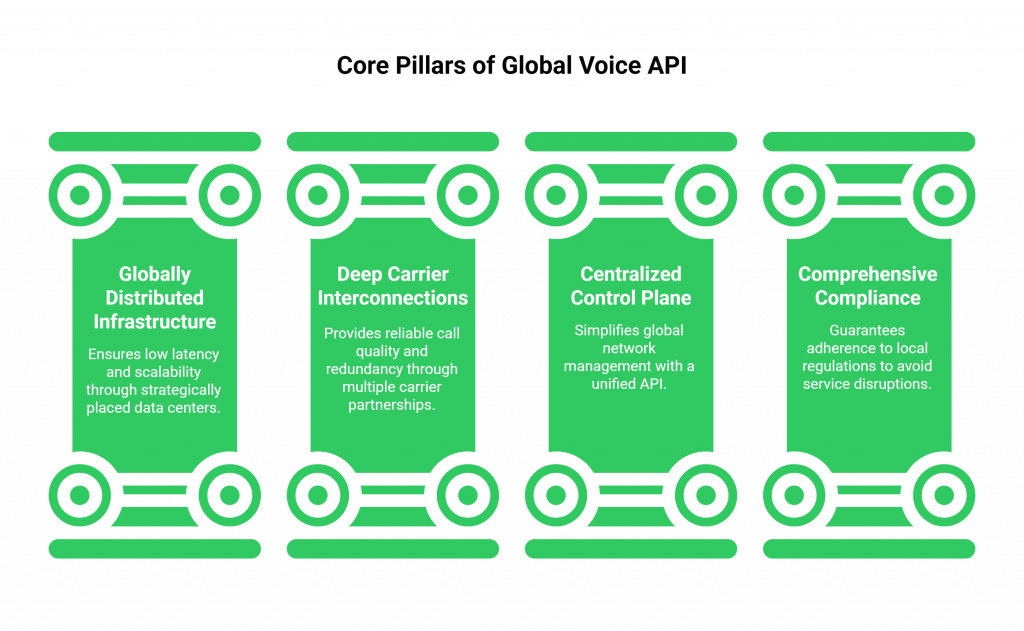
A Globally Distributed, Edge-Native Infrastructure
This is, without a doubt, the most important architectural consideration. The speed of light is a physical constant, and the primary cause of latency (delay) in a voice call is the physical distance the data has to travel.
- What to Look For: A provider with a global network of Points of Presence (PoPs). These are data centers, distributed across continents, where the provider has their core voice infrastructure (their Teler engine, in our case).
- Why It Matters: When a user in Germany makes a call to your platform, it should be handle by a server in Frankfurt, not routed all the way to a data center in Virginia and back. This “edge-native” approach is the only way to achieve true global scalability and latency control. It ensures that every call, no matter where it originates, has the shortest possible travel path, resulting in a crystal-clear, low-latency conversation. The impact is significant; an edge architecture can reduce latency by over 50% compared to a centralized cloud model.
Deep, Redundant Carrier Interconnections
The global telephone network is not a single entity; it is a complex web of hundreds of different carriers, each with its own network and its own quality of service. The quality of your provider’s cross-country calling support is a direct function of the quality and depth of their relationships with these carriers.
- What to Look For: A provider that has direct, high-quality interconnections with multiple Tier 1 carriers in every major region they serve. Ask them about their carrier redundancy. What happens if their primary carrier in a specific country has an outage?
- Why It Matters: A provider that relies on a single, cheap “gray route” carrier for a region might offer a lower price, but the call quality will be unpredictable, and the risk of outages will be high. A provider with a deep, multi-carrier network can intelligently and automatically route calls around congestion or outages, ensuring that your calls always connect with the highest possible quality.
A Centralized, API-Driven Control Plane
A global infrastructure is only useful if it is easy to manage. The best voice API for business communications must provide a single, unified API that allows you to control your entire global voice network from one place.
- What to Look For: A single, consistent API that allows you to provision phone numbers in any country, configure call routing logic, and manage compliance requirements globally. You should not have to log in to different portals or use different APIs for different regions.
- Why It Matters: This centralized control plane is the key to agility. It allows your development team to build and deploy global voice applications quickly and efficiently. They can write a single piece of code that can, for example, make an outbound call from a local number in Australia, and it will work just as seamlessly as a call from a number in the United States.
Also Read: Voice API for Warehouse Automation
Comprehensive Global Compliance and Number Management
Every country has its own unique and often-complex set of telecommunication regulations. These rules determine what kinds of phone numbers are available (local, national, mobile, toll-free) and what documentation you must provide to purchase and use them, such as proof of a local address.
- What to Look For: A provider that has a dedicated compliance team and a platform that has these regulatory requirements built directly into its number provisioning workflow. The API and the dashboard should make it clear what is required to legally use a number in a specific country.
- Why It Matters: Failing to adhere to local telecom regulations can result in your service being shut down with no warning, and can even lead to significant fines. A provider who treats compliance as a core competency is an essential partner for any global business. This is a major concern for businesses, with one study indicating that regulatory compliance is a top risk for global enterprises.
This table provides a quick-glance checklist for evaluating a global voice provider.
| Pillar | Key Question to Ask a Provider | Why FreJun Teler Excels |
| Global Infrastructure | “Where are your Points of Presence (PoPs), and how do you handle calls at the edge?” | Our Teler engine is a globally distributed, edge-native network designed for low-latency. |
| Carrier Network | “Who are your Tier 1 carrier partners in my key regions, and what is your redundancy strategy?” | We have deep, multi-carrier interconnections in every region we serve for maximum reliability. |
| Control Plane | “Can I manage my entire global number inventory and call logic through a single, unified API?” | Our developer-first platform provides a single, powerful API to control your entire global voice network. |
| Compliance | “How does your platform help me navigate the address and documentation requirements for different countries?” | Our platform has global compliance logic built directly into the number provisioning workflow. |
Ready to build your global voice application on an infrastructure that was designed for it? Sign up for FreJun AI.
How FreJun Teler Was Built for the Global Business
The FreJun Teler architecture was not an accident. It was the result of a deliberate, first-principles approach to solving the problem of global business communication. We did not take a U.S.-centric platform and try to expand it. We built a globally distributed, API-first conversational infrastructure from day one.
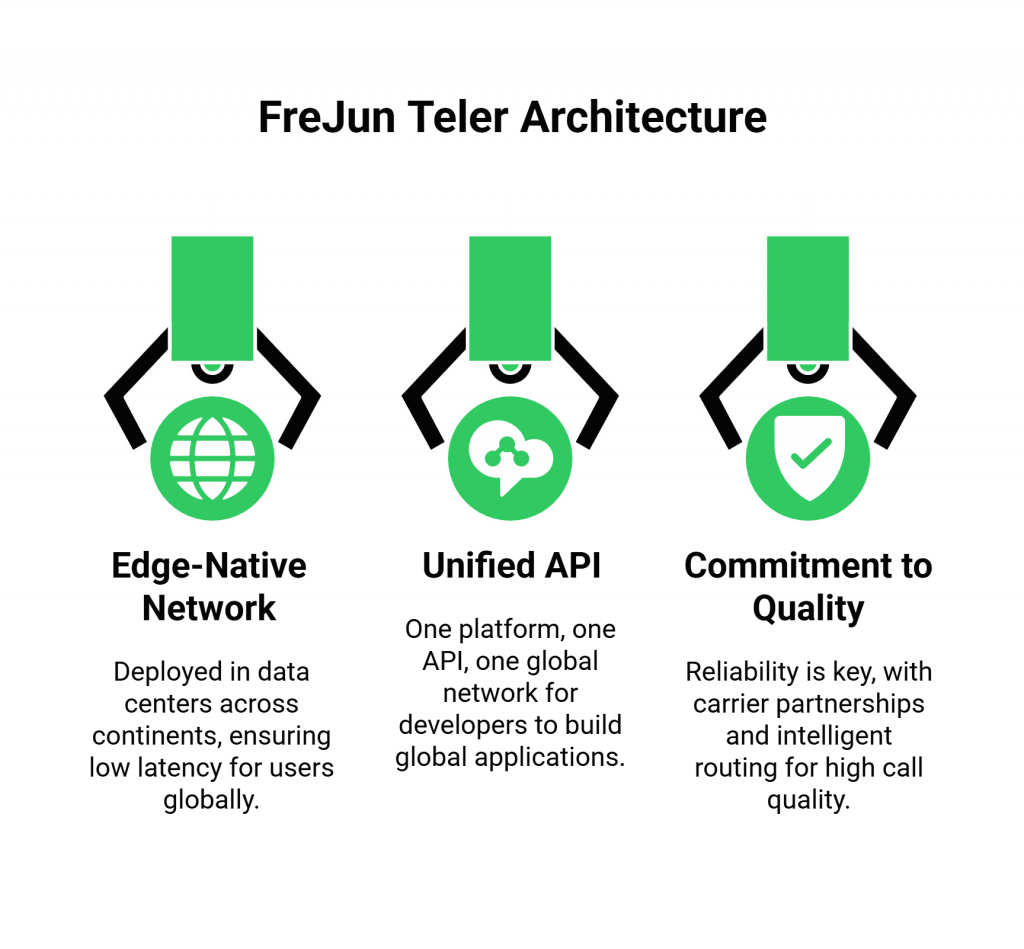
- Our Edge-Native Network: We deploy our Teler engine and MCP servers in data centers across North America, Europe, and Asia. This global footprint ensures that no matter where your users are, the system handles their voice traffic with the lowest possible latency, essential for high-quality human calls and absolutely critical for real-time AI calling.
- Our Unified API: Our philosophy is simple: one platform, one API, one global network. Our powerful and consistent API allows your developers to build applications that are inherently global, without having to worry about the underlying regional complexities.
- Our Commitment to Quality: We know the best voice API is defined by reliability. With Tier 1 carrier partnerships across regions and an intelligent routing engine, we continuously optimize for the highest call quality and uptime.
Also Read: AI Voicebot for Shipment Tracking
Conclusion
In today’s interconnected global economy, your voice platform is no longer a local concern. It has become a critical part of your core global infrastructure. The provider you choose will have a long-term impact on your customer experience, your operational agility, and your ability to scale effectively.
The best voice API for business communications is not the one with the longest feature list or the lowest price; it is the one with the smartest architecture.
It runs on a globally distributed, edge-native network with deep carrier redundancy, a unified API-driven control plane, and a strong commitment to regulatory compliance. The team designed the platform to be global from its very first line of code.
Want to do a deep dive into our global network and see how the FreJun Teler architecture can support your specific international use case? Schedule a demo with our team.
Also Read: Telephone Call Logging Software: Keep Every Conversation Organized
Frequently Asked Questions (FAQs)
It is a set of programming tools (an API). It allows developers to build custom voice communication features. These features include making and receiving phone calls, building AI agents, and managing call flows, directly into their own applications.
A globally distributed infrastructure (with servers in multiple regions) is the key to reducing latency. It ensures that a call from a user in Europe is handle by a server in Europe, not one in the U.S. It helps dramatically shortens the data travel time and improves call quality.
This is achieved through an “edge-native” architecture. The provider has a network of servers (Points of Presence) around the world. Their system intelligently routes calls to the server closest to the user. It provides both global scalability and latency control by processing the call as close to the source as possible.
A Tier 1 carrier is a major telecommunications provider that has a large, high-quality, and reliable network. An API provider that has direct connections with multiple Tier 1 carriers in region can offer much higher call quality.
No. A key benefit of a developer-first platform like FreJun Teler is that it abstracts away the low-level telecom complexity. The API is designed to be simple and intuitive for any software developer who is familiar with standard web technologies.
FreJun AI is the overall brand for our voice infrastructure platform. Teler is the name of our core, underlying voice engine, the powerful, globally distributed system that provides the API and handles all the real-time communication.
Yes. The FreJun Teler platform is model-agnostic. Our job is to provide the high-quality, low-latency global voice “nervous system.” You are free to connect any AI “brain” (your STT, LLM, and TTS models) to it.
With a modern provider, you can typically sign up for a developer account online. It get instant access to your API keys, and start building and testing with a free credit. You can provision a number in a different country and make your first international, API-driven phone call in minutes.