
The sky darkens. The wind howls. And then, in an instant, everything goes dark. The first instinct for thousands of residents in the affected area is the same: reach for the phone and call the utility company.
What happens next is a predictable and frustrating communications disaster. The utility’s phone lines are instantly overwhelmed by a tidal wave of calls, leading to endless busy signals and hours-long hold times.
For the customer, the moment creates anxiety and a feeling of being unheard. For the utility provider, it creates an operational crisis. This scenario occurs countless times daily across the country, and a modern AI voicebot is perfectly engineered to solve it.
The frequency of these events is increasing. A recent analysis by Climate Central revealed that the number of weather-related power outages in the U.S. has increased by 78% over the last decade.
As our grid faces more strain, the need for a resilient, scalable, and efficient communication strategy during these critical events is no longer a luxury; it is a fundamental requirement for public safety and customer trust.
Table of contents
- Why is Traditional Outage Reporting Ineffective?
- How Does an AI Voicebot Act as a First Responder?
- What Are the Core Benefits for Utility Companies and Customers?
- How Do You Implement a Resilient Outage Reporting System?
- Can a Voicebot Do More Than Just Take Reports?
- Conclusion
- Frequently Asked Questions (FAQs)
Why is Traditional Outage Reporting Ineffective?
During a widespread power outage, a utility’s call center becomes the epicenter of a massive information bottleneck. The traditional model relies on a limited number of human agents to handle sudden, overwhelming surges of calls, causing the system to fail exactly when it is needed most.
The Anatomy of a Communications Breakdown
The moment an outage occurs, the system is immediately pushed beyond its breaking point.
- Massive, Instantaneous Call Spikes: A single outage can cause a call volume to spike by a factor of 100x or more in a matter of minutes. No human-staffed call center can possibly scale to meet this instantaneous demand.
- The Inevitability of the Busy Signal: With a limited number of phone lines and agents, most callers encounter a busy signal or a pre-recorded message telling them to call back later, which increases their frustration.
- Overwhelmed Human Agents: The agents who do manage to take calls are under immense pressure. They are dealing with stressed, anxious, and sometimes angry customers while trying to manually log information into an Outage Management System (OMS). This leads to burnout, errors, and a poor customer experience.
- The Data Black Hole: Information from social media, emails, and voicemails is unstructured and difficult to process in real-time. This creates a scattered and incomplete picture of the outage’s scope, hindering the restoration effort.
How Does an AI Voicebot Act as a First Responder?
An AI voicebot acts as an infinitely scalable, instantly available, and perfectly calm first responder for your utility. It is a conversational AI that can handle a virtually unlimited number of inbound calls simultaneously, ensuring that every single customer who calls during an outage gets an immediate and productive response.
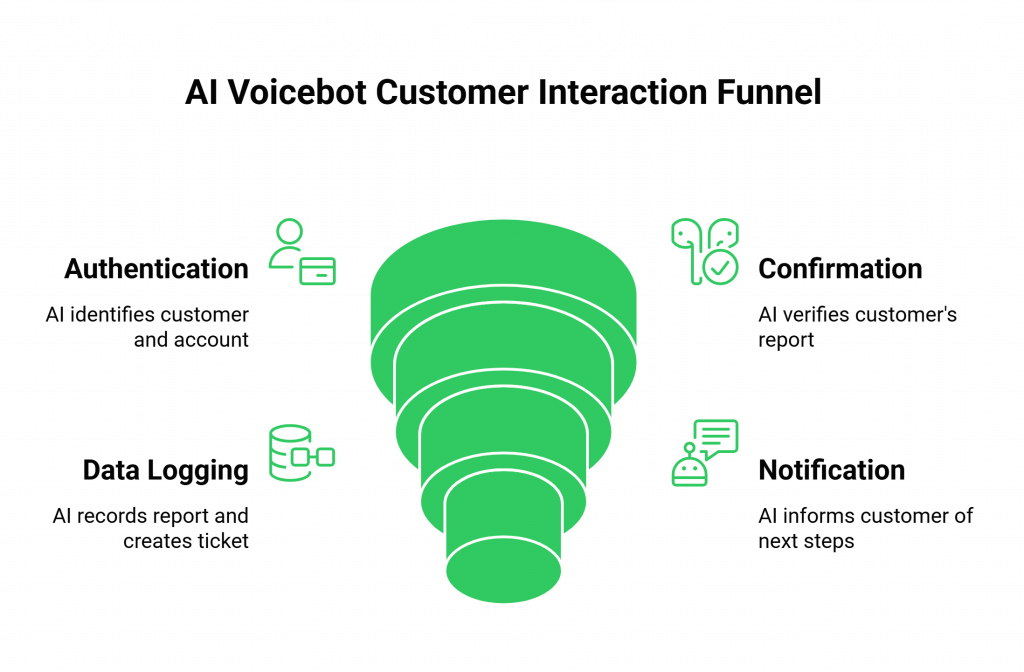
When a customer calls, they are not met with a busy signal. They are greeted by a professional, reassuring voice. The AI voicebot can immediately get to work, transforming a moment of chaos into a structured, efficient data-gathering process.
How Does It Capture Critical Data Instantly?
The AI can be programmed to have a simple, guided conversation.
- Authentication: It can recognize the customer’s phone number (Caller ID) and instantly match it to an account in the utility’s system, saying, “I see you’re calling from the number associated with 123 Oak Street. Are you calling to report an outage at that address?”
- Confirmation: The customer simply says “Yes.”
- Data Logging and Confirmation: The AI then says, “Thank you. I have logged your report. Our crews have been notified of an outage in your area. We have created a ticket for you, your reference number is 1-2-3-4-5. We will notify you via a call or text message when we have an estimated restoration time.”
The system completes this entire interaction in under 45 seconds, giving the customer immediate reassurance that their report is receive and logg, and delivering a clean, structured data entry directly into the OMS in real time.
For this conversation to feel helpful and not frustrating, the voice infrastructure powering it must be rock-solid. This is where FreJun AI comes in.
We provide the enterprise-grade “plumbing” that handles the real-time, low-latency audio streaming, ensuring the conversation with the AI voicebot is clear and natural, even when call volumes are at their peak.
Also Read: How to Integrate Teler with AgentKit: Real-time Voice Agents through the MCP Server
What Are the Core Benefits for Utility Companies and Customers?
Deploying an AI voicebot for outage reporting is a strategic investment in operational resilience and customer trust. The benefits are felt by the operations center, the customer service department, and every resident in the service area.
A recent industry report underscored this, noting that during major weather events, call volumes can increase to 400 times the normal level, a scale that only automation can realistically handle. Here is a clear comparison of the two models:
| Feature | Traditional Manual Reporting | AI Voicebot-Powered Reporting |
| Call Capacity | Limited by the number of agents and lines. | Virtually unlimited; scales instantly to meet demand. |
| Customer Wait Time | Extremely long, or met with busy signals. | Zero wait time, instant response for every caller. |
| Data Entry | Manual, slow, and prone to human error. | Automated, instant, and perfectly accurate. |
| Availability | Typically limited, with potential for after-hours overflow. | 24/7/365, always on and ready. |
| Agent’s Role | Repetitive, high-stress data entry. | Managing complex escalations and proactive communication. |
How Do You Implement a Resilient Outage Reporting System?
Building an AI-powered system that you can trust during a crisis requires a focus on reliability, scalability, and security. The implementation process is a logical progression of integrating your core systems with an intelligent voice platform.
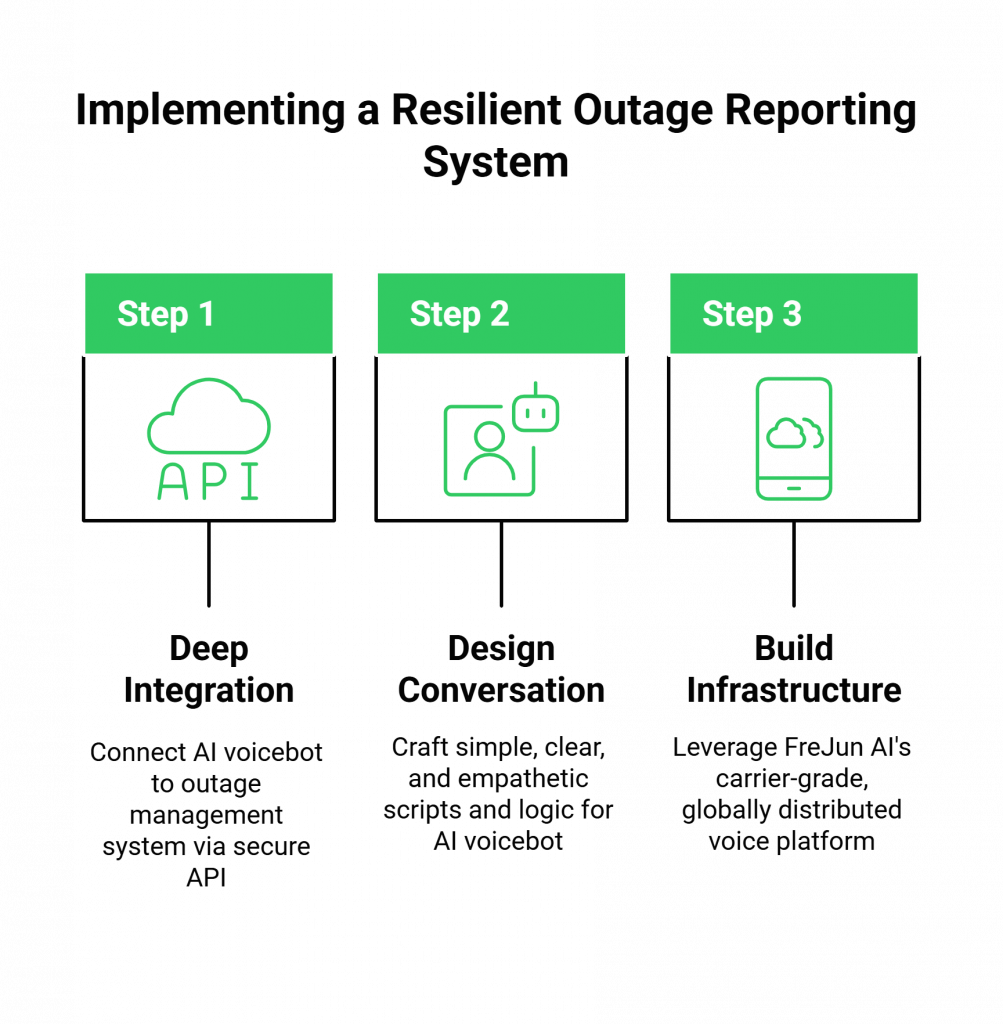
Step 1: Deep Integration with Your Outage Management System (OMS)
The AI voicebot must be the voice of your operational brain. The first step is to create a secure API connection between the AI platform and your OMS. This is a two-way street. It allows the voicebot to push new outage reports into your system and to pull information, like Estimated Times of Restoration (ETRs), to provide updates to customers.
Step 2: Design the Customer Conversation
This is where you craft the experience. You will design the scripts and the logic for the AI voicebot. The conversation should be simple, clear, and empathetic. You will also define the logic for what to do in different scenarios.
For example, if the system already knows there is a widespread outage in the caller’s area, the AI’s message can be different: “We are aware of a major outage in your area and our crews are already working on the problem.”
Also Read: Step-by-Step Guide to Building Voice-Enabled AI Agents Using Teler and OpenAI’s AgentKit
Step 3: Build on a Rock-Solid Voice Infrastructure
The intelligence of your AI is useless if the phone lines go down. The voice infrastructure is the most critical component. This is the essential role of FreJun AI. We provide a carrier-grade, globally distributed platform designed for the kind of high availability and massive scalability that a utility company needs. Our platform is model-agnostic, giving you the freedom to choose the best AI models (STT, LLM, TTS) for your needs. We handle the complex voice infrastructure so you can focus on building your AI.
Ready to build an outage communication system that never fails? Sign up for FreJun AI and get your API keys to start building.
Can a Voicebot Do More Than Just Take Reports?
Absolutely. The true power of a fully integrated AI voicebot is its ability to handle the entire communication lifecycle of an outage. Once the AI has taken the initial report, its role is just beginning.
As soon as your dispatchers have an Estimated Time of Restoration (ETR) for a specific area, the system can automatically trigger a proactive outbound calling campaign. The AI voicebot can call every customer in that area and provide them with the update.
Even more powerfully, once power is restored, the AI makes a final round of calls to confirm that service is back on for each household. This proactive communication is a massive driver of customer satisfaction and trust.
Also Read: How MCP Servers Bridge AgentKit and Teler for AI Workflow Automation
Conclusion
The traditional model for handling power outage reporting is broken. It fails customers by leaving them in the dark, and it fails utility companies by creating an unmanageable operational crisis. An AI voicebot offers a modern, resilient, and customer-centric solution.
By providing an infinitely scalable front door for communication, the system instantly hears and logs every customer’s report. By integrating deeply with a utility’s core systems, it transforms from a simple reporting tool into a proactive communication platform.
This technology is more than just an efficiency play; it is a fundamental tool for building a more reliable grid and a more trusting relationship with the community you serve.
Want to discuss how a custom AI voicebot can be tailored for your specific Outage Management System and customer base? Schedule a demo for FreJun Teler.
Also Read: UK Phone Number Formats for UAE Businesses
Frequently Asked Questions (FAQs)
It is a conversational AI program that can handle a massive volume of inbound phone calls from customers who want to report a power outage. It can understand their request, use their phone number to identify their location, and automatically log the outage in the utility’s system.
No, it is a tool designed to augment them, especially during a crisis. The AI voicebot handles the initial, high-volume surge of simple reports. This frees up your human agents to handle complex cases, medical emergencies, and calls from critical infrastructure facilities.
It is integrated with the utility’s Customer Information System (CIS). When a call comes in, the AI can use the Caller ID to instantly look up the account and service address associated with that phone number for quick verification.
The AI listens for critical keywords like ‘fire,’ ‘wires down,’ or ’emergency.’ When it detects them, it immediately bypasses the standard script and transfers the call to a live, priority human operator.
Yes. When integrated with the Outage Management System (OMS), the AI voicebot accesses the latest Estimated Time of Restoration (ETR) for the caller’s area and provides that information directly.
Absolutely. The system automatically calls all customers once power is back, informs them, confirms their service is back on, and greatly improves customer satisfaction.
Yes. FreJun AI builds its platform with enterprise-grade security, encrypts all data, and handles customer information securely and confidentially.