
Picture this: you have just landed in a new city, juggling your luggage while trying to navigate a busy airport. You need to book a ride, but your hands are full. Or consider the driver’s perspective: they are trying to find you in a crowded pickup area, but calling you means taking their eyes off the road and hands off the wheel.
These are common friction points in the ride-hailing experience, where a simple miscommunication can lead to frustration and canceled trips. Now, imagine a world where you can book, manage, and communicate during your ride entirely with your voice. This is the new reality being built with Voice AI.
The global ride-hailing market is massive, expected to reach nearly $386 billion by 2030. In such a competitive landscape, the companies that thrive will be those that offer the most seamless, safe, and convenient user experience.
Integrating intelligent voice agents is quickly becoming a key differentiator, transforming how riders and drivers interact with the platform and with each other. This article will explore how Voice AI is revolutionizing the ride-hailing industry.
Table of contents
Why is Communication a Major Hurdle in Ride-Hailing?
At its core, ride-hailing is a logistics business built on communication. A breakdown in communication at any point can derail the entire experience. The challenges are numerous and affect both sides of the marketplace.
For riders, the issues often begin before the ride even starts. Vague pickup instructions or the inability to quickly contact a driver can lead to confusion and delays. Language barriers can further complicate things, making it difficult to convey a precise location or ask a simple question.
For drivers, the challenges are even more acute and directly impact their safety and efficiency. They need to communicate with riders to confirm pickup spots, but texting while driving is incredibly dangerous. Making a phone call is safer, but it still requires them to divert attention from navigating traffic.
Furthermore, many riders are hesitant to answer calls from unknown numbers, leading to missed connections and wasted time for the driver. These small moments of friction add up, contributing to lower earnings for drivers and a poor experience for riders.
Also Read: How Voice AI in Banking is Reducing Queue Times?
How Can Voice AI Revolutionize the Ride-Hailing Experience?
Implementing Voice AI directly into a ride-hailing platform addresses these challenges head on. It creates a hands free, intuitive, and safer communication channel for everyone. The applications are extensive and can be woven into every step of the journey.
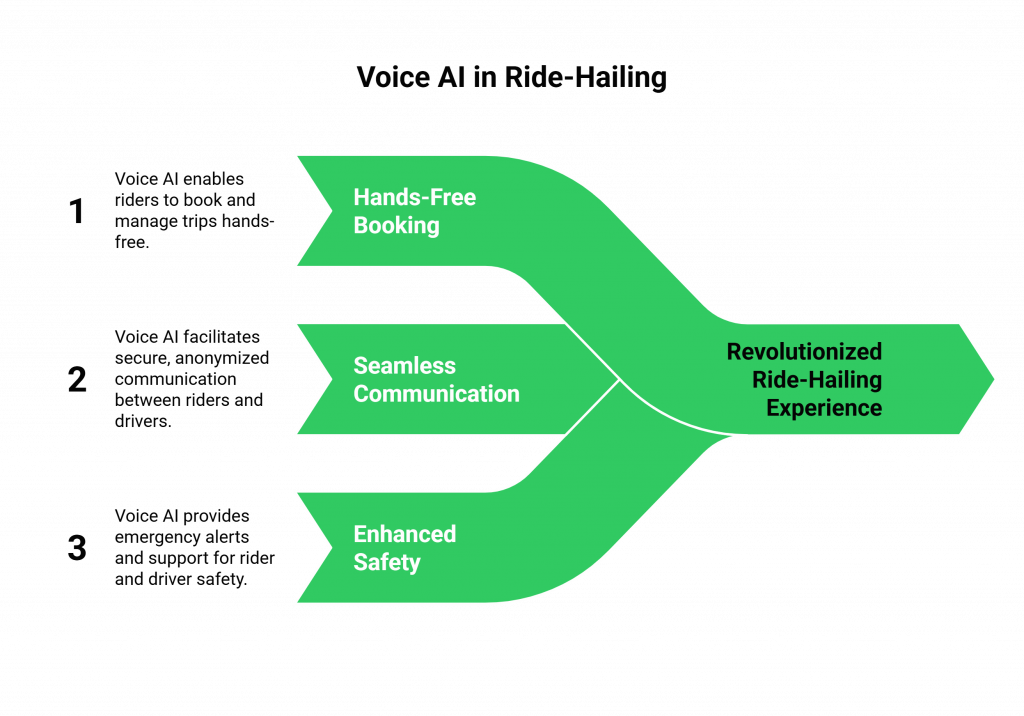
A powerful Voice AI agent can act as a personal assistant for both the rider and the driver, fundamentally changing how they interact with the service.
How Does Voice AI Enable Hands Free Booking and Management?
For riders, the most immediate benefit is the ability to manage their trip without ever touching their screen. This is especially useful when they are multitasking, carrying bags, or have accessibility needs.
A user can simply open the app and say:
- “Book a ride for two people to the central train station.”
- “What is the estimated arrival time for my driver?”
- “Add a stop at the coffee shop on Main Street.”
The Voice AI agent understands these natural language commands, processes the request, and confirms the action, all within seconds. This makes the booking process faster and far more convenient.
How Does It Improve Driver and Rider Communication?
One of the most powerful applications of Voice AI is in facilitating seamless and secure communication between the driver and the rider. Instead of exchanging personal phone numbers, platforms can use a voice infrastructure provider like FreJun AI to enable in app, anonymized calls.
When a driver needs to confirm a pickup location, they can simply tap a button in their app and say, “Call rider.” FreJun AI’s infrastructure would then connect the call through the internet, without revealing either party’s phone number. The key here is low latency.
For the call to be effective, the audio must be clear and happen in real time, with no lag. FreJun AI is optimized for this, ensuring the conversation is as natural as a regular phone call. This protects privacy and encourages more successful connections.
How Can Voice AI Enhance Platform Safety?
Safety is a top concern for both riders and drivers. A Voice AI agent can serve as a critical safety feature. A user could activate an emergency alert by using a predefined safe word or phrase.
The AI could then discreetly open a live audio feed to a support center or even notify emergency services with the trip details and location. This provides a hands free way to get help in a stressful situation. Here is a look at how Voice AI transforms the user journey:
| Stage of Journey | Traditional Method (Manual) | Voice AI Method (Automated) |
| Booking a Ride | Manually typing in destination, selecting options. | Speaking the destination and ride preferences. |
| Contacting Driver | Calling or texting from a personal number. | In app, anonymized voice calls with a single command. |
| Mid-Ride Changes | Tapping through menus to add a stop or change destination. | Simply speaking the request to the voice agent. |
| Customer Support | Navigating menus or typing out an issue in the help section. | Reporting an issue by speaking to the AI assistant. |
| Emergency | Manually finding and pressing a panic button in the app. | Triggering an emergency response with a spoken safe word. |
Also Read: How Are Real Estate Agents Using AI for Inbound Calls?
What Technology Powers These Voice AI Agents?
Creating a sophisticated Voice AI experience involves several layers of technology working together in perfect harmony. It’s not a single piece of software but an ecosystem of services.
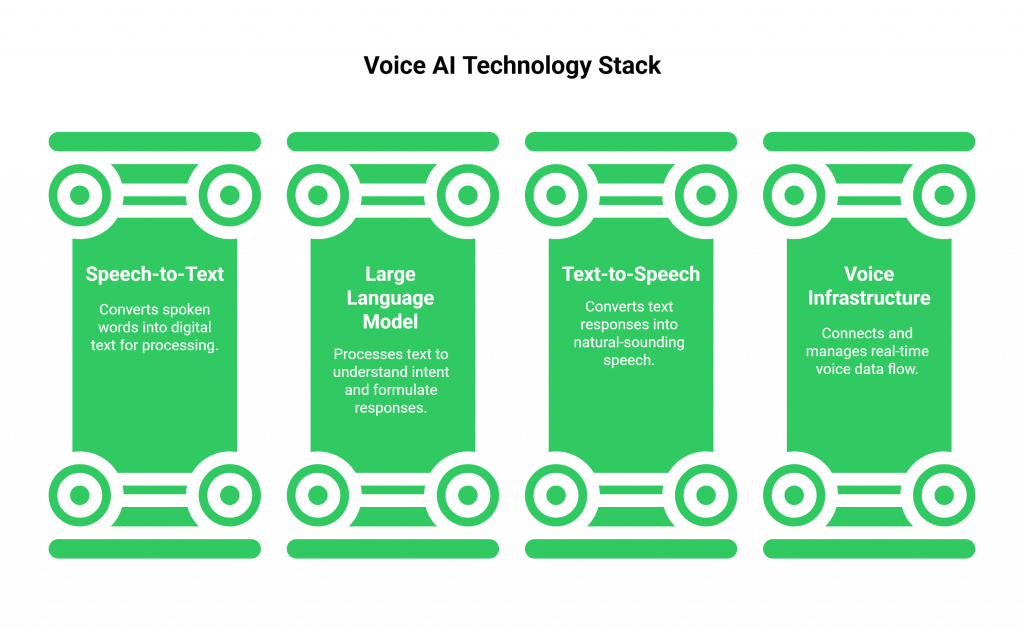
- Speech-to-Text (STT): This is the “ears” of the system. An STT engine listens to the user’s spoken words and converts them into digital text.
- Large Language Model (LLM): This is the “brain.” The LLM processes the text, understands the user’s intent (e.g., they want to book a ride), and formulates the appropriate response or action.
- Text-to-Speech (TTS): This is the “mouth.” The TTS engine takes the text response from the LLM and converts it back into natural sounding human speech.
The invisible, yet most critical, piece of this puzzle is the voice infrastructure that connects these services. This is where a platform like FreJun AI comes in. FreJun AI acts as the voice transport layer. It handles the complex task of streaming the user’s voice to the STT engine and streaming the AI’s response from the TTS engine back to the user, all in real time and with minimal delay.
FreJun AI is model agnostic, which is a huge advantage for global ride-hailing platforms. It means you can bring your own AI models and choose the best STT or TTS provider for different languages and dialects. FreJun AI provides the robust, reliable “plumbing” so that your developers can focus on building the intelligence of your Voice AI agent.
Ready to build the next generation of in-app communication? Sign up for a FreJun AI to get started.
Also Read: How Retailers Use Voice AI for Customer Support?
What Are the Business Benefits for Ride-Hailing Companies?
Integrating a powerful Voice AI is not just about creating a cool feature; it’s about driving real business results. The benefits impact everything from customer loyalty to operational costs.
First, it significantly enhances the user experience. A frictionless, convenient, and safe platform encourages repeat business. According to research, a majority of customers, around 86%, are willing to pay more for a great customer experience. A well implemented Voice AI is a powerful tool for building that experience.
Second, it improves operational efficiency. Clearer communication leads to fewer missed connections and canceled rides. This means drivers waste less time and fuel, increasing their potential earnings and satisfaction. Happy drivers are more likely to stay with your platform.
Finally, it can reduce the load on human customer support teams. A Voice AI agent can handle common queries, report simple issues, and guide users through the app. This frees up human agents to focus on more complex and sensitive cases, reducing operational costs while improving the quality of support.
Conclusion
The ride-hailing industry was built on technological disruption, and the next wave of innovation is here. Voice AI is evolving from a novelty into an essential component of a modern, competitive platform. It addresses the core challenges of communication, safety, and convenience in a way that no other technology can.
By enabling hands free interactions, facilitating secure communication, and providing an extra layer of safety, voice agents create a superior experience for both riders and drivers.
As this technology becomes more widespread, the platforms that successfully integrate a sophisticated and reliable Voice AI will set themselves apart from the competition. By partnering with a robust voice infrastructure provider like FreJun AI, companies can ensure their voice solutions are built on a foundation of speed, clarity, and reliability, paving the way for the future of mobility.
Want to explore how a robust voice infrastructure can elevate your ride-hailing platform? Schedule a demo with our team at FreJun Teler.
Also Read: How to Log a Call in Salesforce: A Complete Setup Guide
Frequently Asked Questions (FAQs)
In ride-hailing, Voice AI refers to an intelligent agent integrated into the app that can understand and respond to spoken commands. It allows users to book rides, contact drivers, and manage their trips using only their voice.
It allows drivers to communicate and get information without taking their hands off the wheel or their eyes off the road. For riders, it can provide a hands free way to trigger an emergency feature by speaking a safe word.
No. When powered by a voice infrastructure platform like FreJun AI, these calls are anonymized. The connection is made over the internet through the platform, protecting the privacy of both the rider and the driver.
Yes. A model-agnostic platform lets ride-hailing companies select the best STT and TTS engines for diverse languages, accents, and dialects.
With a developer-first platform like FreJun AI, comprehensive SDKs and APIs let developers easily embed voice features into existing web or mobile applications.
It enhances driver–rider communication, using anonymized, low-latency in-app calls to reduce misunderstandings, increase pickup success, and prevent cancellations.
Yes, a Voice AI agent can be programmed to handle first level customer support. It can answer frequently asked questions, log complaints about a trip, and guide users to the right resources, freeing up human support agents.
Absolutely. For users with visual impairments or motor disabilities, a voice-first interface provides a much easier way to navigate the app and book rides, making the service more inclusive.