
In the modern enterprise, voice is rapidly becoming the next major user interface. From the C-suite executive dictating a memo on their phone to the warehouse worker confirming a pick with a hands-free command, the demand for fast, accurate, and secure voice recognition is exploding.
But for an enterprise, “voice recognition” means far more than the simple dictation feature on a consumer device. It means a mission-critical component of their technology stack, one that must meet the rigorous demands of enterprise-grade security, compliance, and scalability. This is where the choice of an advanced voice recognition SDK becomes a decision of profound strategic importance.
An enterprise does not just need to turn speech into text; it needs to do so with unwavering accuracy, in challenging real-world environments, and within a framework that protects its most sensitive data. The consumer-grade tools that power our smart speakers are simply not built for the high-stakes world of business.
A true enterprise voice stack requires a secure STT SDK (Speech-to-Text) that is designed from the ground up for the unique challenges of the corporate environment. This article will explore the essential, non-negotiable features that define an advanced voice recognition SDK for enterprise-level applications.
Table of contents
Why is “Good Enough” Not Good Enough for the Enterprise?
The voice recognition on your smartphone is a marvel of technology, but it operates in a very different context than an enterprise application. For a consumer, if a voice assistant mishears a song title, the consequence is a moment of minor annoyance. For an enterprise, the consequences of an inaccurate transcription can be catastrophic.
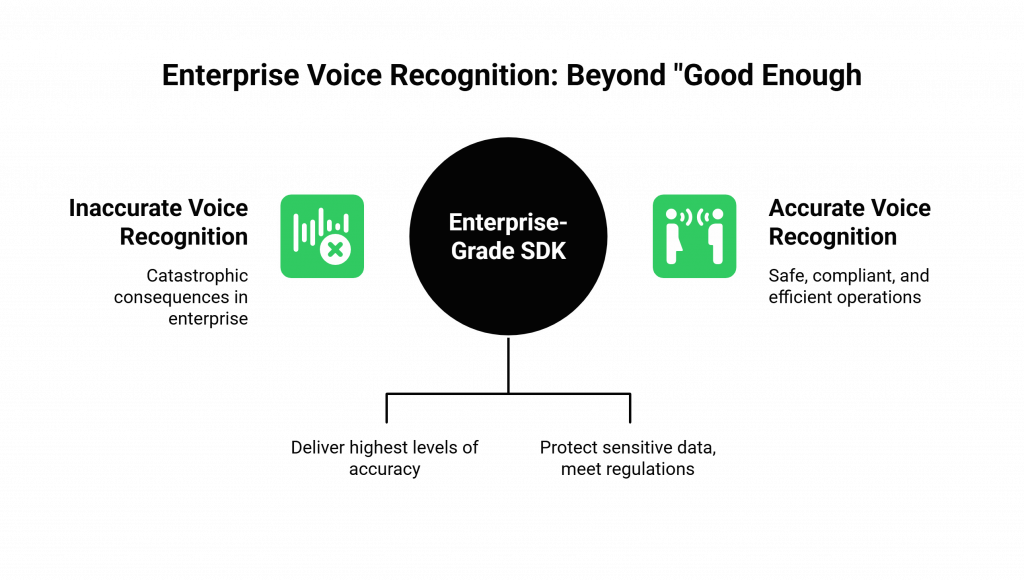
The High Stakes of Accuracy
Imagine these scenarios:
- Healthcare: A doctor is using a voice-enabled EMR system to dictate patient notes. An inaccurate transcription could lead to a misdiagnosis or an incorrect prescription, a life-threatening error.
- Finance: A financial advisor is on a recorded line with a client, and the client gives a verbal confirmation to execute a major trade. A failure to accurately transcribe that confirmation could lead to a massive compliance violation and legal liability.
- Manufacturing: A worker on a noisy factory floor is using a voice command to operate a piece of heavy machinery. A misrecognized command could lead to a serious safety incident.
In these contexts, “good enough” is a recipe for disaster. An enterprise-grade voice recognition SDK must deliver the highest possible levels of accuracy, even in specialized and challenging environments.
Also Read: How Do You Reduce Latency When Building Voice Bots For Live Calls?
The Imperative of Security and Compliance
For an enterprise, data is its most valuable asset, and voice is a rich new source of that data. This data must be protected with the utmost rigor.
- Data Confidentiality: Conversations within a business often contain sensitive intellectual property, trade secrets, and strategic plans. The voice recognition process cannot expose this data to unauthorized parties.
- Regulatory Compliance: Many industries are governed by strict data privacy and security regulations. A compliant speech recognition solution is non-negotiable for enterprises in healthcare (HIPAA) or finance (PCI DSS). It is also required for any business that handles European customer data under GDPR.
A recent study by IBM found that the average cost of a single data breach has now reached an all-time high of $4.45 million, making compliance a critical financial imperative.
What Are the Essential Features of an Enterprise-Grade Voice Recognition SDK?
An advanced voice recognition SDK is far more than just a simple API endpoint for transcription. It is a comprehensive toolkit that gives an enterprise the power, control, and security it needs to deploy voice recognition in mission-critical applications.
This table highlights the key features that separate a consumer-grade tool from a true enterprise voice stack component.
| Feature | Consumer-Grade SDK | Advanced Enterprise Voice Recognition SDK |
| Accuracy & Customization | General-purpose, “one-size-fits-all” model. | Highly accurate, with the ability to create custom models for specific jargon and accents. |
| Deployment Model | Typically a multi-tenant, public cloud service only. | Flexible deployment options, including on-premise and private cloud for maximum security. |
| Security | Basic authentication and transport encryption. | Robust, end-to-end encryption, fine-grained access controls, and a secure STT SDK design. |
| Compliance | Not designed or certified for specific industry regulations. | Architected for and can be certified as a compliant speech recognition solution (e.g., HIPAA, GDPR). |
| Real-Time Performance | Optimized for short, simple commands. | Optimized for low-latency, real-time streaming for long-form dictation and live conversation. |
Also Read: What Architecture Patterns Work Best For Building Voice Bots At Scale?
The Power of Custom Model Training
This is perhaps the single most important feature for enterprise accuracy. Every industry has its own unique lexicon of jargon, acronyms, and product names.
- The Problem: A general-purpose voice recognition model that was trained on web data has no idea what “subcutaneous immunotherapy” or “Q2 earnings forecast” means. It will consistently mis-transcribe this critical, domain-specific language.
- The Solution: An advanced voice recognition SDK allows an enterprise to create a custom acoustic and language model. You can train the AI on your own data, your product manuals, your call recordings, your internal documents to teach it your unique vocabulary. This can dramatically improve transcription accuracy for your specific use case.
The Flexibility of Deployment
For many enterprises, especially in highly regulated industries, sending their sensitive voice data to a multi-tenant, public cloud service is a non-starter.
- The Need for Control: A secure STT SDK must offer flexible deployment options. This includes the ability to deploy the entire speech recognition engine on-premise, within the enterprise’s own data centers, or in a private cloud environment.
- The Benefit: This ensures that the sensitive audio data never leaves the company’s trusted network perimeter, providing the highest possible level of security and control.
Ready to build your enterprise voice applications on a foundation of security and control? Sign up for FreJun AI
What is FreJun AI’s Role in Building an Enterprise Voice Stack?
While FreJun AI is not a Speech-to-Text provider, we are the essential, foundational layer that makes a secure STT SDK useful in a real-time communication context. Our platform is the “voice” of your enterprise voice stack.
We provide the powerful and secure voice infrastructure that acts as the bridge between a live phone call and your chosen voice recognition SDK.
- The Secure Connection: Our platform establishes the initial, encrypted (via TLS/SRTP) phone call.
- The Real-Time Media Stream: Our Real-Time Media API allows you to get a live, secure stream of the call’s audio.
- The Bridge to Your STT: You can then pipe this real-time audio stream directly to your chosen compliant speech recognition engine, whether it is running in a private cloud or on-premise.
Also Read: How Is Building Voice Bots Evolving With Real-Time Streaming AI?
Conclusion
The integration of voice recognition into enterprise applications is no longer a question of “if,” but “how.” For an enterprise, the “how” must be answered with a relentless focus on accuracy, security, and compliance. The consumer-grade tools that have popularized voice assistants are not sufficient for the high-stakes, mission-critical demands of the business world.
A true, advanced voice recognition SDK provides the essential, enterprise-grade features, from custom model training to flexible, on-premise deployment options that are required.
By choosing a secure STT SDK and building it on top of a flexible and secure voice infrastructure, enterprises can confidently unlock the immense power of voice. It transforms their operations and building the next generation of intelligent, voice-powered applications.
Want to do a deep dive into the architecture of how to securely stream real-time audio from our platform to your on-premise or private cloud STT engine? Schedule a demo for FreJun Teler.
Also Read: United Kingdom Country Code Explained
Frequently Asked Questions (FAQs)
It is a specialized Speech-to-Text (STT) toolkit designed for business use. It prioritizes high accuracy, robust security, regulatory compliance, and the ability to be customized for specific industry vocabularies, distinguishing it from consumer-grade tools.
Compliant speech recognition refers to an STT solution that is architected and can be deployed in a way that meets the strict data privacy and security requirements of regulations like HIPAA (for healthcare), GDPR (for European data), or PCI DSS (for financial transactions).
A custom model is trained on your company’s own data (e.g., call recordings, documents). This teaches the AI to recognize unique product names, industry-specific acronyms, and the particular accents of your user base, which dramatically reduces transcription errors.
The key advantage is security and data privacy, your STT engine runs on your own servers, so sensitive audio never leaves your network, giving you full control.
FreJun AI securely connects to the public phone network and streams call audio in real time (via SRTP) to your STT engine, whether it’s in a private cloud or on-prem.
Yes, advanced enterprise SDKs are built on powerful AI models that can support a wide array of languages. They can often be configured to switch between languages or even handle multiple languages within the same conversation.
An acoustic model is the part of the AI that has been trained to recognize the fundamental sounds (phonemes) of a language.
You should conduct a “bake-off” by running your own real-world audio data through each SDK’s models to compare their accuracy on the vocabulary that matters to you