
Building a modern application is a lot like building a house. You can have the most beautiful paint and the most expensive furniture, but if the foundation is weak, the whole thing will crack.
For developers building communication apps, customer support platforms, or AI voice agents, the voice calling API and SDK is the foundation. It is the invisible engine that powers every conversation.
If you choose the right provider, your users get crystal-clear audio and your app scales effortlessly. If you choose the wrong one, you end up with dropped calls, robotic voices, and angry customers who leave bad reviews.
The challenge is that there are dozens of providers out there. They all promise the same things: “High Quality,” “Low Cost,” and “Easy to Use.” But how do you know what is real? How do you look past the marketing fluff and evaluate the actual technology?
In this guide, we will break down the specific, technical, and business criteria you must evaluate. We will look at infrastructure, usage-based voice pricing, and the importance of billing transparency. We will also explain how platforms like FreJun AI are setting a new standard for reliability in the voice infrastructure space.
Why Is Network Reliability the First Thing You Should Check?
Before you look at features or price, you must look at reliability. In the world of voice, “uptime” is everything.
Imagine you are running a healthcare app. A patient tries to call a doctor for an emergency consultation. If the API is down, that call fails. That is not just an inconvenience; it is a critical failure.
When assessing a provider, look for their Service Level Agreement (SLA). You want to see a guarantee of at least 99.99% uptime. This is often called “four nines.”
But do not just read the number on the website. Ask about their redundancy.
- Geographic Redundancy: If their server in New York loses power, does the traffic automatically switch to a server in London or Singapore?
- Carrier Redundancy: Do they rely on a single telephone carrier? Or do they have relationships with multiple Tier-1 carriers so they can reroute calls if one line goes dead?
FreJun AI is built on a distributed architecture. We utilize FreJun Teler, our telephony arm, to provide elastic SIP trunking that automatically reroutes traffic around failures. This ensures that your application stays online even when parts of the global internet are struggling.
How Does Audio Quality Impact User Retention?
Audio quality is subjective, right? Wrong. In the world of APIs, quality is a measurable science.
Bad audio is the fastest way to lose a user. If there is an echo, or if the voice sounds like it is underwater, users get frustrated.
When testing a voice calling API and SDK, you need to measure two specific things:
- Latency: This is the delay between when you speak and when the other person hears you. High latency leads to people talking over each other.
- Jitter: This is when the audio packets arrive out of order, making the voice sound robotic or choppy.
According to data from TechJury, 70% of consumers say they will support a company that delivers great customer service. If your voice tech prevents that great service due to lag, you are losing money.
FreJun AI is engineered specifically for low latency. We act as the transport layer and do not bloat the signal with unnecessary processing. We stream the media in real-time using optimized routes, ensuring that the conversation feels natural and “instant.”
Also Read: What Drives Reliable Inbound Call Flows Using Voice APIs?
What Should You Look for in Voice Calling API and SDK Documentation?
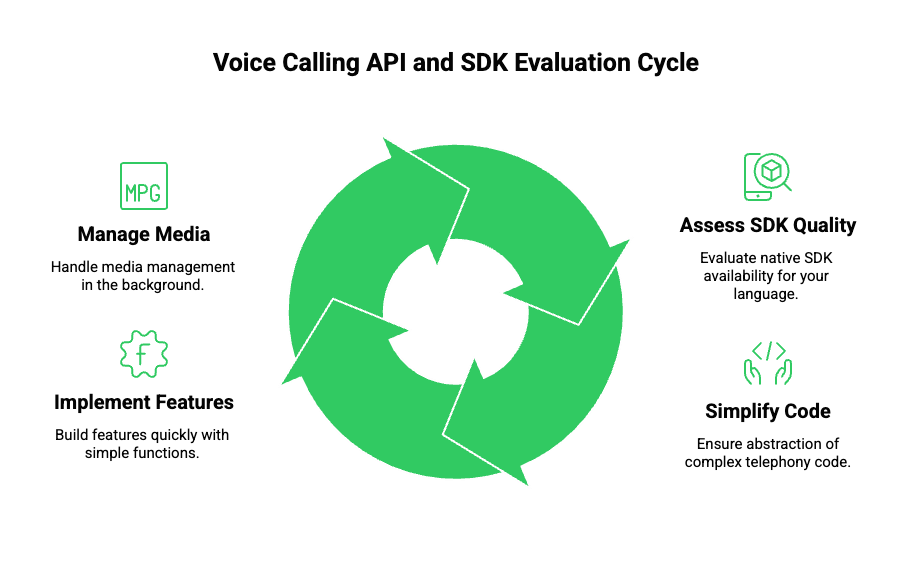
You can have the best infrastructure in the world, but if the code is impossible to use, it is worthless.
The “Developer Experience” (DX) is a critical assessment criterion. You want to build your feature in days, not months.
The Quality of the SDK
Does the provider offer a native Software Development Kit (SDK) for your programming language?
- If you are building a web app, do they have a Javascript/React SDK?
- If you are building a backend service, do they have Python or Node.js libraries?
A good voice calling API and SDK abstracts away the hard stuff. You should not have to write raw SIP code. You should be able to write simple functions like call.connect() or call.record().
FreJun provides a developer-first toolkit. Our documentation is full of copy-paste examples. We allow you to integrate voice capabilities into your web or mobile apps with minimal code, handling the complex media management in the background.
How Do Usage-Based Voice Pricing Models Work?
Cost is always a factor. However, in the voice world, pricing can be incredibly confusing.
Most providers operate on usage-based voice pricing. This means you pay for every minute of every call. But the devil is in the details.
Inbound vs. Outbound
Usually, receiving a call (inbound) costs less than making a call (outbound). You need to know your traffic mix. Are you a customer support center (mostly inbound)? Or a sales team (mostly outbound)?
Rounding Rules
This is a hidden cost. Some providers round up to the nearest minute. If a call lasts 61 seconds, you pay for two minutes. Other providers, like FreJun, offer more granular billing. Over thousands of calls, these seconds add up to thousands of dollars.
Committed Use Discounts
If you know you will have high volume, ask about “committed use.” This is where you promise to spend a certain amount per month in exchange for a lower rate per minute.
Understanding these API cost models ensures you can forecast your expenses accurately.
Why Is Billing Transparency Critical for Scaling?
It is one thing to have a low price. It is another thing to understand your bill.
Many developers get a shock at the end of the month. They see a huge charge and have no idea where it came from. Was it international calls to high-cost regions? Was it a testing script left running overnight?
Billing transparency is a non-negotiable criterion.
You need a dashboard that shows you:
- Real-time spend tracking.
- Breakdowns by country and carrier.
- Breakdowns by specific sub-accounts or projects.
If a provider hides this data or only gives you a PDF invoice once a month, run away. You cannot optimize what you cannot measure.
FreJun AI prioritizes transparency. We provide detailed logs and analytics so you can see exactly where every penny is going. This allows you to spot inefficiencies and scale your usage confidently.
How Important Is Scalability and Global Reach?
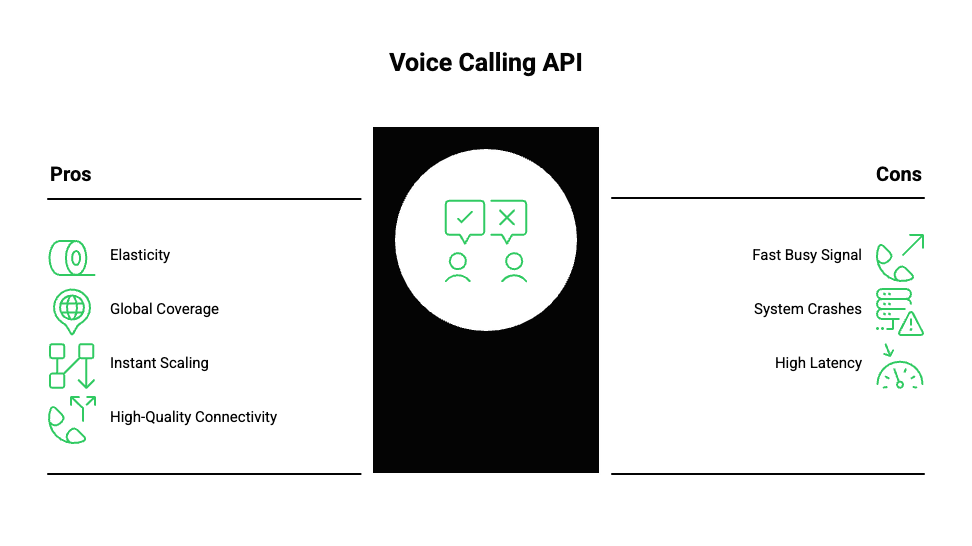
You might be a startup today, but you plan to be an enterprise tomorrow. Your voice calling API and SDK needs to grow with you.
Elasticity
What happens if you launch a marketing campaign and 5,000 people call you at once?
- Bad Provider: You get a “fast busy” signal. The system crashes.
- Good Provider: The system expands automatically.
This is where FreJun Teler shines. We offer elastic SIP trunking. “Elastic” means it stretches. We do not have fixed limits on channels. Whether you have one call or ten thousand, our infrastructure scales up instantly to handle the load.
Global Coverage
If you have customers in Europe or Asia, you need local phone numbers there. You also need servers there to keep latency low.
Assess the provider’s global footprint. Do they have Points of Presence (PoPs) in the regions that matter to you? FreJun has a distributed global network, ensuring high-quality connectivity regardless of where your users are located.
What Level of Support Should You Expect?
When things go wrong (and they eventually will), who do you call?
Many large API providers have terrible support. You submit a ticket and get an automated reply three days later. For a live voice application, three days is an eternity.
When assessing a provider, test their support before you sign the contract.
- Do they have a live chat?
- Do they have dedicated account managers for enterprise clients?
- Do they offer integration support to help you architect your app correctly?
At FreJun, we believe in dedicated integration support. We help our customers with pre-integration planning and post-integration optimization. We act as a partner, not just a vendor.
Also Read: Which Systems Enable Scalable Call Recording via Voice APIs?
How Secure Is the Infrastructure?
Voice calls often contain sensitive data. Credit card numbers, medical information, and personal addresses are spoken over the line.
Security is not just a feature; it is a requirement.
Encryption
Ask the provider: Is the voice media encrypted?
You want to look for SRTP (Secure Real-time Transport Protocol). This ensures that even if a hacker intercepts the call, they only hear static.
Compliance
Depending on your industry, you might need specific certifications.
- HIPAA: For healthcare in the US.
- GDPR: For data privacy in Europe.
- PCI-DSS: For taking payments over the phone.
FreJun AI is engineered with security by design. We protect data integrity and confidentiality through robust protocols, ensuring that your application remains compliant with global standards.
Why Is Model Agnosticism Important for AI?
This criterion is specific to the modern era of AI.
Many voice providers try to lock you into their ecosystem. They say, “Use our voice API, and you must use our transcription and our AI bot.”
But what if their AI isn’t the best? What if you want to use OpenAI’s GPT-4 for the brain and ElevenLabs for the voice?
You need a provider that is model-agnostic.
FreJun AI stands out here. We do not provide the STT (Speech-to-Text) or LLM directly. Instead, we act as the high-speed bridge. We allow you to bring your own best-in-class AI models. We simply transport the audio from the caller to your AI and back, faster than anyone else. This gives you the freedom to build the exact experience you want without being trapped in a “walled garden.”
Comparison: What a Good vs. Bad Provider Looks Like
Here is a quick reference table to help you evaluate your options.
| Criteria | The Wrong Provider | The Right Provider (e.g., FreJun) |
| Uptime | Frequent outages, no transparency | 99.99% SLA, Status Page |
| Latency | High delay, awkward pauses | Ultra-low latency media streaming |
| Pricing | Hidden fees, rounding up | Transparent usage-based voice pricing |
| Support | Automated bots, slow email | Dedicated integration engineers |
| Scalability | Fixed channels (busy signals) | Elastic SIP Trunking (Unlimited) |
| AI Flexibility | Locked ecosystem | Model-agnostic (Bring Your Own AI) |
| Documentation | Outdated, hard to read | Developer-first SDKs and guides |
Ready to build with a provider that meets all these criteria? Sign up for a FreJun AI developer account and start coding today.
How Do You Test for “Edge Cases”?
Finally, a great assessment strategy involves testing for things that rarely happen.
- The “Tunnel Test”: What happens if a user switches from Wi-Fi to 4G in the middle of a call? Does the SDK handle the handover gracefully, or does the call drop?
- The “Silence Test”: If no one speaks for 30 seconds, does the connection time out?
- The “Volume Test”: Can you blast the API with 100 calls in one second?
A robust voice calling API and SDK handles these edge cases automatically. FreJun’s client-side SDKs are designed to manage network fluctuations, keeping the call alive even when the user’s internet is unstable.
What About Future-Proofing?
Technology moves fast. Today you might just need simple 1-to-1 calling. Tomorrow you might need AI voice agents, conference calling, or sentiment analysis.
Choose a provider that is innovative. Look at their product roadmap. Are they releasing new features? Are they keeping up with AI trends?
FreJun is built for the next generation of voice automation. By focusing on the infrastructure layer, we ensure that as AI gets faster and smarter, your voice connection is ready to support it.
According to Gartner, the market for communications APIs is growing by 30% annually. This means more innovation is coming. You need a partner who is leading that charge, not following it.
Also Read: Why Voice Calling APIs Are Used for AI Agent Integration?
Conclusion
Choosing a voice provider is a big decision. It is not something you want to change six months later because you realized the call quality was bad.
You need to look beyond the homepage marketing and need to dig into the API cost models. You need to demand billing transparency and need to test the voice calling API and SDK yourself to feel the latency.
The best providers are the ones that make themselves invisible. They handle the complex infrastructure—the carrier negotiations, the codec optimization, the global routing—so you don’t have to.
FreJun AI is that provider. With our focus on low latency, security, and elastic scale via FreJun Teler, we provide the rock-solid foundation your app needs. We handle the complex voice infrastructure so you can focus on building your AI.
Want to discuss your specific infrastructure needs? Schedule a demo with our team at FreJun Teler and let us help you build a world-class voice experience.
Also Read: UK Mobile Code Guide for International Callers
Frequently Asked Questions (FAQs)
A Voice API (Application Programming Interface) is the set of rules that allows your server to talk to the provider’s server. An SDK (Software Development Kit) is a package of code (library) that you install in your app to make using the API easier.
Usage-based pricing is fairer. You only pay for the minutes you actually use. This is perfect for startups or businesses with fluctuating call volumes.
It is a method of delivering voice over the internet that scales automatically. Unlike traditional phone lines where you have a fixed number of channels (e.g., 20 lines).
Check their “Status Page.” Most reputable providers publish a public status page that shows their historical uptime and any past incidents.
Latency is the time delay between speaking and hearing. High latency causes people to interrupt each other, making the conversation feel awkward and frustrating.
No. FreJun is model-agnostic. We provide the infrastructure (the phone lines and audio streaming). You bring your own AI (like OpenAI or Deepgram).
Surprisingly, no. Many legacy providers have complex bills with hidden carrier fees.
Yes. This is called “Number Porting.” A good provider will have a dedicated team to help you move your existing business numbers to their platform without interrupting service.