
Then, one of your biggest clients decides to run a massive calling campaign through the voice calling API. Their fifty sales agents all pick up the phone at the exact same time to dial prospects directly through your dashboard.
Suddenly, the audio starts to chop. Calls get dropped. The delay between speaking and hearing becomes three seconds long. Your client is furious. They send an angry email threatening to cancel their subscription.
What went wrong? Your software code was fine. Your user interface was beautiful. But the “pipe” connecting your software to the telephone network was too small. You lacked scalability.
For SaaS (Software as a Service) companies, growth is the goal. But growth breaks things. If you are building communication features, choosing the right voice calling API and SDK provider is the most critical infrastructure decision you will make. It determines whether your product flies or crashes when user demand spikes.
In this guide, we will explore what true scalability looks like in voice technology. We will look at how elastic infrastructure, global routing, and seamless integration capabilities empower SaaS products to grow without limits, and how platforms like FreJun AI provide the sturdy foundation needed for this expansion.
Why Is Scalability the Number One Challenge for SaaS Voice Calling API?
SaaS products are unique because they are “multi-tenant.” This means thousands of different companies use the same infrastructure at the same time.
If you run a standard website, traffic usually grows steadily. But in the world of voice, traffic is “bursty.”
Think about a call center software or a sales CRM.
- 9:00 AM: Everyone logs in and starts dialing. Traffic spikes by 1,000%.
- 12:00 PM: Everyone goes to lunch. Traffic drops to zero.
- 1:00 PM: Everyone returns. Another massive spike.
A traditional phone system cannot handle this. It has a fixed capacity. It is like having a highway with only two lanes. When the rush hour comes, everything stops.
A scalable voice calling API and SDK works differently. It functions like a magical highway that creates new lanes instantly whenever more cars appear. This elasticity is essential. If your provider cannot scale dynamically, your users will experience “jitter” (robotic voice) or blocked calls during peak hours.
According to Gartner, the shift to cloud-based communications is accelerating precisely because legacy systems cannot handle the flexible demands of modern business. SaaS companies that fail to adopt scalable cloud infrastructure risk losing their competitive edge.
What Is the Role of Elastic SIP Trunking?
The secret sauce behind scalability is something called “Elastic SIP Trunking.”
In the old days, you bought phone lines in bundles. You paid for 20 lines. If you had 21 calls, the 21st person got a busy signal.
FreJun AI utilizes FreJun Teler, which provides elastic SIP trunking. The word “elastic” is key. It stretches.
- If your SaaS has one active call, we allocate resources for one call.
- If your SaaS suddenly has 10,000 active calls, we automatically expand the capacity to handle 10,000 calls.
There is no manual switch to flip. You do not have to call us to “add more lines.” It happens automatically in the background. For a SaaS founder, this is peace of mind. You know that no matter how fast your marketing team grows your user base, your voice infrastructure will never be the bottleneck.
Also Read: What Secures Production Voice Systems Built on Calling SDKs?
How Does a Voice Calling API and SDK Speed Up Development?
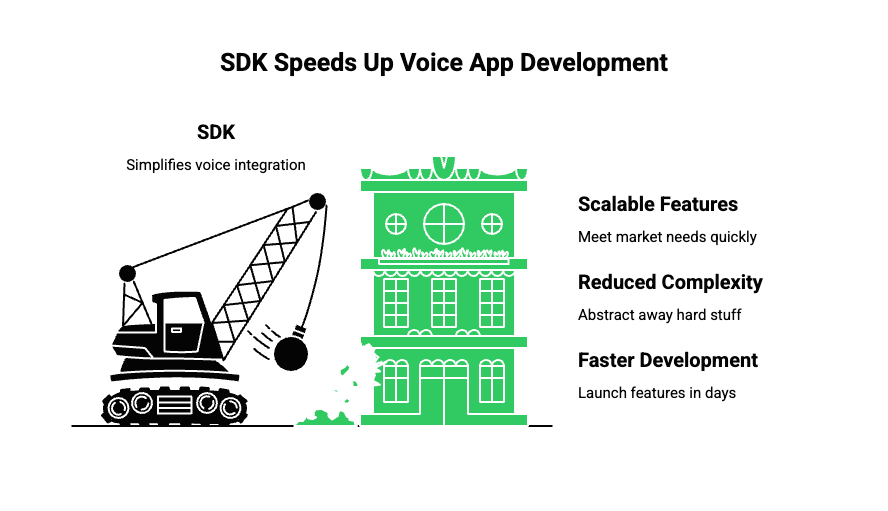
Scalability is not just about handling calls; it is also about handling code.
As your SaaS product grows, your code becomes more complex. Maintaining a custom-built voice engine from scratch is a nightmare. It requires deep knowledge of telecom protocols that most web developers do not have.
This is where the “SDK” part of voice calling API and SDK becomes vital. SDK stands for Software Development Kit.
The Developer’s Toolkit
A good provider offers SDKs for both the client-side (frontend) and server-side (backend).
- Client-Side SDK: This handles the microphone access, the browser audio streams, and the connection stability on the user’s laptop or phone.
- Server-Side SDK: This handles the logic. “Who is calling whom?” “Should this call be recorded?”
FreJun provides a developer-first toolkit. We abstract away the hard stuff. Instead of writing thousands of lines of code to manage media packets, your developer simply imports the FreJun SDK and writes a few lines to start a call.
This allows your team to move fast. You can launch new voice features in days, not months. Speed of iteration is a different kind of scalability—it is the ability to scale your feature set to meet market needs.
Why Is Global Reach Essential for Scalability?
SaaS products rarely stay local. You might start in New York, but soon you will have customers in London, Singapore, and Sydney.
Voice is sensitive to distance. If your server is in the US and your user is in Australia, the voice data has to travel halfway around the world. This creates latency (delay).
- User: “Hello?”
- (2 seconds later)
- System: “Hello.”
This delay ruins the conversation. It makes the software feel slow and “buggy.”
True scalability means being global. FreJun AI operates on a geographically distributed infrastructure. We have points of presence around the world.
When a user in Europe makes a call using your SaaS, we route the audio through our nearest European node. We do not force it to travel to the US and back. This low latency routing ensures that the call feels instant and natural, regardless of where your customer is located.
How Do CRM-Integrated Voice Providers Enable Sales Automation?

Voice does not live in a vacuum. For most B2B SaaS products, voice is part of a larger workflow, usually involving a Customer Relationship Management (CRM) system.
Your users want to make calls, but they also want those calls to automatically log in their database. They want the recording attached to the contact. They want the transcript to be searchable.
Scalable providers act as CRM-integrated voice providers. They make it easy to push and pull data between the phone system and the external database.
This enables sales automation.
- Trigger: A lead fills out a form on a website.
- Action: The CRM tells your SaaS to initiate an immediate outbound call via the FreJun API.
- Result: The sales agent is connected to the lead instantly.
If your voice provider cannot handle these rapid-fire API requests reliably, the automation breaks. FreJun is built to handle high-frequency API traffic, ensuring that your automated workflows fire correctly every single time.
What Role Does Call Data Sync Play in Analytics?
As your SaaS grows, your customers will demand data. They want to know:
- “How many calls did my team make today?”
- “What was the average duration?”
- “Which calls resulted in a sale?”
To answer these questions, you need robust call data sync.
A scalable voice calling API and SDK does not just transmit audio; it transmits metadata. It sends webhooks (real-time notifications) to your server whenever a call starts, connects, or ends.
If you have ten users, you can query this data manually. If you have ten thousand users generating millions of call logs, you need a system that syncs this data efficiently without crashing your database.
FreJun ensures reliable data delivery. We capture the call details, the recording URL, and the status, and we push it to your application in real time. This allows you to build beautiful analytics dashboards for your users, proving the ROI of your platform.
Ready to build a voice feature that grows with your business? Sign up for a FreJun AI developer account to access our scalable infrastructure.
How Does FreJun AI Ensure High Availability?
In the SaaS world, downtime is the enemy. If your software goes down, your customers cannot work. If they cannot work, they stop paying you.
Reliability is the foundation of scalability. You cannot scale a system that keeps breaking.
FreJun is engineered for enterprise-grade reliability.
- Redundancy: We do not rely on a single server. If one node fails, traffic is automatically rerouted to a healthy node.
- Security: We encrypt voice data in transit. Scalability must never come at the cost of security.
- Monitoring: We watch the network 24/7. We fix potential jitter or latency issues before your users even notice them.
We handle the complex voice infrastructure so you can focus on building your AI and your product. By offloading the “plumbing” to us, you ensure that your service remains up and running, even as you scale from a startup to a unicorn.
Also Read: Which Metrics Become Visible Through Live Call Analytics APIs?
Comparison: Rigid vs. Scalable Voice Infrastructure
Here is a quick look at why the “old way” fails and the “new way” succeeds for SaaS.
| Feature | Legacy / Rigid Infrastructure | Scalable Voice API (FreJun) |
| Capacity | Fixed limit (e.g., 50 lines) | Unlimited / Elastic |
| Growth Speed | Weeks (requires manual setup) | Instant (automatic scaling) |
| Global Reach | Expensive / High Latency | Distributed / Low Latency |
| Integration | Difficult / Hardware-based | Easy / SDK-based |
| Maintenance | High (you manage servers) | Zero (provider manages it) |
| Cost | Pay for capacity (even if unused) | Pay for usage (only what you use) |
| Reliability | Single point of failure | Redundant failover systems |
Can You Bring Your Own AI Models?
Modern SaaS products are not just about calling; they are about intelligent calling. You might want to build an AI sales agent that talks to customers automatically.
Some providers lock you into their AI models. They force you to use their transcription or their text-to-speech voices. This limits your scalability because you cannot swap out components as technology improves.
FreJun takes a different approach. We are the transport layer and model-agnostic.
- You bring your own LLM (Large Language Model).
- You bring your own Speech-to-Text provider.
- You bring your own Text-to-Speech engine.
We simply provide the high-speed connection between the telephone network and your AI. This makes your product future-proof. As AI models get cheaper and faster, you can switch them out without changing your voice infrastructure. This flexibility is a critical component of long-term scalability.
Real-World Example: The Power Dialer
Let’s look at a concrete example. Imagine you are building a “Power Dialer” for sales teams. This tool dials down a list of numbers automatically.
If you use a non-scalable provider:
- Your user uploads 1,000 leads.
- They hit “Start.”
- The system tries to open 50 lines at once.
- The provider blocks 40 of them because of a rate limit.
- The 10 that connect have poor audio quality.
- The user churns.
If you use FreJun’s voice calling API and SDK:
- Your user hits “Start.”
- FreJun Teler detects the spike in demand.
- It instantly allocates the necessary SIP trunks.
- All calls connect with crystal-clear audio.
- Webhooks sync the call outcomes back to the CRM immediately.
- The user closes more deals and upgrades their plan.
This is the difference between a toy and a tool. Scalability is what turns a feature into a business.
Also Read: What Allows Voice Calling APIs to Absorb Traffic Surges?
Conclusion
Building a SaaS product is hard. Scaling it is even harder. You have to worry about database loads, server costs, and user acquisition. You should not have to worry about whether your phone lines will work.
Choosing the right voice calling API and SDK is about more than just finding a way to make a call. It is about finding a partner that can grow with you. It is about ensuring that when your biggest customer has their busiest day, your software shines.
Scalability comes from elastic infrastructure, global low-latency routing, and developer-friendly tools that speed up integration. It comes from having robust call data sync and the ability to integrate with CRM-integrated voice providers.
FreJun AI provides this foundation. With FreJun Teler handling the heavy lifting of global telephony and our model-agnostic approach giving you the freedom to innovate, we are the engine behind the next generation of high-growth SaaS platforms.
Want to discuss your growth plans with an infrastructure expert? Schedule a demo with our team at FreJun Teler and let us show you how to build without limits.
Also Read: UK Phone Number Formats for UAE Businesses
Frequently Asked Questions (FAQs)
A voice calling API (Application Programming Interface) allows different software programs to communicate with the telephone network.
SaaS usage is unpredictable. Elasticity means the system automatically expands to handle traffic spikes and shrinks when traffic is low.
FreJun Teler is the telephony infrastructure arm of FreJun AI. It provides elastic SIP trunking, which is the technology that connects your application to the global public telephone network (PSTN).
FreJun has a distributed network with servers (Points of Presence) around the world. We route calls through the nearest server to the user to ensure low latency and high audio quality, regardless of location.
Yes. FreJun provides the APIs and webhooks needed to build deep integrations with CRMs. This allows for features like click-to-dial, automatic call logging, and screen pops.
No, and that is a good thing. FreJun handles the voice transport layer. We allow you to connect any AI model (like OpenAI or Deepgram) to the call. This gives you total control over the intelligence of your bot.
Call data sync is the process of automatically transferring information about a call (duration, recording link, status) from the voice provider to your application’s database or CRM.
Yes. FreJun is built with enterprise-grade security. We encrypt voice data in transit and rest, ensuring that sensitive business conversations remain private.