
Imagine you are running a large financial firm. You have five thousand traders on the phone every day. They are making deals worth millions of dollars. By law, you must record every single one of those conversations.
One day, the market goes crazy. Call volume triples. Your old recording server, sitting in a dusty basement, starts to smoke. It cannot handle the load. It crashes. Thousands of calls go unrecorded.
Two weeks later, regulators ask for the tapes. You do not have them. You are fined millions of dollars.
This nightmare scenario is why “scalability” is the most important word in voice technology today. It is not enough to just record a call. You must be able to record all the calls, even when the volume spikes unexpectedly.
Traditional hardware cannot do this easily. But modern cloud systems can. By using a voice calling API and SDK, businesses can build recording systems that expand and contract like a rubber band.
In this article, we will explore the systems that enable this massive scale. We will look at how concurrent call handling API architecture works, why performance depends on infrastructure, and how platforms like FreJun AI provide the backbone for fail-safe recording.
Table of contents
- Why Is Scalable Call Recording So Difficult?
- How Do Voice Calling API and SDK Solutions Work?
- What Architecture Enables Concurrent Call Handling API?
- How Does FreJun AI Ensure High Performance?
- Why Is Low Latency Critical for Recording?
- How to Implement High Concurrency SDKs?
- What Are the Key Features of a Robust Recording System?
- Comparing Legacy vs. API-Based Recording
- Conclusion
- Frequently Asked Questions (FAQs)
Why Is Scalable Call Recording So Difficult?
Recording audio sounds simple. Your phone does it. A tape recorder does it. But recording thousands of simultaneous streams is an engineering challenge.
The Storage Problem
Audio files are heavy. If you record one hour of high-quality audio, it takes up a lot of space. If you record 10,000 hours a day, you are generating terabytes of data. Traditional systems run out of hard drive space quickly.
The Processing Load
Capturing audio requires computer power (CPU). The system has to listen to the data packets, assemble them, and write them to a disk in real-time. If the CPU gets overwhelmed, the audio skips. You get gaps in the recording. In a legal dispute, a gap of five seconds can hide the most important part of the conversation.
The Network Bottleneck
This is the most common failure point. Audio travels over the network. If your network pipe is too small, and everyone calls at once, the data gets stuck. This is called “congestion,” and it kills recording quality.
How Do Voice Calling API and SDK Solutions Work?

To solve these problems, developers have moved away from hardware boxes and toward software solutions. A voice calling API and SDK allows you to build recording capabilities directly into your application.
Think of an API (Application Programming Interface) as a remote control. Your software presses a button that says “Start Recording.” The heavy lifting happens somewhere else—in the cloud.
When you use a cloud-based voice calling API and SDK, you are not recording the call on your own computer. You are telling a massive, industrial-grade server farm to do it for you.
This architecture offers three main benefits:
- Elasticity: If you have 10 calls, the cloud uses a little bit of power. If you have 10,000 calls, it instantly allocates more power. You do not have to buy new servers.
- Off-site Storage: The files are saved directly to cloud storage (like Amazon S3 or Google Cloud). You never run out of space.
- Redundancy: If one server fails, another one takes over instantly. You never lose a recording.
Also Read: The Future of Programmable SIP in the Age of AI and LLMs
What Architecture Enables Concurrent Call Handling API?
The secret sauce to handling thousands of calls at once is “concurrency.” This refers to the number of events happening at the exact same time.
To build a concurrent call handling API, you need a distributed system.
The Load Balancer
Imagine a traffic cop at a busy intersection. This is the load balancer. When thousands of calls come in, the load balancer distributes them across hundreds of different servers. No single server gets overwhelmed.
The Media Forking
This is how modern recording works efficiently. In the past, the audio went to the phone, and then the phone sent it to a recorder. That is slow.
In a modern system like FreJun, we use “media forking.” The moment the call enters our network, we split the audio stream. One stream goes to the listener. A duplicate stream goes directly to the recording engine. This happens deep in the infrastructure, ensuring zero delay for the caller.
Elastic SIP Trunking
This is where FreJun Teler shines. SIP Trunking is the digital pipe that connects your calls to the world. Standard pipes have a fixed size. FreJun Teler offers elastic SIP trunking. It expands automatically. This ensures that your concurrent call handling API never hits a limit. Whether it is Black Friday or a quiet Sunday, the capacity is always exactly what you need.
How Does FreJun AI Ensure High Performance?
You can write the best recording code in the world, but if the underlying network is slow, you will fail. Performance in voice recording is all about the infrastructure.
FreJun handles the complex voice infrastructure so you can focus on building your AI and applications. We approach recording with a “transport-first” mindset.
Low Latency Media Streaming
We optimize the path the audio takes. We route the voice data through the nearest data center. By minimizing the distance the data travels, we reduce the risk of “jitter” (choppy audio) and ensure that the recording is crystal clear.
Model Agnostic Flexibility
FreJun does not lock you into a proprietary format. We capture the raw media. You can then stream that recording to any storage bucket or even stream it live to an AI for real-time transcription. This flexibility allows enterprises to build custom compliance workflows without fighting the infrastructure.
Why Is Low Latency Critical for Recording?
You might ask, “If I listen to the recording later, why does latency matter now?”
It matters for synchronization and accuracy.
If you are using real-time analytics like an AI that detects if a customer is angry, the recording must be processed instantly. If there is high latency (delay), the AI is analyzing old news.
Furthermore, high latency causes “packet loss.” This is when pieces of the audio go missing because they arrived too late. A recording with packet loss sounds like a robot talking underwater. It is useless for compliance and useless for training.
FreJun’s infrastructure prioritizes performance and low latency to ensure every syllable is captured exactly as it was spoken.
Ready to build a recording system that never fails? Sign up for FreJun AI to get your API keys.
How to Implement High Concurrency SDKs?
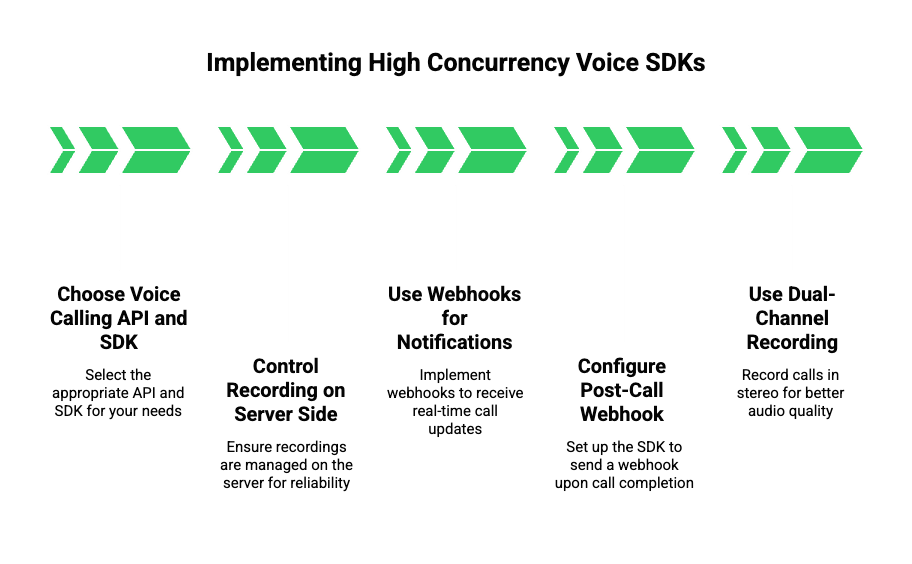
If you are a developer, choosing the right voice calling API and SDK is the first step. But how you implement it matters too.
Step 1: Client-Side vs. Server-Side
For high scale, you should control recording on the server side.
- Client-Side: The app on the user’s phone records. This is risky. If the user’s battery dies or their Wi-Fi drops, the recording stops.
- Server-Side: The infrastructure records. This is safe. Even if the user drops off, the system captures the event accurately.
Step 2: Use Webhooks
Do not poll the server asking, “Is the call done? Is the recording ready?” That wastes bandwidth. Use webhooks.
Configure your high concurrency SDK to send a “Post-Call” webhook. As soon as the call ends, FreJun sends a message to your server with the URL of the recording. This is efficient and scalable.
Step 3: Dual-Channel Recording
Always use stereo recording (dual-channel).
- Mono: Mixes everyone into one track. It is hard to tell who interrupted whom.
- Stereo: Records the agent on the left channel and the customer on the right channel. This is essential for AI transcription and performance analysis.
Also Read: Why Programmable SIP Is the Backbone of Voice Infrastructure for AI Agents?
What Are the Key Features of a Robust Recording System?
When evaluating systems that support a concurrent call handling API, look for these non-negotiable features.
1. Encryption
Voice data is sensitive. It contains credit card numbers and health information. A scalable system must encrypt the audio while it is being recorded (at rest) and while it is moving over the network (in transit).
2. Searchability
Recording a million calls is easy. Finding one specific call is hard. A good system indexes metadata. You should be able to search by “Agent Name,” “Date,” “Duration,” or even “Customer Phone Number.”
3. Compliance Tools
The system should allow you to set retention policies. “Delete all calls after 7 years.” Or “Pause recording when the user enters a credit card number.” This pause/resume feature is critical for PCI-DSS compliance.
Comparing Legacy vs. API-Based Recording
To see why the industry is shifting, look at this comparison.
| Feature | Legacy Hardware Recorder | API-Based Recording (FreJun) |
| Capacity | Fixed (e.g., 100 channels) | Unlimited (Elastic) |
| Setup Time | Weeks (Install servers) | Minutes (Write code) |
| Maintenance | High (Replace hard drives) | Zero (Managed by provider) |
| Cost | High Upfront CapEx | Pay-as-you-go OpEx |
| Reliability | Single point of failure | Distributed redundancy |
| Integration | Difficult (Silos) | Easy (Connects to CRM) |
| Global Reach | Local only | Worldwide |
Also Read: What Ethical Issues Should Leaders Consider When Building Voice Bots?
Conclusion
The days of worrying about hard drive space or server capacity are over. Modern businesses operate in a world where call volumes fluctuate wildly and compliance requirements are stricter than ever.
To survive and thrive, you need a system that enables scalable call recording. You need a voice calling API and SDK that acts as a flexible, powerful building block.
Systems that offer a concurrent call handling API allow you to grow without growing pains. They ensure that whether you have ten calls or ten thousand, every word is captured, encrypted, and stored safely.
However, the software is only as good as the network it runs on. Performance relies on low latency and elastic capacity. This is why infrastructure platforms like FreJun AI are essential. With FreJun Teler providing the global scale and our developer-first tools handling the media stream, we ensure that your recording system is robust enough for the enterprise.
Want to discuss your specific recording and compliance needs? Schedule a demo with our team at FreJun Teler and let us help you build a bulletproof voice architecture.
Also Read: Create High-Impact WhatsApp Message Templates for Enterprises in Bahrain
Frequently Asked Questions (FAQs)
A voice calling API (Application Programming Interface) and SDK (Software Development Kit) are tools that allow developers to integrate voice calling and recording features into their own applications without building the telecom infrastructure themselves.
Scalable systems use cloud infrastructure and elastic SIP trunking (like FreJun Teler). When call volume increases, the system automatically allocates more computing resources to handle the recording load, ensuring no calls are dropped.
Concurrent call handling refers to the ability of a system to process multiple phone calls at the exact same time. A high concurrency API can manage thousands of simultaneous connections without performance degradation.
Stereo recording separates the speakers into two different tracks (e.g., Agent on Left, Customer on Right). This improves the accuracy of speech-to-text transcription and makes it easier to analyze who said what.
Yes, if you use a reputable provider. FreJun AI uses enterprise-grade encryption for data in transit and at rest, ensuring that your recordings meet strict security standards.
Yes. Using the API, you can set logic to record every call by default, or you can trigger recording based on specific criteria (e.g., only record outbound sales calls).
It depends on volume, but cloud APIs solve this by storing data in scalable object storage (like S3). You pay for what you use, so you never have to “provision” hard drives in advance.
In a poorly designed system, yes. However, FreJun uses “media forking” at the infrastructure level. This splits the audio stream efficiently so that the recording process has zero impact on the live conversation quality.