
Imagine you own a stadium. You have a big event coming up. If you have only one small door for people to enter, you will have a disaster. The line will stretch for miles. People will get angry and leave. You need a gate that can expand. You need a hundred doors that open instantly when the crowd arrives.
This is exactly what happens in the world of voice technology.
A business might usually handle fifty calls an hour. But then they launch a massive marketing campaign. Suddenly, they have fifty thousand people trying to call in, or they need their AI agent to call fifty thousand leads in one afternoon.
If you are using a traditional phone system, it crashes. The lines get jammed. You hear the dreaded fast busy signal.
But if you are using a modern cloud infrastructure accessed via an AI Voice API Key, the system handles it effortlessly. The “gates” fly open. Every call connects instantly.
The secret lies in what happens behind that simple API key. It is not just a password; it is the access point to a massive, elastic infrastructure. In this article, we will explain how this technology works, how to manage regulated AI calls, and how platforms like FreJun AI provide the heavy-duty engineering required to scale from one call to one million.
Table of contents
- What Is an AI Voice API Key?
- Why Do Traditional Systems Fail at Scale?
- How Does Elastic Infrastructure Work?
- What Is Rate Limiting and Policy Based Access?
- How Do You Maintain Quality During Mass Volume?
- Why Are Compliant Voice APIs Critical?
- How Do Developers Monitor Massive Traffic?
- How Does FreJun AI Architect for Scale?
- Best Practices for High Volume Campaigns
- Conclusion
- Frequently Asked Questions (FAQs)
What Is an AI Voice API Key?
At first glance, an AI Voice API Key looks like a random string of letters and numbers. It looks like a password. But functionality wise, it is much more than that.
Think of the API key as your VIP pass to a global telecommunications network. When your software sends a request using this key, it tells the provider three things:
- Identity: Who are you?
- Authorization: What are you allowed to do? (e.g., Make calls, record audio).
- Capacity: How many resources are you allowed to use right now?
When you paste this key into your code, you are not just connecting to a server; you are connecting to a dynamic engine that can throttle up or down based on your needs.
Why Do Traditional Systems Fail at Scale?
To appreciate the power of the API, we have to look at the alternative.
In the old days, businesses bought phone lines called PRIs or T1s. These were physical wires. One wire could handle 23 calls. If you wanted to handle 24 calls, you had to buy a second wire and wait weeks for the phone company to install it.
Scaling was slow, expensive, and physical.
Cloud telephony changed this. But even some cloud providers struggle with “bursts.” If everyone on a shared server tries to make a call at once, the server overloads. This causes latency (delay), jitter (choppy voice), and dropped calls.
Also Read: Future-Focused Voice Recognition SDK for Rapid Innovation
How Does Elastic Infrastructure Work?
This is where the magic happens. When you use an AI Voice API Key from a provider like FreJun AI, you are tapping into “elastic” infrastructure.
This concept is similar to how electricity works. You do not tell the power company, “I am going to turn on my vacuum cleaner now.” You just plug it in, and the grid supplies the power.
FreJun utilizes FreJun Teler, our specialized telephony arm, to provide elastic SIP trunking.
- Normal Load: You make 10 calls. We allocate resources for 10 calls.
- Spike Load: You make 10,000 calls. Our system detects the surge instantly. It automatically spins up more media servers and allocates more bandwidth.
- Result: The 10,000th call sounds just as clear as the first call.
The API key is the controller. It ensures that your application can request unlimited resources without you ever needing to touch a server configuration file.
What Is Rate Limiting and Policy Based Access?
With great power comes great responsibility. Just because you can make a million calls does not mean you always should.
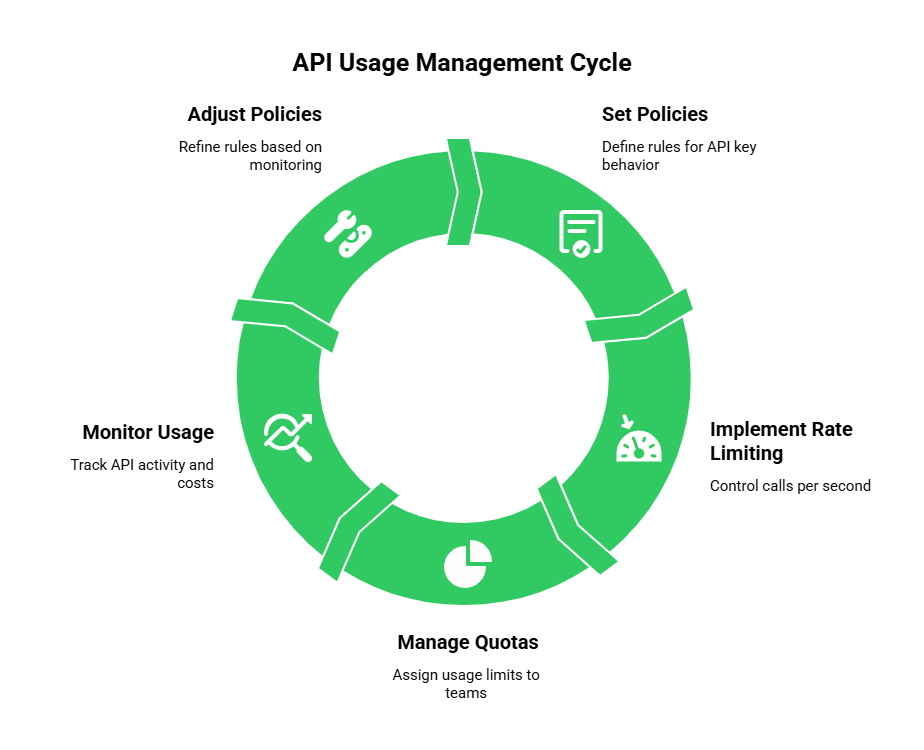
A robust AI Voice API Key allows for policy-based access. This means you can set rules on how the key behaves. This protects both your budget and your reputation.
Rate Limiting
You can configure your key to limit calls per second (CPS).
For example, you might want to send 100,000 appointment reminders. But if you call everyone at 9:00 AM, and they all call back at 9:01 AM, your support team will be crushed.
You can use the API settings to “smooth” the traffic, making 5 calls per second over several hours.
Quota Management
You can assign different keys to different teams.
- Sales Team Key: Unlimited outbound calls.
- Intern Project Key: Capped at $50 usage per month.
This ensures that a coding error or a rogue script does not drain your bank account or flood the network.
How Do You Maintain Quality During Mass Volume?
Scaling volume is easy. Scaling quality is hard.
When thousands of audio streams run through a network, traffic jams happen. Data packets get delayed. In a voice call, a delay of just 200 milliseconds creates an annoying echo. If you are using an AI agent, this delay breaks the illusion of a natural conversation.
FreJun AI solves this through distributed architecture.
- Points of Presence (PoPs): We have servers located all over the world.
- Low Latency Routing: When your API key initiates a call, we do not send it to a central server in one location. We route it to the data center closest to the user.
If you are calling customers in London, the media is processed in Europe. If you are calling customers in Tokyo, it is processed in Asia. This ensures that even when volume is massive, the audio path is short and fast. Here is a comparison of how different systems handle a traffic spike:
| Feature | Traditional Server | FreJun Elastic Infrastructure |
| Capacity | Fixed (e.g., 100 channels) | Unlimited (Scales on demand) |
| Response to Spike | Busy signals / Crash | Auto-scaling resources |
| Latency | Increases with load | Remains low and stable |
| Setup Time | Weeks (Manual upgrade) | Instant (Code based) |
| Cost | Pay for max capacity always | Pay only for what you use |
Ready to scale your voice operations? Sign up for FreJun AI to get your high-capacity API keys today.
Why Are Compliant Voice APIs Critical?
When you start making calls at scale, you attract attention. Telecom regulators and mobile carriers are constantly watching for spam.
If you blast out thousands of calls without following the rules, your phone numbers will get flagged as “Spam Likely.” Your answer rate will drop to zero.
This is why you need compliant voice APIs.
A premium infrastructure provider like FreJun helps you navigate this:
- STIR/SHAKEN: This is a protocol that verifies caller ID. FreJun signs your calls digitally so carriers know they are legitimate.
- Number Health: We monitor the reputation of your phone numbers.
- Consent Management: Your application logic can integrate with Do Not Call (DNC) lists to ensure you never accidentally call someone who opted out.
Managing regulated AI calls is complex. Regulations like the TCPA (Telephone Consumer Protection Act) in the US have strict rules about automated dialing. Using a high-quality API ensures that you have the technical controls (like time-of-day restrictions) to stay compliant.
Also Read: Voice Recognition SDK Built for Modern Digital Platforms
How Do Developers Monitor Massive Traffic?
When you are running a high-volume operation, you cannot fly blind. You need visibility.
The AI Voice API Key connects you to an observability layer.
- Real Time Dashboards: You can see exactly how many calls are active right now.
- Webhooks: Your application receives instant notifications. Call_Started, Call_Connected, Call_Failed.
- Error Logs: If 5% of your calls are failing, the API logs tell you why. Is it a bad carrier route? Is it an invalid number?
FreJun provides granular analytics. We allow you to drill down into specific calls to see the jitter, packet loss, and latency metrics. This allows developers to debug issues even when managing thousands of concurrent connections.
How Does FreJun AI Architect for Scale?
We have mentioned that we handle the “plumbing.” But what does that actually mean for your massive call volume?
FreJun is designed differently from standard VoIP providers. We are developer-first and AI-ready.
- Model Agnostic: You can bring your own massive AI models (like GPT-4) and we handle the connection.
- Media Streaming: We specialize in streaming raw audio. This is heavier than standard voice data. Our infrastructure is built to handle the high bandwidth required for thousands of simultaneous AI conversations.
- FreJun Teler: Our SIP trunking arm is built for enterprise load. We work with carriers globally to ensure that when you scale up, the underlying telephone network supports you.
Best Practices for High Volume Campaigns
If you are planning to use your API key for a massive campaign, follow these rules.
1. Warm Up Your Numbers
Do not buy a new phone number and make 10,000 calls on day one. Carriers will block you. Start with 50 calls, then 100, then 500. This builds a “reputation” for the number.
2. Use Local Presence
If you are calling customers in New York, use a New York area code. If you are calling California, use a California code. Compliant voice APIs allow you to dynamically select the outbound number to match the customer’s region, increasing trust and pickup rates.
3. Implement Retry Logic
At scale, some calls will fail. Maybe the user is out of coverage. Maybe the carrier had a blip. Your code should handle this gracefully. “If call fails, wait 10 minutes, then try again.” Do not retry instantly, or you look like a spammer.
Also Read: How a Voice API for Bulk Calling Streamlines Customer Updates?
Conclusion
Handling massive call volumes is no longer a challenge of hardware. It is a challenge of software.
The AI Voice API Key is your tool to unlock infinite scale. It allows you to transform a small laptop into a global communications center capable of reaching millions of people.
However, the key is only as good as the infrastructure behind it. You need a platform that offers elastic scaling to handle the bursts. You need compliant voice APIs to keep your numbers clean. And you need low-latency routing to ensure that your AI agents sound human, even when they are talking to ten thousand people at once.
FreJun AI provides this robust foundation. With FreJun Teler managing the global telephony and our developer-focused tools ensuring precise control, we enable businesses to scale their voice operations without fear of crashing. We handle the complex voice infrastructure so you can focus on building your AI.
Want to discuss your enterprise volume needs? Schedule a demo with our team at FreJun Teler and let us help you architect a solution that grows with you.
Also Read: United Kingdom Country Code Explained
Frequently Asked Questions (FAQs)
It is a secure credential that allows software applications to authenticate and interact with a voice platform’s infrastructure. It grants permission to make calls, receive calls, and manage resources programmatically.
With a provider like FreJun, there is theoretically no limit. The infrastructure is elastic. However, you can set your own limits (quotas) to manage costs and ensure you don’t overwhelm your own support team.
If you try to make more calls per second than your policy allows, the API will return a “429 Too Many Requests” error. Your application should be built to catch this error and queue the call for a few seconds later.
These are calls made by artificial intelligence that must adhere to government laws, such as the TCPA in the US. These laws govern things like calling hours, consent requirements, and the need to provide an opt-out mechanism.
FreJun Teler uses elastic SIP trunking. This technology allows the number of concurrent call channels to expand automatically based on real-time demand, rather than being limited to a fixed number of physical lines.
Not with FreJun. Our platform uses distributed media servers and load balancing. When volume spikes, we distribute the traffic across multiple data centers to ensure every call maintains high definition audio quality.
Yes. The same key typically authenticates your application for all voice functions. However, you can create separate sub-keys for different departments if you want to track usage separately.
It is a security feature where you define what a specific API key can do. For example, you can create a key that is allowed to make calls but not allowed to listen to recordings, enhancing security and privacy.