
Imagine a natural disaster strikes a coastal city. The government issues a warning. Thousands of worried citizens pick up their phones at the exact same moment. They dial the emergency helpline to ask about evacuation routes or shelter locations.
In a traditional setup, the system crashes. The phone lines get jammed. People hear a busy signal or wait on hold for hours. Panic increases. Misinformation spreads because the official source is unreachable.
This scenario is not hypothetical. It happens frequently during tax seasons, public health crises, and natural disasters. The infrastructure powering most public helplines is outdated. It is rigid and expensive and unable to scale when it matters most.
This is where voice API integration becomes a matter of public safety.
By moving from legacy hardware to modern cloud-based voice software, government agencies can transform how they serve the public. They can build systems that never sleep and never crash and speak every language.
In this article, we will explore why voice API integration is essential for modern governance. We will look at how it solves the scalability crisis and improves accessibility for vulnerable populations and how infrastructure platforms like FreJun AI provide the reliable foundation needed for mission-critical public services.
Table of contents
- What Is the Current State of Public Helplines?
- Why Is Scalability the Number One Priority?
- How Does Voice Automation Improve Accessibility?
- Can Voice APIs Save Public Funds?
- Comparison: Legacy vs. Modern Helplines
- How Does Infrastructure Impact Public Trust?
- How to Implement Voice Integration in Government?
- What Are the Security Implications?
- Can Voice APIs Help with Disaster Recovery?
- What Does the Future of Public Service Look Like?
- Conclusion
- Frequently Asked Questions (FAQs)
What Is the Current State of Public Helplines?
Most government agencies still rely on on-premise Private Branch Exchange (PBX) systems. These are physical boxes of wires sitting in a basement.
They have a fixed number of lines. If a department pays for fifty lines, the fifty-first caller gets a busy signal. Expanding capacity requires buying new hardware and waiting weeks for installation.
This “hardware first” approach creates a bottleneck. It limits the ability to respond to citizens quickly. It also traps data. Calls are rarely recorded or analyzed, meaning the agency has no real data on what citizens are actually asking about.
Voice API integration changes the paradigm. It replaces the physical box with code. It connects the telephone network directly to the cloud. This allows agencies to scale up or down instantly and integrate voice data with other digital systems.
Why Is Scalability the Number One Priority?
Government demand is “bursty.”
For ten months of the year, a tax helpline might be quiet. Then, in April, call volume explodes by 10,000%. A rigid system cannot handle this. You cannot hire 500 temporary agents for two weeks and install 500 desk phones efficiently.
Cloud-based voice API integration solves this through elasticity.
This is where FreJun Teler shines. FreJun Teler provides elastic SIP trunking. Think of it like a highway that widens automatically. If ten citizens call, the road is two lanes wide. If ten thousand citizens call, the road instantly becomes a hundred lanes wide.
Because the infrastructure is virtual, there is no limit to the number of concurrent calls the system can handle. This ensures that during a crisis, every citizen gets through to an automated system or an agent.
Also Read: Why Is Low Latency Essential for Modern Voice Bot Solutions?
How Does Voice Automation Improve Accessibility?
Governments have a mandate to serve everyone. This includes the elderly, the visually impaired, and those who do not have smartphones or internet access.
While apps and websites are great, they leave many people behind. The telephone is the most universal technology. Everyone knows how to use it.
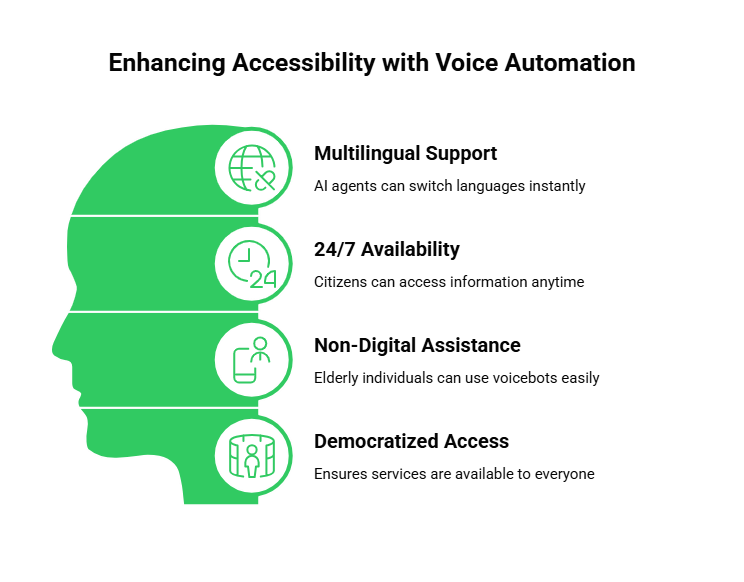
However, traditional phone lines are limited by language and hours. If a citizen speaks a minority language or calls at 2:00 AM, they are often out of luck.
Using voice API integration, agencies can deploy AI voice agents. These agents can:
- Speak Multiple Languages: An AI can detect that the caller is speaking Spanish or Mandarin and switch languages instantly.
- Operate 24/7: Citizens can get answers about bus schedules or clinic hours at midnight.
- Assist the Non-Digital: An elderly person who cannot navigate a complex website can simply ask a voicebot, “Where do I get my flu shot?”
This democratizes access to information. It ensures that services are available to the people who need them most, not just the tech-savvy.
Can Voice APIs Save Public Funds?
Budget efficiency is always a concern. Running a large call center with hundreds of human agents is incredibly expensive.
According to a study by McKinsey, improving customer experience in government services can reduce costs by 15 to 25% . A significant portion of this saving comes from reducing the volume of calls that require human intervention.
Voice API integration enables “call deflection.”
- Routine Queries: A citizen calls to ask “When is trash pickup?”
- The API: Connects to the sanitation database.
- The Response: “Trash pickup for your area is Tuesday.”
- The Result: The call is resolved in 30 seconds without a paid human agent ever lifting a finger.
This allows the government to spend tax dollars on solving complex problems rather than answering the same simple question a thousand times a day.
Comparison: Legacy vs. Modern Helplines
Here is how the old way stacks up against the API-driven approach.
| Feature | Legacy Government Helpline | API-Integrated Helpline |
| Capacity | Fixed (Busy signals frequent) | Unlimited (Elastic scaling) |
| Hours | 9 AM to 5 PM | 24 Hours / 7 Days |
| Wait Times | Long (30+ minutes) | Instant (Self-service options) |
| Language | Dependent on staff on duty | Instant multi-language support |
| Cost | High (Hardware + Staff) | Lower (Usage-based + Automation) |
| Data | Isolated | Integrated with databases |
| Reliability | Single point of failure | Distributed cloud redundancy |
How Does Infrastructure Impact Public Trust?
Trust in government is fragile. If a helpline fails during a crisis, trust evaporates.
For a government service, “uptime” is not a technical metric. It is a promise.
To keep this promise, the underlying infrastructure must be rock solid. Voice API integration is only as good as the network it runs on.
FreJun AI provides the robust foundation required for public sector work.
- High Availability: Our infrastructure is distributed. If a server in one region has an issue, traffic is automatically routed to another. The helpline never goes down.
- Low Latency: We ensure audio travels fast. This is critical for emergency services where every second counts.
- Security: Governments handle sensitive data (social security numbers, health info). FreJun encrypts voice data in transit, ensuring privacy and compliance with data protection standards.
Also Read: What Makes Voicebot Solutions Suitable for Multilingual Customers?
How to Implement Voice Integration in Government?
Moving a massive government agency to the cloud sounds daunting. However, it does not have to happen overnight. The API model allows for gradual adoption.
Step 1: The Hybrid Approach
Agencies do not need to throw away their old phones immediately. Using FreJun Teler, they can connect their existing on-premise PBX to the cloud via SIP trunking. This gives them the elasticity of the cloud while keeping their current hardware during the transition.
Step 2: Automate the Easy Stuff
Start by building an Interactive Voice Response (IVR) system for the most common questions. “Press 1 for hours, Press 2 for locations.” Use the API to fetch this data dynamically.
Step 3: Deploy AI Agents
Once the basics are working, integrate an AI voicebot. Sign up for FreJun AI to access the tools needed to connect LLMs (Large Language Models) to the phone network. This allows citizens to ask questions in natural language.
Step 4: Full Integration
Connect the voice system to the agency’s CRM or case management system. When a citizen calls, the agent sees their previous case history instantly, reducing the need for the citizen to repeat their story.
What Are the Security Implications?
Security is the first question any government IT director will ask.
Voice APIs utilize modern encryption standards like TLS (Transport Layer Security) and SRTP (Secure Real-time Transport Protocol). This means the audio of the call is scrambled as it travels over the internet. Even if a bad actor intercepted the data packet, they would just hear noise.
FreJun AI is built with a “security by design” philosophy. We understand that in a public helpline, confidentiality is paramount. Whether it is a whistleblower line or a health advice line, the caller’s identity and information are protected by enterprise-grade security protocols.
Can Voice APIs Help with Disaster Recovery?
Yes. In fact, this is one of their strongest use cases.
Physical call centers are vulnerable. If a hurricane hits the building where the call center is located, the lines go dead.
With voice API integration, the physical location does not matter. The system lives in the cloud. If the main office is evacuated, agents can log in from their homes or from a safe location in a different city. They can answer calls on their laptops or mobile phones.
The API simply reroutes the calls to wherever the agents are. This ensures business continuity even in the worst-case scenarios.
What Does the Future of Public Service Look Like?
We are moving toward a proactive government.
Imagine a water main breaks. Instead of waiting for angry calls, the water department uses the voice API to send a proactive automated voice message to every resident in the affected zip code. “We are aware of the break. Crews are on site. Water will be restored by 4 PM.”
This is voice API integration used for outbound communication. It keeps citizens informed and prevents the inbound call center from being overwhelmed.
Furthermore, as AI gets better, voice agents will be able to handle complex tasks like filing permit applications or scheduling court dates entirely over the phone.
Also Read: How Can Voice bot Solution Scale Across Global Voice Operations?
Conclusion
The question is not if government services should adopt voice API integration, but when. The old model of fixed lines and limited hours is incompatible with the needs of the modern citizen.
Adopting this technology makes government services more accessible, more efficient, and more resilient. It saves taxpayer money while providing a higher level of service. It ensures that in a crisis, the government is there to answer the call.
However, public trust depends on reliability. Governments cannot afford dropped calls or choppy audio. They need an infrastructure partner that is built for mission-critical scale.
FreJun AI provides that foundation. With FreJun Teler ensuring elastic capacity and our low-latency global network ensuring clarity, we enable government agencies to build helplines that actually help. We handle the complex voice infrastructure so you can focus on serving the public good.
Ready to modernize your agency’s communication strategy? Schedule a demo with our team at FreJun Teler and let us help you build a responsive, reliable public helpline.
Also Read: Why Call Routing Is Essential for High-Volume Call Centers
Frequently Asked Questions (FAQs)
It is the technology that connects government telephone lines to the cloud. It allows agencies to manage calls using software, enabling features like automated answering, smart routing, and instant scaling.
Yes. Reputable providers like FreJun AI use banking-grade encryption (TLS/SRTP) to protect voice data. This ensures that sensitive citizen conversations remain private and secure.
It uses elastic SIP trunking. This technology automatically adds more capacity when call volume spikes, such as during a disaster or tax season, preventing citizens from hearing a busy signal.
It does not replace them but it helps them. It handles simple, repetitive questions (like office hours), allowing human agents to focus on complex cases that require empathy and judgment.
Yes. That is the main benefit. It works on any standard landline or mobile phone. Citizens just dial a number and speak. They do not need an app or internet access.
Yes. By integrating with AI translation services, the system can understand and speak dozens of languages, making services accessible to non-native speakers.
It is often cheaper than maintaining legacy hardware. Because it is cloud-based, there are no expensive servers to buy or maintain. You typically pay for what you use.
FreJun Teler is the telephony infrastructure service from FreJun. It provides the global connectivity and elastic scaling needed to run high-volume public helplines reliably.