
Imagine you are standing in your kitchen. Your hands are covered in flour because you are baking bread. The oven timer goes off, but you cannot touch it without making a mess. You shout, “Turn off timer!” and the oven obeys instantly.
Now, imagine a forklift driver in a massive warehouse. He is moving a heavy pallet. He notices a safety hazard on the ceiling. Without stopping the machine or taking his hands off the wheel, he says, “Log maintenance request: broken light fixture in Aisle 4.” The system records the request, tags the location, and alerts the maintenance team immediately.
This is the power of the Internet of Things (IoT) combined with voice. We are moving beyond simple smart speakers that play music. We are entering an era where washing machines, industrial robots, cars, and medical devices can listen and speak.
This revolution is driven by voice API integration. Developers are no longer just building apps for phones; they are embedding voice capabilities into the physical world. However, making a toaster understand human speech is difficult. It requires reliable connectivity, massive processing power, and incredibly fast data transfer.
In this article, we will explore the cutting-edge innovations in voice for IoT. We will look at how edge computing, context awareness, and industrial applications are changing the game, and how infrastructure platforms like FreJun AI provide the invisible highway that allows these devices to communicate without lag.
Table of contents
- What Is Voice API Integration in the Context of IoT?
- Why Is Voice the Ultimate Interface for IoT?
- How Is Voice Transforming Industrial IoT (IIoT)?
- Innovation 4: Multi-Modal Interaction
- What Role Does FreJun Teler Play in IoT Connectivity?
- The Latency Problem in IoT
- Innovation 5: Emotional AI in Devices
- Traditional Control vs. Advanced Voice IoT
- How Developers Can Get Started?
- The Future: The Proactive Home
- Conclusion
- Frequently Asked Questions (FAQs)
What Is Voice API Integration in the Context of IoT?
To understand the innovation, we must understand the baseline. IoT refers to physical objects (“Things”) that are connected to the internet. Voice API integration is the software bridge that allows these objects to process audio.
In the past, if you wanted to build a voice-controlled thermostat, you had to build the hardware microphone, the speech recognition software, and the language processing engine from scratch. It was too expensive for most companies.
Today, developers use APIs (Application Programming Interfaces). The thermostat records the audio and sends it via an API to a cloud server. The server processes the command and sends a signal back to the thermostat to lower the temperature.
The innovation happening right now is that this process is becoming faster, cheaper, and more reliable. We are moving from “command and control” (simple on/off switches) to “conversational computing” (complex dialogues with machines).
Why Is Voice the Ultimate Interface for IoT?
Screens are great, but they demand your attention. You have to look at them. You have to touch them. Voice is different. It is the only interface that allows you to multitask.
In a hospital, a surgeon cannot touch a screen to view an X-ray during surgery. But they can say, “Zoom in on the upper quadrant.” In a factory, a worker wearing thick gloves cannot type on a keyboard. But they can speak.
Voice allows technology to disappear into the background. It makes the environment itself responsive.
Also Read: How Do Voice Bot Solutions Deliver Human-Like Voice Interactions?
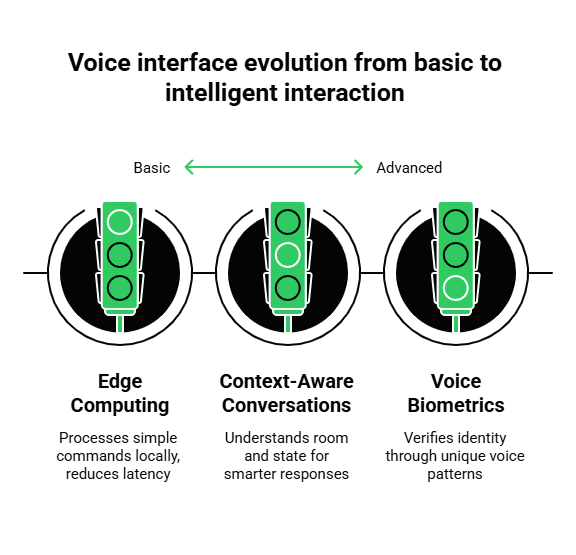
Innovation 1: Edge Computing and Hybrid Processing
One of the biggest problems with IoT voice control is the internet connection. If your internet goes down, your smart lights stop listening. This is annoying at home, but it is dangerous in a factory.
The solution is “Edge Computing.” This is a major innovation in voice API integration.
Instead of sending every piece of audio to the cloud, the device processes some of it locally (on the “edge”).
- Local: The device handles the “wake word” (e.g., “Hey Computer”) and simple commands like “Stop.”
- Cloud: The device sends complex questions like “What is the weather in Tokyo?” to the API.
This hybrid approach reduces latency. It feels instant.
FreJun AI supports this by providing a flexible infrastructure. When the device does need to connect to the cloud for heavy lifting, our low-latency media streaming ensures the transition is seamless. We optimize the data path so the user cannot tell the difference between local processing and cloud processing.
Innovation 2: Context-Aware Conversations
Early voice assistants were dumb. If you said “Turn it on,” they would ask “Turn what on?”
The new wave of voice API integration utilizes Large Language Models (LLMs) to understand context.
- Room Awareness: If you are in the living room and say “Turn on the lights,” the API knows you mean the living room lights, not the bedroom lights.
- State Awareness: If the TV is already on and you say “Turn it up,” the API understands “it” refers to the volume.
This level of intelligence requires sending metadata along with the voice stream. FreJun’s infrastructure allows developers to pass this contextual data efficiently. We ensure that the “brain” of the AI receives not just the audio, but the location and status of the device, leading to a smarter response.
Innovation 3: Voice Biometrics for Security
As we put voice control into door locks and bank accounts, security becomes critical. You do not want a burglar shouting “Unlock the door!” through your mail slot.
Innovations in voice biometrics are solving this. This is like a fingerprint, but for your voice. The voice API integration analyzes the unique frequencies and patterns of the speaker.
- Authentication: The system verifies who is speaking.
- Authorization: The system checks if that person has permission to perform the action.
For example, in a smart office, the CEO can say “Access confidential files,” and the system obeys. If an intern says the exact same phrase, the system denies access.
This requires high-fidelity audio. If the audio is compressed or scratchy, the biometric analysis fails. FreJun AI prioritizes uncompressed, high-quality media streaming to ensure that security systems have the clear data they need to verify identities accurately.
How Is Voice Transforming Industrial IoT (IIoT)?
While smart homes get the attention, the real revolution is happening in industry. This is often called “The Connected Worker.”
In a noisy factory, typing on a tablet is slow and dangerous. Voice allows workers to keep their heads up and hands free.
The Noise Challenge
Factories are loud. Drills, alarms, and engines create a chaotic audio environment. A standard microphone cannot hear a worker speaking.
The innovation here is in “noise cancellation” and “voice isolation.” Advanced APIs can filter out the background roar and isolate the human voice.
FreJun plays a vital role here. Our infrastructure is built to handle robust media streams. We allow developers to integrate specialized noise-reduction algorithms into the pipeline. By ensuring the transport layer is stable, we guarantee that the maintenance log is recorded accurately, even if a jackhammer is running ten feet away.
Innovation 4: Multi-Modal Interaction
Voice is rarely used alone. The future is “multi-modal.” This means using voice combined with screens or gestures.
Imagine a smart mirror. You look at it and say, “Show me a tie that matches this shirt.” The mirror uses a camera to see your shirt and uses a screen to project tie options on your reflection.
This requires synchronizing voice data with video data. It is a complex engineering challenge.
FreJun AI simplifies this. Our APIs are designed for real-time media. We allow developers to synchronize voice streams with other data inputs, creating a fluid experience where what you see matches what you hear instantly.
Ready to build the next generation of smart devices? Sign up for FreJun AI to access our low-latency infrastructure.
Also Read: What Role Do Voice bot Solutions Play in AI-First Business Workflows?
What Role Does FreJun Teler Play in IoT Connectivity?
You might wonder how a telephone platform fits into IoT. Not all IoT devices are connected to Wi-Fi. Many use cellular networks or connect to legacy intercom systems.
FreJun Teler provides elastic SIP trunking. This is crucial for:
- Smart Intercoms: When a visitor presses the buzzer on a smart apartment building, it triggers a “phone call” to the resident’s mobile app. Teler handles this call.
- Emergency Alerts: If a smart smoke detector triggers, it can initiate an outbound voice call to the homeowner and the fire department. Teler ensures this call connects instantly, bypassing network congestion.
This bridge between the “internet of things” and the “telephony network” is a unique strength of FreJun.
The Latency Problem in IoT
We have mentioned latency before, but in IoT, it is the difference between a cool gadget and a piece of junk.
If you say “Stop!” to a smart saw, it needs to stop now. Not in two seconds.
According to tech industry benchmarks, latency for critical IoT applications often needs to be under 100 milliseconds.
The journey of that voice command is long:
Mic -> Wi-Fi -> Router -> ISP -> Cloud Server -> Processor -> Cloud Server -> ISP -> Router -> Device.
Every step adds delay. FreJun minimizes the delay in the “Cloud Server” part of the journey. We use optimized routing and distributed data centers. We shave milliseconds off the transport time. In the world of voice control, those milliseconds save lives and frustration.
Innovation 5: Emotional AI in Devices
The next frontier is emotion. Devices are learning to detect how you are speaking, not just what you are saying.
If you yell “Turn off the music!” the device detects anger. It might turn off the music faster and skip the polite “Okay, turning off the music” response. It just acts.
If an elderly person speaks to a healthcare robot with a trembling, fearful voice, the robot detects distress and alerts a nurse.
This emotional analysis requires analyzing the “prosody” of speech—the rhythm, pitch, and tone. This data is easily lost in poor-quality connections. FreJun’s commitment to high-fidelity streaming ensures that these subtle emotional cues are preserved for the AI to analyze.
Traditional Control vs. Advanced Voice IoT
Here is how the user experience shifts with these innovations.
| Feature | Traditional Interface (App/Button) | Advanced Voice API Integration |
| Input Speed | Slow (Unlock phone, open app, tap) | Fast (Speak command instantly) |
| Physicality | Requires hands and eyes | Hands-free and eyes-free |
| Complexity | Good for complex settings | Getting better (Context-aware) |
| Accessibility | Hard for elderly/disabled | Easy (Natural language) |
| Environment | Hard in dirty/busy areas | Works anywhere (with noise cancellation) |
| Feedback | Visual only | Audio and Visual |
| Security | PIN/Password | Voice Biometrics |
How Developers Can Get Started?
If you are building an IoT device, here is how to integrate voice.
Step 1: The Hardware
Choose a microphone array. For “far-field” (across the room) voice control, you need hardware that can beam-form (focus on the speaker).
Step 2: The Transport Layer
This is where you use FreJun AI. Do not try to build your own WebSocket servers to handle audio. It is difficult to scale. Use FreJun’s SDKs to stream the audio from the device to the cloud reliably.
Step 3: The Intelligence
Connect the FreJun stream to a transcription service and an LLM. Train the LLM on your specific device capabilities (e.g., “Toast,” “Defrost,” “Bagel Mode”).
Step 4: The Feedback Loop
Use FreJun to stream the TTS (Text-to-Speech) response back to the device’s speaker. “Toasting bagel now.”
The Future: The Proactive Home
Today, we command devices. Tomorrow, they will talk to us first.
Imagine your fridge notices you are out of milk. It uses voice API integration to ask you, “I noticed we are out of milk. Should I add it to the shopping list?”
This proactive assistance turns the house into a partner. It relies on the device being “always ready” to speak. This constant connectivity requires an infrastructure that is efficient and low-cost. FreJun’s usage-based model allows developers to experiment with these proactive features without massive upfront costs.
Also Read: Why Are Voice bot Solutions Critical for AI-Driven Customer Support?
Conclusion
The integration of voice into IoT devices is redefining our relationship with technology. We are moving away from screens and buttons toward a world where we simply speak our intentions, and the environment responds.
Innovations like edge computing, context awareness, and voice biometrics are making these interactions faster, smarter, and safer.
However, the smartest toaster in the world is useless if it cannot hear you or if it takes five seconds to respond. The backbone of this entire ecosystem is the network.
FreJun AI provides the robust, low-latency infrastructure that IoT developers need. Whether you are connecting a smart intercom via FreJun Teler or streaming high-fidelity audio from a factory robot, our platform ensures the connection is solid. We handle the complex voice infrastructure so you can focus on building the smart devices of the future.
Want to discuss your IoT voice strategy? Schedule a demo with our team at FreJun Teler and let us help you bring your devices to life.
Also Read: Why Call Routing Is Essential for High-Volume Call Centers
Frequently Asked Questions (FAQs)
It is the process of using software to connect physical devices (like smart home gadgets or industrial machines) to cloud-based voice processing services, allowing users to control them with speech.
FreJun provides the infrastructure for developers to build their own voice assistants inside their devices. It allows you to create a custom brand voice rather than relying on a generic assistant.
Edge computing means processing voice commands on the device itself rather than sending data to the cloud. This improves speed and works even without an internet connection.
FreJun Teler provides SIP trunking. This is essential for devices that need to make phone calls, such as smart intercoms calling a resident or security systems dialing emergency services.
Latency is the delay between speaking and the device reacting. In IoT, high latency makes the device feel broken. FreJun optimizes the network to keep this delay as low as possible.
Yes, but it requires specialized software. Developers use APIs to filter out background noise so the machine only hears the worker’s voice commands.
Security depends on the implementation. FreJun AI uses enterprise-grade encryption to ensure that voice data streamed from devices is secure and cannot be intercepted by hackers.
It is the ability of the AI to understand the situation. For example, knowing that “Open it” means “Open the Garage Door” because the user is currently sitting in their car.