
Picture a call center from the year 2005. You probably imagine a massive, windowless room. There are hundreds of cubicles. The noise is deafening. Every agent is tethered to a desk by a curly cord connected to a bulky plastic phone. To work there, you had to physically be there.
Now, fast forward to today and look at the future. The “call center” is no longer a place. It is a piece of code.
The agent is working from a home office in London. The manager is reviewing data from a coffee shop in Austin. The customer is calling from Tokyo. They are all connected instantly, clearly, and securely.
This transformation from a physical room to a global cloud network is driven by one key technology: Voice API integration.
The future of customer service is virtual, programmable, and intelligent. It is no longer about buying hardware; it is about writing software. In this article, we will explore how APIs are dismantling the old way of doing business and building a future where contact centers are infinitely scalable, deeply personal, and powered by next-generation infrastructure like FreJun AI.
Table of contents
- Why Are Virtual Call Centers Replacing Physical Ones?
- How Does Voice API Integration Enable the “Work from Anywhere” Model?
- How Will APIs Power the AI-Driven Agent?
- Why Is Infrastructure the “Hidden” Key to Virtual Success?
- How Does Programmable Voice Allow for “Hyper-Personalization”?
- The Legacy Center vs. The API-Driven Virtual Center
- How Will APIs Enable Omnichannel Synchronization?
- How Can Developers Build Custom Workflows?
- What About Security in a Distributed World?
- How Will This Impact Agent Well-being?
- Conclusion
- Frequently Asked Questions (FAQs)
Why Are Virtual Call Centers Replacing Physical Ones?
The shift was already happening, but recent years hit the accelerator. Businesses realized that renting massive office buildings for support teams was expensive and unnecessary.
A virtual call center lives in the cloud. It allows companies to hire the best talent anywhere in the world, not just people who live within twenty miles of the headquarters.
However, moving to the cloud is not just about using Zoom. It requires a fundamental change in how voice traffic is handled. You cannot plug a traditional phone line into a laptop.
You need a digital way to handle calls. This is where voice API integration becomes the architect of the future. It allows developers to build custom communication flows that work over the internet, freeing the business from the constraints of physical wires.
How Does Voice API Integration Enable the “Work from Anywhere” Model?
In the past, if you wanted to set up a support team in a new country, it was a nightmare. You had to negotiate with local telecom carriers, and you had to ship hardware. You had to set up a private network (VPN). It took months.
With voice API integration, this physical barrier vanishes.
APIs allow you to provision phone numbers and voice capabilities instantly through code. A company in New York can spin up a local presence in Brazil or Germany in seconds.
This is powered by underlying infrastructure like FreJun Teler. FreJun provides elastic SIP trunking, which acts as a digital bridge. It allows your application to connect to the global telephone network without needing physical equipment in every country.
For the future of virtual centers, this means:
- Instant Scaling: Need 50 more agents for the holiday season? Just add seats in the software. No new cables needed.
- Global Local Presence: Agents can call customers from numbers that look local, increasing answer rates, even if the agent is thousands of miles away.
- Unified Quality: Whether the agent is on fiber in a city or Starlink in the countryside, the API manages the connection standards.
Also Read: How Do Voice Bot Solutions Deliver Human-Like Voice Interactions?
How Will APIs Power the AI-Driven Agent?
The biggest change coming to virtual centers is the partnership between humans and Artificial Intelligence.
In the old world, AI was separate. You had a chatbot on the website and a human on the phone. In the future, voice API integration will merge them.
Because the API streams the audio in real-time (not just recording it for later), developers can feed that live audio into AI models.
Imagine an agent talking to an angry customer. The API streams the voice to an AI. The AI analyzes the tone and sentiment. It instantly pops up a suggestion on the agent’s screen: ” The customer seems frustrated about a late delivery. Offer a 10% refund immediately.”
This is the concept of the “Bionic Agent.” The human provides the empathy, but the AI provides the knowledge.
Why Is Infrastructure the “Hidden” Key to Virtual Success?
When everyone is working from the same office, the internet connection is easy to control. You buy a big fiber line.
In a virtual call center, you have 100 agents on 100 different home Wi-Fi networks. Some are good, some are bad. This creates a massive risk of “jitter” and “latency”, the enemies of clear voice.
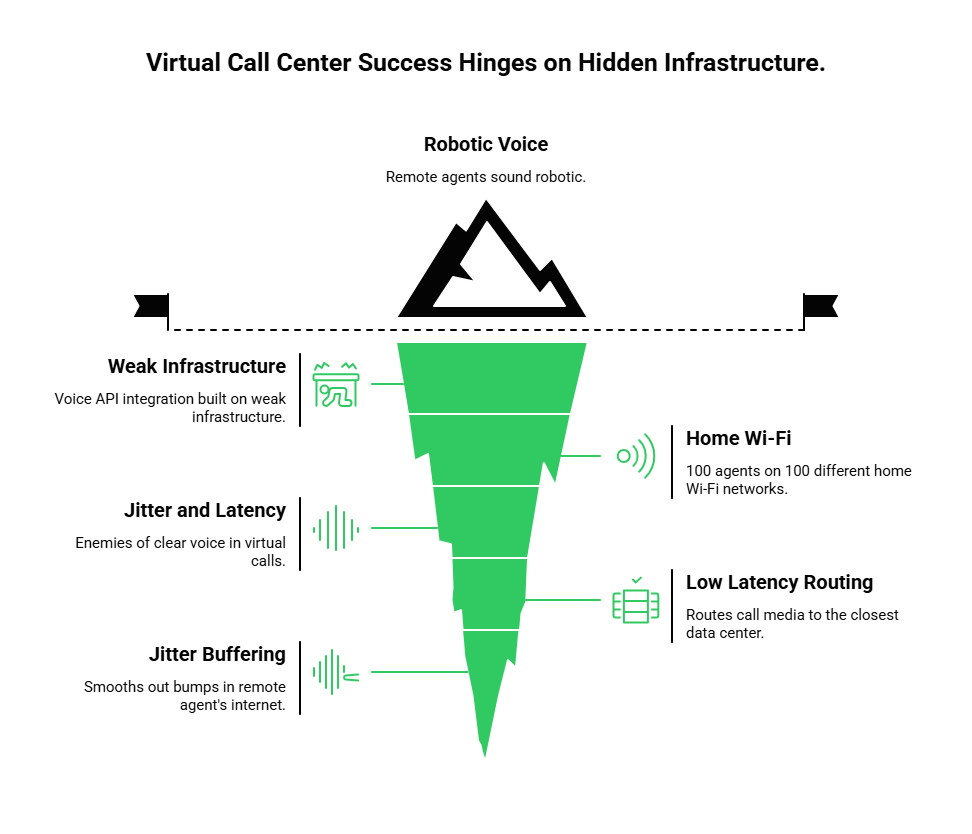
If the voice API integration is built on weak infrastructure, the remote agents will sound robotic. The customers will get annoyed.
FreJun AI is built specifically for this distributed future. We handle the complex voice infrastructure so you can focus on building your AI.
- Low Latency Routing: We route the call media to the data center closest to the agent, not just the headquarters. This minimizes the travel time of the audio packets.
- Jitter Buffering: Our system dynamically adjusts to smooth out the bumps in a remote agent’s internet connection.
The future of virtual centers depends on quality. If the call sounds bad, the virtual model fails. FreJun ensures the quality matches or exceeds the old physical office.
How Does Programmable Voice Allow for “Hyper-Personalization”?
Legacy call centers treated everyone the same. You called, you waited, you spoke to whoever picked up.
The future is hyper-personalized. Because the phone system is now software, it can talk to your data.
With voice API integration, the call flow changes based on who is calling.
- The High-Value Client: The API recognizes the number. It skips the IVR menu entirely. It routes the call directly to the “VIP Team.”
- The Debt Collection: The API sees the caller owes money. It routes them to the finance department automatically.
- The Returning Problem: The API sees the caller had a ticket closed yesterday. It routes them back to the same agent they spoke to previously.
This logic is not hard-coded into a machine. It is written in Python or JavaScript by your developers, meaning it can change and evolve every day.
The Legacy Center vs. The API-Driven Virtual Center
Here is how the shift looks on paper.
| Feature | Legacy Physical Center | Future Virtual Center (API Driven) |
| Location | Centralized Office | Distributed (Anywhere) |
| Setup Time | Months (Hardware Install) | Days (Software Deploy) |
| Scalability | Limited by desks/phones | Infinite (Elastic Cloud) |
| Integration | Siloed (Hard to link to CRM) | Native (Deep CRM integration) |
| AI Capability | Low (Post-call analysis only) | High (Real-time AI assist) |
| Cost Model | CapEx (Upfront hardware) | OpEx (Pay-as-you-go) |
| Reliability | Single Point of Failure | Distributed Redundancy |
Also Read: What Role Do Voice bot Solutions Play in AI-First Business Workflows?
How Will APIs Enable Omnichannel Synchronization?
Customers do not just call. They text, they email, and they chat.
In the past, the voice team didn’t know what the email team was doing. A customer would call and say, “I emailed you about this,” and the agent would say, “I can’t see emails.”
Voice API integration breaks this silo. Because voice is now just data, it can live in the same database as text and email.
When a call comes in, the API can pull the context from the chat history. The future virtual center is “omnichannel.” The agent sees the whole story.
- “I see you were chatting with our bot five minutes ago.”
- “I see you replied to our SMS marketing campaign.”
This synchronization creates a fluid experience where the customer feels known and understood, regardless of how they choose to contact you.
How Can Developers Build Custom Workflows?
The future belongs to the builders. In the past, you bought a call center software “out of the box.” You had to use their features. If you didn’t like how the transfer button worked, too bad.
With voice API integration, businesses are building their own bespoke contact center platforms.
- Custom Dashboards: Build a view that shows exactly the metrics your specific business cares about.
- Unique Routing: Create routing rules based on the weather, stock prices, or agent skill levels.
- Embedded Voice: Instead of a separate phone app, embed the “call” button directly into your internal CRM web page.
FreJun provides the developer-first toolkit to make this possible. Our SDKs allow you to weave voice capabilities directly into your existing workflows, rather than forcing your team to learn a new tool.
Ready to build the future of your contact center? Sign up for FreJun AI to get your API keys.
What About Security in a Distributed World?
Security is the biggest concern for virtual centers. When agents are working from home, how do you protect customer data?
Traditional phone lines were secure because they were physical. The internet is open.
However, modern voice API integration is actually more secure than legacy systems if done right.
- Encryption: FreJun encrypts voice data in transit (SRTP) and signaling data (TLS). This prevents eavesdropping.
- No Data on Device: Because the call is handled via the cloud and browser, no recordings are stored on the agent’s personal laptop. Everything is saved centrally in the secure cloud.
- Compliance: APIs allow for automated redaction. If a customer speaks a credit card number, the API can detect it and “beep” it out of the recording automatically for PCI compliance.
How Will This Impact Agent Well-being?
Working in a call center is hard. Burnout is high.
The future virtual center uses APIs to make the job easier. By automating the robotic tasks like verifying identity or typing in notes, the agent is less stressed.
Furthermore, voice API integration enables “Agent Assist” tools. If an agent doesn’t know the answer, the AI listens and puts the answer on the screen. This reduces the anxiety of not knowing what to say.
A happy agent performs better. By removing the friction of bad technology, businesses can retain talent longer and provide better service.
Also Read: Why Are Voice bot Solutions Critical for AI-Driven Customer Support?
Conclusion
The virtual call center is not a temporary trend. It is the inevitable evolution of customer service. The rigid, hardware-based centers of the past simply cannot move fast enough for the modern world.
Voice API integration is the engine of this evolution. It decouples voice from the wire. It allows businesses to scale globally, integrate deeply with AI, and create hyper-personalized experiences that were previously impossible.
But remember, software is only as good as the network it runs on. A virtual center with choppy audio is a failure.
This is why FreJun AI is the critical partner for the future. We provide the robust, low-latency infrastructure that powers these next-generation experiences. With FreJun Teler providing global elasticity and our APIs ensuring crystal-clear media streaming, we enable you to build a virtual contact center that feels local, personal, and professional, no matter where your agents are sitting.
Want to discuss your virtual contact center strategy? Schedule a demo with our team at FreJun Teler and let us help you build for the future.
Also Read: Why Call Routing Is Essential for High-Volume Call Centers
Frequently Asked Questions (FAQs)
A virtual call center is a customer service operation where agents are geographically dispersed (working from home or different offices) rather than being in a single physical location. They are connected via cloud software.
It allows agents to make and receive calls directly through their web browser or a customized app. They do not need a physical desk phone; they just need a headset and an internet connection.
CCaaS (Contact Center as a Service) is a pre-built software solution (like Zoom Contact Center). A Voice API (like FreJun) is the building block that allows developers to build their own custom contact center software or add voice features to existing apps.
FreJun uses a distributed global network. We route the call audio to the server closest to the agent to minimize latency. We also use adaptive codecs that maintain voice clarity even if the agent’s Wi-Fi fluctuates.
Yes. Voice APIs provide access to the raw audio stream. You can feed this stream into AI models for real-time transcription, sentiment analysis, and live agent coaching.
Yes, if using a secure API provider. FreJun encrypts the voice traffic so it cannot be intercepted. Also, because data is stored in the cloud, sensitive customer info does not stay on the agent’s personal computer.
It is a method of delivering voice over the internet that scales automatically. FreJun Teler offers this, allowing your virtual center to handle 1 call or 10,000 calls without needing to buy more “lines.”
Yes. Voice APIs allow for features like “Call Whispering” (speaking to the agent without the customer hearing) and “Barge-in” (joining the call), giving managers full control even remotely.