
For decades, telecom operators had a simple business model. They built the towers, laid the cables, and sold SIM cards. You paid them a monthly fee to make calls and send text messages. It was a solid, predictable business.
But then, the world changed. Apps like WhatsApp, Zoom, and Skype arrived. These “Over-The-Top” (OTT) players used the internet to offer free calls and messages. They built trillion-dollar empires on top of the infrastructure that the telecom operators paid to build.
Meanwhile, the telecom operators were left with the bill. They became “dumb pipes,” simply carrying data from point A to point B while others made the real money.
Now, the giants are waking up. They realize that they are sitting on a goldmine of data and capability. They are realizing that their networks can do more than just carry data; they can be programmable platforms.
The key to unlocking this value is voice API integration. By opening up their networks to developers, telecom operators are creating entirely new revenue streams. They are moving from selling minutes to selling capabilities.
In this article, we will explore how this shift is happening. We will look at the new business models emerging from programmable networks and how infrastructure platforms like FreJun AI provide the essential “glue” that makes these new APIs reliable and profitable.
Table of contents
- What Exactly Is the API Economy for Telcos?
- How Does Voice API Integration Create Value?
- What Is the Role of FreJun AI in This Ecosystem?
- How Does 5G Accelerate API Revenue?
- Comparison: The Old Telco vs. The New Techco
- How Can Operators Monetize “Network as a Service” (NaaS)?
- Why Is Developer Experience the New Battleground?
- What Are the Technical Challenges?
- How Will AI Voice Agents Drive Consumption?
- Conclusion
- Frequently Asked Questions (FAQs)
What Exactly Is the API Economy for Telcos?
In the past, if a bank wanted to know if a customer was on a secure phone line, they had to trust the customer. The telecom operator knew the truth, but there was no way to share that information.
The API economy changes this. An API (Application Programming Interface) acts as a secure door. It allows external developers to ask the network questions or give it commands.
- Bank App: “Is this user currently on a call?”
- Telco API: “Yes, they are.”
- Bank App: “Okay, we will block this transaction because it might be a scammer coaching them.”
Every time the Bank App asks that question, the Telco gets paid a small fee. Multiply this by millions of transactions a day, and you have a massive new revenue stream. This is the power of opening up the network.
Also Read: What Makes Voice Bot Solutions Effective for High-Volume Customer Calls?
How Does Voice API Integration Create Value?
The most immediate opportunity is in voice. Businesses need to communicate with customers, and they need it to be secure and high quality. Operators can sell premium voice features via API.
1. Number Verification (Silent Authentication)
Passwords and SMS OTPs (One Time Passwords) are clumsy. Hackers can steal them. With voice API integration, an app can verify a user’s phone number silently in the background by checking the network session. This is faster for the user and safer for the business. Telcos charge for every verification.
2. Call Masking and Privacy
Ride-sharing apps need to connect drivers and riders without revealing their real numbers. Telcos can offer “temporary number” APIs. The app requests a bridge, the Telco sets it up instantly, and tears it down when the ride is over. This is a premium service that platforms are willing to pay for.
3. Quality on Demand (QoD)
This is the game changer. Imagine a telehealth doctor performing a remote consultation. The video freezes. The audio cuts out. It is a disaster.
With specialized APIs, the telehealth app could pay the Telco a premium fee to guarantee a “fast lane” for that specific call. The network prioritizes that data packets above people watching YouTube. The doctor gets perfect quality, and the Telco gets a new revenue stream.
What Is the Role of FreJun AI in This Ecosystem?
You might wonder where FreJun fits in. If Telcos are selling the APIs, what does FreJun do?
FreJun AI is the infrastructure enabler. We handle the complex voice infrastructure so you can focus on building your AI.
Many telecom operators have legacy systems. Their networks are old and clunky. They are not ready to handle millions of API requests from modern apps. FreJun acts as the bridge.
We utilize FreJun Teler, which provides elastic SIP trunking. This allows the network to scale. When a developer uses a Telco API to launch a massive voice campaign, FreJun’s infrastructure ensures the calls actually connect. We handle the signaling and the media streaming.
Furthermore, we ensure low latency. If an app pays for a premium voice connection, it must be fast. FreJun’s optimized routing ensures that the promise of quality is actually kept.
How Does 5G Accelerate API Revenue?
5G is not just about faster internet for your phone. It was built from the ground up to be programmable.
In 4G, the network was a single block. In 5G, the network can be sliced. This is called “Network Slicing.” An operator can create a virtual slice of the network specifically for self-driving cars, and another slice for voice calls.
Voice API integration is the remote control for these slices.
A gaming company could pay for a “Low Latency Voice Slice” so that teammates can chat without lag during a tournament. The operator charges a premium for access to this slice. Without APIs, this capability is useless because developers cannot access it.
Comparison: The Old Telco vs. The New Techco
Here is how the business model is shifting.
| Feature | The Old Telco Model | The New “Techco” Model |
| Primary Product | Minutes and Megabytes | APIs and Solutions |
| Customer Base | Consumers (B2C) | Developers & Enterprises (B2B) |
| Pricing | Flat monthly fee | Usage-based (Pay per API call) |
| Integration | Closed system (Walled Garden) | Open ecosystem |
| Value Prop | Connectivity | Programmability |
| Infrastructure | Static Hardware | Cloud-Native Software |
Also Read: How Do Voicebot Solutions Support Continuous Conversation Flow?
How Can Operators Monetize “Network as a Service” (NaaS)?
The concept of Network as a Service (NaaS) is simple. You rent the network’s brain.
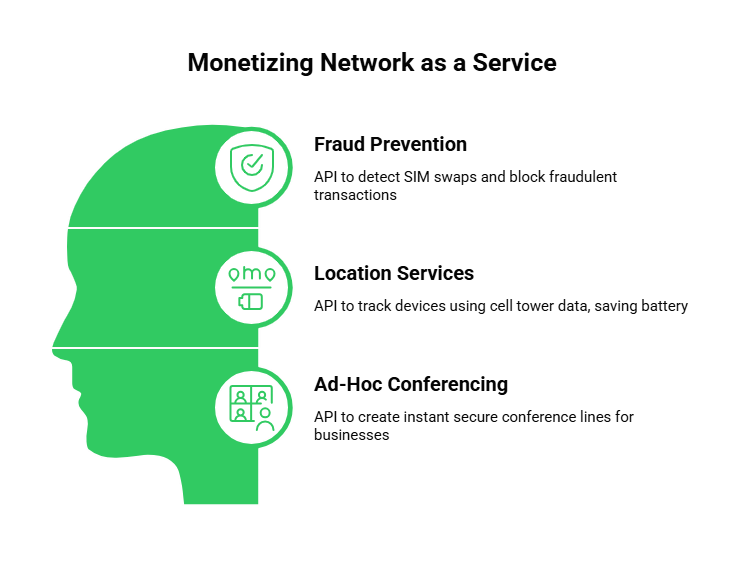
Fraud Prevention
When a SIM card is swapped (a common hacking tactic), the network knows instantly. Operators can sell a “SIM Swap API.” Banks check this API before sending a password. If the SIM was swapped recently, they block the transfer. This single API call saves banks millions in fraud, making it highly valuable.
Location Services
GPS is hard on battery life. Telcos know where a phone is based on cell towers. Logistics companies can query a “Location API” to track truck drivers without draining their batteries.
Ad-Hoc Conferencing
Businesses often need to spin up secure conference lines instantly. Instead of using a third-party app, they can use an API to tell the Telco: “Create a secure bridge for these five numbers right now.”
Ready to build applications on top of modern voice networks? Sign up for FreJun AI to access our powerful voice tools.
Why Is Developer Experience the New Battleground?
In this new world, the customer is the software developer.
If an operator has great network features but a terrible API, developers will ignore it. They will use a competitor or an aggregator (like Twilio).
Operators need to think like software companies. They need good documentation and they need sandboxes for testing. They need easy authentication.
FreJun AI helps here by providing a developer-first layer. We abstract away the complexity of the raw telecom protocols.
- Model Agnostic: We allow developers to bring their own AI and logic.
- Easy SDKs: We provide simple code kits.
- Global Reach: With FreJun Teler, a developer can deploy a voice solution globally without negotiating with twenty different carriers.
What Are the Technical Challenges?
Opening the network is not easy.
Security Risks
If you open the door to developers, you also open the door to bad actors. APIs must be secured. FreJun ensures enterprise-grade security on the transport layer, encrypting voice data to prevent eavesdropping.
Legacy Debt
As mentioned, old equipment does not speak modern API languages (like REST or GraphQL). Operators often need a “wrapper” or a middleware layer to translate modern code into old telecom commands.
Latency Management
If the API takes two seconds to respond, the app feels slow. Real-time applications need real-time responses. FreJun’s distributed infrastructure minimizes this delay, ensuring that API calls result in immediate action.
How Will AI Voice Agents Drive Consumption?
The rise of AI voice agents is a massive driver for this revenue.
AI agents need to talk. They make millions of calls. They need clear audio to understand what users are saying.
Operators can sell “AI-Optimized Voice Routes.” These are connections specifically tuned for machine listening. They have lower jitter and higher clarity. An AI company would happily pay extra for a line that guarantees their bot understands the user 99% of the time versus a standard line that only works 90% of the time.
This is where voice API integration meets the AI boom. Operators provide the premium roads, FreJun provides the vehicle (infrastructure), and developers provide the destination (the AI application).
Also Read: How Can Voice Bot Solution Integrate with CRM and Support Systems?
Conclusion
The telecom industry is at a crossroads. The old model of selling simple connectivity is fading. The new model of the programmable network is just beginning.
Voice API integration is the key that unlocks this future. It allows operators to monetize their massive investments in 5G and security. It allows them to sell trust, privacy, and quality—things that modern businesses are desperate for.
By exposing these capabilities to developers, operators can unlock billions in new revenue. They stop being just the “dumb pipe” and become the intelligent platform that powers the digital economy.
However, this transition requires robust, scalable, and developer-friendly infrastructure. You cannot build the future on shaky ground. Platforms like FreJun AI provide the reliability that makes this ecosystem work. With FreJun Teler handling the elastic scale and our focus on low-latency media, we enable the next generation of voice applications to run smoothly on top of telecom networks.
Want to learn how our infrastructure supports next-gen telecom strategies? Schedule a demo with our team at FreJun Teler and let us explore the future of programmable voice together.
Also Read: Call Routing for Healthcare: Improve Patient Support & Appointment Handling
Frequently Asked Questions (FAQs)
It is the process of exposing internal network capabilities (like making calls, verifying numbers, or checking quality) to external developers via secure software interfaces. This allows developers to build apps that use the telecom network’s power.
Operators charge a fee for every API call. For example, a bank pays a small fee every time it verifies a customer’s phone number to prevent fraud. With millions of transactions, this adds up to significant revenue.
It is a term used to describe a scenario where operators simply carry data traffic (like a water pipe) while other companies (like Netflix or Google) make all the profit from the services running on that data. APIs help operators add value beyond just carrying data.
5G allows for “Network Slicing.” This means operators can create virtual networks with specific speeds or latency. APIs allow developers to pay for access to these premium slices for high-performance apps.
FreJun Teler provides elastic SIP trunking. It acts as the scalable bridge that connects high-volume applications to the telecom network, ensuring that voice calls connect reliably even during traffic spikes.
Yes. “SIM Swap” APIs allow banks to check if a user’s SIM card was recently changed. If it was, the bank can block high-value transactions to prevent theft. This is a high-demand service.
If a voice API is slow, the conversation has a delay. People talk over each other. For AI agents, delay makes the bot seem stupid. Low latency ensures smooth, natural interactions.
CPaaS stands for Communications Platform as a Service. It is the industry term for companies (like Twilio or FreJun) that bundle telecom APIs for developers. Telcos are now entering the CPaaS space directly or partnering with platforms.