
Imagine it is Black Friday. Your e-commerce business is booming. Thousands of customers are browsing your site and hundreds are calling your support line with questions about shipping and payments. Suddenly, silence.
Your primary cloud provider has suffered a regional outage and your phone lines go dead. Your AI voice agents stop responding. Plus, your customers are frustrated, and every minute of silence costs you thousands of dollars in lost revenue.
This nightmare scenario is real. Even the biggest tech giants experience outages. If your entire voice infrastructure relies on a single cloud provider, you have a single point of failure. When they go down, you go down.
This is why forward-thinking enterprises are moving toward multi-cloud deployments. Instead of putting all their eggs in one basket, they spread their infrastructure across AWS, Google Cloud, Azure, and specialized providers.
For voice API integration, this strategy is particularly critical. Voice demands 100% uptime and low latency. In this guide, we will explore whether a multi-cloud strategy is right for your business. We will look at the benefits of redundancy, the power of avoiding vendor lock-in, and how infrastructure platforms like FreJun AI act as the essential glue that makes multi-cloud voice deployments possible.
Table of contents
- What Is Multi-Cloud Voice API Integration?
- Why Is Reliability the Number One Factor?
- How Does Multi-Cloud Prevent Vendor Lock-In?
- Can Multi-Cloud Improve Latency and Voice Quality?
- What Are the Challenges of Multi-Cloud?
- How Does FreJun AI Facilitate Multi-Cloud Strategies?
- Comparison: Single-Cloud vs. Multi-Cloud
- When Should You Make the Switch?
- How to Implement a Multi-Cloud Voice Strategy?
- What About Disaster Recovery?
- Real-World Example: The Hybrid AI Agent
- Conclusion
- Frequently Asked Questions (FAQs)
What Is Multi-Cloud Voice API Integration?
To understand the solution, we must define the architecture. A single-cloud deployment means every part of your application—the database, the server logic, the speech-to-text engine, and the telephony connection—lives within one ecosystem (e.g., only Amazon Web Services).
A multi-cloud deployment allows you to mix and match.
- You might use Google for its superior Speech-to-Text accuracy.
- You might use OpenAI (on Azure) for the intelligence of the Large Language Model.
- You might use a specialized infrastructure provider like FreJun for the telephony and media streaming layer.
Voice API integration in a multi-cloud environment means your voice application is decentralized. It uses the best tools from different providers to create a system that is stronger, faster, and more resilient than the sum of its parts.
Why Is Reliability the Number One Factor?
The primary driver for multi-cloud is reliability. In the voice world, uptime is everything. If a website takes three seconds to load, users are annoyed. If a phone call drops, users are angry.
A single cloud region can fail due to power outages, fiber cuts, or bad software updates. If your voice API integration is tied to that one region, your business stops.
In a multi-cloud setup, you have redundancy. If Cloud Provider A has an outage in Virginia, your system can automatically reroute traffic to Cloud Provider B in Ohio. This failover happens instantly. The customer on the phone might hear a split-second glitch, but the call does not drop.
Also Read: How Programmable SIP Simplifies Voice Application Deployment?
How Does Multi-Cloud Prevent Vendor Lock-In?
Vendor lock-in is a trap. When you build your entire product using proprietary tools from one cloud giant, it becomes incredibly difficult to leave. They can raise their prices, change their terms, or deprecate features, and you are stuck.
Adopting a multi-cloud strategy for your voice API integration gives you leverage.
- Negotiation Power: If Provider A raises prices, you can shift more traffic to Provider B.
- Feature Freedom: You are not forced to use a mediocre Text-to-Speech engine just because it comes bundled with your hosting. You can pick the best-in-class voice from a different provider.
FreJun AI supports this freedom perfectly. We are model-agnostic. We do not force you to use a specific AI or cloud. FreJun provide the neutral transport layer. You can connect FreJun to any cloud service you want. If you want to switch your AI brain from GPT-4 to Claude tomorrow, you can do it without changing your voice infrastructure.
Can Multi-Cloud Improve Latency and Voice Quality?
Latency (delay) is the enemy of natural conversation. In a voice call, data has to travel from the user to the server and back. The physical distance matters.
If you use a single cloud provider, they might not have a data center close to all your customers. A customer in Southeast Asia calling a server in the US will experience lag.
A multi-cloud strategy allows you to optimize for geography. You can host your voice API integration logic on different clouds that have strong presences in different regions.
- Use Cloud A for North American traffic.
- Use Cloud B for European traffic.
- Use Cloud C for Asian traffic.
FreJun AI enhances this further with our global infrastructure. We utilize FreJun Teler, which offers elastic SIP trunking and global points of presence. We pick up the call locally and route the media stream to the nearest available cloud processor. This low latency routing ensures that the voice data travels the shortest possible distance, resulting in crystal-clear audio.
What Are the Challenges of Multi-Cloud?
While the benefits are huge, we must be honest about the complexity. Running a multi-cloud system is harder than running a single one.
1. Data Synchronization
You need to ensure that your databases stay in sync across different clouds. If a user updates their profile on AWS, the system on Azure needs to know about it immediately.
2. Security Complexity
Each cloud has different security protocols and compliance standards. Managing access keys and firewalls across three different platforms requires a disciplined DevOps team.
3. Cost Management
It is easy to lose track of spending when bills are coming from three different vendors. You need strict monitoring to ensure you are not paying for idle resources.
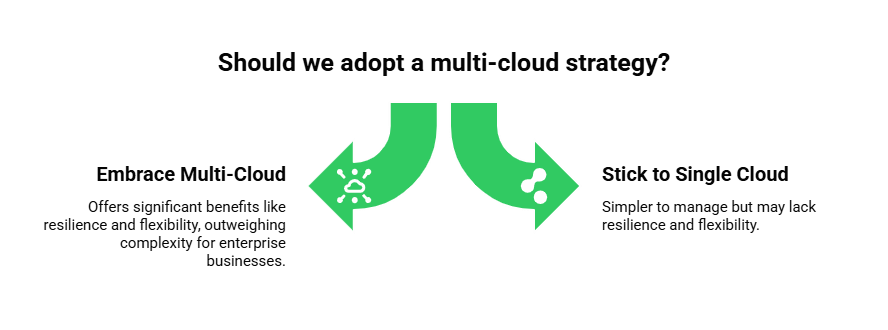
However, for enterprise businesses, the cost of an outage usually far outweighs the cost of managing this complexity.
How Does FreJun AI Facilitate Multi-Cloud Strategies?
This is where a specialized partner becomes essential. FreJun AI acts as the abstraction layer. We sit between the telephone network and your various cloud services.
We handle the complex voice infrastructure so you can focus on building your AI.
Here is how FreJun enables a seamless multi-cloud voice architecture:
- Unified API: You interact with FreJun’s API to manage calls. We handle the connections to your backend services, whether they are on AWS, Google, or a private server.
- Media Forking: We can stream audio to multiple destinations. You could send the audio to Google for transcription and simultaneously save a backup recording to AWS S3.
- Elastic Scalability: FreJun Teler scales automatically. Whether your logic is distributed across ten clouds or one, our SIP trunks handle the inbound and outbound volume reliably.
Ready to build a resilient, multi-cloud voice agent? Sign up for FreJun AI to get your API keys and start building.
Also Read: Top 5 Use Cases of Programmable SIP for AI Voice Agents in 2026
Comparison: Single-Cloud vs. Multi-Cloud
Here is a quick breakdown to help you decide which architecture fits your stage of growth.
| Feature | Single-Cloud Deployment | Multi-Cloud Deployment |
| Complexity | Low (Easy to set up) | High (Requires DevOps expertise) |
| Reliability | Vulnerable to regional outages | High redundancy and failover |
| Latency | Dependent on one provider’s map | Optimized by region |
| Vendor Lock-In | High risk | Low risk (Complete freedom) |
| Cost | Lower management overhead | Higher management overhead |
| Best For | Startups, MVPs, Small Biz | Enterprises, Mission-Critical Apps |
| Voice Quality | Variable based on location | Consistent globally |
When Should You Make the Switch?
You do not need to start with multi-cloud on day one. If you are a startup building a prototype, simplicity is your friend. Stick to one provider to move fast.
However, you should consider moving to a multi-cloud voice API integration if:
- You hit scale: You have thousands of concurrent calls and cannot afford a minute of downtime.
- You go global: You have customers in regions where your current provider is slow.
- You need specific features: You need the AI capabilities of one cloud but the storage pricing of another.
- Compliance: You operate in countries that require data to stay within local borders (data residency), requiring different providers in different nations.
How to Implement a Multi-Cloud Voice Strategy?
If you decide to go this route, do not try to do everything at once.
Step 1: Decouple the Voice Layer
This is the most important step. Separate your telephony from your application logic. Use FreJun AI as your voice gateway. By having FreJun handle the SIP trunking and media streaming, you are free to move your backend logic anywhere you want without changing your phone numbers.
Step 2: Containerize Your Application
Use technologies like Docker and Kubernetes. This allows you to package your application code into portable containers. You can run the exact same container on AWS, Azure, or Google Cloud without rewriting code.
Step 3: Implement Load Balancing
Set up a global traffic manager. This tool watches the health of your clouds. If Cloud A slows down, it automatically directs the next voice call to Cloud B.
What About Disaster Recovery?
Disaster recovery is the ultimate insurance policy. In a traditional setup, if your data center floods, you are offline for days.
In a multi-cloud setup enabled by voice API integration, you have “Active-Active” or “Active-Passive” recovery.
- Active-Active: Both clouds are running and taking calls. If one fails, the other just takes the extra load.
- Active-Passive: One cloud takes calls. The other is on standby. If the first fails, the second wakes up and takes over.
FreJun’s infrastructure supports these models. We can configure routing rules to failover to a secondary endpoint instantly if your primary server stops responding to our webhooks.
Real-World Example: The Hybrid AI Agent
Let us look at a sophisticated use case. A global bank wants to build a secure banking voice bot.
- Telephony: They use FreJun Teler for secure, encrypted SIP trunking.
- Transcription: They use Google Cloud because it handles their specific banking dialects best.
- Intelligence: They use a private LLM hosted on Azure for security compliance.
- Storage: They archive call logs on AWS for long-term compliance retention.
This is the power of multi-cloud. The bank gets the best security, the best accuracy, and the best pricing, all tied together by FreJun’s neutral voice API.
According to a report, 87% of enterprises have already adopted a multi-cloud strategy. The market is moving this way because the benefits of resilience and flexibility are too great to ignore.
Also Read: Why Startups Are Switching to Programmable SIP for Scalable Voice AI?
Conclusion
The question is no longer “should” you consider multi-cloud, but “when.” As your voice application becomes critical to your revenue and customer experience, reliance on a single vendor becomes a massive risk.
Voice API integration is the bridge that allows you to span multiple clouds safely. It decouples the hard physical layer of telephony from the flexible software layer of the cloud.
However, managing this complexity requires a strong partner. You need a voice infrastructure provider that is neutral, reliable, and fast. FreJun AI is that partner. With FreJun Teler handling your global connectivity and our low-latency media handling ensuring premium audio quality, we empower you to build a multi-cloud strategy that makes your business unbreakable.
Want to discuss your infrastructure resiliency? Schedule a demo with our team at FreJun Teler and let us help you design a bulletproof voice architecture.
Also Read: How CRM Integration Enhances Call Routing Accuracy
Frequently Asked Questions (FAQs)
Hybrid cloud mixes a public cloud (like AWS) with your own private on-premise servers. Multi-cloud mixes services from two different public clouds (like AWS and Google).
It can be, due to management costs and paying multiple vendors. However, it often saves money in the long run by preventing costly downtime and allowing you to shop for the cheapest services for specific tasks.
Yes. FreJun is cloud-agnostic. We can send webhooks and stream media to any public cloud IP address or URL you provide.
It allows you to program failover logic. If your primary server doesn’t acknowledge a call event, the API can instantly route the call to a backup server in a different cloud.
It is when you are so dependent on one provider’s proprietary tools that moving to a competitor is too expensive or technically difficult. Multi-cloud prevents this.
If designed poorly, yes. If designed well, it reduces latency by allowing you to serve users from the cloud data center physically closest to them.
Yes. You can use OpenAI on Azure for one type of call and Google Gemini for another. FreJun simply handles the voice transport, giving you total flexibility on the logic side.
FreJun Teler provides the elastic SIP trunking. It acts as the stable front door for your calls, ensuring the connection remains solid even if you are switching backend cloud processors behind the scenes.