
Imagine you are a business owner. You just signed a contract with a big client. In that contract, you promised that your support team would be available 99.9% of the time. You promised that calls would be clear and that your system would never go down. This promise is called a Service Level Agreement or SLA.
Now imagine it is Tuesday morning. Your phone system glitches. Calls start dropping. The audio sounds robotic and choppy. Your client tries to call for support and gets a busy signal.
You just broke your promise. You might owe the client money as a penalty. Worse than that you lost their trust.
For years businesses relied on traditional telephone carriers to keep these promises. They had no control. They just had to hope the carrier did not have an outage. But hope is not a strategy.
Today modern companies are taking control of their destiny using Voice API integration. By connecting their software directly to the phone network they gain visibility and control and the ability to fix problems before the customer even notices.
In this guide we will explore how shifting from black box telephony to programmable voice helps you meet your SLAs. We will look at how to monitor call quality in real time and how infrastructure platforms like FreJun AI provide the reliability you need to keep your promises.
Table of contents
- What Are SLAs and Why Do They Matter in Voice?
- What Is Voice API Integration?
- The Problem with the “Black Box” of Legacy Telephony
- How Does API Integration Provide Visibility?
- How Does FreJun AI Ensure High Availability?
- Can Integration Improve Audio Clarity?
- How Does Automated Failover Protect SLAs?
- Comparison: Legacy vs. API Driven Quality Management
- The Role of Codecs in Call Quality
- How to Monitor and Report on SLAs?
- The Financial Impact of Better Quality
- Steps to Implement High Quality Architecture
- Conclusion
- Frequently Asked Questions (FAQs)
What Are SLAs and Why Do They Matter in Voice?
An SLA is a contract. It defines the standard of service you agree to provide. In the world of voice and contact centers these agreements usually cover three things.
- Availability: The system is online and ready to take calls.
- Quality: The voice sounds clear without delay or echo.
- Resolution: Problems are fixed within a certain time frame.
If you are running a high stakes business like a telemedicine platform or an emergency hotline hitting these numbers is critical.
According to data from Uptime Robo, the average cost of IT downtime is $5,600 per minute. For a voice dependent business like a call center that number can be even higher. A single hour of downtime can cost hundreds of thousands of dollars in lost revenue and SLA penalties.
Legacy phone systems make it hard to guarantee these numbers because they are rigid. If a cable is cut down the street your phones go dead and you are helpless. Voice API integration changes this dynamic entirely.
What Is Voice API Integration?
To understand the solution we must define the technology. Voice API integration is the process of using software code to control phone calls.
Instead of plugging a phone into a wall jack you use an API (Application Programming Interface) to tell the network what to do. You can write code that says “If carrier A is failing send the call to carrier B” or “If the audio quality drops switch to a different codec.”
This enables a concept called “Programmable Voice.” It means your voice infrastructure is not static. It is intelligent and reactive.
Also Read: How Programmable SIP Simplifies Voice Application Deployment?
The Problem with the “Black Box” of Legacy Telephony
The biggest enemy of call quality is lack of visibility.
In a traditional setup you buy a SIP trunk from a provider. You connect it to your PBX (Private Branch Exchange). When a call sounds bad you call the provider.
“Hey the calls are choppy,” you say.
“Everything looks fine on our end,” they reply.
You are stuck and you have no data. You cannot see where the packet loss is happening. Plus, you cannot prove that the carrier is at fault. This is the “Black Box” problem. You cannot fix what you cannot see and you cannot guarantee an SLA if you are flying blind.
How Does API Integration Provide Visibility?
Voice API integration turns the lights on. Because the call is routed through software you get access to rich data streams.
Modern voice platforms provide real time statistics for every single call. This includes:
- Jitter: The variation in packet arrival time.
- Latency: The delay in the audio.
- Packet Loss: The percentage of audio data that is lost in transit.
- MOS: Mean Opinion Score which is a grade from 1 to 5 of the call quality.
With this data you are no longer guessing. You can see exactly what is happening. You can set up alerts that say “Warning Packet loss on Carrier X is rising.” This allows you to react instantly often before the user even complains.
How Does FreJun AI Ensure High Availability?
Visibility is good but action is better. You need infrastructure that is built to stay online no matter what.
FreJun AI handles the complex voice infrastructure so you can focus on building your AI and business logic. We are not just a software layer. We operate a robust physical network.
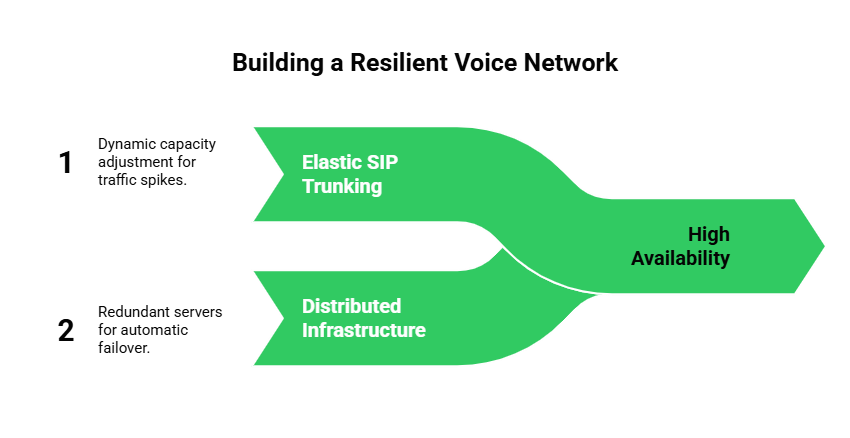
FreJun utilize Teler which provides elastic SIP trunking. This is the foundation of high availability.
- Elasticity: Traditional trunks have a limit. If you have 10 lines and the 11th person calls they get a busy signal. FreJun Teler is elastic. It expands automatically to handle traffic spikes ensuring you never miss a call.
- Redundancy: Our infrastructure is distributed. If a server in one region encounters an issue traffic is automatically rerouted to a healthy server in another region. This failover capability is essential for meeting 99.99% uptime SLAs.
Can Integration Improve Audio Clarity?
Yes. Audio clarity often depends on the “route” the call takes.
The internet is a web of connected networks. Some paths are fast highways. Some are slow dirt roads. Low cost carriers often send calls down the “dirt roads” to save money. This causes robotic voice and echo.
When you use a premium voice API integration like FreJun you gain access to optimized routing.
FreJun prioritize low latency media streaming. We analyze the network conditions in real time. We choose the most direct path for the audio to travel. By minimizing the number of “hops” the voice data takes we reduce the chance of jitter and delay. This results in High Definition (HD) voice quality which is a key metric in customer satisfaction SLAs.
How Does Automated Failover Protect SLAs?
The most powerful feature of programmable voice is automated failover.
In a manual world if a carrier goes down an engineer has to wake up at 3 AM log into a server and change settings. By the time they fix it you have missed your SLA.
With Voice API integration you can automate this. You can write logic that says:
“Monitor Carrier A. If the MOS score drops below 3.5 for more than one minute automatically switch all outbound traffic to Carrier B.”
This happens instantly. The system heals itself. The users on the phone might hear a slight glitch for a second but the call stays connected. The business keeps running. The SLA remains intact.
Comparison: Legacy vs. API Driven Quality Management
Here is a breakdown of how the two approaches differ in managing quality.
| Feature | Legacy Phone System | Voice API Integration |
| Visibility | Blind spots (No real time data) | Full visibility (Live metrics) |
| Routing | Static (Fixed path) | Dynamic (Performance based) |
| Scalability | Fixed capacity | Elastic capacity |
| Failover | Manual and slow | Automated and instant |
| Resolution | Reactive (Wait for complaint) | Proactive (Fix before impact) |
| SLA Risk | High | Low |
Also Read: Top 5 Use Cases of Programmable SIP for AI Voice Agents in 2026
The Role of Codecs in Call Quality
A codec is the software that compresses audio to send it over the internet.
Old systems use old codecs like G.711. It is reliable but it does not handle bad internet well. If the connection drops slightly the audio breaks up.
Modern voice API integration allows you to use modern codecs like Opus. Opus is adaptive. It is smart. If it detects that the internet connection is weak it automatically adjusts the compression to keep the audio smooth. If the connection is strong it upgrades to HD studio quality.
FreJun supports these advanced media capabilities. By allowing your application to negotiate the best possible codec we help you maintain intelligible conversation even in challenging network conditions.
Ready to upgrade your infrastructure? Sign up for FreJun AI to access our high availability network.
How to Monitor and Report on SLAs?
To prove you are meeting your SLA you need reports.
Legacy bills just show you “Duration” and “Cost.” That tells you nothing about quality.
With FreJun you can generate detailed Quality of Service (QoS) reports. You can show your client:
- “We processed 10,000 calls.”
- “99.95% of calls had a MOS score above 4.0.”
- “Our average latency was 45 milliseconds.”
This data turns your SLA from a scary liability into a competitive advantage. You can prove to your customers that you offer superior quality compared to your competitors.
The Financial Impact of Better Quality
Investing in voice API integration is not just a technical decision. It is a financial one.
Poor quality leads to longer calls. If the agent and the customer have to keep repeating themselves a 5 minute call becomes a 7 minute call. That is a 40% increase in labor costs.
Poor quality leads to churn. According to research by PwC, 32% of all customers would stop doing business with a brand they loved after just one bad experience. A dropped call or a static filled line is definitely a bad experience.
By ensuring high quality through robust infrastructure you reduce operational costs and protect your revenue.
Steps to Implement High Quality Architecture
If you are a developer looking to improve your SLAs here is the roadmap.
Step 1 choose the Right Partner
You need a provider that owns the network not just a reseller. FreJun AI provides the direct control and FreJun Teler infrastructure required for enterprise grade reliability.
Step 2 Implement RTCP Feedback
Configure your application to listen to RTCP (Real time Transport Control Protocol) reports. These are the heartbeat signals that tell you the quality of the stream.
Step 3 Build Failover Logic
Do not rely on one path. Use the API to configure redundant routes. Ensure your application handles errors gracefully.
Step 4 Test Under Load
Use the API to simulate high traffic. See how your system performs when 500 calls happen at once. Ensure your elastic trunking expands as expected.
Also Read: Why Startups Are Switching to Programmable SIP for Scalable Voice AI?
Conclusion
In the modern business world an SLA is more than a contract. It is your reputation. Breaking it costs money and loses customers.
Relying on legacy telephony to keep these promises is a gamble. You lack the visibility to see problems and the tools to fix them.
Voice API integration offers a better way. It gives you the control to monitor quality in real time and allows you the power to route around outages. It gives you the data to prove your performance.
However software is only as good as the network it runs on. To truly guarantee quality you need a partner like FreJun AI. With FreJun Teler providing global elastic scale and our developer first tools managing low latency media streams we provide the foundation you need to make promises you can keep.
We handle the complex voice infrastructure so you can focus on delivering a flawless experience to your customers.
Want to discuss how to bulletproof your voice SLAs? Schedule a demo with our team at FreJun Teler and let us help you build a more reliable system.
Also Read: How CRM Integration Enhances Call Routing Accuracy
Frequently Asked Questions (FAQs)
An SLA or Service Level Agreement is a contract that guarantees a specific level of performance. For voice this typically includes uptime (availability) and audio clarity (quality) and resolution time for issues.
It allows for automated failover. If one carrier or server fails the API can instantly reroute calls to a backup path keeping the system online and preserving the SLA.
MOS stands for Mean Opinion Score. It is a standard metric from 1 to 5 that rates voice quality. It is important because it gives you a concrete number to measure user experience against your SLA targets.
While no system is 100% perfect FreJun Teler significantly reduces dropped calls using elastic SIP trunking and redundant infrastructure. If one path fails traffic flows to another seamlessly.
High latency is usually caused by the voice data taking a long indirect route across the internet. FreJun optimizes routing to find the shortest path reducing delay.
Yes. Integration allows you to use modern adaptive codecs that can handle jitter (network variation) much better than older fixed codecs resulting in smoother audio.
Not necessarily. Most Voice APIs use a pay as you go model. This allows small businesses to access enterprise grade infrastructure and reliability without a massive upfront investment.
Yes. This is a key benefit. Unlike old phone bills that come once a month Voice APIs provide live data streams so you can see quality issues the moment they happen.