
We have all been there. You call customer service, and a robotic voice says, “Tell me what you are calling about.” You say, “My bill is higher than I expected.” The robot pauses for three seconds and replies, “I think you said… Bill… Payment. Is that correct?”
You sigh. You say “No.” The cycle repeats.
This is the current generation of voice bots. They are rigid. They follow a decision tree. If you go off-script, they break. They are frustrating because they force humans to speak like machines.
But a shift is happening. We are standing on the edge of a revolution in conversational AI. The next generation of voice bots will not sound like robots. They will sound like helpful, empathetic humans. They will understand sarcasm and they will handle interruptions. Voice bots will remember that you called last week about a different issue.
However, having a smart AI brain is not enough. You can have the smartest Large Language Model (LLM) in the world, but if it cannot connect to the telephone network reliably, it is useless.
This is where voice API integration becomes the critical piece of the puzzle. It is the nervous system that connects the AI brain to the ears and mouth of the telecom world.
In this article, we will explore how this integration is fueling the rise of next-gen voice bots, why infrastructure is the hidden variable for success, and how platforms like FreJun AI are building the highways for this new era of communication.
Table of contents
- What Defines the “Next Generation” of Voice Bots?
- Why Is the API Layer the Critical Missing Link?
- How Does Infrastructure Scale with AI Demand?
- Can Voice APIs Enable Multimodal Interactions?
- Real-World Scenarios: Where Will We See This First?
- What Role Does Security Play in Future Voice Bots?
- How Do Developers Build These Next-Gen Experiences?
- Why Is the “Barge-In” Feature So Important?
- The Economic Impact of Next-Gen Bots
- Conclusion
- Frequently Asked Questions (FAQs)
What Defines the “Next Generation” of Voice Bots?
To understand the future, we have to look at how different it is from the past.
The old bots were “command-based.” You had to say a specific keyword to trigger a specific action. They were built on simple logic: If user says X, play recording Y.
The next generation is “generative.” These bots create their responses in real-time. They do not have a list of pre-recorded sentences. They have a personality and a knowledge base.
Here are the traits of a next-gen bot:
- Contextual Awareness: They remember what you said five minutes ago.
- Interruptibility: If the bot is talking and you say, “Wait, stop,” the bot stops immediately.
- Latency-Free: The conversation flows back and forth without awkward pauses.
- Emotional Intelligence: The bot detects if you are angry and changes its tone to be more apologetic.
Achieving this requires a massive amount of data to flow instantly between the caller, the cloud, and the AI. This is impossible with old phone systems. It requires sophisticated voice API integration.
Why Is the API Layer the Critical Missing Link?
You might wonder, “Why can’t I just connect ChatGPT to a phone line?”
It sounds simple, but the telephone network (PSTN) and the internet are two different worlds. They speak different languages. The phone network speaks in SIP (Session Initiation Protocol) and audio frequencies. The internet speaks in HTTP and JSON.
A voice API integration acts as the translator. It bridges these two worlds.
When you build a next-gen bot, the API handles the heavy lifting:
- Ingestion: It catches the phone call from the carrier network.
- Streaming: It converts the audio into a digital stream (WebSockets).
- Orchestration: It sends that stream to the AI “brain” and receives the audio response.
- Playback: It plays that response back to the caller.
Without a robust API, developers would have to build their own telecom towers and servers just to make a bot talk. APIs democratize this technology, allowing any developer to build a Jarvis-like assistant.
Also Read: What Ethical Issues Should Leaders Consider When Building Voice Bots?
How Does Infrastructure Scale with AI Demand?
The next generation of voice bots requires more power.
An old IVR system uses very little bandwidth. It just plays a tiny audio file. A generative AI bot requires real-time, bi-directional media streaming. It is data-heavy.
If you have ten callers, any system works. If you have ten thousand callers simultaneously—say, during a product launch or a crisis—standard systems crash.
This is why FreJun Teler is a game-changer. It provides elastic SIP trunking.
“Elastic” means flexible. Imagine a pipe that expands when more water flows through it. FreJun Teler automatically scales your capacity. You do not need to buy fixed “lines” or predict your traffic perfectly. The infrastructure adapts to the demand.
This scalability is what empowers enterprises to deploy next-gen bots. They know that whether they have one caller or one million, the voice API integration will hold up, and the audio quality will remain crystal clear.
Can Voice APIs Enable Multimodal Interactions?
The future of voice is not just voice. It is voice plus other actions.
Imagine you are talking to a bot about booking a flight.
Bot: “I found a flight for $300.”
You: “Can I see the itinerary?”
Bot: “I just texted it to you. Check your screen.”
This is a multimodal interaction. The voice bot triggers an SMS or an email while keeping the conversation going.
Voice API integration makes this possible. Because the voice layer is software, it interacts with other APIs.
- CRM Integration: The bot updates your Salesforce record while talking.
- Payment Integration: The bot processes your credit card securely.
- Visual Integration: The bot pushes data to your app screen.
FreJun’s developer-first toolkit enables these connections. We provide the hooks and webhooks that allow developers to weave voice into the rest of their digital ecosystem.
Real-World Scenarios: Where Will We See This First?
This technology is not theoretical. It is being built right now. Here is how the transition looks in different industries.
| Industry | Current Voice Bot | Next-Gen Voice Bot (Powered by API) |
| Healthcare | “Press 1 for appointments.” | “How are you feeling today, Sarah? I can fit you in with Dr. Smith at 2 PM.” |
| Banking | “Please enter your account number.” | “I see you are calling from a new device. Is this about the transaction in London?” |
| Retail | “Check our website for returns.” | “I can process that return for you right now. Would you like a QR code for the shipping label?” |
| Hospitality | “Front desk is busy. Please hold.” | “Good evening. Do you need extra towels or a late checkout?” (Answers instantly) |
| Insurance | Rigid menus. | Empathetic claims processing that detects stress and acts kindly. |
Also Read: How Can Businesses Predict ROI Before Building Voice Bots?
What Role Does Security Play in Future Voice Bots?
With great power comes great responsibility. Next-gen bots sound human. This is amazing for service, but scary for security.
How do you know you are talking to a real bank bot and not a scammer? How do you ensure the bot isn’t recording your password?
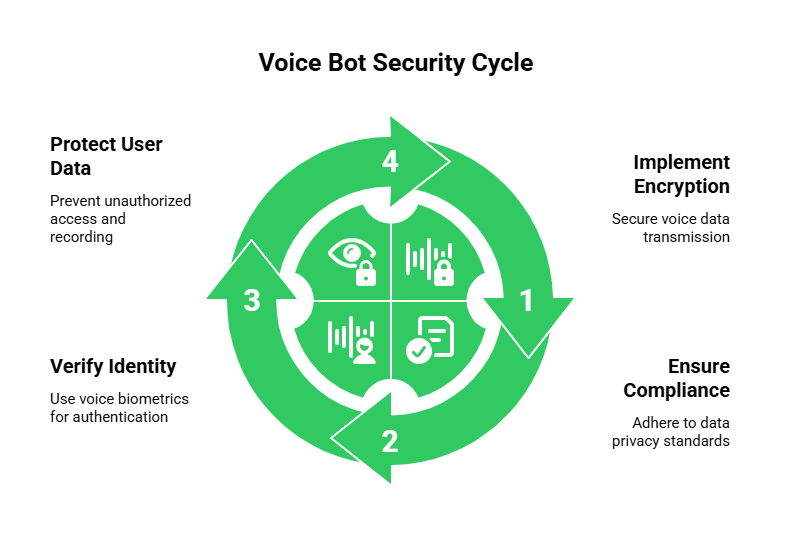
Secure voice API integration is the defense.
FreJun AI prioritizes security by design.
- Encryption: We encrypt voice data as it travels through our network (SRTP).
- Compliance: We adhere to strict data standards to protect user privacy.
- Verification: APIs can implement “voice biometrics” to verify the speaker’s identity, ensuring that the next-gen bot only gives account details to the actual account owner.
How Do Developers Build These Next-Gen Experiences?
The shift to next-gen bots is also a shift in who is building them.
Ten years ago, you needed a “Telecom Engineer” to set up a phone system. It involved wires, hardware, and proprietary coding languages.
Today, a “Full Stack Developer” builds voice bots. Using voice API integration, a web developer who knows Python or JavaScript can build a phone system.
FreJun empowers this developer community. We provide SDKs (Software Development Kits) that act as building blocks.
- Want to make a call? frejun.call.create()
- Want to stream audio? frejun.media.stream()
We abstract away the complexity of SIP and VoIP. This allows developers to focus on the “intelligence” of the bot, the prompts, the personality, the logic rather than worrying about how packets move through the internet.
Ready to start building the future of voice? Sign up for FreJun AI developer account to get your API keys and access our documentation.
Why Is the “Barge-In” Feature So Important?
We touched on this earlier, but it deserves a deeper look. The defining feature of a “smart” conversation is the ability to listen while speaking.
Humans do this all the time.
Person A: “So the plan covers dental and…”
Person B: “Does it cover vision?”
Person A: “Yes, it covers vision.”
Old bots cannot do this. They are “half-duplex.” They can speak OR listen, but not both. If you shout at an old bot while it is talking, it ignores you.
Next-gen bots, powered by advanced APIs, are “full-duplex.” They stream audio in both directions simultaneously.
FreJun’s infrastructure supports this real-time media manipulation. We deliver the user’s interruption to the AI instantly. The AI logic then triggers a “Stop Audio” command. This creates a natural flow that makes the user feel respected and heard. Without this API capability, the bot feels rude.
The Economic Impact of Next-Gen Bots
This shift is not just about cool technology; it is about economics.
According to a report by Bloomberg, the generative AI market is poised to become a $1.3 trillion market by 2032. A significant portion of this growth will come from customer service automation.
Enterprises prefer voice API integration because it lowers costs while raising quality.
- Lower OpEx: AI agents cost pennies per minute compared to dollars per minute for human agents.
- Higher CSAT: Customers are happier because they don’t wait on hold.
- Revenue Growth: Next-gen bots can be programmed to upsell effectively, driving new revenue.
However, these economic gains are only realized if the bot works reliably. If the infrastructure is cheap and the call drops, you lose the customer forever. This is why investing in premium infrastructure like FreJun Teler is a strategic business decision, not just a technical one.
Also Read: What Future Trends Will Define Building Voice Bots Over The Next Five Years?
Conclusion
The era of the “dumb” voice bot is ending. We are entering an age where talking to a computer will feel as natural as talking to a friend.
This transition is powered by the convergence of Generative AI and voice API integration. The AI provides the brain, but the Voice API provides the body. It allows the AI to hear, speak, and connect with the world.
For this next generation to succeed, speed and reliability are paramount. The “intelligence” of the bot is fragile; it breaks if there is lag or static.
FreJun AI stands as the foundational layer for this new era. By providing a developer-first, low-latency, and scalable infrastructure, we empower businesses to build voice experiences that were previously impossible. We handle the complex plumbing of the global telephone network so that your next-gen voice bot can shine.
Want to discuss your vision for next-gen voice automation? Schedule a demo with our team at FreJun Teler and let us help you build the future of communication.
Also Read: Virtual Number Call Routing: Handle Calls From Any Location Seamlessly
Frequently Asked Questions (FAQs)
Voice API integration is the use of code to connect software applications to the public telephone network. It allows developers to programmatically make calls, receive calls, and manage voice data without physical hardware.
IVR (Interactive Voice Response) systems are menu-based (Press 1 for Sales). Next-gen voice bots are conversational. They use AI to understand natural language, allowing users to speak freely rather than pressing buttons.
Latency is the delay in audio. If an AI bot takes too long to respond, the conversation feels unnatural and awkward. Low latency ensures the bot responds instantly, maintaining the illusion of a human interaction.
Yes. FreJun is model-agnostic. Our infrastructure acts as the transport layer. You can connect our voice stream to OpenAI, Anthropic, Google Gemini, or any other LLM you choose.
Barge-in is the ability for a user to interrupt the bot while it is speaking. The bot detects the user’s voice, stops talking, and listens to the new input. This is essential for natural conversation flow.
Yes. FreJun Teler offers elastic SIP trunking with global reach. You can provision phone numbers and handle calls from customers all over the world through a single API connection.
Yes. FreJun prioritizes security. We use encryption protocols (like SRTP) to protect voice data as it travels through our network, ensuring the privacy of your users’ conversations.
Yes. Voice API integration allows you to connect the call data to systems like Salesforce or HubSpot. The bot can look up customer details and log call summaries automatically.