
Imagine waking up at 3:00 AM with a high fever. You are shivering. Your throat hurts. The last thing you want to do is drive to an emergency room and sit in a waiting room full of other sick people for four hours.
In the past that was your only option. Today you pick up your phone. You open an app. You tap a button. Within seconds you are speaking to a doctor. They listen to your cough and ask about your symptoms. They prescribe medication that is waiting for you at the pharmacy when the sun comes up.
This miracle of modern convenience is called telemedicine. But the magic behind it is not just the doctor. It is the technology that connects you.
Telemedicine relies heavily on clear and secure and instant communication. This is powered by voice API integration. By embedding high quality voice calling directly into healthcare apps developers are changing how we receive medical care.
In this article we will explore how this technology works. We will look at how it protects privacy and improves diagnosis accuracy and how infrastructure platforms like FreJun AI provide the reliable connection that acts as the digital lifeline between patient and provider.
Table of contents
- What Is Voice API Integration in Healthcare?
- Why Is Telemedicine Exploding in Popularity?
- How Does Voice Integration Protect Privacy?
- How Does FreJun AI Ensure Reliable Consultations?
- How Does Voice Data Improve Medical Records?
- Comparison: Traditional Clinic vs. Integrated Telehealth
- How Does Voice Integration Enable Multi Party Care?
- Why Is Low Latency Vital for Doctor Patient Trust?
- How Do Developers Build Secure Health Apps?
- What Is the Future: AI Diagnostic Support?
- How Does FreJun Teler Handle Rural Connectivity?
- Conclusion
- Frequently Asked Questions (FAQs)
What Is Voice API Integration in Healthcare?
To understand the transformation we first need to define the tool. Voice API integration is the process of adding voice calling capabilities to a software application using code.
Think of it as a secure tunnel. When a patient taps “Call Doctor” in an app the audio does not go over the standard public phone line in the usual way. It travels through a specialized digital pathway created by the API.
This pathway allows the app to do things a normal phone cannot. It can hide phone numbers. It can record the conversation for the patient’s file and can transcribe the medical advice automatically.
Why Is Telemedicine Exploding in Popularity?
The shift to virtual care was happening slowly but recent years accelerated it massively. Patients realized they valued convenience. Doctors realized they could see more patients efficiently.
According to the American Medical Association, nearly 85% of physicians indicate they currently use telehealth to care for patients. This creates a massive demand for reliable voice platforms.
If a doctor is seeing twenty patients a day virtually they cannot afford dropped calls or robotic audio. They need a system that works every single time. This demand for reliability is driving the adoption of enterprise grade voice APIs over basic consumer tools.
How Does Voice Integration Protect Privacy?
In healthcare privacy is not just a preference. It is the law. Regulations like HIPAA in the US demand strict protection of patient data.
Voice API integration is essential for maintaining this privacy through a feature called call masking.
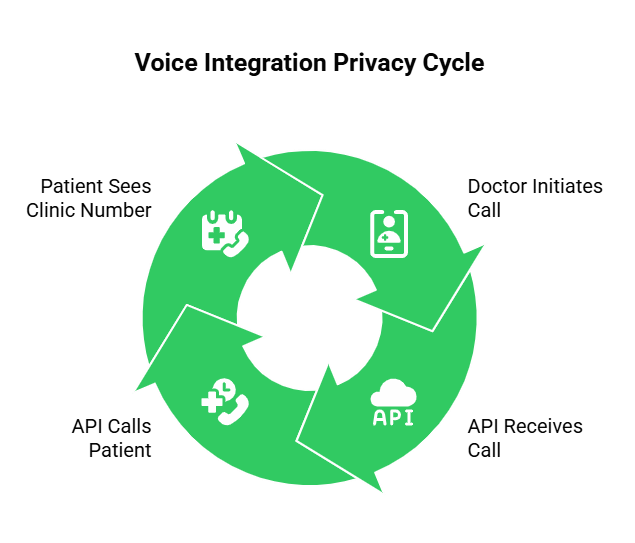
Imagine a doctor calling a patient from their personal cell phone. They do not want the patient to have their private number. They do not want the patient texting them on Sunday night.
With call masking the API sits in the middle.
- The doctor calls through the app.
- The API receives the call.
- The API calls the patient.
- The patient sees the clinic’s office number on their Caller ID not the doctor’s cell number.
This protects the provider while ensuring the patient knows who is calling. It creates a professional boundary that is difficult to maintain with standard telephony.
Also Read: How Is Edge Computing Accelerating Building Voice Bots For Real-Time Calls?
How Does FreJun AI Ensure Reliable Consultations?
In a medical consultation clarity is critical. If a patient says “I am taking 50 milligrams” but the audio cuts out and the doctor hears “15 milligrams” it could lead to a dangerous prescription error.
This is where infrastructure becomes a matter of safety. FreJun AI handles the complex voice infrastructure so you can focus on building your AI and healthcare logic.
FreJun prioritizes audio fidelity. We utilize FreJun Teler which provides elastic SIP trunking to handle high volumes of concurrent medical calls. Whether it is flu season with thousands of calls or a quiet night our infrastructure scales to ensure every connection is stable.
Furthermore we focus on low latency media streaming. This ensures that when a patient describes a symptom the doctor hears it instantly. There is no lag. This allows for natural interruption and questions which is vital for an accurate diagnosis.
How Does Voice Data Improve Medical Records?
One of the biggest burdens on doctors is paperwork. After every visit they have to type up notes. This leads to burnout.
Voice API integration transforms this workflow. Since the call flows through the software it can be processed in real time.
- Transcription: The audio is converted to text automatically.
- Summarization: An AI model reads the transcript and extracts key details like symptoms and medication.
- Integration: These notes are pushed directly into the Electronic Health Record (EHR) system.
This allows the doctor to focus entirely on the patient rather than typing on a keyboard during the consultation.
Comparison: Traditional Clinic vs. Integrated Telehealth
Here is how the two experiences stack up against each other.
| Feature | Traditional Clinic Call | Integrated Telehealth Call |
| Privacy | Doctor uses office landline only | Doctor uses any device securely |
| Identity | No verification of caller | App verifies patient identity |
| Data Entry | Doctor types notes manually | Auto transcribed and synced |
| Wait Time | Patient sits in waiting room | Patient waits in virtual queue |
| Cost | High (Physical overhead) | Lower (Virtual infrastructure) |
| Follow Up | Manual scheduling call | Automated SMS/Voice reminder |
| Accessibility | Local patients only | Rural/Remote access |
How Does Voice Integration Enable Multi Party Care?
Medicine is often a team effort. A primary care physician might need to consult with a cardiologist while the patient is on the line. Also a patient might want a family member to listen in.
On a standard phone adding a third person is clunky. “Hold on let me try to conference them in.” Click. Click. Disconnected.
With voice API integration developers can build seamless conferencing. The app can have a button: “Add Specialist.” The API dials the cardiologist and adds them to the secure room instantly. This creates a virtual care team environment that improves patient outcomes.
Also Read: How Can Companies Enable Real-Time Interruptions While Building Voice Bots?
Why Is Low Latency Vital for Doctor Patient Trust?
Trust is built on empathy. Empathy is conveyed through timing.
If a patient reveals something sensitive and there is a three second delay before the doctor responds it feels cold. It feels like the doctor is distracted.
FreJun AI is engineered for this. We use optimized routing to ensure voice packets take the fastest path. This low latency environment preserves the emotional nuance of the conversation. When the doctor says “I understand” immediately it comforts the patient.
How Do Developers Build Secure Health Apps?
If you are building the next great telemedicine platform security is your top priority.
Step 1 Secure Infrastructure
Choose a partner like FreJun that encrypts voice data in transit. You cannot have medical conversations travelling over open unencrypted channels.
Step 2 Authentication
Ensure your app authenticates the user before the call starts. The API should only allow a connection if the user has a valid session token.
Step 3 Minimal Data Retention
Configure your Voice API integration to only store what is necessary. If you record calls ensure they are stored in a HIPAA compliant storage bucket and not on the voice provider’s public server.
Ready to build a secure medical voice platform? Sign up for FreJun AI to access our secure infrastructure.
What Is the Future: AI Diagnostic Support?
The future of voice in healthcare goes beyond just communication. It moves into diagnostics.
Researchers are developing “vocal biomarkers.” These are AI algorithms that can detect disease by analyzing the voice.
- Does the patient sound short of breath? (Possible heart failure).
- Is there a tremor in the voice? (Possible Parkinson’s).
- Is the speech pattern slurred? (Possible stroke).
To use these advanced tools you need pristine audio. You cannot analyze a voice that is full of static or jitter.
FreJun’s commitment to high definition audio makes this possible. By delivering raw high quality media streams via our API we enable developers to feed that audio into diagnostic AI models unlocking a new frontier of preventative care.
How Does FreJun Teler Handle Rural Connectivity?
Telemedicine is a lifeline for rural areas where there are no nearby hospitals. However rural internet can be spotty.
FreJun Teler helps bridge this gap. Because we support elastic SIP trunking and use adaptive codecs we can maintain a call even on lower bandwidth connections. If the patient’s data signal is weak our infrastructure optimizes the stream to prioritize voice clarity over everything else. This ensures that patients in remote locations are not left behind.
Also Read: Why Do Developers Prefer a Flexible Voice Recognition SDK Today?
Conclusion
Telemedicine is not just a trend. It is the new standard of care. It makes healthcare more accessible and more efficient and more human.
But for telemedicine to fulfill its promise the technology must be invisible. The patient should not be thinking about the connection. They should be thinking about their health.
Voice API integration makes this possible. It provides the secure private and high quality link between healer and patient. It automates the administrative burden so doctors can focus on medicine.
However software is only as good as the network it runs on. To build a truly reliable health platform you need infrastructure designed for critical communications. FreJun AI provides that foundation. With FreJun Teler handling the global connectivity and our developer first tools ensuring secure low latency streaming we help you build the healthcare of tomorrow.
Want to discuss your telemedicine infrastructure needs? Schedule a demo with our team at FreJun Teler and let us help you connect patients to care.
Also Read: AI vs. Rule-Based Call Routing: Which One Should You Choose?
Frequently Asked Questions (FAQs)
It is the technology that embeds voice calling capabilities directly into healthcare apps. It allows patients and doctors to speak securely over the internet without using standard phone lines.
The technology itself acts as a conduit. To be HIPAA compliant developers must choose a provider that signs a Business Associate Agreement (BAA) and ensures that all data is encrypted and stored securely.
Call masking is a privacy feature. It displays a generic business number on the Caller ID instead of the doctor’s personal cell phone number protecting the provider’s privacy.
Yes. Voice APIs allow you to record consultations programmatically. These recordings can be transcribed and added to the patient’s Electronic Health Record (EHR) for accurate documentation.
FreJun uses a global network of servers and optimized routing protocols. We prioritize voice traffic to minimize latency and jitter ensuring clear audio even on mobile networks.
Voice APIs focus on audio. However many developers combine Voice APIs with Video APIs to create a complete telehealth experience. FreJun specializes in the voice component ensuring the audio track is perfect.
With FreJun Teler you can configure failover logic. If the data connection fails the system can automatically reroute the call to the patient’s standard telephone number (PSTN) as a backup.
Yes. By streaming the audio to an AI translation service you can build real time translation features allowing a doctor to speak with a patient who speaks a different language.