
Imagine a typical office worker named Sarah. It is 10:00 AM on a Tuesday. Sarah is typing a message to her team on a chat app. Suddenly her desk phone rings. It is a client. She stops typing and picks up the heavy plastic receiver. She holds it to her ear with her shoulder while trying to find a pen to write down a number.
After the call she has to open a spreadsheet to log the call details manually. Then she goes back to her chat app but she has forgotten what she was typing.
This is the “toggle tax.” It is the mental energy wasted switching between different tools.
For years businesses operated this way. They had one system for typing (email/chat) and a completely separate system for talking (phones). It was clunky and inefficient. It was expensive.
Then came Unified Communications (UC). This is the idea that all communication should happen in one place. One app for chat and video and voice.
But here is the catch. Building a chat app is relatively easy. Building a reliable global phone system inside an app is incredibly hard. This is where voice API integration becomes the most critical piece of the puzzle. It is the bridge that connects the software world to the telecom world.
In this article we will explore why voice API integration is the backbone of modern Unified Communications platforms. We will look at how it enables custom workflows and ensures high quality audio and how infrastructure providers like FreJun AI make this seamless connectivity possible.
Table of contents
- What Is Unified Communications (UC)?
- What Is Voice API Integration in this Context?
- The Problem with Keeping Voice Separate
- How Voice API Integration Solves the Puzzle
- The Role of Infrastructure in UC Reliability
- Comparing Legacy Systems vs API Driven UC
- How Does Voice API Enable Global Scale?
- Enhancing Collaboration with AI
- Security and Compliance in UC
- The Developer Advantage
- Conclusion
- Frequently Asked Questions (FAQs)
What Is Unified Communications (UC)?
Unified Communications is not a single tool. It is a strategy. It brings together various communication methods into a single interface.
Think of it like a Swiss Army Knife. Instead of carrying a knife and a screwdriver and a pair of scissors separately you have them all in one pocket tool.
A UC platform typically includes:
- Instant Messaging (Chat)
- Video Conferencing
- File Sharing
- Voice Calling (Telephony)
The goal is to allow a user to switch modes instantly. You are chatting with a colleague. The topic gets complex. You click one button and instantly you are on a voice call with them. No dialing numbers. No picking up a separate device.
What Is Voice API Integration in this Context?
To make that “one button” click work you need voice API integration.
The public telephone network (PSTN) is old. It runs on cables and protocols that were designed decades ago. Modern software runs on the cloud. These two worlds do not speak the same language.
A Voice API (Application Programming Interface) acts as the translator.
When a developer builds a UC platform they do not want to run copper wires to their server room. They want to write code. The API allows them to say “Connect user A to user B” using a simple command. The API provider handles the complex routing through the telephone network in the background.
Also Read: What Makes Voice Bot Solutions Effective for High-Volume Customer Calls?
The Problem with Keeping Voice Separate
Before APIs became popular businesses treated voice as a hardware problem. They bought Private Branch Exchange (PBX) boxes. These were expensive refrigerators of technology that sat in a closet.
Keeping voice separate from the rest of the digital workflow creates massive problems.
1. Data Silos
If your sales team talks on desk phones but tracks deals in Salesforce the data is lost. Unless someone manually types in “I called the client,” the business has no record of the interaction.
2. Maintenance Costs
maintaining physical phone lines and hardware requires specialized technicians. If a line goes down you have to wait for a truck roll to fix it.
3. lack of Mobility
Old phone systems are tied to a desk. If Sarah wants to work from home she cannot take her desk phone with her. She has to use her personal cell phone which compromises privacy and professionalism.
How Voice API Integration Solves the Puzzle
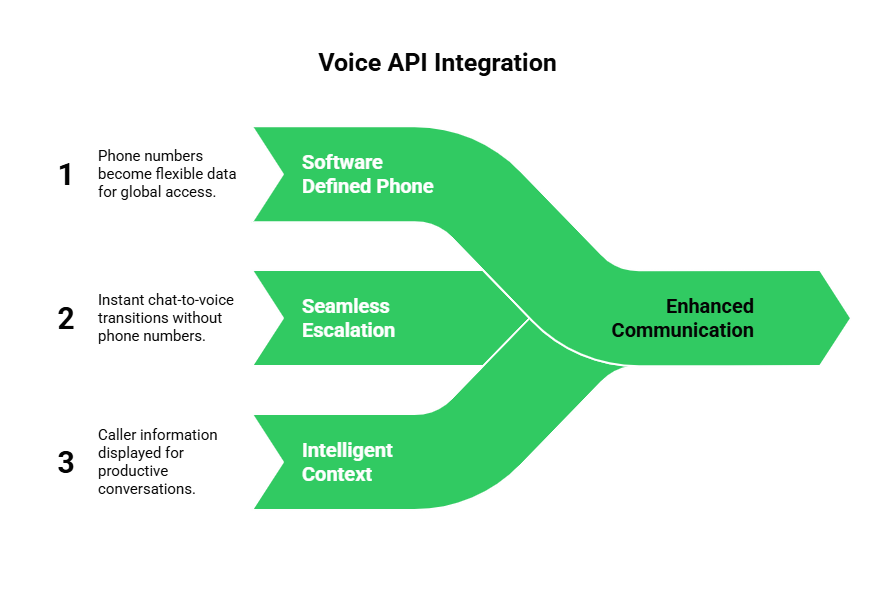
Integrating voice via API changes the game completely. It turns voice into software.
The “Software Defined” Phone
With voice API integration the phone number is just a piece of data. It can be assigned to a user anywhere in the world. Sarah can answer her work calls on her laptop or her mobile app or a tablet. The UC platform becomes her office regardless of where she is physically sitting.
Seamless Escalation
We mentioned the chat to voice transition earlier. This is only possible with APIs. Because the voice capability is embedded in the code the application knows the context. It knows who the users are. It connects them instantly without asking for phone numbers.
Intelligent Context
When a call comes in through a UC platform the system can look up the caller ID in the company database. It can display the caller’s name and photo and recent emails on the screen before the user answers. This context makes the conversation much more productive.
The Role of Infrastructure in UC Reliability
Software is great but voice calls have a unique requirement. They need to happen in real time.
If an email arrives five seconds late nobody notices. If a voice packet arrives five seconds late the conversation is ruined.
This is where infrastructure providers like FreJun AI are essential. We handle the complex voice infrastructure so you can focus on building your AI and UC features.
FreJun provides the transport layer. We ensure that the audio moves from the user’s device to the destination with ultra low latency. We use FreJun Teler to provide elastic SIP trunking. This allows UC platforms to connect to the global telephone network reliably.
Without robust infrastructure a fancy UC app is useless. If the call quality is choppy users will go back to using their personal cell phones. FreJun ensures that the voice quality is crystal clear making the UC platform the preferred tool for communication.
Comparing Legacy Systems vs API Driven UC
Here is a look at how the old way stacks up against the modern API driven approach.
| Feature | Legacy Hardware PBX | API Driven Unified Communications |
| Setup Time | Weeks or Months | Minutes or Hours |
| Location | Tied to a physical desk | Work from anywhere |
| Scalability | Limited by hardware ports | Infinite (Elastic software) |
| Integration | None (Standalone) | Deep integration with CRM/Apps |
| Maintenance | Requires onsite technicians | Automated cloud updates |
| Cost Model | High upfront CapEx | Low monthly OpEx (Usage based) |
| Features | Basic calling | AI transcription & analytics |
Also Read: How Do Voicebot Solutions Support Continuous Conversation Flow?
How Does Voice API Enable Global Scale?
Imagine your company opens a new office in France.
In the old days you would have to call a French telecom carrier. You would have to sign a long term contract. You would have to buy hardware for that office. It would take months to set up.
With voice API integration you can provision French phone numbers instantly via code.
FreJun Teler provides global connectivity. A UC platform built on FreJun can offer local phone numbers in over 100 countries. The infrastructure is already there. You just tap into it.
This “elasticity” is vital for modern businesses. If you hire fifty new remote employees tomorrow you do not need to buy fifty phones. You just create fifty new accounts in your software and the API handles the rest.
Enhancing Collaboration with AI
The “Unified” in Unified Communications is starting to include Artificial Intelligence. Voice APIs are the gateway for this data.
Because the voice call is processed as a digital stream it can be fed into AI models in real time.
Real Time Transcription
While you are on a call the UC platform can generate a live transcript. This is great for taking notes or for accessibility for deaf employees.
Meeting Summaries
After the call ends the AI can summarize the discussion and email action items to all participants.
Sentiment Analysis
For sales or support teams the AI can analyze the tone of the conversation. If a client sounds angry it can alert a manager to intervene.
To do this you need a voice provider that supports media forking and streaming. FreJun is designed for this. We allow developers to stream the raw audio to their chosen AI models (like OpenAI or Google) while the call is happening without adding latency.
Security and Compliance in UC
When you move voice to the cloud security becomes a top priority.
Business calls often contain sensitive information. Financial details. Legal strategy. Patient data.
A robust voice API integration must be secure. FreJun implements enterprise grade security protocols.
- Encryption: We use SRTP (Secure Real-time Transport Protocol) to encrypt the audio as it travels over the internet.
- Access Control: We use secure tokens to ensure that only authorized users can initiate calls.
- Compliance: We provide tools to help businesses comply with recording laws and data privacy regulations like GDPR.
By using a trusted infrastructure partner UC platforms can promise their customers that their conversations are private and safe.
The Developer Advantage
For companies building UC platforms speed to market is everything.
Building a telephony stack from scratch is a nightmare. It involves understanding complex protocols like SIP and RTP and dealing with carrier negotiations.
Using a Voice API abstracts all of this away.
Sign up for FreJun AI and you can make your first call in minutes.
FreJun provides SDKs (Software Development Kits) that act as building blocks. Developers can drag and drop voice features into their app. This allows them to focus on the user interface and the unique features of their platform rather than worrying about dial tones and codecs.
Also Read: How Can Voice Bot Solution Integrate with CRM and Support Systems?
Conclusion
Unified Communications is the future of work. It breaks down walls between teams, allowing for flexible remote working. It integrates data to make businesses smarter.
But a UC platform without voice is just a chat app. To truly unify communication you must integrate the telephone network.
Voice API integration is the key. It provides the flexibility to turn voice into code. It allows for instant scaling and global reach and deep integration with AI.
However the software is only as good as the network it runs on. Latency and jitter and packet loss are the enemies of a good conversation. That is why choosing the right infrastructure partner is critical.
FreJun AI provides the robust foundation that modern UC platforms need. With FreJun Teler providing elastic connectivity and our low latency media streaming ensuring crystal clear quality we enable developers to build the next generation of communication tools. We handle the heavy lifting of the telecom world so you can build a seamless experience for your users.
Ready to power your Unified Communications platform with reliable voice? Schedule a demo with our team at FreJun Teler and let us help you build a better way to communicate.
Also Read: Why Call Routing Is Essential for High-Volume Call Centers
Frequently Asked Questions (FAQs)
It is the process of using software code to connect a Unified Communications (UC) platform to the global telephone network. It allows users to make and receive calls directly within their collaboration app.
Standard phone systems are isolated. They do not talk to your computer or your other apps. Integrating voice via API allows for features like click to call and automatic logging and using one number across multiple devices.
FreJun Teler is the telephony infrastructure arm of FreJun. It provides elastic SIP trunking which is the digital connection that allows your application to connect to phone numbers worldwide.
Yes provided the infrastructure is good. FreJun optimizes for low latency and uses high quality codecs to ensure that voice calls over the internet sound clear and professional.
Yes. Most Voice API providers including FreJun allow you to “port” your existing numbers into their system so you do not have to change your business contact details.
While Voice APIs focus on audio many UC platforms use similar technologies (WebRTC) to handle video as well. FreJun focuses on the audio transport layer which is critical for both voice only and video calls.
Yes. FreJun encrypts voice traffic using secure protocols. This ensures that business conversations remain private and cannot be intercepted by hackers.
Absolutely. FreJun allows you to stream audio to AI models for real time transcription or sentiment analysis making your UC platform much smarter than a standard phone.