
Building a voice application is a lot like building a car. Creating a prototype in your garage that drives around the block is one thing. Building a fleet of thousands of race cars that need to drive at top speed without crashing is a completely different challenge.
Many developers fall into a trap. They build a voice feature using a standard voice API integration. They test it with five users. It works perfectly. The audio is clear and the response is fast.
Then they launch. Suddenly five thousand users try to call at the same time. The system buckles. Calls drop. The audio sounds robotic. The delay becomes so long that people start talking over each other.
Scaling voice is infinitely harder than scaling a website. A website can load a second slower and nobody panics. A voice call that lags by a second becomes unusable.
In this guide we will explore the hidden hurdles of deploying voice API integration at an enterprise scale. We will look at latency and carrier fragmentation and security risks. We will also explain how robust infrastructure platforms like FreJun AI solve these problems to allow businesses to grow without limits.
Table of contents
- Why Is Scaling Voice Harder Than Scaling Web Apps?
- What Happens When Latency Spikes?
- How Do You Manage Carrier Fragmentation?
- Why Is Elastic Scalability a Problem?
- How Does Jitter Affect Large Volumes?
- What Are the Security Risks at Scale?
- How Do You Handle Compliance Across Regions?
- How Does FreJun AI Solve Scale Challenges?
- How Do You Monitor Thousands of Calls?
- The Cost of Scale
- Conclusion
- Frequently Asked Questions (FAQs)
Why Is Scaling Voice Harder Than Scaling Web Apps?
To understand the challenge you need to understand the physics of the internet.
When you visit a website your browser requests data. If the network is busy the data arrives a little later. Your browser waits until it has all the pieces and then shows you the page. This is called buffering.
Voice calls happen in real time. You cannot buffer a live conversation. If you speak now the other person needs to hear it now.
Voice data travels in tiny packets using a protocol called UDP (User Datagram Protocol). Unlike standard web traffic (TCP) UDP does not check if every packet arrived safely. It just throws data at the receiver as fast as possible.
At a small scale this is easy to manage. At a large scale with thousands of concurrent streams the network gets congested. Packets get lost. This results in “packet loss” which sounds like glitchy audio.
Infrastructure providers like FreJun AI are built specifically to handle this chaotic traffic. We use optimized routing paths to ensure that even when volume is high the voice packets flow smoothly like cars on a superhighway rather than a crowded city street.
What Happens When Latency Spikes?
Latency is the time it takes for audio to travel from the speaker to the listener. In a large scale voice API integration latency is your biggest enemy.
If you have servers in New York and users in London and Tokyo the distance creates a natural delay. When you multiply this by thousands of calls routing through different internet providers the delay can spike unpredictably.
For AI voice agents this is even more critical. The AI needs time to “think” (process the text). If the network adds extra delay the total silence can last seconds. This breaks the illusion of a natural conversation.
FreJun solves this with a distributed network architecture. We route calls to the media server closest to the user. By minimizing the physical distance the audio travels we keep latency low even when the system is under heavy load.
Also Read: What Makes Voice Bot Solutions Effective for High-Volume Customer Calls?
How Do You Manage Carrier Fragmentation?
The “cloud” sounds like a single unified place. The telephone network is the opposite. It is a patchwork quilt of thousands of different carriers.
When you make a call via a voice API integration that call hops from one carrier to another to reach the final phone number. This is called the “carrier chain.”
At a small scale you might not notice issues. At a large scale you will find that certain carriers in certain regions have poor quality.
- Calls to rural areas might fail.
- Calls to specific mobile networks might have static.
- Caller ID might not show up correctly.
Dealing with hundreds of local carriers is a logistical nightmare.
This is why FreJun Teler is essential. We act as the aggregator and we have established relationships with Tier 1 carriers globally. We handle the carrier logic. You just make the API call and we ensure it takes the highest quality route to the destination.
Why Is Elastic Scalability a Problem?
Imagine you run a marketing campaign. You send a text message to 50,000 customers offering a discount if they call now.
Suddenly 5,000 people call you in the span of ten minutes.
Most legacy phone systems have a limit on “concurrent calls” or “channels.” If you have 100 channels the 101st caller gets a busy signal.
In the world of voice API integration this is solved by “elasticity.”
Elastic SIP trunking allows your capacity to expand and contract automatically. It is like a balloon. It grows when you need it and shrinks when you do not.
However not all APIs are truly elastic. Some have “rate limits” (calls per second) that cap how fast you can dial. FreJun Teler is designed for high volume enterprise use cases. We allow massive bursts of traffic ensuring you capture every lead during peak times.
How Does Jitter Affect Large Volumes?
We talked about latency (delay). Now let us talk about jitter (variation).
Jitter is when packets arrive at different speeds. Packet A takes 10ms and Packet B takes 50ms. Packet C takes 20ms.
The receiving computer gets confused. It does not know how to play the sound smoothly. It results in a robotic or metallic voice.
At a large scale network congestion increases jitter. Managing this requires sophisticated “jitter buffers.” These are software tools that hold the audio for a tiny fraction of a second to smooth out the lumps.
FreJun’s media servers use dynamic jitter buffers. We monitor the health of the stream in real time. If the network gets choppy we adjust the buffer instantly to keep the voice sounding human.
What Are the Security Risks at Scale?
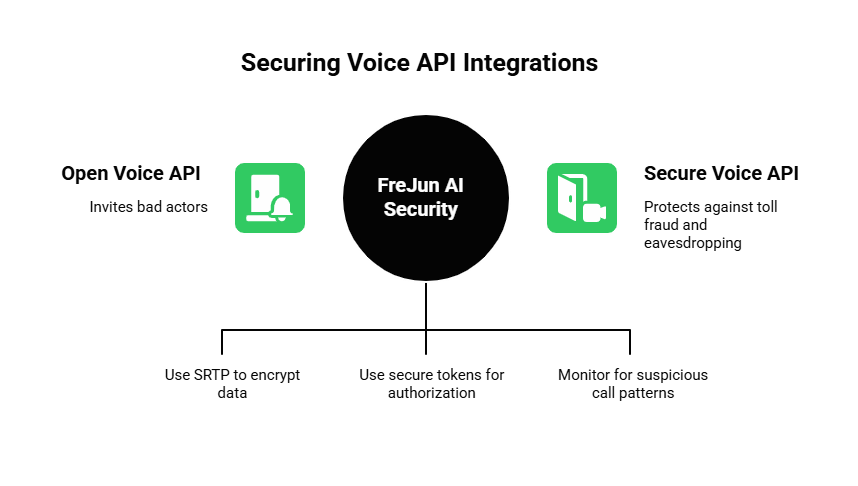
When you open up a voice API integration to the world you invite bad actors.
Toll Fraud
This is a huge risk. Hackers might gain access to your API keys and use your account to make thousands of calls to expensive premium rate numbers in foreign countries. They share the revenue with the number owner and you get stuck with a massive bill.
Eavesdropping
With thousands of calls happening are they secure? Voice data travels over the internet. Without encryption it could be intercepted.
FreJun AI implements strict security protocols.
- Encryption: We use SRTP (Secure Real-time Transport Protocol) to encrypt voice data in transit.
- Authentication: We use secure tokens to ensure only your authorized servers can initiate calls.
- Fraud Detection: Our system monitors for suspicious spiking patterns to catch potential fraud early.
Also Read: How Do Voicebot Solutions Support Continuous Conversation Flow?
How Do You Handle Compliance Across Regions?
If you scale globally you face a legal minefield.
- US: You must comply with TCPA laws regarding automated dialing.
- Europe: You must comply with GDPR regarding data privacy.
- Recording Laws: Some regions require “two party consent” (both sides must agree to be recorded). Others only require one.
Managing this logic in your own code is difficult. A robust voice API integration platform provides tools to help. For example FreJun allows you to toggle recording on or off programmatically or play a “This call is being recorded” disclosure automatically ensuring you stay on the right side of the law.
How Does FreJun AI Solve Scale Challenges?
We have discussed the problems. Let us look at the solution.
FreJun AI is not just a wrapper around another API. We are an infrastructure provider. We built our platform specifically to handle the heavy lifting of large scale voice.
The Transport Layer Focus
We focus on the “plumbing.” We ensure the pipes are big enough and clean enough for your data. By handling the low level media streaming and SIP signaling we abstract away the complexity of the telephone network.
Model Agnosticism
At scale you might want to switch AI models. Maybe GPT-4 is too expensive for simple tasks so you want to use a smaller model. FreJun allows you to swap “brains” easily without changing your voice infrastructure.
Developer First Tools
We provide SDKs and detailed documentation that make it easy to integrate robust voice features.
Ready to build a voice application that can handle enterprise scale? Sign up for FreJun AI to get your API keys.
How Do You Monitor Thousands of Calls?
In a small system you can listen to every recording to check for quality. When you process a million minutes a month that is impossible.
You need “observability.” This means having dashboards and logs that tell you the health of your system at a glance.
- ASR (Answer Seizure Rate): What percentage of calls are picking up?
- MOS (Mean Opinion Score): An automated score of audio quality.
- Error Rates: Are calls failing due to the carrier or the code?
FreJun provides detailed logs and webhooks. We give you the data you need to debug issues instantly. If a specific region is failing you will see it in the analytics and can reroute traffic accordingly.
The Cost of Scale
Finally there is the challenge of cost. Voice APIs are usually usage based. You pay per minute.
At a small scale a penny per minute does not matter. At a large scale it adds up to millions of dollars.
Inefficient code costs money.
- Are you hanging up calls correctly?
- Are you detecting voicemail machines accurately to avoid wasting money talking to robots?
FreJun provides accurate answering machine detection. This ensures your expensive AI only talks to humans saving your budget for valuable interactions.
Also Read: How Can Voice Bot Solution Integrate with CRM and Support Systems?
Conclusion
Scaling a voice API integration is one of the toughest engineering challenges in the communication world. The combination of real time demands and fragmented carriers and unpredictable internet weather makes it difficult to maintain quality.
When you move from a prototype to production you will face latency that kills conversations and jitter that destroys audio quality and compliance rules that vary by border.
However these challenges are solvable with the right partner. You do not need to become a telecom expert. You need a platform that has already solved these infrastructure problems for you.
FreJun AI provides the elastic, secure, and low latency foundation required for large scale voice applications. With FreJun Teler handling the global connectivity and our optimized media stack managing the quality we enable you to scale your voice agent from ten calls to ten million calls with confidence.
Want to discuss your enterprise scaling strategy? Schedule a demo with our team at FreJun Teler and let us help you build a robust voice architecture.
Also Read: Why Call Routing Is Essential for High-Volume Call Centers
Frequently Asked Questions (FAQs)
Latency is generally the biggest challenge. As call volume and distance increase keeping the delay low enough for natural conversation becomes difficult without optimized infrastructure.
Packet loss occurs when small pieces of audio data fail to reach the destination. In a voice call this sounds like words are being cut out or the audio is skipping.
FreJun Teler uses elastic SIP trunking. This technology automatically allocates more capacity as your call volume increases ensuring that callers never get a busy signal during spikes.
This refers to the fact that the global phone network is made up of thousands of different independent companies. Navigating the connections between them to ensure call delivery is complex.
You should secure your API keys and implement logic in your application to block calls to high risk countries. FreJun also monitors traffic for suspicious patterns to help prevent fraud.
Yes. FreJun provides global phone numbers and routing. You can deploy your agent to serve customers in Asia and Europe and the Americas from a single integration.
Jitter distorts the voice. AI models (Speech to Text) need clear audio to understand what the user said. High jitter causes the AI to misunderstand words leading to wrong answers.
TCP ensures all data arrives but is slow. UDP is fast but does not guarantee delivery. Voice uses UDP because speed is more important than perfection for real time conversation.