
Imagine you are trying to resolve a billing issue with your internet provider. You start by chatting with a bot on their website. You type in your account number and explain the problem. The bot gets confused and tells you to call customer support.
You dial the number. The first thing the automated system asks is, “Please enter your account number.” Then, when a human agent finally picks up, they ask, “Can I have your account number? And what are you calling about today?”
You have now provided the same information three times and you are frustrated. You feel like the company does not know you and does not value your time.
This is a failure of strategy. The company has a website, a chat bot, and a phone line. That is “multichannel.” But because these channels do not talk to each other, it is not “omnichannel.”
The missing piece in this puzzle is usually the phone system. For years, voice calls were trapped in old, isolated hardware. They were separate from the digital world of apps and websites.
Voice API integration changes this. It turns the phone system into software. It allows voice to be woven directly into the digital customer journey, connecting the dots between a chat on a screen and a conversation with a human.
In this guide, we will explore exactly where voice API integration fits into a modern omnichannel strategy. We will look at how it bridges the gap between digital and physical interactions and how infrastructure platforms like FreJun AI provide the essential “plumbing” to make these connections seamless.
Table of contents
- What Is an Omnichannel Strategy Anyway?
- Why Is Voice Often the “Missing Link”?
- How Does Voice API Integration Connect the Dots?
- The Role of Infrastructure in Omnichannel Success
- Comparing Multichannel vs. Omnichannel Voice
- What Are the Key Use Cases for Voice in Omnichannel?
- How Does FreJun Teler Enable Scalability?
- Improving Data Synchronization with Voice APIs
- How to Implement Voice into Your Existing Stack?
- Why Low Latency Matters for Omnichannel
- Conclusion
- Frequently Asked Questions (FAQs)
What Is an Omnichannel Strategy Anyway?
Before we plug voice into the machine, we need to understand the machine itself.
“Omni” means “all.” But an omnichannel strategy is not just about being everywhere. It is about being connected everywhere.
In a multichannel setup, a business has a Facebook page, a phone number, and an email address. They operate in silos. The Facebook team does not know what the Phone team is doing.
In an omnichannel setup, the customer is at the center. The data flows with them. If a customer starts a conversation on Twitter and finishes it on the phone, the context moves with them. It feels like one continuous conversation, not five separate ones.
Why Is Voice Often the “Missing Link”?
Companies have spent the last decade perfecting their digital channels. They have beautiful apps and smart chatbots. But they often ignore the phone channel because it is “hard.”
Traditional telephony is clunky. It uses copper wires and physical switchboards. It is difficult to connect a 1990s phone system to a 2024 web application.
Because of this difficulty, voice gets left behind. It becomes the “channel of last resort.”
But here is the reality: Voice is not dead. When things go wrong, people want to talk. When a situation is complex, urgent, or emotional, typing is too slow.
This is where voice API integration fits in. It digitizes the voice channel. It allows developers to treat a phone call just like a line of code. This means the phone call can now access the same database as the website and the mobile app.
Also Read: Why Are Voicebot Solutions Replacing Traditional IVR Systems?
How Does Voice API Integration Connect the Dots?
So, how does this actually look in practice? How does an API (Application Programming Interface) fix the broken experience we described in the introduction?
It acts as a bridge. It allows your website or app to “control” the phone call.
The Context Handoff
Let us replay the internet provider scenario with voice API integration.
- The Digital Start: You are chatting with the bot about your bill.
- The Escalation: The bot realizes it cannot help. It offers a “Call Agent” button right in the chat window.
- The Click: You click the button.
- The Data Transfer: The app uses the voice API to start a call. Crucially, it attaches “metadata” to the call. This metadata says: “This is John. Account #123. He is angry about the $50 fee.”
- The Resolution: The agent’s phone rings. On their screen, they see your name and the chat history. They answer, “Hi John, I see you are asking about that $50 charge. Let me fix that for you.”
You are relieved. The agent is efficient. The problem is solved in seconds. That is the power of fitting voice into the omnichannel flow.
The Role of Infrastructure in Omnichannel Success
You can build the smartest customer journey in the world, but if the call quality is bad, it falls apart.
If a user clicks “Call Now” in your app and hears silence for five seconds, they will hang up. If they get connected but the audio is choppy, they will lose trust.
This is where FreJun AI becomes the foundation of your strategy. We handle the complex voice infrastructure so you can focus on building your AI and customer journeys.
FreJun provides the high-speed transport layer for your voice data.
- Low Latency: We ensure that the handoff from app to voice happens instantly.
- Media Streaming: We process the audio in real-time, ensuring crystal clear quality.
- Reliability: In an omnichannel world, downtime is not an option. Our distributed infrastructure ensures your voice channel is always online.
Comparing Multichannel vs. Omnichannel Voice
To visualize the difference, let us look at how voice functions in a silo versus how it functions in an integrated system.
| Feature | Traditional Multichannel Voice | Omnichannel Voice API Integration |
| Initiation | User dials a number manually | User clicks a button in-app (Contextual) |
| Authentication | “What is your mother’s maiden name?” | Verified via App Login (Seamless) |
| Context | None. Agent starts from zero. | Full history displayed to Agent. |
| Data Sync | Agent types notes manually later. | Call data logs to CRM automatically. |
| Routing | Generic (Press 1 for Sales) | Smart (Route to the agent who emailed you) |
| Customer Feeling | Frustrated and repetitive | Valued and understood |
Ready to start building conversations that actually understand your customers? Sign up for FreJun AI and explore our powerful voice AI infrastructure.
What Are the Key Use Cases for Voice in Omnichannel?
Where exactly should you insert voice into your strategy? Here are the most high-impact areas.
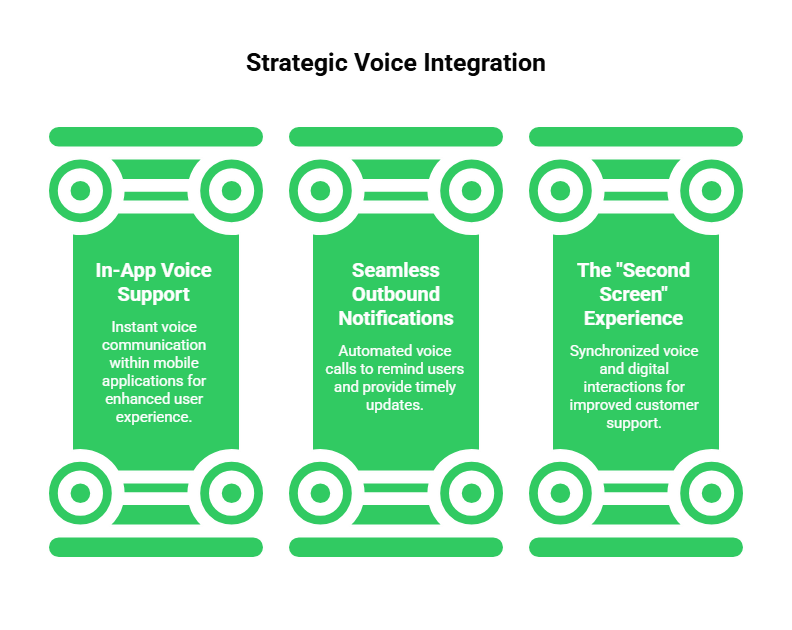
1. In-App Voice Support
This is huge for the gig economy and fintech. If you are using a banking app and see a fraudulent charge, you should not have to close the app to dial a number. You should tap the transaction and click “Dispute via Call.” The voice API connects you to the fraud department instantly, passing the transaction ID along with the call.
2. Seamless Outbound Notifications
Omnichannel is two-way. Imagine a pharmacy.
- SMS: “Your prescription is ready.”
- Voice: If the user does not pick it up in 2 days, the system triggers an automated voice call. “Hi, this is a reminder to pick up your order.”
- Action: If the user presses 1 on the call to speak to a pharmacist, the system routes them instantly.
3. The “Second Screen” Experience
Sometimes, voice is the primary channel, and the screen is the support. A customer calls support to reset a router. The agent uses the integration to “push” a diagram to the customer’s mobile app while talking to them. “Do you see the image I just sent? Press that button.” This synchronization is only possible when voice and digital are integrated via APIs.
Also Read: Why Is a Voice API for Developers the Backbone of AI Voice Systems?
How Does FreJun Teler Enable Scalability?
An omnichannel strategy means you must be ready for traffic spikes from any direction.
If you send a marketing email to 100,000 people, you might get 1,000 phone calls in ten minutes. A traditional phone system would crash. The lines would be jammed.
FreJun Teler provides the solution through elastic SIP trunking.
- Elasticity: Our system stretches. It can handle one call or ten thousand calls.
- Global Reach: We allow you to integrate voice across borders without negotiating with local carriers.
This ensures that your voice channel is just as scalable as your website. You never have to worry about the “busy signal” destroying your customer experience.
Improving Data Synchronization with Voice APIs
In a siloed world, voice data disappears into a black hole. Recordings sit on a server nobody checks. Notes are scribbled on post-its.
In an omnichannel world, voice data is gold.
Because voice API integration is software, it generates data automatically.
- Transcription: Every call can be converted to text.
- Sentiment Analysis: You can track if customers are happy or angry.
- CRM Sync: This data is pushed into your Salesforce or HubSpot record immediately.
This completes the loop. The next time the customer emails, the support agent can read the summary of the phone call that happened yesterday.
According to PwC, 59% of consumers feel that companies have lost the human touch in their customer experience. By using data to remember previous interactions, you bring that human touch back.
How to Implement Voice into Your Existing Stack?
You do not need to rebuild your entire business to add this. That is the beauty of APIs.
Step 1: Map the Journey
Look at your customer journey map. Where are the friction points? Where do people get stuck and try to call? That is where you need integration.
Step 2: Choose a Developer-First Provider
You need a platform that is easy for your engineering team to work with. Sign up for a FreJun AI developer account to access SDKs that make embedding voice simple. We are developer-first, meaning we provide clean documentation and robust testing tools.
Step 3: Embed the Call Control
Use the API to place “Click-to-Call” buttons in your web and mobile apps. Configure the logic to pass user IDs as metadata.
Step 4: Connect the Data
Use webhooks to send call data back to your CRM. Ensure that when a call ends, the recording URL is saved to the customer’s profile.
Why Low Latency Matters for Omnichannel
We mentioned latency earlier, but it deserves a deeper look.
In an omnichannel interaction, the user is often multitasking. They are looking at your app while talking to you. If the agent says, “I am sending you a notification now,” and it takes ten seconds to arrive, the flow is broken.
If the voice audio is delayed, the agent and customer talk over each other.
FreJun AI is obsessed with speed. We optimize our network routes to ensure the lowest possible latency.
- Direct Routing: We do not bounce calls around the world unnecessarily.
- Jitter Handling: We smooth out network bumps to ensure the voice sounds natural.
This technical performance is what makes the strategy work. Without it, the “seamless” experience becomes a “stressful” one.
Also Read: How Can a Voice API for Developers Future-Proof Your Voice Applications?
Conclusion
The customer journey is no longer a straight line. It is a web of interactions across email, chat, apps, and phone calls.
For a long time, the phone call was the outlier. It was the disconnected dead end. Voice API integration brings the phone call back into the fold. It turns voice into a connected, intelligent, and data-rich channel that enhances every other part of your business.
By fitting voice into your omnichannel strategy, you reduce friction. You save your customers time. You empower your agents with context.
However, simply adding code is not enough. You need a robust engine to power that code. You need infrastructure that guarantees the call will connect, the audio will be clear, and the system will scale.
FreJun AI provides that engine. With FreJun Teler handling the global connectivity and our low-latency infrastructure managing the media, we allow you to build a truly unified customer experience. We handle the heavy lifting so your brand can speak clearly to your customers, no matter where they are.
Want to do a deep dive into the infrastructure required to power a modern, AI-powered voicebot? Schedule a demo with our team at FreJun Teler.
Also Read: Call Log: Everything You Need to Know About Call Records
Frequently Asked Questions (FAQs)
Multichannel means you have many ways to communicate (phone, email, chat), but they are not connected. Omnichannel means they are all connected, so data and context flow freely between them.
It converts the phone system into software code. This allows developers to connect phone calls to websites, apps, and databases, ensuring they share information in real-time.
Yes. With FreJun Teler, you can port your existing business numbers into our system or purchase new ones from over 100 countries to support a global strategy.
Context is the background information. Instead of just seeing a phone number, the agent sees “This is Sarah, she is a VIP customer, and she was just looking at the cancellation page on our website.”
No. You can integrate voice APIs into your existing mobile apps or websites using Software Development Kits (SDKs). It acts as an add-on feature to your current technology.
Yes. FreJun AI uses enterprise-grade encryption. We ensure that voice data and customer metadata are protected as they travel between your app and our servers.
It saves the customer time. They do not have to repeat their story or answer verification questions multiple times. This makes them feel valued and reduces frustration.
Voice APIs typically rely on the internet (VoIP). However, FreJun’s infrastructure is distributed. If one server path has an issue, we can route traffic through another to maintain connectivity.