
There is a famous piece of advice given to almost every startup founder in Silicon Valley: “Do things that don’t scale.” The idea is that in the early days, you should manually recruit users, hand-write emails, and personally answer customer support calls to learn as much as possible.
This is great advice for learning, but it is dangerous advice for infrastructure.
Imagine you are building a house. You start with a small wooden shack because it is cheap and fast. But then, ten people move in. Then a hundred. You try to nail more boards onto the shack, but the foundation is weak. Eventually, the whole thing collapses, and you have to tear it down and rebuild from scratch while your residents (customers) stand outside in the rain.
This is exactly what happens when startups ignore their communication stack. They buy cheap physical phones or use personal cell numbers. Then, they hit a growth spurt. Suddenly, the phones are ringing non-stop, data is getting lost, and customers are angry.
This is why the question of voice API integration is so critical. It is not just a fancy feature for big tech companies; it is the digital foundation that allows a startup to go from a garage to a global enterprise without breaking.
In this article, we will explore why investing in programmable voice early is a cheat code for scalability. We will look at the hidden costs of waiting, the benefits of building on a robust platform, and how infrastructure providers like FreJun AI allow you to scale your voice capabilities as easily as you scale your server code.
Table of contents
- Why Do Startups Often Neglect Voice Infrastructure?
- What Does Voice API Integration Mean for a Startup?
- How Does Early Integration Drive Scalability?
- What Are the Hidden Costs of “Fixing It Later”?
- Comparing Traditional vs. API-First Approaches
- How Does FreJun AI Solve the Infrastructure Headache?
- Can Voice APIs Help with Fundraising and Valuation?
- What Use Cases Should Startups Tackle First?
- How to Handle Global Expansion?
- The Role of AI in Your Voice Strategy
- Conclusion
- Frequently Asked Questions (FAQs)
Why Do Startups Often Neglect Voice Infrastructure?
Startups are obsessed with “shipping.” They want to get their product out the door. Often, voice communication feels like an afterthought. Founders think, “We will just use Google Voice for now,” or “We don’t need a complex phone system yet.”
This mindset stems from a misunderstanding of what modern voice technology is. Many founders still view telephony as “hardware”, desk phones, wires, and contracts. They see it as a cost center, not a growth engine.
However, modern voice API integration is software. It is code. By neglecting it, startups are missing out on the ability to automate interactions, capture data, and provide a professional experience from day one.
What Does Voice API Integration Mean for a Startup?
For a startup, an API (Application Programming Interface) is like a set of Lego blocks. Instead of buying a pre-built toy castle (a rigid phone system), you get the blocks to build whatever you want.
Voice API integration allows your app or website to interact with the telephone network.
- It is not: Buying a phone number and diverting it to your cell.
- It is: Writing a script that says, “When a high-value user calls, check our database, see that their subscription is active, and route them immediately to the founder’s phone. If it is a free user, route them to an automated voicemail.”
This level of logic turns your phone system into a smart application. It allows a team of three people to look and act like a team of fifty.
Also Read: How Can Voicebot Solutions Improve Lead Qualification Calls?
How Does Early Integration Drive Scalability?
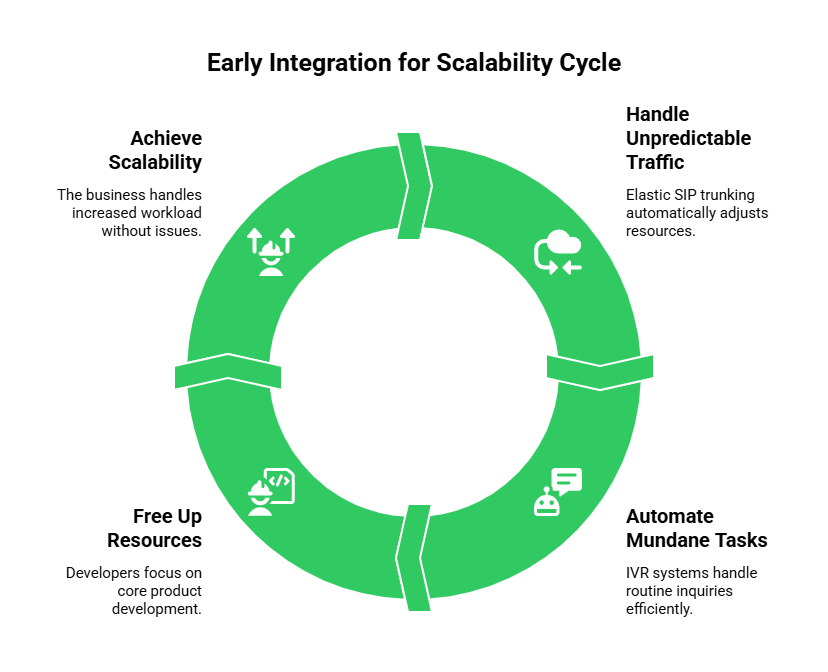
Scalability is the ability to handle more work without falling apart. In the context of voice, it means handling more calls without hiring more people or buying more hardware.
1. The Elasticity Factor
Startups have unpredictable traffic. One day you have zero calls; the next day, you get featured on Product Hunt, and you have 500 calls.
If you are using traditional phone lines, you get a “busy signal.” Your potential customers hear a beep and hang up. You lost them.
With an API-based approach, specifically using FreJun Teler for elastic SIP trunking, your capacity is infinite. “Elastic” means the system stretches. It automatically allocates more resources when traffic spikes and shrinks when it stops. You do not have to pay for 500 lines all year round; you just pay for what you use. This is the only way to handle viral growth without crashing.
2. Automating the Mundane
In a startup, time is the most scarce resource. If your lead developer is stopping every 10 minutes to answer a question about password resets, your product development dies.
Early voice API integration allows you to build an IVR (Interactive Voice Response) system immediately. “Press 1 for Password Reset.” The system can then trigger an SMS with a reset link automatically. The developer never has to pick up the phone.
What Are the Hidden Costs of “Fixing It Later”?
In software engineering, taking a shortcut now that you have to fix later is called “technical debt.” Voice technical debt is incredibly expensive.
If you start with a disconnected phone system:
- Data Silos: Your call history is on a cell phone, but your customer data is in HubSpot. They do not talk to each other. You have no idea if the person calling is a VIP or a troll.
- Migration Nightmares: When you finally decide to switch to an API later, you have to port numbers (which takes weeks), retrain staff, and migrate data. It disrupts your business right when you are trying to grow.
- Lost Insights: You miss out on a year of recording data that could have been used to train your future AI models.
By investing in voice API integration from the start, you build a “single source of truth.” All your communication data lives in your code and your database from day one.
Comparing Traditional vs. API-First Approaches
Here is a breakdown of how the two approaches look for a growing company.
| Feature | Traditional/Manual Setup | API-First Integration |
| Setup Cost | Low initially (Cell phones) | Moderate (Dev time required) |
| Scalability | Zero (Must buy more phones) | Infinite (Scale via code) |
| Data Access | None (Locked in device) | Full (Recordings, Transcripts) |
| Flexibility | None (Standard features) | High (Build custom logic) |
| Reliability | Variable (Cell signal) | High (Enterprise infrastructure) |
| Global Reach | Hard (Roaming charges) | Easy (Local numbers globally) |
How Does FreJun AI Solve the Infrastructure Headache?
Startups have small engineering teams. You do not have a “Telecom Engineer” on staff but you have full-stack developers who know JavaScript or Python.
You might worry that implementing voice is too hard. “We don’t know how SIP works. We don’t know about codecs or latency.”
This is where FreJun AI acts as your partner. We handle the complex voice infrastructure so you can focus on building your AI and your product.
FreJun abstracts away the hard stuff. You don’t need to configure routers or manage carrier negotiations.
- FreJun Teler: This provides the backbone. It gives you the elastic SIP trunking we mentioned earlier. It ensures the call connects.
- Low Latency: We route audio through the fastest paths. This ensures that your app feels professional.
- Developer-First: We provide SDKs (Software Development Kits) that your web developers already understand.
Ready to start building conversations that actually understand your customers? Sign up for FreJun AI and explore our powerful voice AI infrastructure.
Also Read: Why Is Low Latency Essential for Modern Voice Bot Solutions?
Can Voice APIs Help with Fundraising and Valuation?
This might sound like a stretch, but investors look for “defensibility” and “moats.”
If your startup’s operations rely on humans answering phones, your margins will be low. As you grow, your costs grow linearly. Investors hate that.
If your startup relies on voice API integration, your margins improve as you scale. You have built an automated asset. You are capturing proprietary data (voice recordings) that you can use to train AI models later. This makes your company more valuable.
Furthermore, integrating voice capabilities directly into your product (e.g., a “Talk to an Expert” button inside your SaaS dashboard) increases user engagement and retention. Sticky products get higher valuations.
What Use Cases Should Startups Tackle First?
You do not need to build Jarvis from Iron Man on day one. Here are three simple integrations that provide immediate ROI (Return on Investment) for startups.
1. Two-Factor Authentication (2FA) via Voice
Security is huge. Sending a code via a voice call is often more reliable and accessible than SMS, especially for international users or landlines. This prevents bot sign-ups and protects your platform.
2. Click-to-Call for Sales
If you are a B2B startup, you want to close deals fast. Placing a “Call Me Now” button on your pricing page that triggers an immediate bridge between the lead and your sales rep can double conversion rates.
3. Automated Order Confirmation
For e-commerce or delivery startups, uncertainty kills trust. A simple automated call saying, “Your driver is 5 minutes away,” reduces support tickets significantly.
How to Handle Global Expansion?
Startups today are “born global.” You might have users in London, developers in India, and sales in New York.
If you rely on physical phone lines, this is a nightmare. You have to deal with international long-distance fees and different carriers.
With voice API integration, geography is just a variable in your code. You can purchase local phone numbers in 100+ countries instantly via the API. You can route a call from a German user to a German-speaking agent (or an AI agent) dynamically.
FreJun’s global infrastructure ensures that the voice quality is crystal clear, whether the call is local or trans-Atlantic. We manage the “hops” across the internet to minimize jitter and packet loss, so your startup looks like a local player in every market.
The Role of AI in Your Voice Strategy
Even if you are not an “AI Startup,” you will eventually use AI. It is the future.
To use AI, you need clean data. You need clear audio recordings and accurate transcripts.
If you use a cheap VoIP provider or a cell phone, your audio data will be noisy and fragmented. If you use a robust platform like FreJun AI, you get high-definition audio streams.
This means that when you are ready to deploy an AI agent to handle support tickets in Year 2, you already have the infrastructure to support it. You don’t have to rebuild. You just plug the AI model into your existing voice API integration.
According to Salesforce, 58% of service organizations are already using process automation to streamline operations. By investing in the right API now, you join the ranks of these forward-thinking companies rather than playing catch-up later.
Also Read: What Makes Voicebot Solutions Suitable for Multilingual Customers?
Conclusion
Building a startup is hard. You have to make a thousand decisions, and you have limited cash. It is tempting to cut corners on “boring” things like phone systems.
But communication is the lifeline of your business. It is how you talk to customers, how you close deals, and how you solve problems.
investing early in voice API integration is not an expense; it is an investment in your company’s skeleton. It gives you the structural integrity to grow fast without breaking. It allows you to automate work, capture data, and expand globally with a few lines of code.
You do not need to build this infrastructure yourself. You just need to connect to it. FreJun AI provides the robust, elastic, and developer-friendly platform that powers the next generation of unicorns. With FreJun Teler handling the scale and our low-latency network handling the quality, you can focus on what you do best: changing the world.
Want to do a deep dive into the infrastructure required to power a modern, AI-powered voicebot? Schedule a demo with our team at FreJun Teler.
Also Read: United Kingdom Country Code Explained
Frequently Asked Questions (FAQs)
It is the process of using software code to connect your startup’s applications to the telephone network. It allows you to automate calls, build IVR menus, and manage numbers programmatically.
No. Most voice APIs, including FreJun, operate on a pay-as-you-go model. You only pay for the minutes you use. This is often cheaper for startups than buying fixed contracts for business phone lines.
No. Modern APIs are designed for web developers. If your team knows Python, Node.js, or similar languages, they can integrate voice features using SDKs very quickly.
It is a virtual phone line technology provided by FreJun Teler that automatically scales up or down. If you get 100 calls at once, it expands to handle them. If you get zero, you don’t pay for the capacity.
Yes. You can “port” your existing phone numbers to the FreJun platform so you don’t have to change your contact details on your website or business cards.
Integrating early prevents data silos and technical debt. It ensures all your customer communication data is stored centrally and cleanly from the beginning, making future growth and AI adoption much easier.
Yes. This is a primary use case. You can write code that automatically logs every call, recording, and outcome directly into your CRM (like HubSpot or Salesforce), saving your team hours of manual data entry.
Since the API lives in the cloud, the system keeps working even if your office internet dies. You can program logic to forward calls to mobile phones or take voicemails automatically during an outage.