
Walk into the basement of any large office building built twenty years ago and you will likely find a locked room. Inside that room is a humming, heat-generating monster. It is a massive box of wires, blinking lights, and circuit boards. This is the PBX (Private Branch Exchange). It is the brain of the company’s phone system.
For decades this hardware was the only way to handle business communication. It was reliable but it was also expensive, rigid, and hard to fix. If you wanted to add ten new employees you had to buy physical cards and hire a technician to come out and install them.
Today that entire room of equipment can be replaced by a few lines of code.
This transformation is happening because of voice API integration. We are witnessing a massive shift from heavy hardware to agile software. But the question remains: Is this just a trend or is it the end of the traditional phone system as we know it?
In this article we will explore the battle between legacy infrastructure and modern voice APIs. We will look at why businesses are cutting the cord, the hidden costs of sticking to the old ways, and how platforms like FreJun AI are building the digital highways that will carry the voice traffic of the future.
Table of contents
- What Is the Difference Between Legacy Infrastructure and Voice APIs?
- Why Are Enterprises Moving Away from Hardware?
- How Does Voice API Integration Enable Innovation?
- Is Legacy Infrastructure Completely Dead?
- What Are the Risks of Sticking to the Old Ways?
- How Does the Migration Process Work?
- What Is the Future of Voice Communication?
- Why FreJun AI Is the Infrastructure for the Future
- Conclusion
- Frequently Asked Questions (FAQs)
What Is the Difference Between Legacy Infrastructure and Voice APIs?
To understand the future we must look at the past.
Legacy infrastructure relies on the Public Switched Telephone Network (PSTN) connected via physical copper wires or T1 lines. It is hardware based. The “intelligence” of the system lives in that box in the basement. If you want a new feature like call recording you often have to buy a new physical module.
Voice API integration is cloud based. API stands for Application Programming Interface. It is a way for computers to talk to each other. In this context it allows a software developer to write a program that sends instructions to a cloud provider. The command might be “dial this number” or “play this audio file.”
The cloud provider (like FreJun) handles the telecom complexity. They have the servers and the carrier connections. The business just uses the code.
Here is a simple comparison of the two worlds:
| Feature | Legacy Infrastructure (PBX) | Voice API Integration |
| Setup | Requires physical installation (weeks/months) | Requires coding (minutes/days) |
| Cost Model | High upfront CapEx (buying hardware) | Pay as you go OpEx (usage based) |
| Scalability | Limited by physical slots/ports | Infinite (Elastic scaling) |
| Maintenance | Requires specialized technicians | Managed by the cloud provider |
| Location | Tied to a specific office building | Accessible from anywhere (Remote ready) |
| Integration | Difficult to connect to other software | Designed to connect to CRMs/Apps |
Why Are Enterprises Moving Away from Hardware?
The shift to voice API integration is not happening just because it is cool technology. It is happening because of money and speed.
The Cost of Rigidity
Legacy systems are inflexible. Imagine you run a retail company. During the holiday season your call volume triples. With a legacy system you cannot easily add capacity just for December. You have to buy hardware that will sit unused for the other eleven months.
With a cloud based system you pay for what you use. This concept is vital. FreJun utilizes FreJun Teler which provides elastic SIP trunking. “Elastic” means the capacity stretches when you need it and shrinks when you do not. This saves enterprises massive amounts of money on unused capacity.
The Maintenance Nightmare
Hardware breaks. Fans die. Power supplies fail. When a legacy system goes down it is a crisis. You have to wait for a repair person.
In the cloud maintenance is someone else’s problem. FreJun handles the complex voice infrastructure so you can focus on building your AI and your business. We ensure the servers are running and the connections are stable.
Also Read: How Can Voice bot Solution Scale Across Global Voice Operations?
How Does Voice API Integration Enable Innovation?
The biggest killer of legacy systems is not cost. It is innovation.
Legacy systems are dumb. They transmit voice and that is about it. Modern businesses need smart communication. They need AI.
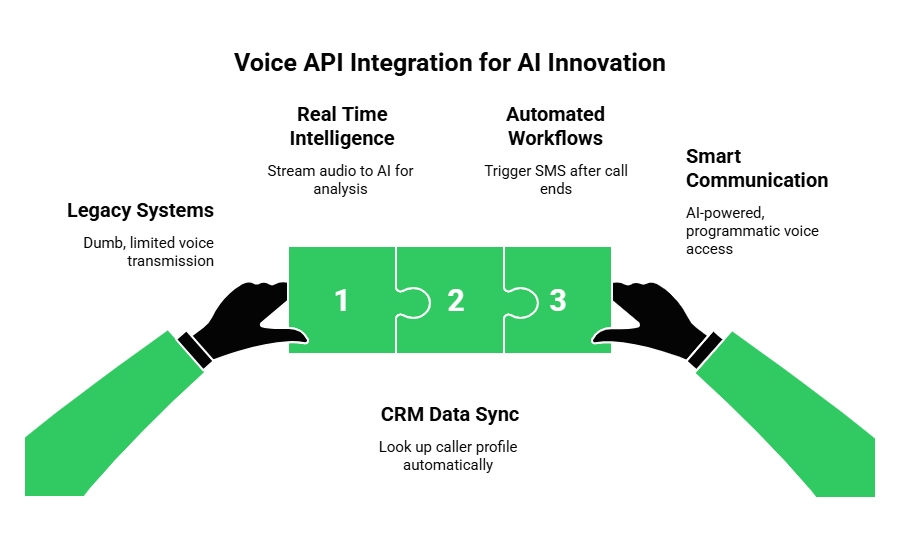
You cannot easily run a Large Language Model (LLM) on a twenty year old PBX. To build an AI voice agent or a smart IVR you need programmatic access to the call audio.
Voice API integration unlocks this potential.
- Real Time Intelligence: You can stream the audio to an AI to detect if a customer is angry.
- CRM Data Sync: You can automatically look up the caller in your database and show their profile to the agent.
- Automated Workflows: You can trigger an SMS to be sent automatically after a voice call ends.
FreJun is built specifically for this new era. Our platform is optimized for low latency media streaming. This is crucial for AI. If you want an AI agent to respond instantly the audio must travel fast. Legacy systems simply were not designed for the high speed data requirements of modern AI applications.
Is Legacy Infrastructure Completely Dead?
Not yet. There are industries that move slowly. Hospitals, government agencies, and some banking sectors still rely on legacy systems. Sometimes this is due to regulation and sometimes it is due to the sheer cost of replacing decades of wiring.
However even these industries are changing. They are adopting “Hybrid” models.
In a hybrid model the business keeps its old phones but connects them to the cloud using SIP Trunking. They unplug the old copper phone lines and plug the PBX into the internet.
This is a major use case for FreJun Teler. We allow businesses to modernize their connectivity without ripping out every desk phone. It acts as a bridge between the old world and the new world.
Also Read: How Do Voice Bot Solutions Deliver Human-Like Voice Interactions?
What Are the Risks of Sticking to the Old Ways?
Staying with legacy infrastructure is becoming risky.
The Talent Gap
The technicians who know how to fix old Nortel or Avaya systems are retiring. It is becoming harder and harder to find people who can service this hardware. In contrast every web developer knows how to use an API.
The Security Risk
Old hardware does not get security updates. It becomes vulnerable to hacking. Cloud providers like FreJun are dedicated to security. We constantly update our infrastructure to protect against threats.
The Opportunity Cost
This is the biggest risk. If your competitor uses voice API integration to build a 24/7 AI customer support agent and you are still using a voicemail machine, you will lose customers.
How Does the Migration Process Work?
Many businesses fear the switch. They think it will be complicated. They worry about losing their phone numbers.
The reality is that voice API integration makes migration smooth.
- Porting: You can take your existing phone numbers and “port” (move) them to FreJun. You do not have to change your business number.
- Parallel Run: You can set up the new cloud system while the old one is still running. You can test it to ensure everything works perfectly before flipping the switch.
- Softphones: You do not even need to buy new desk phones. Your employees can make calls from their computers or mobile apps.
Ready to start building conversations that actually understand your customers? Sign up for FreJun AI and explore our powerful voice AI infrastructure.
What Is the Future of Voice Communication?
The future is programmable. The concept of a “phone call” is changing. It is no longer just two people talking. It is data exchange.
In the future voice will be embedded into everything.
- In App Calling: You will call your delivery driver directly from the food app without dialing a number.
- Context Aware Calls: When you call an airline the agent will already know your flight was cancelled and will have a new ticket ready.
- AI Agents: Most first tier support will be handled by voice AI that sounds indistinguishable from a human.
To support this future you need infrastructure that is invisible, reliable, and fast. You need a platform that treats voice as data.
Why FreJun AI Is the Infrastructure for the Future
As we move away from legacy systems developers need a partner that understands the nuance of voice. It is not just about sending packets. It is about quality.
FreJun AI provides the robust foundation for this next generation of apps.
- Low Latency: We ensure that audio arrives instantly which is non negotiable for AI interactions.
- Reliability: Our distributed infrastructure ensures that if one server has an issue the traffic reroutes instantly.
- Elasticity: With FreJun Teler you can scale from ten calls to ten thousand calls in seconds.
We handle the messy parts of telephony—the carrier negotiations, the codec transcoding, the jitter buffering—so you can just write code.
Also Read: What Role Do Voice bot Solutions Play in AI-First Business Workflows?
Conclusion
So, will voice API integration replace legacy call infrastructure? The answer is an overwhelming yes. The transition is already well underway.
The benefits of the cloud, speed, scalability, cost savings, and innovation, are too great to ignore. Physical hardware in the basement is a relic of the past. It is heavy, expensive, and dumb.
The future belongs to agile, software defined communication. It belongs to businesses that can adapt their voice strategy with a few lines of code. It belongs to AI agents that can help customers instantly.
While the legacy giants will not disappear overnight they are slowly fading away. The new backbone of global communication is being built on APIs. By adopting this technology now you are not just upgrading your phone system. You are future proofing your entire business.
Want to do a deep dive into the infrastructure required to power a modern, AI-powered voicebot? Schedule a demo with our team at FreJun Teler.
Also Read: UK Mobile Code Guide for International Callers
Frequently Asked Questions (FAQs)
Voice API integration is the use of software interfaces to connect applications to the telephone network. It allows developers to program voice capabilities like making calls and recording audio directly into their software without needing physical phone hardware.
Yes. Modern cloud providers like FreJun use distributed global infrastructure. This means they often have higher uptime and reliability than a single physical PBX sitting in an office basement.
Yes. This process is called “porting.” You can move your existing landline or toll free numbers from your old carrier to a cloud provider like FreJun.
Yes. Unlike traditional landlines which use copper wires, voice APIs use the internet (VoIP) to transmit audio. A stable internet connection is required for high quality calls.
Legacy infrastructure refers to traditional hardware based phone systems like on premise PBX boxes and analog copper phone lines. These systems are physical, rigid, and require manual maintenance.
Usually it saves money. Legacy systems require large upfront payments for hardware (CapEx). Voice APIs typically operate on a pay as you go model (OpEx), meaning you only pay for the minutes you actually use.
FreJun Teler offers elastic SIP trunking. This allows businesses to connect their existing equipment to the cloud or fully migrate to a software solution, providing a flexible path away from legacy hardware.
Historically yes, but today cloud voice quality is exceptional. With modern codecs and low latency infrastructure like FreJun’s, VoIP calls often sound clearer than traditional analog calls (HD Voice).