
You have a problem with a product you bought and you call the support number. You listen to five minutes of terrible jazz music. And then press “1” for English. Press “4” for Billing. You wait another ten minutes. Finally, a human answers and asks, “Can I have your account number?”
You already typed your account number into the keypad three minutes ago. Now you have to say it again. You are frustrated. The agent is stressed. The call takes twenty minutes when it should have taken five.
This is the standard experience for millions of customers every day. It is slow, disjointed, and inefficient.
But it does not have to be this way. Imagine if the system knew who you were the moment you called. What if it routed you directly to the agent who helped you last time. Imagine if the agent could see your recent purchase on their screen before they even said “Hello.”
This is the power of voice API integration. By connecting your phone system directly to your software data, you can transform customer support from a cost center into a competitive advantage.
In this guide, we will explore how programmable voice technology improves efficiency, reduces wait times, and empowers agents. We will also look at how robust infrastructure providers like FreJun AI supply the essential plumbing to make these systems reliable and fast.
Table of contents
- What Is Voice API Integration in a Support Context?
- Why Are Traditional Phone Systems Killing Efficiency?
- How Does Programmable Voice Reduce Wait Times?
- How Does Context Data Speed Up Resolutions?
- What Is the Role of AI and Voicebots?
- How Does FreJun AI Ensure Call Quality?
- Can You Scale Support Without Hiring More People?
- Comparing Legacy Systems vs. API Integration
- Is It Hard to Migrate from Legacy Systems?
- How Does Real-Time Analytics Improve Performance?
- Conclusion
- Frequently Asked Questions (FAQs)
What Is Voice API Integration in a Support Context?
To understand the solution, we first need to look at the tool. Voice API integration is the process of using software code to control phone calls.
In the old days, a call center was a room full of hardware. It had wires, servers, and physical desk phones and was a closed box. It could not talk to your computer or your customer database easily.
A Voice API changes this. It turns the phone network into software. It allows developers to write code that says, “When a call comes in, look up this number in the database, and then route the call to Agent Sarah.”
This means your phone system is no longer a separate island. It is part of your digital ecosystem and talks to your CRM (Customer Relationship Management) software. It talks to your helpdesk tickets and talks to your AI models too.
Why Are Traditional Phone Systems Killing Efficiency?
The biggest enemy of efficiency is friction. Traditional phone systems are full of friction.
The Data Silo Problem
In a legacy system, the phone and the computer are strangers. The agent hears a beep in their ear. They pick up and they have no idea who is on the line. They have to spend the first two minutes of the call just figuring out the basics. “Who are you? What did you buy? What is your problem?”
The Routing Problem
Old systems use rigid rules. “Press 1 for Sales.” But what if the customer presses 1 because they think “Sales” can help with a refund? They end up in the wrong department. The agent has to transfer them. The customer waits on hold again. This bouncing around wastes time for everyone.
Also Read: How Can Voice bot Solution Scale Across Global Voice Operations?
How Does Programmable Voice Reduce Wait Times?
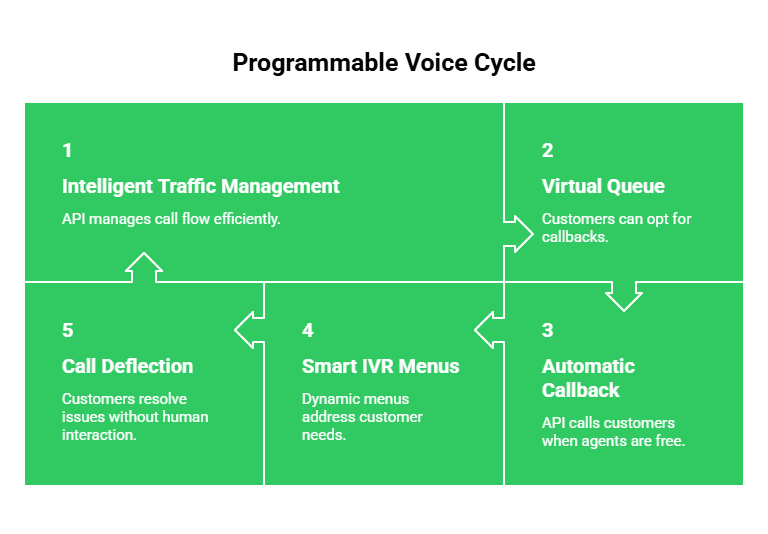
One of the most immediate benefits of voice API integration is the ability to manage traffic intelligently.
The Virtual Queue
Nobody likes holding the phone to their ear for thirty minutes. With an API, you can build a “Virtual Queue.”
When the estimated wait time is high, the system can ask, “Would you like us to call you back when an agent is free?”
If the customer says yes, the API holds their place in line. The customer hangs up and goes about their day. When it is their turn, the API automatically dials the customer and connects them to the agent. This smooths out spikes in call volume and improves customer satisfaction scores immediately.
Smart IVR Menus
Traditional Interactive Voice Response (IVR) menus are static. Programmable voice allows for dynamic menus.
If the API detects that the caller has an overdue bill, the menu can dynamically change to say, “I see you have a balance due. Press 1 to pay it now.”
This solves the customer’s problem without them ever needing to speak to a human. This is called “call deflection,” and it is a massive efficiency booster.
How Does Context Data Speed Up Resolutions?
Speed in customer support is measured by a metric called Average Handle Time (AHT). The lower the AHT, the more customers you can help.
Voice API integration lowers AHT by providing “context.”
The Screen Pop
This is the holy grail of support efficiency. Here is how it works:
- The Call: A customer calls.
- The Lookup: The API grabs the Caller ID.
- The Query: The API asks your CRM, “Who owns this number?”
- The Pop: The CRM finds the customer profile and “pops” it onto the agent’s screen before the agent answers.
Now, when the agent picks up, they see the customer’s name, their last three orders, and their open support tickets. They can answer, “Hi John, are you calling about the laptop you ordered on Tuesday?”
This eliminates the awkward investigation phase of the call. It creates an immediate connection and saves minutes on every interaction.
What Is the Role of AI and Voicebots?
Efficiency isn’t just about helping humans work faster. It is also about automating the simple stuff. This is where voice API integration meets Artificial Intelligence.
By connecting your voice stream to an AI model, you can create intelligent Voicebots. These are not the “dumb” bots of the past. These bots can understand natural language.
A customer can say, “I want to reset my password.”
The Voicebot understands the intent. It authenticates the user, resets the password, and confirms the action.
The entire interaction happens without a human agent.
This frees up your human experts to handle complex, emotional issues that require empathy.
However, to make this work, the connection must be flawless. If the audio is choppy, the AI cannot understand the request. This leads to errors and frustration.
This is where FreJun AI is essential. We handle the complex voice infrastructure so you can focus on building your AI. Our platform ensures that the media stream between the caller and your AI model is crystal clear and ultra-low latency. This ensures that your Voicebot responds instantly, maintaining the illusion of a natural conversation.
How Does FreJun AI Ensure Call Quality?
You can have the smartest routing logic in the world, but if the call drops or sounds robotic, your efficiency is zero.
In the world of voice, quality relies on infrastructure.
- Latency: The delay between speaking and hearing. High latency leads to people talking over each other.
- Jitter: The variation in signal that makes voices sound “choppy.”
- Packet Loss: When parts of the conversation disappear entirely.
FreJun AI is built to combat these issues. We utilize FreJun Teler, which provides elastic SIP trunking. This means your calls are carried over premium, optimized routes rather than the public internet’s “best effort” lanes.
By ensuring high-fidelity audio, FreJun ensures that both human agents and AI bots can hear every word clearly. This reduces the need for “Can you repeat that?” and keeps the conversation moving efficiently.
Also Read: How Do Voice Bot Solutions Deliver Human-Like Voice Interactions?
Can You Scale Support Without Hiring More People?
Every support team faces the “Black Friday” problem. Call volume spikes massively during holidays or product launches.
In a traditional setup, you have a fixed number of phone lines. If you have 50 lines and the 51st person calls, they get a busy signal. This is a lost customer.
Voice API integration solves this with elasticity. Because it is cloud-based, it can scale up instantly.
FreJun Teler offers elastic scalability. It allows your system to handle one call or ten thousand calls simultaneously. You do not need to call the phone company to add more lines. The infrastructure expands automatically to meet demand.
This allows businesses to maintain efficiency during peak times without paying for unused capacity during slow times.
Ready to start building conversations that actually understand your customers? Sign up for FreJun AI and explore our powerful voice AI infrastructure.
Comparing Legacy Systems vs. API Integration
Here is a side-by-side look at how the technology impacts operations.
| Feature | Legacy Phone System (PBX) | Voice API Integration |
| Setup | Hardware-heavy, slow to deploy | Software-based, instant setup |
| Data Access | Isolated from other software | Fully integrated with CRM/Helpdesk |
| Routing | Rigid (Press 1, Press 2) | Dynamic (Based on data/logic) |
| Scalability | Limited by physical lines | Infinite cloud elasticity |
| Agent Insight | Blind (No context) | Full Context (Screen pops) |
| Automation | Basic voicemail/IVR | Intelligent AI Voicebots |
| Maintenance | Requires IT specialists | Managed by API provider |
Is It Hard to Migrate from Legacy Systems?
Many enterprise managers worry that switching to an API means ripping out everything they have built. This is a myth.
You do not have to fire your IT team or throw away your desk phones immediately. Voice API integration is flexible. You can use a hybrid approach.
You can use FreJun Teler to connect your existing on-premise PBX to the cloud. This gives you the benefits of programmable voice (like AI analytics or smart routing) while keeping your existing hardware in place.
This allows businesses to modernize their support efficiency incrementally, reducing risk while still gaining the benefits of modern tech.
How Does Real-Time Analytics Improve Performance?
You cannot improve what you cannot measure. Old phone systems give you basic reports at the end of the month. “You had 5,000 calls.”
A voice API gives you real-time data. You can monitor the sentiment of live calls.
If an AI model detects that a customer is shouting or using angry words, the API can flag that call to a supervisor immediately. The supervisor can “barge in” to the call to help the agent de-escalate the situation.
This real-time coaching capability drastically improves the quality of support and prevents negative reviews before they happen.
According to a report on contact center analytics, companies that leverage advanced analytics can reduce average handle time by up to 40%. This is a massive efficiency gain that directly impacts the bottom line.
Also Read: What Role Do Voice bot Solutions Play in AI-First Business Workflows?
Conclusion
Customer support is no longer just about answering phones. It is about solving problems quickly, accurately, and personally.
Traditional phone systems are simply too slow and disconnected to meet the demands of the modern consumer. They create silos that waste time and frustrate everyone involved.
Voice API integration breaks down these walls. It connects the voice channel to the rest of the business and allows for smart routing, instant data access, & powerful AI automation. It empowers agents to be problem solvers rather than data entry clerks.
However, the software is only as good as the network it runs on. To truly maximize efficiency, you need a partner that guarantees uptime, clarity, and speed.
FreJun AI provides the robust foundation your support team needs. With our low-latency global network and FreJun Teler handling the heavy lifting of scalability, we ensure that your technology never gets in the way of a great customer experience.
Want to do a deep dive into the infrastructure required to power a modern, AI-powered voicebot? Schedule a demo with our team at FreJun Teler.
Also Read: UK Mobile Code Guide for International Callers
Frequently Asked Questions (FAQs)
It is the technology that connects software applications to the telephone network via code. It allows developers to program phone functionalities like making calls, recording audio, and routing calls directly into their apps.
It automates manual tasks. It automatically logs calls, syncs data with the CRM, and provides “screen pops” that show customer details instantly, saving minutes per call.
Yes. You can port your existing business numbers to the FreJun platform. This ensures no disruption for your customers who already know your contact number.
A screen pop is a feature where a customer’s information (name, history, tickets) automatically appears on the support agent’s computer screen the moment the phone rings.
No. FreJun provides the voice infrastructure. We integrate with your existing CRM (like Salesforce, HubSpot, or Zendesk). We are the bridge that connects your phone calls to your database.
VoIP (Voice over IP) is the method of sending voice over the internet. A Voice API is the toolset that lets you control VoIP programmatically to build custom workflows and features.
FreJun Teler uses elastic SIP trunking. This technology automatically scales your capacity up or down. If you get a sudden spike in calls, the system expands to handle them so customers don’t get busy signals.
Yes. You can connect the audio stream from FreJun to an AI model to build intelligent Voicebots that can answer questions, reset passwords, and qualify leads without human intervention.