
Imagine a large bank with five thousand employees. It is 2010. The bank wants to change the hold music on their customer support line. To do this they have to call a specialized technician. He drives to the office building and walks into a cold server room in the basement. Then, he plugs a laptop into a massive beige box called a PBX. He spends three hours configuring settings. He sends a bill for $500.
Now imagine that same bank today. They want to change the hold music. A developer logs into a dashboard. He uploads a new MP3 file. He clicks “Save.” The change is live instantly across the entire globe. Cost is zero dollars in consulting fees.
This is the difference between traditional telephony and voice API integration.
For decades businesses were held hostage by hardware. Phone systems were physical things. They were expensive and rigid and hard to move. But software has eaten the world. Today communication is no longer about wires. It is about code.
Enterprises are abandoning their old copper wire systems in droves. They are moving to the cloud. They are choosing voice API integration not just because it is newer but because it allows them to survive in a market that demands instant adaptability.
In this deep dive we will explore the specific reasons why large organizations are making this switch. We will look at the economics of the cloud versus hardware and the power of programmable voice and how infrastructure platforms like FreJun AI are enabling this massive digital transformation.
Table of contents
- What Is the Fundamental Shift in Business Communications?
- Why Is Scalability the Number One Driver?
- How Does FreJun AI Handle Enterprise Scale?
- The Comparison: Hardware vs. Software
- How Does Voice API Integration Enable Custom Workflows?
- Why Is Data Siloing a Dealbreaker for Legacy Systems?
- How Do Enterprises Handle Global Expansion?
- What About Reliability and Quality?
- The Financial Argument: CapEx vs. OpEx
- How Does FreJun AI Bridge the Gap?
- Conclusion
- Frequently Asked Questions (FAQs)
What Is the Fundamental Shift in Business Communications?
To understand the preference you have to understand the history. Traditional telephony is built on the Public Switched Telephone Network (PSTN) using hardware called Private Branch Exchange (PBX).
Think of a PBX like a train set. The tracks are laid down. The train can only go where the tracks are. You cannot suddenly decide to fly the train to the moon. It is physically limited.
Voice API integration is like a spaceship. It is built on the Internet. It uses code to control voice data. Because it is software it can do anything a computer can do.
Enterprises prefer APIs because they turn voice from a “utility” (like electricity) into a “feature” (like a search bar). With a traditional phone you can pick up and dial. With an API you can program the phone to dial automatically when a server crashes or transcribe the call in real time or route the call based on the weather in London.
Why Is Scalability the Number One Driver?
In the enterprise world growth is the goal. But with traditional telephony growth is painful.
If a company opens a new office in Berlin using traditional systems they have to:
- Sign a contract with a German telecom carrier.
- Buy physical phones and servers.
- Wait weeks for installation.
- Hire an IT guy to manage the German server.
This is slow and expensive. It is also risky. What if the Berlin office closes in six months? You are stuck with the hardware.
With voice API integration scalability is instant. The company logs into their API provider. They buy German phone numbers. They point those numbers to their existing cloud software. The office is live in five minutes.
This concept is called elasticity. It is the same reason companies use cloud storage instead of buying hard drives. You pay for what you use.
Also Read: Why Are Voice bot Solutions Critical for AI-Driven Customer Support?
How Does FreJun AI Handle Enterprise Scale?
This is where the infrastructure provider matters. An API is just code. It needs a network to run on.
FreJun AI provides the robust “plumbing” for this scale. We utilize FreJun Teler which offers elastic SIP trunking.
Elastic SIP trunking is the magic behind the scalability. It allows an enterprise to handle unlimited concurrent calls. Whether you have ten callers or ten thousand callers FreJun’s infrastructure expands automatically to handle the load. We handle the complex voice infrastructure so you can focus on building your AI and business logic.
The Comparison: Hardware vs. Software
Let us look at a direct comparison to see why the C-Suite prefers the software approach.
| Feature | Traditional Telephony (PBX) | Voice API Integration |
| Setup Time | Weeks or Months | Minutes or Days |
| Upfront Cost | High (CapEx) | Low (OpEx) |
| Scalability | Limited by hardware slots | Infinite (Cloud based) |
| Maintenance | Requires specialized technicians | Managed by the provider |
| Integrations | Difficult or Impossible | Easy (connects to any software) |
| Global Reach | Requires local contracts | Global access instantly |
| Analytics | Basic call logs | Deep AI driven insights |
How Does Voice API Integration Enable Custom Workflows?
Enterprises have unique problems. A hospital needs a different phone system than a pizza chain. Traditional telephony offers a “one size fits all” solution. You get voicemail and call waiting and forwarding. That is it.
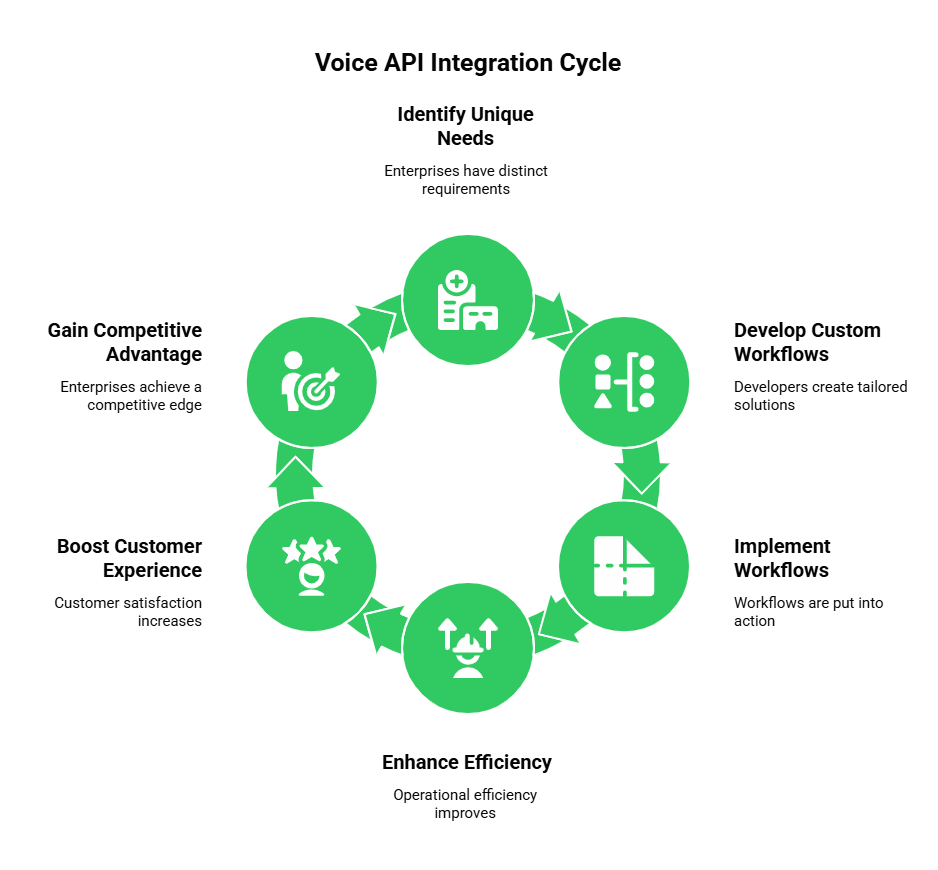
Voice API integration allows developers to build custom workflows.
Example 1: The Secure Bank
A bank uses an API to build identity verification. When a customer calls the system checks their voice print against a database. If it matches it skips the security questions. This is impossible with a standard phone line.
Example 2: The Logistics Company
A delivery company uses an API to mask phone numbers. When a driver calls a customer the driver sees a temporary number. The customer sees a temporary number. The API connects them while keeping their real numbers private. This protects privacy and prevents platform leakage.
Example 3: The Global Call Center
A support team uses an API for “Follow the Sun” routing. The system checks the time of day. If it is 5 PM in New York calls are automatically routed to the team in Sydney. If it is 5 PM in Sydney they route to London.
These workflows give enterprises a competitive advantage. They improve customer experience and operational efficiency.
Why Is Data Siloing a Dealbreaker for Legacy Systems?
Data is the most valuable asset an enterprise owns.
In a traditional phone system data is trapped. It lives in the “black box” in the basement. You might get a report at the end of the month saying “We had 5,000 calls.” But you do not know who called or what they said or if they were happy.
Voice API integration liberates this data.
Because the call is processed by software every interaction can be tracked.
- The Recording: Automatically saved to the cloud.
- The Transcript: Converted to text by AI.
- The Metadata: Synced instantly to the CRM (Customer Relationship Management) system.
This is crucial for sales and support. When a sales rep picks up the phone they should see the customer’s entire history on their screen. They should know that this customer called support yesterday.
According to Salesforce research, 76% of customers expect consistent interactions across departments. If your voice data is siloed in a legacy system you cannot deliver this consistency. You are flying blind.
Also Read: What Makes Voice Bot Solutions Effective for High-Volume Customer Calls?
How Do Enterprises Handle Global Expansion?
Going global is hard. Telecommunications regulations vary by country. In some countries you need a local address to get a phone number. In others you need specific government licenses.
For an enterprise to manage this manually they would need a legal team and a procurement team in every single country.
Voice API integration providers handle this regulatory complexity.
Platforms like FreJun have already done the hard work. We have relationships with carriers all over the world. When an enterprise uses FreJun they can provision a compliant phone number in France or Japan or Brazil with a few clicks.
We handle the local regulations and the carrier interconnects and the codec negotiations. The enterprise just sees a working phone number. This drastically reduces the “Time to Market” for global expansion.
What About Reliability and Quality?
There is a myth that old copper landlines are more reliable than internet calling. Twenty years ago this might have been true. Today it is false.
Traditional systems have a single point of failure. If a construction worker cuts the cable outside your office your phones are dead. If the power goes out in your building your phones are dead.
Cloud infrastructure is distributed.
FreJun AI uses a decentralized network. We have Points of Presence (PoPs) in multiple regions. If a server in New York has an issue traffic is automatically rerouted to a server in Virginia or Chicago.
This is called redundancy. It ensures “High Availability.”
Furthermore we focus on voice quality. We use low latency routing to ensure that audio takes the fastest path across the internet. We prioritize voice packets to prevent jitter and robotic sounds. For an enterprise a dropped call is a lost deal. That is why they prefer the robust redundancy of the cloud over the fragility of a single physical wire.
Ready to start building conversations that actually understand your customers? Sign up for FreJun AI and explore our powerful voice AI infrastructure.
The Financial Argument: CapEx vs. OpEx
CFOs (Chief Financial Officers) love APIs.
Traditional telephony is a Capital Expenditure (CapEx). You have to spend $100,000 upfront to buy the servers and the phones. This is a bad use of cash. It ties up money that could be spent on marketing or R&D.
Voice API integration is an Operating Expenditure (OpEx). You pay as you go. You pay a small fee per minute and per phone number.
If business is slow you pay less. If business booms you pay more but your revenue is also higher. This alignment of cost and revenue is financially healthy. It reduces risk.
Additionally legacy systems have hidden costs. Maintenance contracts. Power bills for the server room. The cost of IT staff to fix the PBX. APIs eliminate these hidden drains on the budget.
How Does FreJun AI Bridge the Gap?
Enterprises often worry that APIs are too complicated. They have developers but those developers are web experts not telecom experts. They do not know what SIP or WebRTC or G.711 means.
FreJun AI acts as the bridge.
We are developer first and we abstract away the telecom complexity. We provide simple SDKs (Software Development Kits) that allow a web developer to add voice capabilities without learning telecom engineering.
- Model Agnostic: Enterprises often have their own AI models for security. We allow you to bring your own Speech to Text (STT) and Text to Speech (TTS) providers. We just provide the secure transport layer.
- FreJun Teler: Our elastic trunking ensures that the connection to the telephone network is enterprise grade.
- Security: We encrypt data in transit meeting the strict compliance standards of enterprise IT departments.
Also Read: How Do Voicebot Solutions Support Continuous Conversation Flow?
Conclusion
The transition from traditional telephony to voice API integration is not a trend. It is an evolution. It is as inevitable as the shift from typewriters to computers.
Enterprises prefer APIs because they offer freedom. The freedom to scale instantly. The freedom to access their own data. And the freedom to expand globally without red tape.
Traditional telephony is a closed box. It does one thing and it refuses to change. Modern business requires agility. It requires systems that can talk to each other.
FreJun AI provides the foundation for this agility. By handling the complex voice infrastructure and providing reliable global connectivity we empower enterprises to stop worrying about phone lines and start focusing on meaningful conversations. Whether you are automating support or building a global sales dialer or creating a next generation AI agent the API is the way forward.
Want to do a deep dive into the infrastructure required to power a modern, AI-powered voicebot? Schedule a demo with our team at FreJun Teler.
Also Read: UK Phone Number Formats for UAE Businesses
Frequently Asked Questions (FAQs)
Voice API integration is the use of software interfaces to connect applications to the global telephone network. It allows businesses to make and receive calls and control call logic using code rather than physical hardware.
Not exactly. VoIP (Voice over IP) is the underlying technology that sends voice over the internet. A Voice API is a tool that allows developers to control VoIP programmatically. Think of VoIP as the engine and the API as the steering wheel.
Traditional telephony relies on physical hardware (PBX) and fixed lines. Adding features or changing capacity requires buying new equipment and manual installation which takes time and money.
FreJun Teler provides elastic SIP trunking. This allows enterprises to connect their existing systems to the cloud and scale their call capacity up or down instantly without needing new physical lines.
It can be. Legacy landlines degrade over distance. High quality API providers like FreJun use optimized low latency routing over the internet ensuring crystal clear audio even for international calls.
Yes. Enterprise grade providers like FreJun use encryption (TLS and SRTP) to protect voice data as it travels over the internet ensuring that calls cannot be intercepted.
Yes. This is called “porting.” You can transfer your existing numbers from your legacy carrier to an API provider like FreJun so your customers do not see any change.
Most enterprise setups have backup internet lines. Additionally because the logic lives in the cloud even if your office internet dies the system can still answer calls and take voicemails or forward them to mobile phones.