
Imagine you are using a food delivery app. You ordered a pizza twenty minutes ago. The app says the driver is nearby, but you cannot find him. You try to text him, but he is driving and cannot reply. You are hungry and frustrated.
Now imagine a small button on that screen that looks like a phone. You tap it. Instantly, you are connected to the driver. You guide him to your driveway. He hands you the hot pizza. Problem solved in thirty seconds.
This simple interaction is what makes modern apps successful. It is fast. It is human. And it is powered by something called voice API integration.
In the past, building a feature like this was incredibly hard. It required expensive hardware and complicated relationships with phone companies. Today, developers can add voice calling to any app with just a few lines of code.
In this guide, we will explore why voice API integration has become the backbone of modern communication apps. We will look at how it saves money, improves user experience, and how platforms like FreJun AI provide the invisible infrastructure that makes it all work.
Table of contents
- Why Are Modern Apps Shifting to Voice?
- How Does Voice API Integration Save Development Time?
- What Features Does a Voice API Add to Your App?
- Why Is Infrastructure the Backbone of Voice APIs?
- How Do You Choose the Right Voice API Provider?
- What Industries Benefit Most from Voice Integration?
- How Does FreJun AI Simplify Voice Integration?
- What Is the Future of Communication Apps?
- Conclusion
- Frequently Asked Questions (FAQs)
Why Are Modern Apps Shifting to Voice?
We live in a world of text messages and emails. So why is voice still so important?
The answer is speed and emotion. Texting is great for simple things. But when there is a problem, people want to talk.
According to a study by Forethought, 65% of consumers believe that voice is still the fastest way to resolve a customer service issue. When a user is confused, angry, or in a hurry, typing on a small screen feels like a barrier. Voice removes that barrier.
Apps that offer voice API integration build trust. They show the user that there is a real human available to help them. This reduces frustration and keeps users from deleting the app.
Also Read: Why Are Voice bot Solutions Critical for AI-Driven Customer Support?
How Does Voice API Integration Save Development Time?
Ten years ago, if you wanted to build a voice app, you had to hire a team of telecom engineers. You had to buy physical servers. You had to negotiate contracts with carriers in every country where you had users. It took months, sometimes years.
Today, the “Build vs. Buy” decision is easy. Using a voice API allows you to “buy” the infrastructure and focus your “building” energy on your unique app features.
Here is a comparison of what it takes to build voice features from scratch versus using an API.
| Feature | Building From Scratch | Using Voice API Integration |
| Setup Time | Months or Years | Days or Weeks |
| Hardware Cost | High (Servers, Cables) | Zero (Cloud based) |
| Maintenance | Continuous manual updates | Automatic updates by provider |
| Scalability | Hard (Must buy more hardware) | Easy (Scale with code) |
| Global Reach | Difficult (Need local carriers) | Instant (Global network) |
| Skill Required | Telecom Engineering | Basic Web Development |
By choosing voice API integration, developers can launch features faster. This speed is critical in a competitive market where being first often means winning.
What Features Does a Voice API Add to Your App?
It is not just about making a simple phone call. A robust API opens up a toolbox of advanced features that can transform how your users communicate.
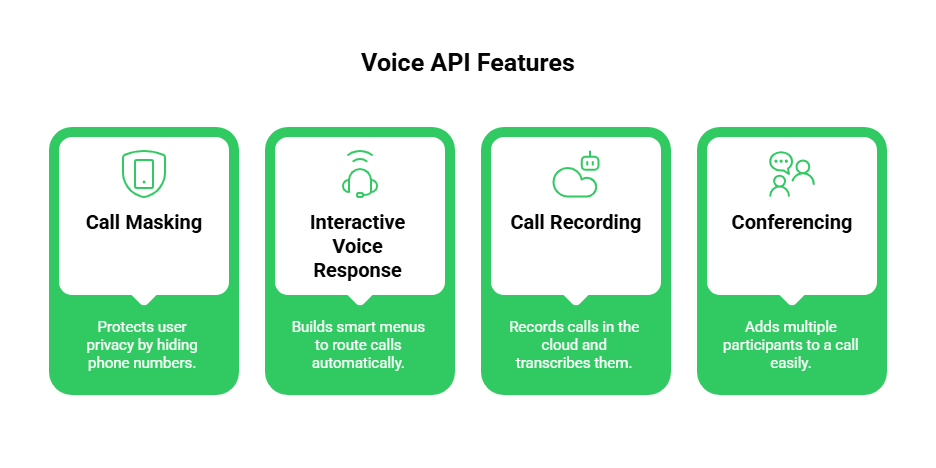
Call Masking for Privacy
This is essential for the gig economy. When you call your Uber driver, you do not see their real phone number, and they do not see yours. The API sits in the middle and connects you anonymously. This protects user privacy while still allowing communication.
Interactive Voice Response (IVR)
You know those menus that say “Press 1 for Sales, Press 2 for Support”? That is IVR. With an API, you can build smart menus that route calls to the right person automatically.
Call Recording and Transcription
For businesses, keeping a record is important. APIs allow you to record calls in the cloud automatically. You can then use AI to transcribe those recordings into text, making them searchable.
Conferencing
APIs make it easy to add a third or fourth person to a call. This is vital for business collaboration apps where teams need to brainstorm together.
Why Is Infrastructure the Backbone of Voice APIs?
This is the most important part that people often forget. An API is just code. But that code needs to travel over a network. If the network is bad, the call will be bad.
Have you ever been on a call where the audio is choppy or there is a weird delay? That is called “latency” and “jitter.” It happens when the voice data gets stuck in traffic on the internet.
This is where FreJun AI stands out. We handle the complex voice infrastructure so you can focus on building your AI.
While many providers focus only on the software, FreJun focuses on the transport layer. We use FreJun Teler, our specialized telephony arm, to provide elastic SIP trunking.
Elastic SIP trunking is like a highway that can expand. If one car is driving on it, the road is open. If ten thousand cars appear suddenly, the road widens automatically to fit them all. This ensures that your calls always connect clearly, no matter how many users you have.
Furthermore, FreJun is obsessed with low latency. We route calls through the fastest possible paths. This ensures that when you speak, the other person hears you instantly. In the world of voice API integration, infrastructure is not just a detail. It is the product.
How Do You Choose the Right Voice API Provider?
There are many options out there. Choosing the wrong one can lead to dropped calls and angry users. Here are three things to look for.
1. Reliability and Uptime
Your voice feature needs to work 100% of the time. Look for a provider with a distributed network. This means they have servers all over the world. If one server fails, the traffic automatically moves to another one.
2. Developer Experience
The best API is the one that is easy to use. Look for clear documentation and Software Development Kits (SDKs) in languages like Python, JavaScript, and Ruby. FreJun provides a developer first toolkit that makes embedding voice features simple.
3. Scalability
Will the provider grow with you? If you go viral tomorrow and have a million users, can they handle the load? This is where FreJun Teler shines. Our elastic infrastructure is designed for scale. We power high volume enterprise use cases, ensuring that you never hit a ceiling.
Ready to start building conversations that actually understand your customers? Sign up for FreJun AI and explore our powerful voice AI infrastructure.
Also Read: What Makes Voice Bot Solutions Effective for High-Volume Customer Calls?
What Industries Benefit Most from Voice Integration?
Voice API integration is changing the game across many different sectors.
Healthcare
Telehealth exploded during the pandemic. Doctors need to speak with patients remotely. Voice APIs allow secure, private calls directly within a medical app. This protects patient data while providing convenient care.
Real Estate
Agents live on their phones. Voice integration can automatically log calls into a CRM (Customer Relationship Management) system. This ensures that no lead is ever lost and every conversation is tracked.
E commerce and Retail
When a customer has a question about a product, they are ready to buy. A “Click to Call” button on a website connects them to a sales rep instantly. This real time connection increases conversion rates significantly.
How Does FreJun AI Simplify Voice Integration?
At FreJun, we believe that developers should not have to be telecom experts. We abstract away the complexity.
Model Agnostic Approach
We do not force you to use a specific AI model. If you are building an AI voice agent, you can bring your own Large Language Model (LLM) and Text to Speech (TTS) engine. FreJun acts as the high performance bridge that connects your smart AI to the telephone network.
Security by Design
Voice data is sensitive. We treat it that way. Our infrastructure is built with enterprise grade security protocols. We encrypt data in transit, ensuring that your user’s conversations remain private.
Dedicated Support
We know that every app is different. That is why we offer dedicated integration support. Whether you are planning your architecture or optimizing for low latency, our team is there to help you succeed.
What Is the Future of Communication Apps?
We are just scratching the surface of what is possible. The next wave of voice API integration will be driven by Artificial Intelligence.
Imagine an app that doesn’t just connect a call but understands it.
- Real time Translation: You speak English, and the person on the other end hears Spanish.
- Sentiment Analysis: The app detects that a customer is angry and automatically alerts a manager to join the call.
- Context Aware Agents: An AI that knows your purchase history and can resolve your issue without a human ever picking up the phone.
To build these futuristic experiences, you need a foundation of speed and clarity. You need an infrastructure that can stream audio in real time to AI processors without lag.
This is the future FreJun is building. By combining robust voice API integration with next generation AI capabilities, we are enabling developers to create apps that sound more human, responsive, and intelligent than ever before.
Also Read: How Do Voicebot Solutions Support Continuous Conversation Flow?
Conclusion
The way we communicate is evolving. Users expect apps to be more than just static menus and text boxes. They want connection and speed. Plus, they also want to be heard.
Voice API integration is the key to delivering this experience. It allows developers to add powerful voice capabilities without reinventing the wheel. It transforms a standard app into a communication powerhouse.
However, the success of your voice features depends heavily on the engine running them. You need a partner that understands the importance of low latency, security, and scale. FreJun AI provides that robust foundation. With tools like FreJun Teler and our elastic SIP trunking, we ensure that your voice integration is not just functional, but exceptional.
Want to do a deep dive into the infrastructure required to power a modern, AI-powered voicebot? Schedule a demo with our team at FreJun Teler.
Also Read: UK Phone Number Formats for UAE Businesses
Frequently Asked Questions (FAQs)
Voice API integration is the process of connecting a software application to the telephone network using code. It allows apps to make, receive, and manage phone calls programmatically without needing physical phone hardware.
No. That is the beauty of it. The API provider handles the complex telecom protocols. You just need standard web development skills to integrate the voice features into your app.
VoIP (Voice over IP) is the technology that sends voice over the internet. A Voice API is a set of tools that allows developers to control VoIP technology within their own software applications.
FreJun uses FreJun Teler, which provides elastic SIP trunking. This means our infrastructure automatically scales up to handle spikes in traffic, ensuring your calls always connect.
Yes, if you choose the right provider. FreJun AI encrypts voice data during transmission to ensure privacy and security for all users.
Yes. FreJun provides global connectivity. You can purchase phone numbers in different countries and route calls globally through our network.
Call masking is a privacy feature. It connects two parties (like a driver and a rider) through a temporary phone number, so neither person sees the other’s real personal number.
Latency is the delay in audio. High latency makes people talk over each other and ruins the conversation. Low latency ensures the call feels natural and instant.