
Imagine you are a coach on the sidelines of a championship basketball game. You see your star player making a mistake. You want to correct them. But imagine if the rules said you could only tell them about the mistake after the game ended. That advice would be useless for winning the current game.
This is exactly how most businesses treat their phone calls. They record the call and analyze it two days later. They find out the customer was angry or that the sales agent missed a huge opportunity. But by then it is too late. The customer has churned. The deal is lost.
Now imagine a different world. Imagine you have a supercomputer listening to every call as it happens. It whispers into the agent’s ear. It says “The customer sounds frustrated, speak softer” or “They mentioned a competitor, offer a discount.”
This is the power of adding real time capabilities. It transforms your voice data from a history lesson into a live tactical advantage. To build this you need the right tools. Specifically you need an AI voice agent API.
In this guide we will explore how to build these live systems. We will look at how to capture audio instantly and how to process it for insights and how platforms like FreJun AI provide the high speed infrastructure needed to make it all happen without delay.
Table of contents
- Why Is Real Time Analytics Better Than Post Call?
- What Is an AI Voice Agent API?
- How Does the Architecture Work?
- What Can You Measure with Live Voice Insights?
- How Do You Implement Real Time Call Analytics?
- Why Is Latency the Enemy of Analytics?
- What Are the Business Benefits of AI Reporting?
- How Does FreJun AI Support This Infrastructure?
- Use Case: The Intelligent Contact Center
- Challenges to Watch Out For
- Conclusion
- Frequently Asked Questions (FAQs)
Why Is Real Time Analytics Better Than Post Call?
For decades businesses relied on post call analytics. This meant recording the call and sending it to a server and waiting for a transcript. It was slow.
Real time call analytics changes the game because it is proactive. It solves problems before they become permanent failures.
Think about a support agent handling a complex technical issue. The customer is getting annoyed. A real time system detects the rising “anger score” in the customer’s voice. It immediately alerts a manager to join the call and save the relationship.
According to a study by Salesforce, 80% of customers say the experience a company provides is as important as its products or services. If you can fix a bad experience while it is happening you win. If you wait until later you lose.
Here is a simple breakdown of the difference.
| Feature | Post Call Analytics (Old Way) | Real Time Analytics (New Way) |
| Timing | Hours or days later | Instantly (milliseconds) |
| Action | Reactive (fixing past mistakes) | Proactive (fixing current issues) |
| Value | Training and compliance | Saving deals and customers |
| Data Flow | Record -> Save -> Analyze | Stream -> Analyze -> Act |
| Infrastructure | Standard storage | Low latency streaming |
What Is an AI Voice Agent API?
To understand the solution we must define the tool. An AI voice agent API is a set of protocols that allows your software to interact with voice calls programmatically.
In the past APIs were used just to start or stop calls. Today they are much more powerful. A modern voice API allows you to tap into the media stream. It allows you to “fork” the audio. This means while the caller and agent are talking the audio is simultaneously being sent to an AI engine for analysis.
This API acts as the bridge. On one side you have the telephone network. On the other side you have your intelligence systems. The API carries the voice data across that bridge.
Also Read: AI Voice Agents for Ride-Hailing Platforms
How Does the Architecture Work?
Building this requires a specific setup. You cannot just record a file. You need to stream data.
Here is the step by step flow of a system using live voice insights:
- The Call Starts: A customer calls your business.
- Media Forking: The voice infrastructure (like FreJun) answers the call. Crucially it splits the audio. One stream goes to the agent or bot. The duplicate stream goes to the analytics engine.
- Transcription: An AI model converts the speech into text in real time.
- Natural Language Understanding (NLU): Another AI model reads the text. It looks for keywords or intent or sentiment.
- The Feedback Loop: The system sends a notification to the agent’s dashboard. This happens in milliseconds.
FreJun AI plays a vital role here. We handle the complex voice infrastructure so you can focus on building your AI. Our platform is designed to handle this media streaming with ultra low latency. If the infrastructure adds a three second delay the “real time” advice arrives too late. FreJun ensures the data flows instantly.
What Can You Measure with Live Voice Insights?
Once you have the stream flowing what should you look for? Live voice insights can reveal incredible details about the conversation.
Sentiment Analysis
This measures emotion. Is the customer happy or neutral or furious? You can display a “Mood Meter” on the agent’s screen. If the meter turns red the agent knows they need to de escalate immediately.
Objection Handling
In sales customers often have objections. They say “It is too expensive” or “I need to talk to my boss.” An AI system can detect these specific phrases. It can then pop up a “Battle Card” on the agent’s screen with the perfect scripted response to overcome that objection.
Compliance Monitoring
In finance and healthcare agents must say specific legal phrases. If they forget the AI can flash a warning saying “You forgot the disclosure statement!”
How Do You Implement Real Time Call Analytics?
If you are a developer the implementation involves working with WebSockets and streams.
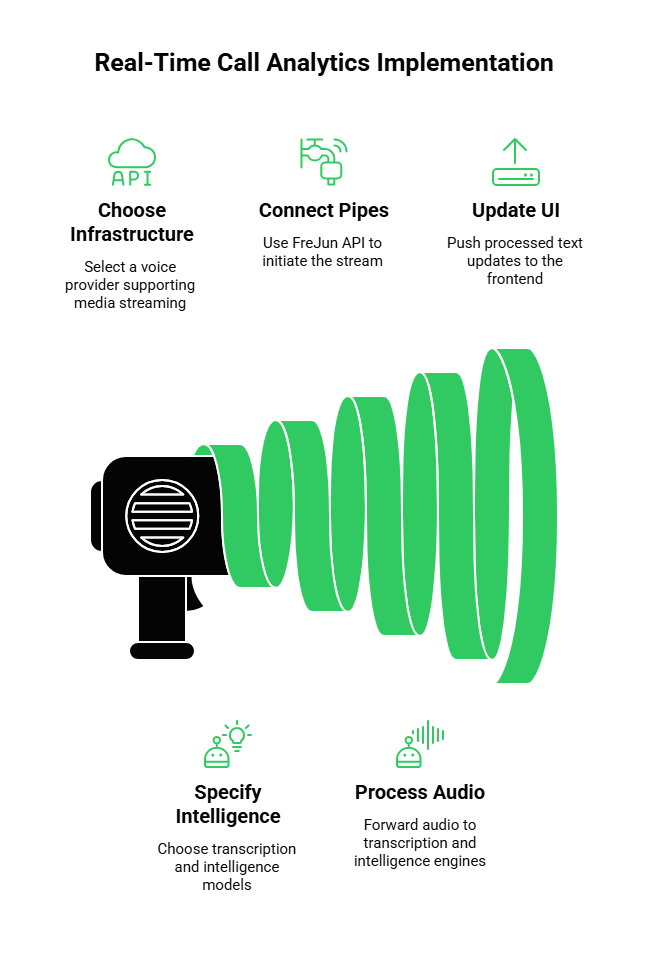
Step 1 Choose Your Infrastructure
You need a voice provider that supports media streaming. This is where FreJun AI shines. We provide the “plumbing” that captures the raw audio from the telephone network.
Step 2 specificy Your Intelligence
Since FreJun is model agnostic you can choose any brain you want. You might use Deepgram for fast transcription and OpenAI for intelligence.
Step 3 Connect the Pipes
You use the FreJun API to initiate the stream.
- The call comes into FreJun.
- FreJun opens a WebSocket connection to your server.
- Your server forwards the audio to the transcription engine.
- The transcription engine returns text.
- Your server processes the text and pushes updates to the frontend UI.
Ready to build your own real time intelligence system? Sign up for a FreJun AI to get your API keys and access our streaming documentation.
Why Is Latency the Enemy of Analytics?
We keep mentioning latency because it is the single biggest technical challenge. Latency is lag. It is the delay between when words are spoken and when the data appears on the screen.
If you are building real time call analytics latency renders the tool useless. Imagine an agent asks “Do you want to buy?” and the customer says “Yes.” If the AI takes five seconds to process this the agent might have already moved on or hung up.
FreJun AI is engineered for speed. We use advanced networking and distributed data centers to minimize the travel time of data.
We also utilize FreJun Teler which provides elastic SIP trunking. This ensures that the connection to the telephone network is robust and direct. By reducing the number of “hops” the audio takes we shave off valuable milliseconds ensuring your insights are truly live.
Also Read: Voice AI for Vehicle Service Reminders
What Are the Business Benefits of AI Reporting?
Moving from static reports to dynamic AI reporting has a direct impact on the bottom line.
Increasing Conversion Rates
When sales agents receive live coaching they close more deals. It is like having your best sales manager listening to every single call and whispering advice. The agents always have the right answer at the right time.
Reducing Churn
Customers leave when they feel unheard. Real time sentiment detection allows companies to intervene before the customer hangs up. Saving just a few customers a month can pay for the entire software investment.
How Does FreJun AI Support This Infrastructure?
Building the AI part is hard enough. You do not want to worry about the telecom part. That is why developers choose FreJun.
We act as the invisible layer that makes everything work.
- Raw Audio Access: We give you access to the raw media stream. We do not compress it or hide it. This gives your AI the highest quality input which leads to better accuracy.
- Scalability: With FreJun Teler you can handle five calls or five thousand calls. Our elastic scaling ensures that you never miss a stream during high traffic periods.
- Security: We encrypt the streams to ensure that sensitive customer data is protected as it travels from the phone network to your analytics engine.
Use Case: The Intelligent Contact Center
Let us look at a real world example. A large insurance company uses an AI voice agent API powered by FreJun.
When a policyholder calls to file a claim they are often stressed.
- The FreJun infrastructure answers the call and streams the audio.
- The AI detects the word “accident” and “car.”
- The system automatically pulls up the auto claims form on the agent’s screen.
- The customer speaks fast. The AI detects high stress.
- A prompt appears telling the agent “Customer is stressed. Show empathy.”
- The agent says “I am so sorry to hear that. I can help you.”
- The AI detects the sentiment shifting to neutral.
- The manager watches a dashboard showing live sentiment across all active calls.
This seamless dance is only possible because the voice infrastructure (FreJun) and the intelligence layer are perfectly integrated.
Challenges to Watch Out For
While this technology is powerful there are pitfalls.
Audio Quality
If the audio is crackly the AI will make mistakes. This is why using a premium voice provider like FreJun is essential. We prioritize audio clarity to ensure high transcription accuracy.
Information Overload
You can show too much data. If you bombard the agent with ten different metrics they will ignore them all. Good AI reporting filters the noise and only shows the most critical “next best action.”
Privacy
You must ensure you are compliant with laws like GDPR or HIPAA. Streaming audio to third party AI processors requires strict data processing agreements. FreJun helps by providing a secure and compliant transport layer.
Also Read: Voice AI for Vehicle Service Reminders
Conclusion
The era of the “black box” phone call is over. Businesses can no longer afford to guess what is happening on their lines. They need to know right now.
Adding real time analytics using an AI voice agent API gives you X ray vision into your operations. It turns every agent into your best agent and turns every manager into a super coach. It turns every support interaction into an opportunity to build loyalty.
But remember that speed is everything. The insights must be instant. To achieve this you need a voice infrastructure built for low latency and high reliability. FreJun AI provides the solid foundation you need. By handling the difficult media streaming and telephony layers we allow you to build the smart, responsive, and profitable voice applications of the future.
Want to discuss how to implement real time streaming for your business? Schedule a demo with our team at FreJun Teler and let us show you how fast your analytics can be.
Also Read: Why Outbound Calls Still Matter in the Era of Digital Marketing
Frequently Asked Questions (FAQs)
An AI voice agent API is a tool that allows developers to connect telephone calls to software applications. It enables features like programmatically answering calls and streaming audio and integrating with AI models.
It works by “forking” the audio stream of a live call. While the call is happening the audio is sent to an AI engine which processes it and sends back insights (like sentiment or keywords) instantly.
Real time happens while the call is active allowing you to influence the outcome. Post call happens after the agent hangs up which is useful for long term trend analysis but cannot save the current interaction.
No. FreJun provides the voice infrastructure and the real time audio stream. You connect this stream to your preferred analytics or AI provider to build the dashboard that fits your specific needs.
Latency is delay. In a live conversation if the AI advice arrives five seconds late it is useless because the conversation has moved on. FreJun ensures ultra low latency so the advice is relevant.
Yes. FreJun is model agnostic. You can use OpenAI or Google or Deepgram or any other AI service you prefer. We simply provide the reliable connection to the phone network.
FreJun Teler is our telephony solution that offers elastic SIP trunking. It provides the scalable phone lines needed to handle high volumes of calls for your analytics platform.
Yes. FreJun uses enterprise grade encryption standards to ensure that the voice data is secure as it travels from the caller to your application.
Yes. This is called sentiment analysis. By processing the audio stream through an AI model you can detect if a customer is happy or angry or neutral based on their tone and words.
Not necessarily. You can often use FreJun’s API to integrate with existing systems or forward calls through our infrastructure to add the analytics layer on top of your current setup.