
Imagine you are calling your bank. You have a complicated problem with a transaction that you do not recognize. You are greeted by a friendly AI voice. It answers your basic questions about your balance and recent deposits quickly. But when you start explaining the fraud issue the AI pauses. It realizes this is a sensitive situation that requires a human touch.
In a bad system the AI would apologize and say “I cannot help with that” and hang up. Or it might force you to dial a different number. That is frustrating.
In a good system the AI says “I understand this is important. Let me connect you to a fraud specialist who can fix this right now.” A few seconds later a human picks up and says “Hello I see you are calling about the transaction on Tuesday. Let’s look at that.”
This smooth transition is called an AI to human handoff. It is the difference between a robot that annoys people and a robot that helps people. To make this happen developers need a powerful AI voice agent API.
In this guide we will explore how to build these hybrid call flows. We will look at the technical steps to transfer calls and how to pass customer data to the human agent and how platforms like FreJun AI provide the infrastructure to make these transfers seamless.
Table of contents
- What Is Call Transfer with an AI Voice Agent API?
- Why Is the AI to Human Handoff So Important?
- How Does Call Transfer Automation Work Under the Hood?
- What Are the Different Types of Transfers?
- How Do You Implement This with FreJun AI?
- How Do You Pass Context During a Handoff?
- When Should You Trigger a Transfer?
- How Does Infrastructure Impact Transfer Quality?
- Dealing with Common Challenges
- Conclusion
- Frequently Asked Questions (FAQs)
What Is Call Transfer with an AI Voice Agent API?
A call transfer is simply moving a live phone call from one endpoint to another. In the past this was done by a receptionist pressing buttons on a desk phone. Today it is done by code.
An AI voice agent API is the tool that allows your software to control the phone line. When you build an AI bot you are not just building a brain that generates text. You are building a system that manages the call.
When the AI brain decides it is time to leave the conversation it sends a command to the API. It says “Transfer this caller to phone number 555-0199.” The API then instructs the telecom network to reroute the audio.
This process enables call transfer automation. It allows businesses to use AI for the repetitive easy tasks while saving their expensive human agents for the high value complex problems.
Why Is the AI to Human Handoff So Important?
You might wonder why we don’t just use AI for everything. AI is getting smarter every day. However there are human elements that AI cannot replicate yet. Empathy and complex negotiation and high level troubleshooting often require a person.
According to a report by Zendesk, nearly 73% to 75% of customers will switch to a competitor after multiple bad experiences. Getting stuck in a loop with a robot is a guaranteed bad experience.
Implementing a smooth AI to human handoff provides a safety net. It ensures that no customer is ever left stranded. It combines the speed of AI with the understanding of a human. Here are three reasons why this matters.
- Efficiency: The AI handles the “Tier 1” support like verifying identity or checking status. The human agent only steps in for “Tier 2” issues.
- Satisfaction: Customers feel heard. If they get frustrated the AI can detect it and pass them to a manager.
- Revenue: In sales calls an AI can qualify a lead. Once the lead is interested the AI transfers them to a closer to seal the deal.
Also Read: Cold Calling Techniques That Actually Work for Outbound Teams
How Does Call Transfer Automation Work Under the Hood?
It might seem like magic but it is actually a precise sequence of technical events.
- Intent Detection: The user says “I want to cancel my account.” The AI model (like GPT-4) analyzes this text and identifies the intent as “Cancellation.”
- Logic Trigger: Your application code sees the “Cancellation” intent. You have a rule that says cancellations must be handled by a human retention specialist.
- API Command: Your application sends a POST request to the AI voice agent API. This request contains the destination phone number or SIP URI (a digital address for the agent).
- Signaling: The voice platform (like FreJun) receives the command. It uses a protocol called SIP (Session Initiation Protocol) to signal the network. It invites the human agent to the call.
- Bridging: Once the human answers the platform bridges the audio streams. The customer is now talking to the human.
- Disconnect: The AI disconnects itself from the call leaving the two humans to talk.
FreJun AI simplifies this entire process. We handle the complex voice infrastructure so you can focus on building your AI. Our platform manages the difficult SIP signaling and media bridging in the background so you just have to send a simple API command.
What Are the Different Types of Transfers?
Not all transfers are the same. In the world of hybrid call flows there are two main ways to move a call.
1. Cold Transfer (Blind Transfer)
In a cold transfer the AI sends the call to the human and hangs up immediately. The AI does not know if the human answers.
- Pros: It is fast and frees up the AI port immediately.
- Cons: If the human agent is busy the customer might get voicemail or be dropped.
2. Warm Transfer (Attended Transfer)
In a warm transfer the AI dials the human and waits for them to answer. The AI can even “whisper” information to the human before connecting the customer.
- Pros: It guarantees a connection. The AI can introduce the caller.
- Cons: It uses more resources because the AI stays on the line longer.
Here is a comparison table to help you choose.
| Feature | Cold Transfer (Blind) | Warm Transfer (Attended) |
| Speed | Instant | Slower (Wait for answer) |
| Customer Experience | Good if agent is ready | Excellent (Seamless handover) |
| Resource Usage | Low | High |
| Best Use Case | Routing to a queue or IVR | High value VIP clients |
| Risk | Call might hit voicemail | Zero risk of dropped call |
How Do You Implement This with FreJun AI?
FreJun is designed to be developer friendly. We provide the plumbing that makes call transfer automation reliable.
Since FreJun is model-agnostic you can use any AI brain you want. You might use OpenAI to decide when to transfer but you use FreJun to execute the transfer.
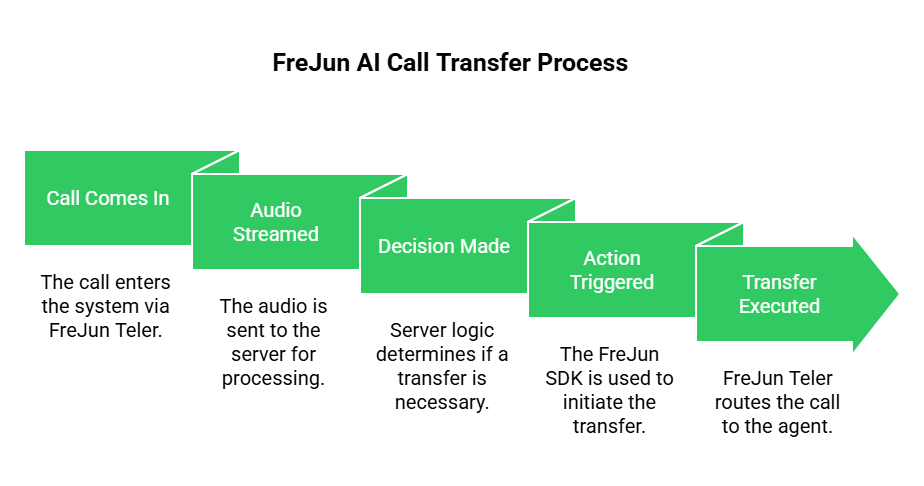
Here is how the flow works with our infrastructure.
- The Call: The call comes in via FreJun Teler which provides elastic SIP trunking. This ensures clear audio and high reliability.
- The Stream: FreJun streams the audio to your server.
- The Decision: Your server logic decides a transfer is needed.
- The Action: You use the FreJun SDK to call a function like transfer_call(destination_number).
- The Execution: FreJun Teler handles the routing instantly connecting the customer to the agent.
We prioritize low latency. This means the switch happens instantly. There is no long silence where the customer wonders if they got hung up on.
Ready to build your own hybrid voice agent? Sign up for a FreJun AI to get your API keys and start testing transfers today.
How Do You Pass Context During a Handoff?
The biggest complaint people have about transfers is repeating themselves. “I already told the robot my account number! Why do I have to tell you?”
To fix this you need to pass context. When you perform the AI to human handoff you should also send data to the human agent’s screen.
This is done using metadata or SIP headers. When your AI voice agent API triggers the transfer it can attach information.
- Customer Name: “John Doe”
- Intent: “Billing Dispute”
- Sentiment: “Frustrated”
- Summary: “User wants a refund for transaction #1234.”
With FreJun you can integrate this with your CRM. As the call routes via FreJun Teler your backend can simultaneously push this data to the agent’s dashboard via a websocket. When the phone rings the agent sees exactly who is calling and why.
Also Read: The Future of Elastic SIP Trunking in an AI-Powered Voice World
When Should You Trigger a Transfer?
Knowing how to transfer is easy. Knowing when to transfer is the art of hybrid call flows. You do not want to transfer too early or too late.
Here are the best triggers to program into your logic.
1. Negative Sentiment
If the user starts yelling or using negative words the AI should detect this. An angry customer does not want to talk to a machine. Transfer them immediately to a de-escalation specialist.
2. Unknown Intent
If the AI says “I didn’t catch that” three times in a row the conversation is failing. Do not let the loop continue. Program a rule that says “After 3 failures transfer to human.”
3. High Value Opportunities
If a sales bot detects that a customer is interested in your “Enterprise Plan” that is a high value lead. Don’t risk the AI losing the sale. Transfer them to your best closer to finish the job.
4. Complex Authentication
Sometimes security questions are too hard for voice AI. If a user fails to verify their identity via voice transfer them to a human who can verify them manually.
How Does Infrastructure Impact Transfer Quality?
The code might be perfect but if the network is bad the transfer will fail. This is where infrastructure matters most.
When you transfer a call you are essentially rerouting data streams. If the infrastructure has high jitter or latency the audio will crackle or drop during the switch.
FreJun AI utilizes FreJun Teler for its telephony backbone. Teler provides elastic SIP trunking. This means it can handle spikes in traffic without breaking a sweat.
- Reliability: We ensure the bridge between the caller and the agent is stable.
- Clarity: We maintain high definition audio quality throughout the transfer.
- Speed: Our distributed network ensures the signaling happens in milliseconds preventing dead air.
Dealing with Common Challenges
Building hybrid call flows comes with challenges. Here is how to solve them.
Latency and Dead Air
Problem: The user says “Transfer me” and then hears 5 seconds of total silence while the system connects. They hang up.
Solution: Use FreJun’s low latency infrastructure. Also program your AI to say “Please hold while I connect you” before initiating the transfer. Play hold music during the gap.
Agent Availability
Problem: The AI transfers the call but no agents are online. The phone just rings forever.
Solution: Check agent status before transferring. Your code should query your CRM or phone system. If no agents are available the AI should say “All agents are busy can I have someone call you back?”
Loss of Recording
Problem: The recording stops when the AI leaves the call.
Solution: Ensure your AI voice agent API supports end-to-end recording. FreJun allows you to record the entire session including the AI portion and the human portion for quality assurance.
Also Read: Elastic SIP Trunking for Startups: Scale Your Voice Infrastructure Without Complexity
Conclusion
The future of customer service is not humans versus robots. It is humans and robots working together. Hybrid call flows allow businesses to offer 24/7 support and instant answers while still providing the emotional connection that only a person can offer.
Handling these transfers requires a robust AI voice agent API. It is not just about routing a call. It is about passing context and maintaining context and ensuring the audio quality never drops.
FreJun AI provides the solid foundation you need to build these sophisticated flows. By handling the difficult telephony layers and providing tools like FreJun Teler for elastic scaling we enable developers to create seamless handoffs. When the technology works perfectly the customer does not notice the switch. They just know they got their problem solved.
Want to optimize your call flows and agent handoffs? Schedule a demo with our team at FreJun Teler to see our infrastructure in action.
Also Read: How Businesses Use Outbound Calls for Lead Generation & Pipeline Growth
Frequently Asked Questions (FAQs)
An AI voice agent API is a software interface that allows developers to control phone calls using code. It enables features like answering calls and generating speech and transferring calls to other numbers.
A cold transfer sends the call to an agent immediately and disconnects the AI. A warm transfer keeps the AI on the line until the agent answers allowing the AI to introduce the caller before connecting them.
FreJun handles the execution of the transfer (the signaling and audio). You build the logic (when to transfer and where to transfer) in your own application using your preferred AI model.
Using a reliable infrastructure provider like FreJun AI is key. We use enterprise grade SIP trunking via FreJun Teler to ensure that the connection remains stable during the handoff process.
Yes. While the phone network passes audio you can use websockets or CRM APIs to push customer data (context) to the agent’s screen at the exact same moment the call arrives.
You should program fallback logic. If the transfer fails or times out the system should either route the caller to a voicemail or have the AI return to the line to take a message.
Yes. FreJun can record the conversation. You can configure it to record the interaction with the AI and continue recording once the human agent picks up.
A hybrid call flow is a system where a conversation can move back and forth between an automated AI agent and a live human agent depending on the complexity of the user’s request.
High latency causes long pauses. If a customer hears silence for too long they assume the call dropped and they hang up. Low latency infrastructure ensures the transfer happens instantly.
Yes. You can transfer calls to any valid phone number. It can be an internal extension or a mobile phone or an external call center located in a different country.