
Imagine you are trying to have a conversation with a friend. But there is a catch. Your friend is standing on the moon. You say “Hello” and you wait. One second. Two seconds. Three seconds. Finally your friend hears you and replies “Hi.” Then you wait another three seconds to hear that reply.
It would be impossible to have a natural conversation. You would constantly talk over each other. It would be frustrating and awkward.
This is exactly what happens when you build a voice bot but host it on a server halfway around the world from your users. In the world of technology we call this “latency.” Latency is the time it takes for data to travel from point A to point B.
When building an intelligent voice bot using an AI voice agent API speed is everything. A delay of even half a second can break the illusion of intelligence. The user feels like they are talking to a machine.
To fix this you cannot just make the computer faster. You have to cheat physics. You have to move the computer closer to the user. This is called multi region deployment.
In this guide we will explain how to deploy your voice agents across the globe. We will look at how to master latency control and how to manage multi region voice agents and how infrastructure platforms like FreJun AI provide the global plumbing to make this possible.
Table of contents
- Why Is Latency the Enemy of Voice AI?
- What Does Global AI Voice Deployment Mean?
- How Do You Architect Multi Region Voice Agents?
- How Does FreJun AI Solve the Distance Problem?
- What Is Latency Control and How Do You Implement It?
- How Do You Handle Data Synchronization?
- What Are the Steps to Deploy Globally?
- Why Is Elastic Infrastructure Essential?
- How Do You Manage Costs?
- Conclusion
- Frequently Asked Questions (FAQs)
Why Is Latency the Enemy of Voice AI?
Voice is different from every other type of data. If an email arrives five seconds late nobody cares. If a webpage takes two seconds to load it is annoying but acceptable. But voice must be instant.
Human beings are wired for real time response. When we speak we expect an answer immediately. In technical terms a delay of more than 200 milliseconds becomes noticeable. A delay of more than 500 milliseconds makes conversation difficult.
When you use an AI voice agent API the data has to make a long round trip.
- The user speaks.
- The audio travels to the server.
- The audio is converted to text.
- The AI thinks and generates a reply.
- The reply is converted to audio.
- The audio travels back to the user.
That is a lot of steps. If your server is in New York and your user is in Sydney the travel time alone will ruin the experience. This is why global AI voice deployment is not just a nice feature. It is a necessity for any serious business.
What Does Global AI Voice Deployment Mean?
Deployment refers to where your software lives. In the old days you had a server in a closet. Today you use the cloud.
Most developers start by picking a single “region” in the cloud. They might choose “US East” because it is cheap and popular. This works great if all your customers are in New York. It is terrible if your customers are in London or Tokyo or Mumbai.
Global AI voice deployment means running your application in multiple locations at the same time. You might have one version of your agent running in Virginia and another in Frankfurt and another in Singapore.
The goal is simple. When a user calls the system should automatically connect them to the server that is physically closest to them. This creates a specialized network of multi region voice agents that act locally but operate globally.
Also Read: Carrier Coordination Through Voice APIs
How Do You Architect Multi Region Voice Agents?
Building a distributed system is harder than building a centralized one. You have to think about how the pieces connect.
There are two main layers to think about.
- The Media Layer: This handles the actual audio stream. It is heavy and sensitive to distance.
- The Logic Layer: This is the brain that decides what to say.
In a perfect world you want both layers to be close to the user. Here is a comparison of how the architecture changes.
| Feature | Single Region (The Old Way) | Multi Region (The New Way) |
| Server Location | One central hub (e.g. California) | Distributed hubs (US, EU, Asia) |
| Latency for Local Users | Low (Good) | Low (Good) |
| Latency for Global Users | High (Bad) | Low (Good) |
| Reliability | If the hub fails the app dies | If a hub fails traffic reroutes |
| Complexity | Simple to manage | Requires synchronization |
| Cost | Lower infrastructure cost | Higher value and efficiency |
How Does FreJun AI Solve the Distance Problem?
You might be thinking that setting up servers in ten different countries sounds expensive and difficult. If you tried to do it yourself from scratch it would be.
This is where FreJun AI comes in. We handle the complex voice infrastructure so you can focus on building your AI.
FreJun acts as your global transport layer. We have already done the hard work of building a distributed network. When you use FreJun as your AI voice agent API provider you are tapping into a system that is already global.
We utilize FreJun Teler which provides elastic SIP trunking capabilities. This means we can accept phone calls from telephone networks all over the world. More importantly we route those calls efficiently.
If a user calls from France FreJun Teler identifies the origin. We then route the audio media to the nearest processing node and do not send it to America just to send it back. We keep the path short. This is how we ensure your agent sounds human and responsive.
What Is Latency Control and How Do You Implement It?
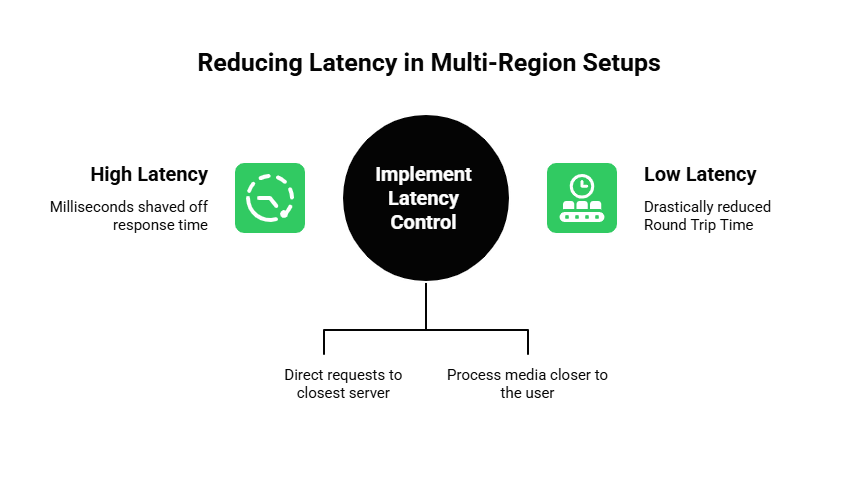
Latency control is the art of shaving milliseconds off the response time. In a multi region setup this involves a few specific technologies.
Geo DNS Routing
This is the traffic cop. When a request comes in the DNS (Domain Name System) looks at the IP address of the caller. It calculates which server is closest.
If the request comes from an IP in Berlin the DNS sends it to the Frankfurt data center. If the request comes from Texas it sends it to Dallas. This happens automatically before the call is even answered.
Edge Computing
This takes it a step further. Instead of just having servers in big data centers you put small pieces of code on the “edge” of the network closer to the user.
FreJun’s infrastructure leverages these principles. We ensure that the media processing (the heavy lifting of streaming audio) happens at the edge. By minimizing the physical distance the light signals have to travel through fiber optic cables we reduce the “Round Trip Time” (RTT) drastically.
Also Read: Reducing Missed Deliveries with Voice AI
How Do You Handle Data Synchronization?
One of the biggest challenges with multi region voice agents is memory.
Imagine a user calls your US line in the morning and updates their address. Then they travel to London and call your UK line in the evening. If the UK server does not know about the address change the AI will look stupid.
To fix this you need a strategy for syncing data.
- Centralized Database: All regions read from one main database. This is easy but adds latency.
- Replicated Databases: Each region has its own copy. When a change happens in the US it is copied (replicated) to the UK in the background.
For voice agents context is key. FreJun allows developers to pass metadata and context with the call. This ensures that no matter which region processes the voice the AI has the right information to be helpful.
Ready to launch your voice agent to the world? Sign up for a FreJun AI developer account to get your API keys and access our global infrastructure.
What Are the Steps to Deploy Globally?
If you are a developer ready to take your AI voice agent API integration global here is the roadmap.
Step 1 choose Your Regions
Do not try to be everywhere at once. Look at your analytics. Where are your users?
- If 90% are in North America start there.
- If you have a growing base in Southeast Asia deploy a node in Singapore.
Step 2 Use a Global Infrastructure Provider
Do not build your own data centers. Use a platform like FreJun that offers global AI voice deployment out of the box. We abstract the complexity of carrier negotiations in different countries.
Step 3 Configure Your Routing
Set up your logic to route calls based on origin. With FreJun Teler this is often handled for you. We optimize the path from the carrier to your application.
Step 4 Monitor Latency
You cannot fix what you cannot measure. Use monitoring tools to track the “PDD” (Post Dial Delay) and the media latency. Set alerts if the delay exceeds that critical 200ms threshold.
Why Is Elastic Infrastructure Essential?
Traffic is not constant. It comes in waves.
Imagine you launch a marketing campaign in Brazil. Suddenly you have 5000 people calling your Brazilian number. If you are running on a fixed server it will crash.
This is why FreJun Teler offers elastic SIP trunking. “Elastic” means it stretches. Our system automatically detects the spike in volume and allocates more resources to handle it.
This is crucial for multi region voice agents. You might be asleep in the US while your Australian traffic is peaking. You need an infrastructure that scales up and down automatically in every region without you having to press a button.
According to a market report by MarketsandMarkets, the global conversational AI market is expected to grow from $17 billion in 2025 to $49 billion by 2031. As this market explodes the demand for scalable and global infrastructure will only increase.
How Do You Manage Costs?
Running servers all over the world sounds expensive. It can be. But it is often cheaper than losing customers.
Also cloud economics have changed. You typically pay for what you use. With FreJun you are not buying servers in Germany. You are paying for the minutes of usage. This allows a startup in a garage to have the same global reach as a Fortune 500 company without the massive upfront capital.
Also Read: AI Voicebots for Hotel Reservations Made Easy
Conclusion
The internet has made the world smaller. Your customers are no longer just down the street. They are everywhere. They expect your service to work seamlessly whether they are calling from a skyscraper in Dubai or a farmhouse in Kansas.
Building a centralized voice agent is a good start. But to truly deliver a great experience you must embrace global AI voice deployment. You must fight latency by moving your intelligence closer to the user.
This might sound like a complex engineering challenge. And it is. But you do not have to solve it alone. Platforms like FreJun AI exist to handle the heavy lifting. We provide the latency control and the elastic scaling and the global connectivity.
By using the FreJun AI voice agent API you are not just writing code. You are plugging into a worldwide network designed for speed and clarity. You bring the AI logic and we ensure it is heard clearly in every corner of the globe.
Want to discuss your global expansion strategy? Schedule a demo with our team at FreJun Teler and let us help you map out your multi region architecture.
Also Read: Cold Calling Techniques That Actually Work for Outbound Teams
Frequently Asked Questions (FAQs)
An AI voice agent API is a set of tools that allows developers to build software that can speak and listen. It connects the telephone network to artificial intelligence allowing for automated voice conversations.
Data travels as light or electricity through cables. While fast it is not instant. The physical distance between the user and the server creates travel time known as latency.
Multi region deployment means hosting your application servers in several different geographic locations (like US, Europe, and Asia) at the same time to be closer to users.
FreJun AI has a distributed infrastructure. We have servers all over the world. When you use our platform we automatically route your voice traffic to the nearest server to minimize delay.
Latency control refers to the techniques used to minimize delay in a network. This includes things like Geo DNS routing and edge computing and optimizing media codecs.
Generally a delay of under 150 milliseconds is considered high quality. delays over 200 milliseconds become noticeable. Delays over 500 milliseconds disrupt the flow of conversation.
Yes. FreJun Teler provides global elastic SIP trunking. This allows you to purchase phone numbers and handle calls in over 100 countries.
Usually no. If you architect your application correctly you can deploy the same code to multiple regions. The infrastructure (like FreJun) handles the routing logic.